
Easiest Mahjong Rules for Millennials: Start Playing Today
Last updated: Nov 23, 2026
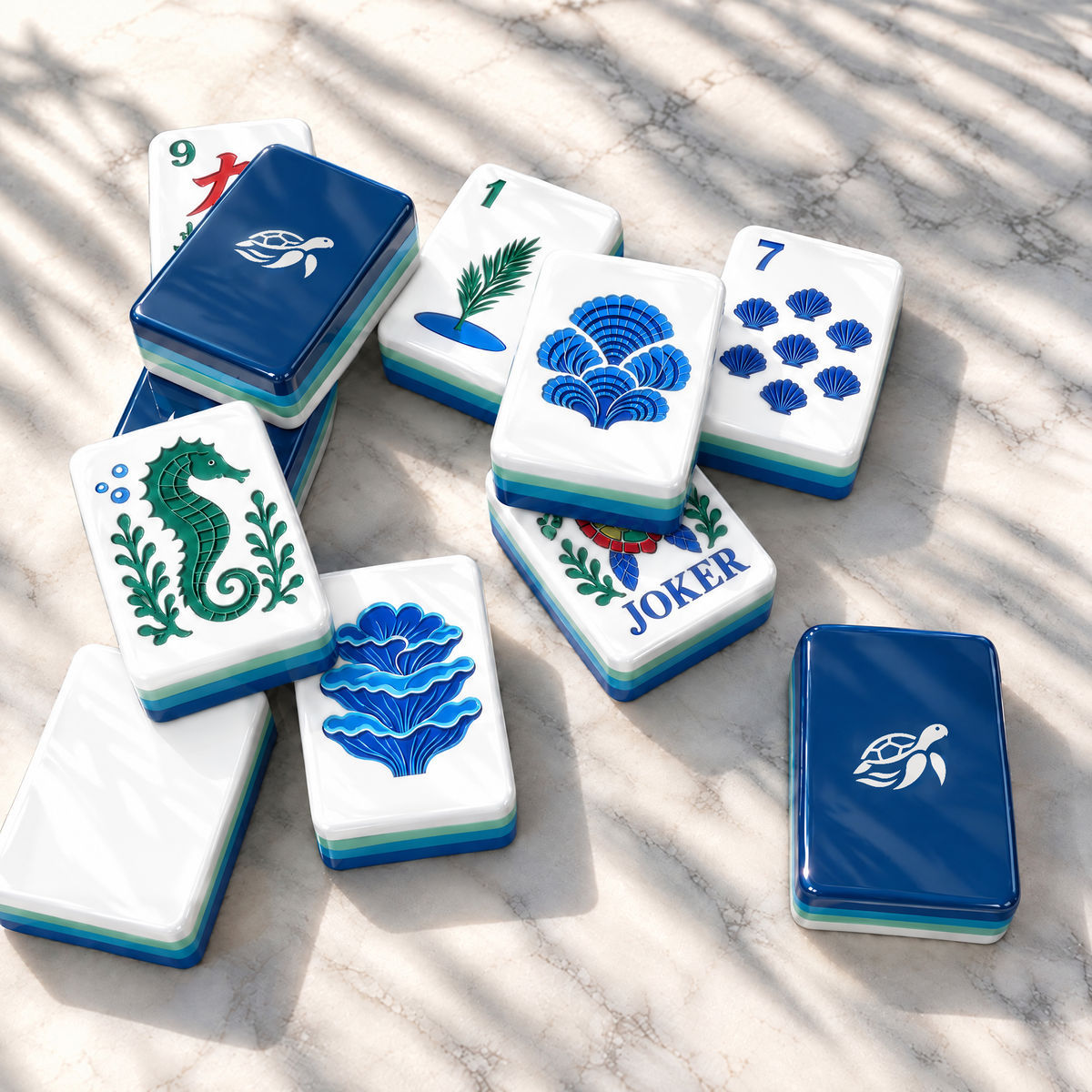
American mahjong uses 152 tiles (Bams, Craks, Dots numbered 1–9 in sets of four; plus Winds, Dragons, Flowers, and Jokers). A game takes 15–30 minutes per hand and plays with exactly four players. You draw and discard tiles to match patterns printed on the current year's National Mah Jongg League card—think of it as building sets (called Pungs: three identical tiles; Kongs: four; or Quints and Sextets) and a pair. Unlike Chinese mahjong, American has no chows or sequences; every exposed combo is identical tiles. The Charleston, a tile-passing ritual before play, levels the skill gap and keeps every hand fresh. A best-selling set gives you tiles, a rack, pushers, and a storage bag—everything you need to host right away. Most beginners play on a mat with pushers to keep tiles organized; scoring is simple point-multiplication once you match your hand to the card.
🀄 Shop best-selling mahjong sets →
Why is American mahjong easier than you think?
American mahjong strips away the memory burden. You don't memorize hand patterns or scoring hierarchies—you carry the official card to every game and cross-reference your tiles against printed patterns. The card changes yearly (issued every spring), so every hand is "legal" only if it matches that year's card. This design means you can play day one without studying for weeks. The Charleston (pre-game tile swap) also scrambles the "learning advantage"—experienced players can't hoard good tiles before you get your turn, so everyone starts on equal footing. Beginners often worry about the tile count and suit names, but once you see a Bam tile (the 1 Bam usually shows a bird), a Crak, and a Dot, the naming clicks fast.

What do those 152 tiles actually represent?
American mahjong has three numbered suits: Bams (bamboo-like symbols), Craks (characters), and Dots (circles). Each suit runs 1 through 9, and there are four copies of every number, giving you 36 tiles per suit—108 total. Add 16 Wind tiles (four each: North, East, West, South), 12 Dragons (four Red, four Green, four White), 8 Flowers, and 8 Jokers, and you hit exactly 152 tiles. The White Dragon also serves as a "Soap" (zero) in certain patterns. Jokers are wildcards that substitute for any tile in an exposed set (Pung, Kong, Quint, Sextet); they cannot be used in a single tile, a pair, or any hand where no other tile type appears. The Winds and Dragons are bonus tiles that players often forget are "there"—they're not tied to the numbered suits but are standalone combos on the card. Understanding this breakdown helps you spot which tiles are scarce (rarely appear in combos) versus common (appear in many patterns), so you know what to keep or discard early.
How does the Charleston actually work?
The Charleston is a three-round hand-passing ritual before the first discard. Everyone receives 13 tiles from the wall. Then:
Round 1 (Pass Right): Each player passes three tiles facedown to their right neighbor, waits for everyone to pass, then picks up the three they receive from their left. No player sees the tiles they're getting until they're in hand.
Round 2 (Pass Left): Repeat, but pass three tiles to your left (opposite direction).
Round 3 (Pass Across): Pass three tiles to the player across from you.
Reverse Charleston (optional): Some groups play a reverse, passing left → right → across. After all passes, each player declares whether they want to swap three more tiles with their neighbor ("Do you want to trade?"). If both agree, swap. If not, keep going. This last chance often changes a weak hand into a playable one.
The beauty: no one can predict what you'll get, so luck and adaptation matter more than expertise. New players rarely feel outgunned after a good Charleston. Many groups house-rule the number of passes or whether the reverse happens—ask before you sit down.
What's actually on that official mahjong card?
The National Mah Jongg League card is a single sheet (updated every spring) showing 75 legal hand patterns. Each pattern is labeled with a number and symbol and lists what tiles you need and how many Jokers you can use. Patterns are grouped by type: Pung (three identical), Kong (four identical), Quint (five identical), Sextet (six identical), pairs, and combos of these. For example, a pattern might read "2024–1" and show "5 Bams (pung), 5 Craks (pung), 5 Dots (pung), one pair"—meaning you'd collect three 5 Bams, three 5 Craks, three 5 Dots, and two of any identical tile. If you're one 5 Crak short, a Joker steps in. The card also shows color-coding: some patterns use Jokers, others don't. The rule: you must match a pattern on the card exactly; any off-card hand is not legal. Beginners often misread the card (confusing a Kong for a pung or missing the pair at the end), so take your time cross-checking tiles against the printed layout before you declare a win.

What are the most common beginner mistakes—and how to avoid them?
Mistake 1: Forgetting the pair. Every winning hand has one pair (two identical tiles). Many new players collect four Pungs and think they've won, then realize they have no pair. Count to 14 tiles (three tiles × four Pungs + two tiles for the pair = 14). If you don't see a pair, you don't have a hand.
Mistake 2: Confusing joker rules. Jokers cannot form a single tile ("I have one Joker and it's my 5 Bam"). They can only substitute within a set (Pung, Kong, Quint, Sextet). So a Pung of 5 Bams might be 5 Bam, 5 Bam, Joker—that works. But you cannot have a hand where Joker is your entire set; Joker must replace an identical tile that could exist in that combo.
Mistake 3: Exposing too early. Once you expose a set (lay it faceup on the table so others can see it), you can no longer change it. Some players expose a Pung too fast and realize later they needed those tiles for a different pattern. Keep your tiles hidden and your options open until you're certain of your path to the card.
Mistake 4: Missing the official card update. Every spring, the League issues a new card. Hands legal last year might be off-card this year. Before your first game of the season, grab the current year's card (2026, in this case) from your host or print it online. Playing with an old card is frustrating and leads to disputed calls.
Mistake 5: Discarding too predictably. If you always throw out high numbers or Dragons first, opponents learn your pattern and block you. Vary your discard order, especially early rounds, to keep your strategy hidden.
A simple checklist: Have I counted 14 tiles? Is there a pair? Do all sets match the card? Are any Jokers replacing a tile type that exists in that set? If "yes" to all four, you have a legal hand.
What equipment do you actually need to get started?
You need one 160-tile set (which includes 152 playing tiles plus spare tiles), four racks with pushers to hold and organize your tiles, a mat to define the play space and keep tiles from sliding, and ideally a storage bag for transport. A set of dice is nice for determining who deals first but not essential (you can also take turns). The best-selling collection includes options ranging from compact travel kits to larger sets built for long weekly games; the quality varies mainly by acrylic thickness and engraving detail. If you're hosting casually, a standard acrylic set with a mat and racks is plenty. If you plan weekly games or want a showpiece for your table, engraved sets with custom titles add personality without changing gameplay. Mahjong mats range from compact (for small tables) to oversized, and a good mat protects tiles and adds grip. Racks with pushers let you sort tiles vertically so your hand stays hidden from others—a game-changer for skill play. For groups that travel, a padded travel bag or case keeps everything organized. You don't need all of this to start; a mat and racks are the biggest quality-of-life upgrades after the tiles themselves.
What You Need | Why It Matters | Who Needs It | Cost Basis |
160-tile set | Core game—tiles, racks, pushers included | Everyone | Entry-level sets |
Mahjong mat | Defines play space, protects tiles, adds grip | Serious players & hosts | Standard size |
Racks with pushers | Hides your hand, organizes tiles visibly | Competitive/weekly games | 4-piece sets |
Travel bag or case | Protects set during transport | Groups that meet away from home | Mid-range |
Dice | Determines dealer/first draw (optional) | Casual games | Minimal |
🎁 See our most-loved mahjong sets & accessories →
One honest thing about learning speed
You will not memorize the card on your first play. You'll ask "Is this pattern on the card?" dozens of times. That's fine. Every player does it, and carrying the card is legal and expected. The learning curve is steeper for strategy—knowing which tiles to keep, which to throw, how to read your opponents' hands—but basic play (understanding turns, exposing sets, scoring) takes one game. Many groups see new players add value by the third session because they play less predictably and bring fresh energy. American mahjong rewards adaptation, not memory, which is why it clicks with people who love social games but don't want homework.
✨ Find your Mahstead set — free US shipping →

FAQ
Do I really need the official card, or can we make up our own hand patterns?
The official card is non-negotiable in standard play. It changes every spring and ensures everyone plays by the same rules. Off-card hands are not legal. If you want to invent patterns for fun, that's a casual house variant, but tournaments and serious groups always use the League card.
Can I play with fewer than four people?
Standard American mahjong is designed for four. Playing with two or three requires special rule adjustments (different wall draws, payout structures). Most groups either find a fourth player or pause until one is available. Some areas have documented 2–3 player variants, but they change core mechanics.
If I use a Joker in a set, can I "steal" it back later?
No. Once a Joker is exposed in a set on the table, it's locked into that set for the rest of the hand. You cannot reclaim it or move it. This is why careful exposure matters.
How long does a typical game take?
One hand (one deal, one winner) usually lasts 15–30 minutes, depending on how quickly players organize their tiles and read the card. A full "game" (often four hands, one round per player as dealer) runs 60–90 minutes. Casual groups often play multiple games in an evening.
What's the difference between American and Chinese mahjong?
American uses the official League card and has NO chows or sequences (only identical-tile sets). Chinese mahjong uses chows (like 1-2-3), requires memory of all legal patterns, and plays by different scoring rules. American is simpler for newcomers because the card removes memorization and strategy is more about reading opponents and tile odds.
Do I have to shuffle tiles a specific way, or does it matter?
Shuffling style doesn't affect legality—shuffle however feels natural. The key is mixing tiles thoroughly so no player knows what they'll draw. Most groups do a quick, vigorous shuffle on the table, then build the wall in four sections. The specific shuffle method is a house tradition, not a rule.


View More
View More
View More
