
Easiest Mahjong Rules for Absolute Beginners
Last updated: Nov 23, 2026
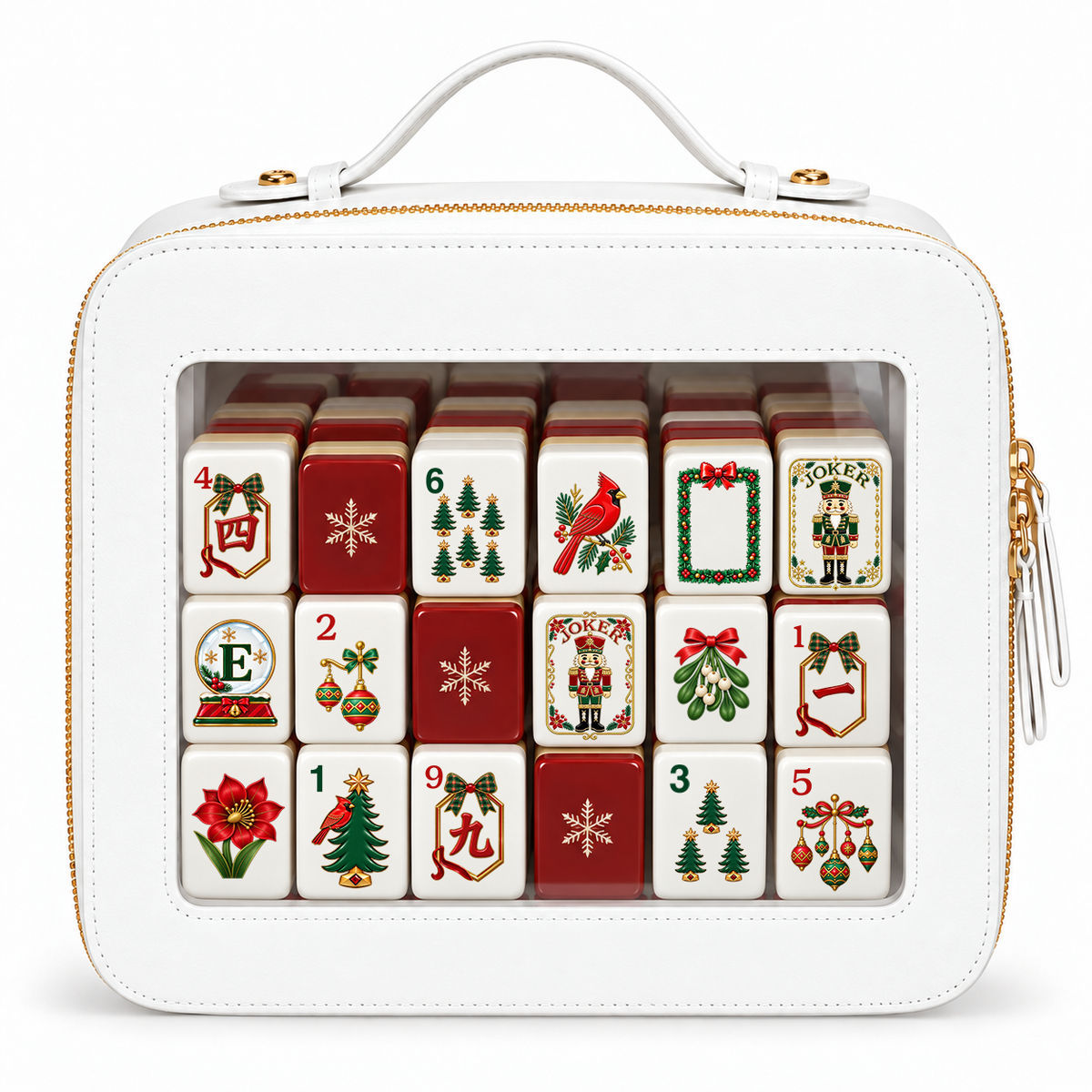
American mahjong uses 152 tiles across three suits (Bams, Craks, Dots numbered 1–9), plus winds, dragons, and flowers. Each player draws 13 tiles; the dealer draws 14. You win by matching 14 tiles to a hand pattern on the current year's National Mah Jongg League card—the "Bible" of American mahjong that changes every spring. Every hand must follow exactly one card pattern; jokers substitute for any missing tile. No sequences allowed (unlike Chinese mahjong)—you only expose groups of three identical tiles (pungs), four (kongs), five (quints), or six (sextets). The Charleston, a three-step tile-passing ritual, starts every game. If you're playing at home on a best-selling mahjong set, you'll spend roughly 30–45 minutes per game once everyone knows the card.
American mahjong is easier than you think. Master the core rules in one sitting, and you'll be playing your first hand tonight.
What's the one thing that makes American mahjong different?
American mahjong has no chows (sequences like 1-2-3). Unlike Chinese or Hong Kong versions, you cannot call or expose a run of consecutive tiles. You build only groups of three, four, five, or six identical tiles—always the same number and suit. This rule alone eliminates half the decision-making complexity. You work from a single hand pattern card each year, not 200+ possible hands floating in your head. On your first night, you'll spend more time learning the card than the rules.

Where do you start: tiles or the card?
Start with the tiles, not the card. Get your hands on one of our best-selling mahjong sets and hold them. A standard set contains 152 playing tiles: 36 Bams (bamboo, numbered 1–9 with four of each number), 36 Craks (characters, 1–9 × 4), 36 Dots (circles, 1–9 × 4), 16 winds (North, East, West, South—four of each), 12 dragons (Red, Green, White—four of each), and 8 flowers (Spring, Summer, Autumn, Winter, plus four season variants). The 1 Bam shows a bird; White dragons look blank ("Soap"). Hold a few tiles. Arrange them in a rack. Feel how the weight and size fit your hands—acrylic tiles from Mahstead are smooth and quiet, with crisp engravings that don't wear off after three seasons. Only then pick up the card.
🀄 Shop best-selling mahjong sets →
How do you read the hand card without panic?
The National Mah Jongg League card (issued each spring) looks dense, but every hand follows the same visual layout. Each row shows one winning pattern in hand notation—numbers and letters for tiles, symbols for winds and dragons. Read left to right: "2024 2B 3C 4D" means two 2 Bams, three 2 Craks, four 2 Dots. Jokers are marked separately. Before your first game, sit with an older player and point to three hands on the card; ask them to name the tiles aloud. Most hands group naturally—three of one tile, five of another, six of another—because identical tiles are easy to see and remember. The card is your safety net, not your enemy. Keep it in front of you during play; no one will judge you for looking. After 10 games, you'll stop looking at half the hands.
What mistakes do beginners make most often?
The two biggest: forgetting that every hand must match the card exactly, and trying to hold onto tiles that feel high-value but don't fit any pattern. New players draw a Red Dragon, a 9 Bam, and think "these are powerful—I'll keep them for later." Wrong. Unless a pattern on today's card uses those exact three tiles in that exact combination, they're dead weight. Discard them immediately. Second mistake: exposing (laying down) a group before triple-checking it matches the card. Once exposed, you cannot take it back. Before any group touches the table, point to the matching section on the card and say the pattern aloud. Slow is correct. Third: misreading jokers. Jokers are wild—they stand in for any tile you need—but they count as tiles. A pattern that says "1 1 1 J" is three 1s and one joker, not four jokers. Never use a joker to stand in for a single tile in a pair. Always use a real tile for your pair if you have it.
Beginner Trap | What Happens | How to Avoid It |
Hand doesn't match the card | You're stuck with 14 unplayable tiles | Before drawing, point to ONE card pattern and trace it mentally |
Exposing too early | Can't adjust; hand falls apart | Only expose when 100% certain it matches the card |
Using joker as a pair tile | Joker is wasted; pattern fails | Pair must always be two real identical tiles |
Holding "good" tiles too long | Discard too slow; someone else wins | Discard any tile not on today's card immediately |
Forgetting which tile is White | Can't tell Soap from a missing Dot | Buy a set with engraved suits; much clearer at a glance |
How does the Charleston actually work?
The Charleston is the three-step tile-pass before anyone plays. Everyone passes 3 tiles to their left neighbor (across the table). Then everyone passes 3 tiles to the right. Then everyone passes 3 tiles straight across. After three passes, you may optionally pass one tile face-down to the player on your left, who may reject it. Why? It ensures everyone starts with semi-random, fresh tiles—no dealer advantage—and it teaches you to read your hand fast. First time, it feels like chaos. Practice it twice, and it's muscle memory. If you're learning at home, do the Charleston even if it seems silly; it's part of the game's rhythm. Skip it only if you're playing informally and have agreed beforehand.

What does a winning hand actually look like?
A winning hand is 14 tiles that match one pattern on the card, period. Common patterns: "three groups of three identical tiles plus one pair of identical tiles" (Pung hand), or "two groups of five identical tiles plus one pair" (Quint hand). Here's the catch: every tile must appear. You cannot have 13 tiles that match and one joker left over. Your 14th tile must complete a pattern—either the last tile of a group or the second tile of a pair. When you have all 14 in hand and they match, you declare "Mah jongg." Everyone stops, and you show your hand and the matching card. Scoring happens (that's a separate skill), and the next dealer deals the next game. Your first few hands will be far simpler than you expect—three small groups, one pair—because the card includes patterns for learning players.
🎁 See our most-loved mahjong sets & accessories →
How long does a beginner game actually take?
First game: 60–90 minutes, including learning the card. Hands two through four: 40–50 minutes each. By game five: 30–35 minutes. A practiced table plays 45 minutes per hand if there's casual chatter (typical). Your speed depends on reading the card, deciding which tiles to discard, and spotting when someone else is close to winning. Don't rush. The rhythm matters more than speed. Stop and ask for a replay if you lose track—no penalty. The mahjong for beginners guide has more examples.
What to Check Before You Buy a Set
Tile Material: Acrylic sets are durable, quiet, and won't warp. Bamboo or bone sets look beautiful but need careful storage (humidity, heat). For beginners, acrylic is forgiving.
Rack Quality: Does the set include racks with pushers? Pushers let you hide your tiles from opponents and make discarding smooth. If not, you'll spend half the game fumbling with exposed tiles.
Set Completeness: The set must contain exactly 152 playing tiles. Extra jokers or blank tiles (in a 160-tile set) are spares only—never added to play. Count the tile types when it arrives: you should have four of every tile, no more, no fewer.
Suit Clarity: Are Bams, Craks, and Dots easy to tell apart? Engravings should be deep and readable at arm's length. Poor contrast between suits will frustrate you constantly.
Bag or Case: Does it ship in a protective bag? American mahjong sets are heavy. If traveling, buy a padded mahjong bag or case separately to avoid tile chips and loss.
The Pip: One tile in each suit should be clearly marked (the 1 Bam has a bird; White is blank). Confirm these before your first game so you never misread a tile.
Why a Mat Matters for Your First Game
You don't need a mat to play mahjong, but one organizes chaos. A mat zones each player's area (discard row, hand tile row) and keeps tiles from sliding off the table edge. If you're playing on someone's dining table, even a cheap cotton mat prevents tile damage. Many beginners skip it and regret it after tiles roll onto the floor. For your first four-player game, a mahjong mat is worth the space.
✨ Find your Mahstead set — free US shipping →

FAQ
Do I need the card to play American mahjong?
Yes. The card is the rulebook. Every hand must match exactly one card pattern from the current year. Buy one from the National Mah Jongg League each spring, or most sets include a reference card.
Can I use jokers for my pair (the two identical tiles that complete the hand)?
No. The pair must always be two real identical tiles. Jokers can only replace tiles in groups of three, four, five, or six identical tiles.
What if I forget what the card says during the game?
Look it up. Point to the pattern, read it aloud, and ask another player to confirm. Pausing to check the card is normal and respected. Speed comes later.
How many players can play American mahjong?
Four players is standard. Two or three players use different rules and tile counts; see the full guide for variations.
If someone wins and I have 13 tiles matching a pattern, did I lose because I didn't draw the right tile?
Yes. Mah jongg is won by one player at a time. Once someone declares victory with 14 tiles, the hand ends. You keep your 13 tiles for scoring (you get points even if you didn't win) but the round is over.
Can I play American mahjong online or with an app?
Yes, apps exist, but the in-person experience is entirely different—reading real tiles, managing your rack, watching opponents' discards, feeling the rhythm of the game. Start in person if possible, then explore apps.


View More
View More
View More
