
Common Mistakes in Classical Chinese Mahjong
Last updated: Nov 23, 2026
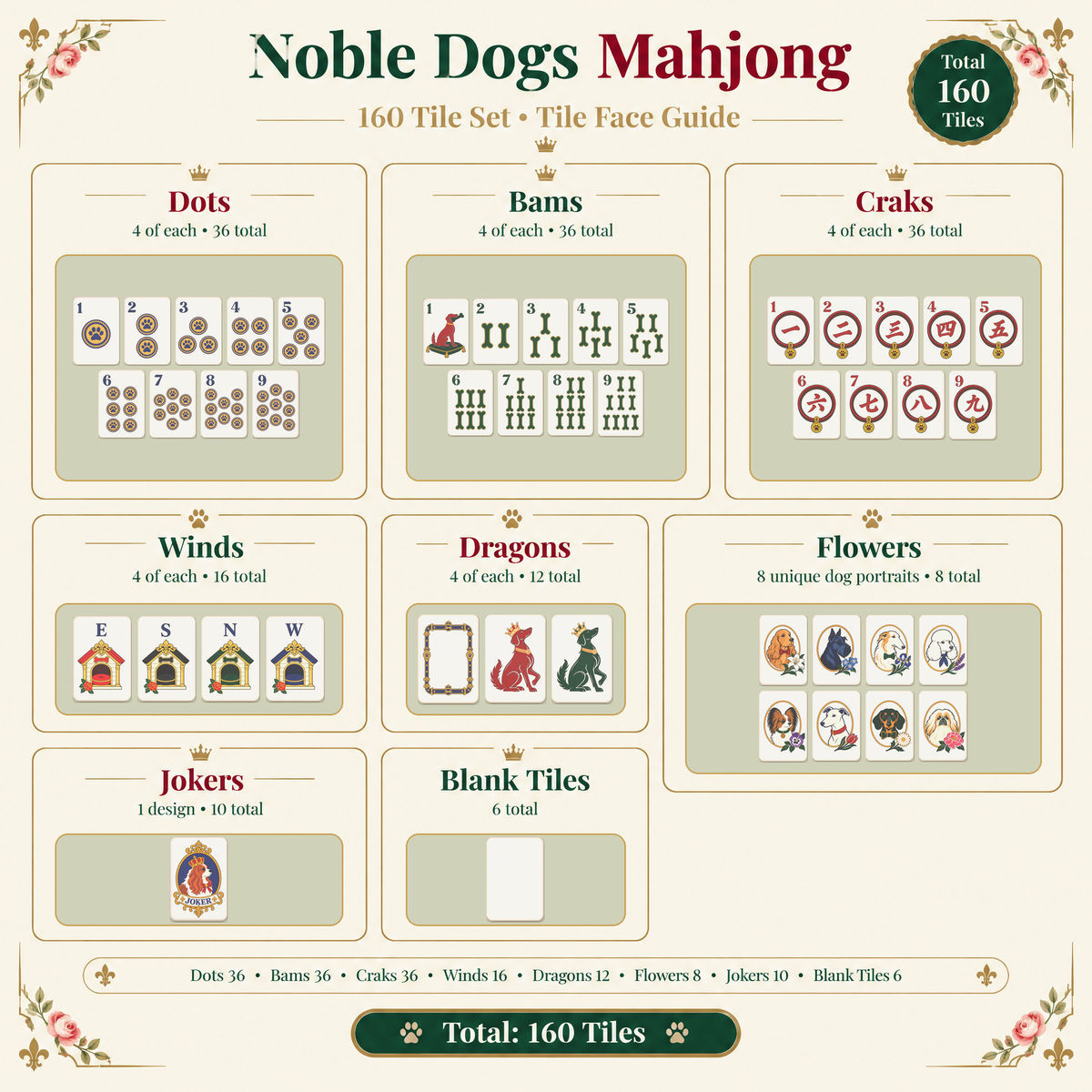
Classical Chinese mahjong differs from American in one critical way: you can declare winning hands off the discard or a drawn tile, and you build hands using chows (1-2-3 sequences), pungs (three identical), kongs (four identical), and a pair. The most common mistakes are misidentifying which tile wins (must be discarded by another player or your own draw), ignoring the ritual hand-check before declaring, playing with the wrong suit orientation, miscounting the 14-tile winning hand structure, and drawing from the wrong end of the wall when the wall diminishes. Many players also confuse which pung can close a hand and forget that bonus tiles add complexity to counts. Classical Chinese also prohibits claiming a discard if a later player declares—first caller wins. Avoiding these errors requires memorizing the suit symbols (Bamboo, Character, Dot, plus Winds and Dragons), understanding your local ruleset's variation (Hong Kong, Cantonese, Shanghai styles exist), and always confirming hand validity with the table before moving on. The cost of error is typically a lost hand and a stalled game; the gain from precision is respect and predictability at the table.
Are you building a hand that actually follows chows, not just any sequence?
In classical Chinese mahjong, a chow (or "chi") is a sequence of exactly three consecutive tiles in the same suit: Bamboo 3-4-5, Character 7-8-9, Dot 1-2-3. A pung is always three identical tiles. The mistake we see most often: new players treat Bamboo 2-4-6 as a valid sequence. It isn't. A chow must be consecutive. Also, you cannot use 9-1-2 as a wrap-around; sequences stop at 1-2-3 or 7-8-9. When you're laying out your hand mentally before declaring, count each chow on your fingers: first number, second, third—all in order, all the same suit, all different numbers. If you've been playing with mixed-suit sequences or non-consecutive groupings, reset your mental model now.

Did you count 14 tiles before calling "win"?
A winning hand in classical Chinese mahjong is always 14 tiles: four groups of three (12 tiles) plus one pair (2 tiles), totaling 14. This structure is non-negotiable. The error here is simple but common: declaring before picking up or discarding the final tile, which leaves you with 13 tiles instead of 14, and thus no win. Another variant is miscounting your hand mid-game—you think you have three completed groups when you actually have only two chows and a partial third. Before you call, physically count in groups of three and one pair. Set them aside on your rack or mat. Announce "14 tiles, winning" only when you've verified the number aloud. Many table disputes dissolve when players simply recount.
Are you sure the winning tile is a legal claim from the wall or discard?
In classical Chinese mahjong, you win by drawing a tile from the wall or claiming an opponent's discard immediately after they discard it. A common mistake is claiming a tile that was discarded two turns ago, or attempting to claim a tile you drew yourself from the wall. The rule: if an opponent discards a tile that completes your hand, you call immediately (before the next player draws). If you draw a tile that completes your hand, you declare on your turn. You cannot declare on a tile that has already passed from the discard area. Additionally, once another player (the player seated after the discarding player in turn order) has drawn from the wall, the discard tile is "locked"—no other player can claim it. If multiple players could win from the same discard, the player closest to the discarding player (in turn order) has priority. This rule varies by local ruleset, so confirm your table's rule at the start of the session. Ignoring the turn order and claiming out of sequence will create a table argument; respecting it keeps the game flowing.
Are bonus tiles (Flowers and Seasons) triggering extra draws and hand penalties?
Bonus tiles—called Flowers (春, 夏, 秋, 冬) and Seasons (or sometimes these are the same set, depending on ruleset)—are a source of confusion. When you draw a bonus tile (either from the wall initially or on a draw), you must immediately place it face-up in front of you, and you draw one replacement tile from the end of the wall. Each bonus tile drawn can trigger a point penalty or bonus, depending on your table's scoring rules. Many players forget to draw the replacement, leaving their hand at 13 tiles and causing an illegal state. Others don't know their local ruleset's point value for bonus tiles (some games reward them, others penalize them). Before you begin, ask: "How many bonus tile sets are in play?" (usually 8 total), "Do bonus tiles score extra points?" and "Do I always draw a replacement?" Document the answers on a notepad at the table.
Mistake | What Happens | How to Prevent It | Check Before Play |
Non-consecutive "chow" (e.g., 2-4-6 Bamboo) | Hand is invalid; disqualified from the round | Verify each group has three consecutive numbers, same suit | Memorize chow rule: 1-2-3 or 4-5-6, never skip |
Declaring with 13 tiles, not 14 | No legal win; hand rejected; points lost | Count aloud: 4 groups of 3 + 1 pair = 14 | Before declaring, place groups visibly and count |
Claiming a locked or old discard | Disqualified or hand voided; argument | Call only on the most recent opponent discard | Know whose discard pile and whose turn it is |
Forgetting replacement draw after bonus tile | Hand falls to 13 tiles; wall becomes unbalanced | Always draw one tile from wall end after bonus | State aloud: "Bonus tile, drawing one" |
Playing with wrong suit orientation or marking | Suit confusion; misidentified winning tile | Learn the symbol for each suit before the game | Print a suit reference card or ask table to confirm |
What tiles actually let you "close" (meld) your hand on a discard?
In many classical Chinese mahjong rulesets, you can only meld (claim a discard to complete a group) if it closes your hand completely—meaning you're about to win—or if your local rules permit specific melds on non-winning discards. A common mistake is melding a chow early in the game when you're not close to winning, which signals weakness to opponents and locks your tiles into a predictable pattern. Some rulesets allow melding chows from any opponent's discard (not just the player directly to your left), while others restrict you to the left player's discard for non-final melds. Ask your table at the start: "Can we meld chows on any discard, or only from the left player?" If you're unclear, sit tight and observe one full round before you declare anything. In Hong Kong style, for instance, you cannot meld a chow to "win" (called "going out") if the winning tile comes from a discard—you can only go out on your own drawn tile or a specific discard if it's the tile you declared. This varies by region, so never assume.

How do you know if your local ruleset uses "trading" or hand-switching variants?
Many classical Chinese mahjong tables play with house rules that include "trades," where players can exchange tiles under specific conditions, or variants where hands can be "switched" between rounds. If your table uses these, misunderstanding the trade window or trading invalid tiles will derail the game. Before you sit down, ask: "Do we use any trading rules?" and "If yes, when do we trade—before the Charleston-equivalent pass, or mid-game?" (Note: classical Chinese has its own tile-exchange ritual, different from American's Charleston.) Some tables also play "declaring early" rules where you can announce a partial hand to try to scare opponents off. If you don't know the rule, you might declare too early and give away your strategy, or too late and lose the chance to bluff. Write down every house rule at the start. Your teammates depend on consistency.
🀄 Shop best-selling mahjong sets →
What to check before you buy tiles for classical Chinese play
If you're investing in a dedicated classical Chinese mahjong set, verify that it includes all eight bonus tiles (Flowers and Seasons, or a regional equivalent), clearly marked Wind and Dragon tiles, and Dot/Character/Bamboo symbols that are large enough to read across the table without leaning in. Many players move between American and classical Chinese games; if you host both, owning engraved sets with clear suit markers ensures you never mix them up. A quality mahjong mat with score trackers also reduces mid-game confusion over who discarded what tile and in which position. Finally, keep a rack with pushers so tiles stand upright and your hand is hidden from opponents—this prevents accidental reveals that break etiquette.
🎁 See our most-loved mahjong sets & accessories →
Common error checklist: before every hand, before every game
Before dealing:
[ ] Confirm the ruleset variant (Hong Kong, Cantonese, Shanghai, or local house rules).
[ ] Clarify bonus tile scoring and replacement draw rules.
[ ] Agree on chow-melding restrictions (whose discard, when allowed).
[ ] Establish tile-draw order and wall-end protocol.
Before declaring:
[ ] Count 14 tiles: four groups of three, one pair.
[ ] Verify each chow is consecutive and same-suit.
[ ] Confirm the winning tile is legal (just discarded or just drawn by you).
[ ] Announce hand composition aloud before the table confirms.
During play:
[ ] Track discards in piles by player (so you know whose discard you're claiming).
[ ] Draw a replacement tile immediately after a bonus tile.
[ ] Call for a recount if you see misaligned tiles or confusion.
[ ] Never claim a discard after another player has drawn.
Why precision matters across variants
American mahjong focuses on strict hand patterns from an annual card; classical Chinese rewards adaptive hand-building and rule variation by region. Both require clarity and etiquette, but classical Chinese adds complexity because your local table may play it differently than the next table in town. A mistake in American mahjong is usually a wrong pattern on the card; a mistake in classical Chinese is more often a misunderstanding of which tile, which turn, which rule. The players who master both—and move smoothly between them—are the ones who invest time in writing down house rules and asking questions before each session. You'll earn respect faster by confirming than by assuming.
✨ Find your Mahstead set — free US shipping →

FAQ
Can I claim a tile discarded by a player two seats away, or only from the left player?
It depends on your ruleset. In strict Hong Kong style, chow-melding is usually restricted to the left (discard) player only; pung-melding from any player is allowed. Ask your table at the start; disagreements over this rule are frequent.
If I draw a bonus tile, do I count it as one of my 14 winning tiles?
No. Bonus tiles are placed outside your hand and trigger a replacement draw. Your 14-tile hand never includes them, but they may increase your score or penalty points.
What happens if I declare "win" but my opponent points out my hand has only 13 tiles?
Your declaration is void. You lose that round and cannot win. Always count before announcing; it's faster than arguing afterward.
How do I know if a tile I'm discarding will let an opponent go out on it?
You don't, fully—but observing discards already in piles, bonus tiles claimed, and patterns of draws gives clues. Play safely when you're losing and aggressively when ahead; experience teaches the rest.
Is "trading" tiles mid-game part of standard classical Chinese mahjong?
No—it's a house rule. Some tables allow it; others forbid it. Confirm before sitting down, or you'll face a conflict.
Are the rules for winning off a discard the same as winning off a drawn tile?
No—and this varies by ruleset. Some games forbid "going out" (winning) on a discard entirely; others allow it only on specific discards or under specific conditions. Check your table's rule on this before your first hand.


View More
View More
View More
