
Classical Chinese Mahjong with 2 Players: Rules and Setup Guide
Last updated: Nov 23, 2026
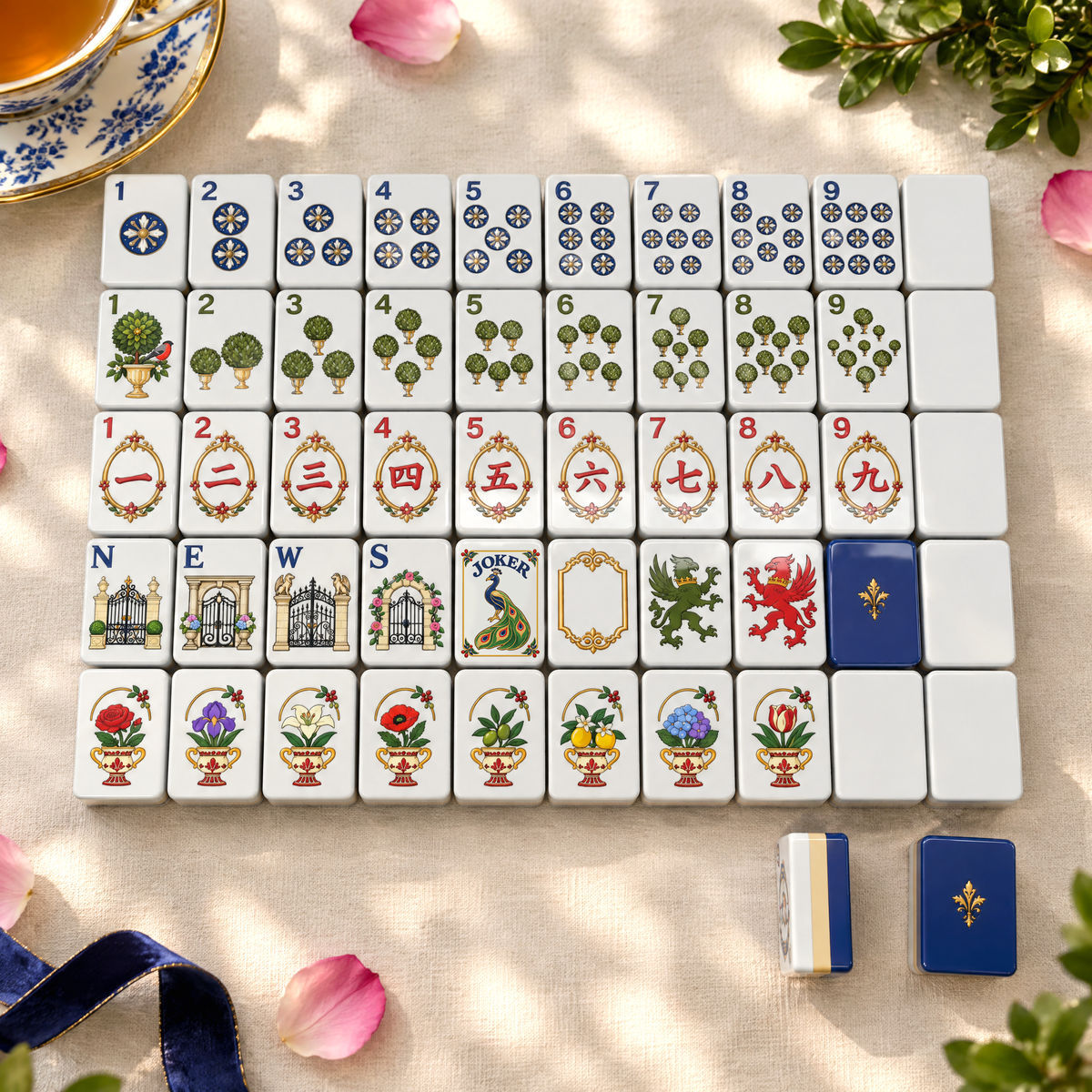
Classical Chinese mahjong with two players uses 136 tiles (removing the flowers) instead of the standard 144, and play rotates between dealer and non-dealer roles after each hand. You draw one tile per turn and discard one, building melds (pungs, kongs, chows) toward a legal winning hand—typically 14 tiles arranged as four melds plus a pair. Two-player games are faster and require sharper memory of discards; draws last roughly 10–15 minutes per hand. Unlike American mahjong, which locks hands to an annual card, classical Chinese mahjong relies on memorized hand patterns: eyes (pair) + melds of three identical (pung) or consecutive (chow) tiles. Setup is simpler—no Charleston, no jokers—and both players draw from a single wall.
How do you set up the tiles for two-player classical Chinese mahjong?
Remove the eight flower tiles from a standard 144-tile set, leaving 136 tiles. Shuffle the remaining tiles face-down and arrange them into a wall roughly 34 tiles long by two tiles high per player (dealer and non-dealer sit across from each other). The dealer draws 14 tiles, the non-dealer draws 13, then the dealer discards one tile to open play. Place a tile rack in front of each player to organize your hand and keep it hidden—this prevents accidental tile reveals and speeds play. No Charleston pass occurs; you begin immediately after the initial draw.

What counts as a winning hand in classical Chinese mahjong?
A winning hand (called "going mahjong" or "declaring") consists of 14 tiles: one pair (two identical tiles) and four melds. A meld is either a pung (three identical tiles: e.g., three 3 Dots), a kong (four identical tiles), or a chow (three consecutive tiles of the same suit: 4–5–6 Bams, for instance). The pair cannot be part of a meld; it must stand alone. You win by drawing a tile that completes one of these melds or the pair, then declaring your hand before discarding. Common winning patterns are all pungs + pair, mixed pungs and chows, or "eyes and flowers"—three pairs plus one chow plus one pair. The game has no "going out" requirement; any legal 14-tile hand wins immediately upon completion.
How is two-player classical Chinese mahjong different from four-player?
Two-player classical mahjong plays much faster because fewer tiles remain in the wall after the initial draw; a hand typically ends within 8–15 turns instead of 15–20. Wind assignments (East, South, West, North) still matter, but only East (dealer) and South (non-dealer) are active, rotating after each hand. In four-player, players can call tiles discarded by others (a kong or pung), but in two-player, calling is often restricted or forbidden—you can only draw from the wall. Scoring is usually simpler: two-player games often use a fixed point value per hand rather than tiered multipliers. The speed and isolation of two-player draw means you must track discards more carefully; opponents have fewer opportunities to steal your winning tiles, so memory and endgame judgment become critical.

What are the key rules for draws, discards, and turn order?
On your turn, you draw one tile from the wall and add it to your hand (14 tiles for the non-dealer on their first turn, 13 for the dealer at game start). You must then discard one tile face-up into the center, and play passes to your opponent. If your opponent declares a pung or kong using your discard, they may take it and discard a different tile to continue play; otherwise, play returns to you after they discard. If you draw the winning tile, you declare immediately; if you draw a tile that does not complete a winning hand, you must discard. Two-player games sometimes allow kong calling (you may claim a discard to form a kong), but pung and chow claiming is rare—check house rules before you begin. Some variants require you to declare a pair as "closed" (unrevealed) until you win; others allow you to expose pairs early (risky, as it telegraphs your strategy).
🀄 Shop best-selling mahjong sets →
What scoring system do most two-player classical Chinese games use?
Scoring in two-player classical Chinese mahjong varies widely by region and house rules. The simplest method is flat-point: a hand win equals a fixed number of points (often 1 point per hand), multiplied by the "fan" (complexity level) of the winning hand. A pung of terminals (1 or 9) or honors (winds/dragons) adds fan; an all-pung hand adds fan; a hand of all one suit ("all simples") adds fan. If you lose and your opponent wins, you pay that point value per fan to the winner. More complex scoring involves "double" and "triple" multipliers based on the number of identical melts or whether you won by drawing (higher) versus claiming a discard (lower). Before each game, agree on a baseline point value, whether fan accumulates additively or multiplicatively, and whether the winner gets paid by both players (in a four-player game) or just the loser (in two-player). This prevents disputes and keeps games social.
Can you play classical Chinese mahjong with American mahjong tiles?
American mahjong sets (152 tiles plus jokers) include flowers, dragons, winds, and Bams, Craks, and Dots—the same suits as classical Chinese tiles. However, American sets are designed for the American game, which has no chows (sequences), uses an annual card of fixed hands, and requires the Charleston. To play classical Chinese mahjong with an American set, you would remove the jokers and flowers, leaving 136 tiles, and ignore the American card entirely. The tile symbols are the same, so this works mechanically. That said, American tile sets are built for American rules; if you plan to play classical Chinese mahjong regularly, consider best-selling sets in acrylic, which are durable and easier to read than vintage bone-and-bamboo, and you'll avoid the confusion of house-rule differences. Acrylic tiles also resist scratching and chip damage during repeated play, a key advantage for two-player games where the wall is turned more often.
🎁 See our most-loved mahjong sets & accessories →
A comparison: two-player versus four-player classical Chinese mahjong
Aspect | Two-Player | Four-Player |
Tile count (flowers removed) | 136 | 136 |
Initial draw: dealer | 14 | 14 |
Initial draw: non-dealer(s) | 13 each | 13 each |
Turns per hand (average) | 8–15 | 15–25 |
Players calling discards | Usually no | Yes, for pung/kong |
Active wind roles | East, South | East, South, West, North |
Dealer rotation | Every hand | Every hand or after win |
Typical game length | 20–40 minutes | 60–90 minutes |
Endgame complexity | High (memory critical) | Moderate (more discard reading) |
What to check before you buy a set for two-player classical Chinese mahjong
Tile count: Confirm the set has at least 136 tiles (or 144 if you're unsure and want spares). Remove flowers before counting.
Clarity of symbols: In two-player, you'll watch discards intently; acrylic tiles with engraved or bright paint are easier to read than worn bone or misaligned bamboo-back tiles.
Tile size: Standard tiles are about 1.25" × 1" (32 mm × 24 mm). Smaller tiles pack closer and tire the eyes; larger ones slow play. Check the product dimensions before ordering.
Rack and pusher: A mahjong rack with pushers is not required but helps you organize and conceal your hand, crucial in two-player where you sit facing your opponent.
Mat or case: A mahjong mat protects your table and provides a defined play area; a bag or case keeps tiles safe between games, especially important for acrylic sets you plan to use regularly.
Jokers and extra tiles: Two-player classical does not use jokers; many best-selling sets include spares. You don't need to pay extra for them, but they're handy if a tile cracks or gets lost.
✨ Find your Mahstead set — free US shipping →

FAQ
Can you play classical Chinese mahjong with only two people?
Yes. Two-player classical Chinese mahjong is a valid variant, though faster and more memory-intensive than four-player. Remove flowers (136 tiles total), assign dealer/non-dealer roles, and start. House rules on calling tiles vary widely, so confirm before play.
What's the main difference between two-player and four-player classical Chinese mahjong?
Two-player restricts calling (claiming opponent discards), making each player solely responsible for their own winning tile draw. Four-player allows calling pungs and kongs, creating more interaction. Two-player hands also finish faster.
Do I need to use the American mahjong card for two-player classical Chinese?
No. The American mahjong card is exclusive to American mahjong (which has no chows). Classical Chinese mahjong relies on memorized hand patterns: pair + four melds. Ignore the card entirely and play by house rules.
How long does a hand of two-player classical Chinese mahjong take?
Usually 10–15 minutes. Two-player games are faster than four-player because fewer tiles are drawn and play never pauses for multiple discards. A full game of 4–8 hands takes 40 minutes to 2 hours depending on pace.
What tiles do I remove to convert a 144-tile set for two-player classical Chinese?
Remove the eight flower tiles (spring, summer, autumn, winter, plum, orchid, bamboo, chrysanthemum), leaving 136 tiles. Some sets may have jokers; those also stay out of play in classical Chinese mahjong.
Is an acrylic mahjong set better than bone-and-bamboo for two-player classical Chinese?
Acrylic tiles are easier to read, resist chipping, and slide smoothly on a mat—advantages in two-player where discards must be tracked closely. Bone-and-bamboo is traditional but requires more care and can wear unevenly. Both work; acrylic suits frequent, intense play.


View More
View More
View More
