
Classical Chinese Mahjong Quick Start Guide
Last updated: Nov 23, 2026
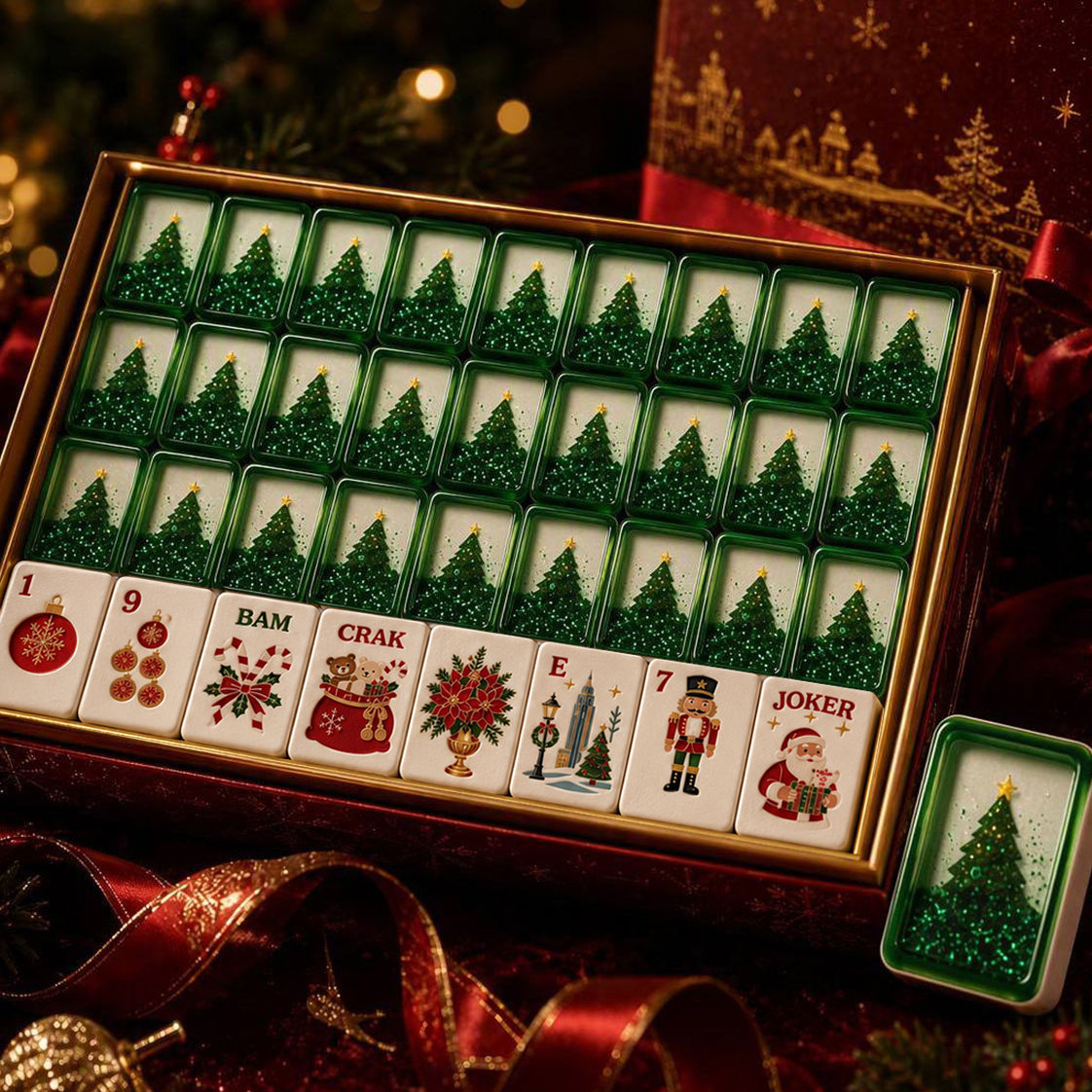
Classical Chinese mahjong (also called Chinese Traditional or Hong Kong mahjong) uses 136 tiles—three number suits (Bams, Craks, Dots: 1–9 in each, four copies per number) plus honors: winds (N/E/W/S), dragons (Red, Green, White), and often flowers or seasons. Unlike American mahjong, Chinese players can form chows (sequences like 4-5-6 Dots) and pungs (three identical tiles), declare them live during play, and use jokers sparingly or not at all. A hand consists of 13 tiles plus 1 drawn tile (14 total), forming melds and a pair. Winning requires a specific combination—usually at least one pung or chow plus a pair, though some variants each have their own point system. A beginner can learn basic rules in 30 minutes and join a casual game the same day.
🀄 Shop best-selling mahjong sets →
What's the main difference between Chinese and American mahjong?
American mahjong requires hands only from that year's official card and forbids chows (you can only call pungs, kongs, quints, and sextets). Chinese mahjong is open—any valid combination of chows, pungs, and a pair wins. American uses 152 tiles with 8 jokers and no blanks; Chinese uses 136 tiles with few or no jokers. American players pass tiles in the Charleston before play; Chinese skip that ritual. Chinese play is live and visible—melds declared at the table—while American conceals hands until win.

How is a winning hand structured?
A standard Chinese mahjong win is 4 melds (each 3 tiles) plus 1 pair (2 tiles) = 14 tiles total. A meld is either a pung (three identical tiles: 5-5-5 Dots) or a chow (three consecutive numbers of the same suit: 4-5-6 Bams). The pair must be two of the same tile. Example: 5-6-7 Bams (chow) + 2-2-2 Dots (pung) + East-East-East (pung) + 9-9-9 Craks (pung) + 3-3 Bams (pair) = win. Some regional rules require the pair to be a specific type (like honors only) or demand "eyes" (a pair of terminals—1 or 9). Always check your table's house rules before play.
What are the key tiles and what do they do?
The 136-tile Chinese set divides into number tiles (1–9 Bams, Craks, Dots: 36 tiles total per suit) and honor tiles (Winds, Dragons, Flowers). Winds are N/E/W/S; Dragons are Red (goes with Craks), Green (with Bams), and White (with Dots). Terminals (1 and 9 of any suit) and honors score higher in some variants. Flowers and seasons (if included) are often draws: you draw an extra tile immediately, keeping the hand at 13 until your turn ends. Jokers or wildcards exist in some variants but are rare in strict classical play; some house rules allow a single wildcard per hand. Most classical games use zero jokers, making play deterministic and skill-driven.
How do you play a round: setup, draw, and meld?
Setup: Shuffle all 136 tiles face-down in a long wall. Four players sit at compass points (East, South, West, North). East (dealer) draws 14 tiles; others draw 13. First turn (East): Draw 1 tile (now holding 14). Form a meld and discard 1 tile face-up. If anyone can pung or chow your discard (using it to complete a meld), they claim it, declare the meld aloud, display it, and discard. If your discard is claimed for a kong (a rare 4-tile meld), the claimant draws again. If no one melds, play passes left (South draws, melds, discards). Continue: Each turn is draw → meld → discard. Once a tile is discarded and no one claims it, play moves on—you cannot go back. When you hold 14 tiles and believe you have a valid hand, declare "win" or "mahjong" after your draw and before discarding. If the tile drawn wins the hand, declare immediately; if a discard from another player wins you, you must claim it before the next player draws.
What are common winning patterns and scoring basics?
A standard win is 4 melds + 1 pair. Bonus patterns include all pungs (no chows—often worth more points), all terminals and honors (high difficulty, high reward), and seven pairs (14 tiles, all pairs—a unique hand type). Most classical variants score in points or faan (multiplier in Cantonese/Hong Kong rules): basic win = 1 faan; all pungs = 2 faan; all terminals and honors = 3+ faan. Scoring also depends on who won (was it your discard? Was the winner East?) and the multiplier system in use. Hong Kong rules (most common) use a base payout that doubles for each faan. Taiwanese and Riichi (Japanese) variants use different tables. Always agree on a scoring system before you play; most casual games accept "basic: 1 faan = 1 point per player to the winner" for learning.
Pattern | Example | Difficulty | Notes |
Standard win | 4 melds + pair | Beginner | Any valid combo |
All pungs | No chows, only 3-tiles | Intermediate | Higher faan (usually 2+) |
All terminals & honors | Only 1, 9, winds, dragons | Advanced | Rare, high payout |
Seven pairs | Seven pairs only | Advanced | Variant hand, different structure |
Mixed vs. pure | Mixed suits vs. one suit | Either | Pure is higher score |

How do you avoid beginner mistakes and play smoothly?
Mistake 1: Declaring a meld too late. Claim your meld before the next player draws. Once they touch the wall, your window closes—no going back. Mistake 2: Forgetting to discard. You must have exactly 13 tiles at the end of your turn (or 14 if it's your draw and you haven't acted). Mistake 3: Miscounting your hand. Always count: 13 tiles in hand + 1 drawn = 14, or 13 if you've just discarded. Miscount = dead hand (you're out). Mistake 4: Breaking the wall incorrectly. The dealer breaks the wall at a random spot (usually opposite themselves). East draws two tiles from the broken end; then each player clockwise draws twice (East last). Get this wrong and the hand is void. Mistake 5: Calling a win you don't have. Check your hand is truly complete before declaring. Call a false win = penalty or automatic loss, depending on house rules. Smooth play tip: Keep your discards in an orderly row so everyone can see what's been thrown. Organize your melds so your hand is easy to read. Move slowly; speed comes later.
🎁 See our most-loved mahjong sets & accessories →
What do you need to play classical Chinese mahjong?
A 136-tile Chinese mahjong set (some include flowers; some start with 144 tiles with extra sets). A mat or play surface (optional but recommended—keeps tiles organized and sounds cleaner). A wall to rest tiles against or a mat with a rim. Four players and a willingness to play 45–90 minutes per game. House rules document or agreement on scoring before you start. A pencil and paper to track points if playing multiple rounds. If you're learning with friends who own a set, you can borrow; if hosting weekly, investing in a durable set means years of consistent play.
American mahjong sets are purpose-built for American game and won't work for classical Chinese—the tile composition, absence of chows, and joker-heavy design make them incompatible. If you're learning classical Chinese, source a set explicitly labeled as Chinese mahjong (136 or 144 tiles, includes winds, dragons, and traditional flower/season tiles). Many quality acrylic mahjong sets designed for American play can confuse beginners; confirm the tile count and suit structure before buying. For a durable, long-term set suited to hosting frequent games, select sets with clear markings and sturdy racks that keep tiles organized during extended play.
What variants exist and how do they differ?
Hong Kong/Cantonese mahjong: The most widespread classical variant. Uses 136 tiles, pungs and chows, and faan-based scoring. Plays in 13 draws + 1 discard rounds. Most flexible on winning patterns; almost any meld combo + pair wins. Easy entry point for beginners.
Taiwanese mahjong: Faster, stricter. Often requires all melds to be concealed (not declared during play until win). Scoring is point-based, not faan. Hands feel more challenging; often played for higher stakes.
Riichi (Japanese) mahjong: Four suits (Bams, Craks, Dots, Honors only; no flowers). 136 tiles total. Introduces riichi (a formal declaration you're one tile away from win—locks your hand, disables melds, but signals strength). Uses a dora (bonus tile). Scoring is complex; winning faan × base points × multipliers. Played competitively worldwide; steeper learning curve but very strategic.
Sichuanese & Hunan variants: Regional. Often use fewer tiles (108–136), allow fewer melds, or demand high-tile hands. Scoring is pocket-based (small fixed payouts). Less common outside China; check local rules if you encounter them.
Most Western casual players start with Hong Kong rules; it's forgiving and fun. Move to Riichi if you want depth; Taiwanese if you prefer speed and concealment.
✨ Find your Mahstead set — free US shipping →
Quick checklist: before your first game
[ ] Confirm your group's variant (Hong Kong, Taiwanese, Riichi, or house rules)
[ ] Agree on scoring system and payout per point (if any)
[ ] Verify tile count: classical Chinese uses 136, not American's 152
[ ] Assign East (dealer), South, West, North
[ ] Shuffle and build the wall; East breaks it
[ ] Each player draws to 13; East draws 14
[ ] East discards; play proceeds left
[ ] Claim melds before the next player draws
[ ] Discard after every turn (except the winning turn)
[ ] Check your hand = 4 melds + 1 pair before calling "mahjong"
[ ] Settle points per agreed scoring
[ ] Rotate East to the next player clockwise; begin again

FAQ
Can I use an American mahjong set to play classical Chinese mahjong?
No. American sets use 152 tiles with 8 jokers and no blanks; they're designed for American game hands only. Classical Chinese needs 136 tiles, includes chows, and requires fewer jokers. Using an American set will confuse players and break the game's logic.
What's the fastest classical Chinese variant to learn?
Hong Kong mahjong. It allows almost any meld combination to win, uses standard faan scoring, and plays in under an hour for beginners. Riichi and Taiwanese variants have stricter rules and longer learning curves.
Do I need to buy a mat and racks if I'm just starting?
No, but they help. A mat keeps tiles organized and contained, and a rack with pushers speeds meld-building and keeps your hand tidy. Both improve the experience during long games, especially if hosting weekly.
How long does a typical game take?
A casual game with four players takes 45–90 minutes, depending on house rules and player speed. Competitive Riichi play can extend to 2+ hours for a full session.
What's the biggest rule difference from American mahjong I should remember?
American forbids chows and requires hands from an official card; Chinese requires chows, pungs, and a pair in any combination. American uses 152 tiles with 8 jokers; Chinese uses 136 with few or no jokers. Play styles are completely different.
If someone calls a false win, what happens?
Most casual games forfeit their hand and they pay a penalty (usually the base payout). Competitive play may have stricter penalties. Agree before you play.


View More
View More
View More
