
Chinese Official Mahjong for 2 Players: Rules & Setup
Last updated: Nov 23, 2026
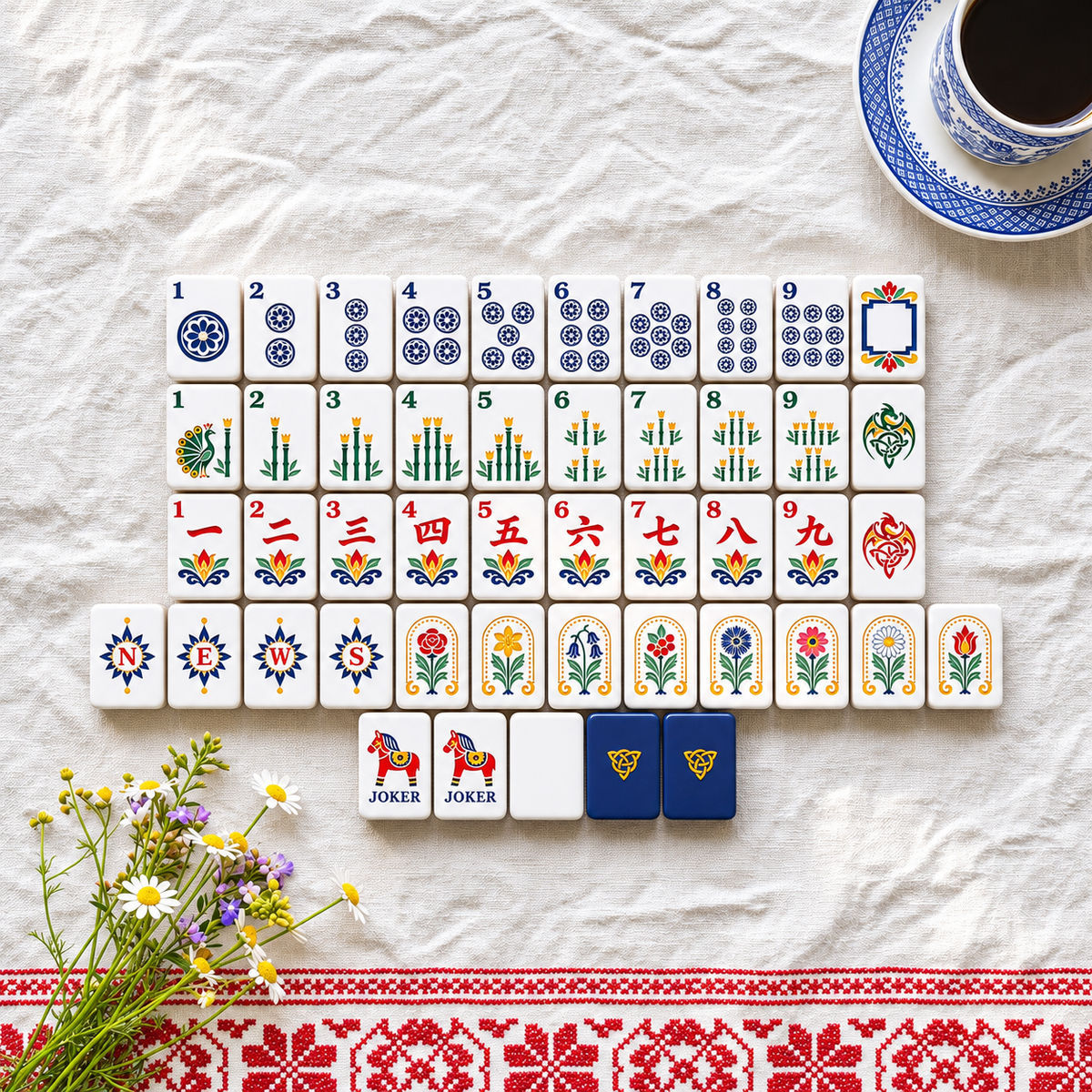
Chinese official mahjong (國標麻將) is designed for four players; a true two-player variant does not exist in the official rulebook. However, you can adapt the game using all 136 tiles (or 144 with flowers), dealing 25 tiles each, removing one dealer position, and rotating turns among two players. Draws happen from the same wall; discard rules stay the same. Many players instead choose two-player Taiwanese mahjong or Hong Kong mahjong, which have purpose-built two-player modes. If you want flexibility for both four-player standard and occasional two-player sessions, a 160-tile set from Mahstead gives you the full tile count and quality pushers to manage larger hands smoothly.
Why Chinese official mahjong doesn't have a true two-player mode
Chinese official (國標麻將) follows a strict four-player structure codified by the International Mahjong Federation. The wall arrangement, wind assignments, and melds are built around four active hands. A two-player adaptation breaks core logic: you lose the three other discards per round, which changes probability and strategy entirely. Removing a player position means unused melds and forced rotations that slow the game. Most clubs and leagues in mainland China, Singapore, and Taiwan stick to four-player matches because the official ruleset is what tournaments recognize.

How to play a two-player Chinese mahjong game anyway
If you have two players and a Chinese official tile set, you can run an unofficial adaptation:
Tile setup. Use all 136 tiles (four suits × 1–9, plus 16 winds, 12 dragons, 8 flowers). Build a standard wall; each player takes 25 tiles plus 1 from the live draw. Dealer sits East; the other sits West. Skip North and South positions.
Draw and discard. Dealer draws first, discards. Non-dealer draws from the wall (not from discard), discards. Melds (pung, kong, quint) are called and exposed as usual. No chow/sequence calls.
Win condition. First to declare mahjong (a complete hand matching official hand patterns) wins. You'll need the current year's hand chart if you're following strict patterns.
Scoring. Use standard point tables; adapt for two players by doubling base points (since there are no other players to share losses).
This is not an official game format. Expect house-rule debates on flower draws and kong replacement tiles.
🀄 Shop best-selling mahjong sets →
Comparing two-player options: Chinese, Taiwanese, and Hong Kong rules
Variant | Players | Tile Count | Sequences (Chows) | Official Format | Best For |
Chinese official (adapted) | 4 (or 2 if houseruled) | 136–144 | No | International tournament standard | Purists; four-player league play |
Taiwanese mahjong | 4 or 2 (built-in) | 136–144 | Yes (called and exposed) | Taiwan Mahjong Association | Flexible groups; casual play |
Hong Kong mahjong | 4 (occasionally 2) | 108 | Yes (called and exposed) | Hong Kong Mahjong Association | Fast-paced; weekend games |
American mahjong | 4 only | 152 + 8 jokers | No | NMJL card; spring update yearly | US players; women's clubs |
Conclusion: If you're set on two-player Chinese official, accept that you're playing by house rules, not the official standard. Taiwanese or Hong Kong mahjong gives you a true two-player game with official backing.
What equipment matters for two-player Chinese mahjong
A two-player game with larger hands (25 tiles each) needs good support. Standard bamboo or plastic tiles work, but pushing 25 tiles across a small table leads to spills. Mahjong racks with pushers prevent tiles from sliding off the edge, and pushers let you draw smoothly without fumbling. A mat also helps: acrylic mats keep discard piles organized, prevent tile noise at night, and make it easy to spot the live draw wall. If you travel between venues, a padded case or travel bag protects your set from warping and tile loss.
Quality tiles matter too. Acrylic or wood-composite tiles last longer under frequent play than printed cardboard; thicker tiles resist chipping when you're shuffling two hands worth of draws every round.

Finding a two-player Chinese mahjong community
Most official Chinese mahjong clubs and leagues are four-player only. If you want to learn two-player Chinese mahjong properly, your best bets are:
Online forums and WeChat groups. Search for 國標麻將 or Chinese mahjong groups in your region; many share house rules and video tutorials.
Casual tables. Some community centers or retirement homes in areas with large Chinese populations run informal two-player games; ask at local libraries or Chinatown community boards.
Hybrid play. Host a weekly game with a rotation: play two-player rounds when someone can't make four, then switch to official four-player rules when the table fills.
Be clear upfront about house rules—starting tile count, kong replacement tiles, and win-condition scoring—so everyone agrees before the first draw.
🎁 See our most-loved mahjong sets & accessories →
Common mistakes in two-player Chinese mahjong adaptation
Error 1: Starting with too few tiles. Some players deal only 13 tiles per person to "simplify" two-player play. This breaks the probability model entirely; skips turn order and adds confusion. Use the full 25-tile starting hand or don't play the variant.
Error 2: Forgetting the wall order. In official four-player Chinese mahjong, the wall is drawn in strict sequence: East side first, then South, West, North. With two players, you're drawing from all four wall sides in one game. Mark your wall clearly with dice or a mat to avoid drawing out of order.
Error 3: Changing meld rules mid-game. Some informal games allow chows (sequences) in two-player mode to speed up wins. Official Chinese mahjong has no sequences—only pungs, kongs, and pairs. Pick a rule set before the first tile and stick to it.
Error 4: Miscounting replacement tiles after a kong. When a kong is declared, you draw one tile from the end of the wall (the kong replacement tile). In two-player mode, you must still follow this rule; skipping it means undrawn tiles stay in play, breaking the game.
What to check before you buy a Chinese mahjong set for two players
Tile size. Standard Chinese tiles are about 1.25 inches; check that they fit comfortably in mahjong racks with pushers if you plan to use them.
Tile count. You need all 136 tiles (144 with flowers). Don't buy a set that excludes any suit or wind.
Weight and material. Acrylic or resin tiles are heavier and shuffle quietly; plastic tiles are lighter but noisier. Choose based on your table surface and noise tolerance.
Official hand chart. If you're following official patterns, get a current hand reference sheet (many Chinese mahjong clubs publish them free online).
Space. Two players with 25 tiles each need at least 4–5 feet of table width. If you're playing in a small space, a mat with clear zones helps organize the layout.
✨ Find your Mahstead set — free US shipping →

FAQ
Is two-player Chinese official mahjong in the rulebook?
No. Chinese official (國標麻將) is designed for four players only. You can adapt it for two players using house rules, but this isn't an official format recognized by the International Mahjong Federation or Chinese leagues.
How many tiles should I deal to each player in two-player mode?
Deal 25 tiles to each player plus 1 from the live draw wall. This keeps hand sizes proportional to a four-player game and maintains draw probability. Dealing fewer than 25 breaks the game's balance.
Can I use American mahjong tiles for two-player Chinese play?
No. American mahjong sets have 152 tiles (with jokers and extra blanks) and follow different rules entirely. Chinese official uses 136 or 144 tiles with no jokers. The hand patterns won't match.
What's the difference between two-player Chinese and two-player Taiwanese mahjong?
Taiwanese mahjong has a built-in two-player mode with official rules; Chinese official does not. Taiwanese also allows sequences (chows), while Chinese official does not. If you want a true two-player game, Taiwanese is the safer choice.
Do I need a mat and racks for two-player Chinese mahjong?
Not strictly, but they help. With 25 tiles per player, a mat organizes discard piles and racks with pushers prevent tiles from sliding off the edge. Many casual players skip them; serious players don't.
Where can I find a two-player Chinese mahjong group?
Online WeChat or Facebook groups for Chinese mahjong often have house-rule guides. Some community centers or libraries in areas with Chinese populations host informal two-player games. Expect to clarify house rules before sitting down.


View More
View More
View More
