
Cantonese Mahjong Setup: Tiles, Rules & How to Start
Last updated: Nov 23, 2026
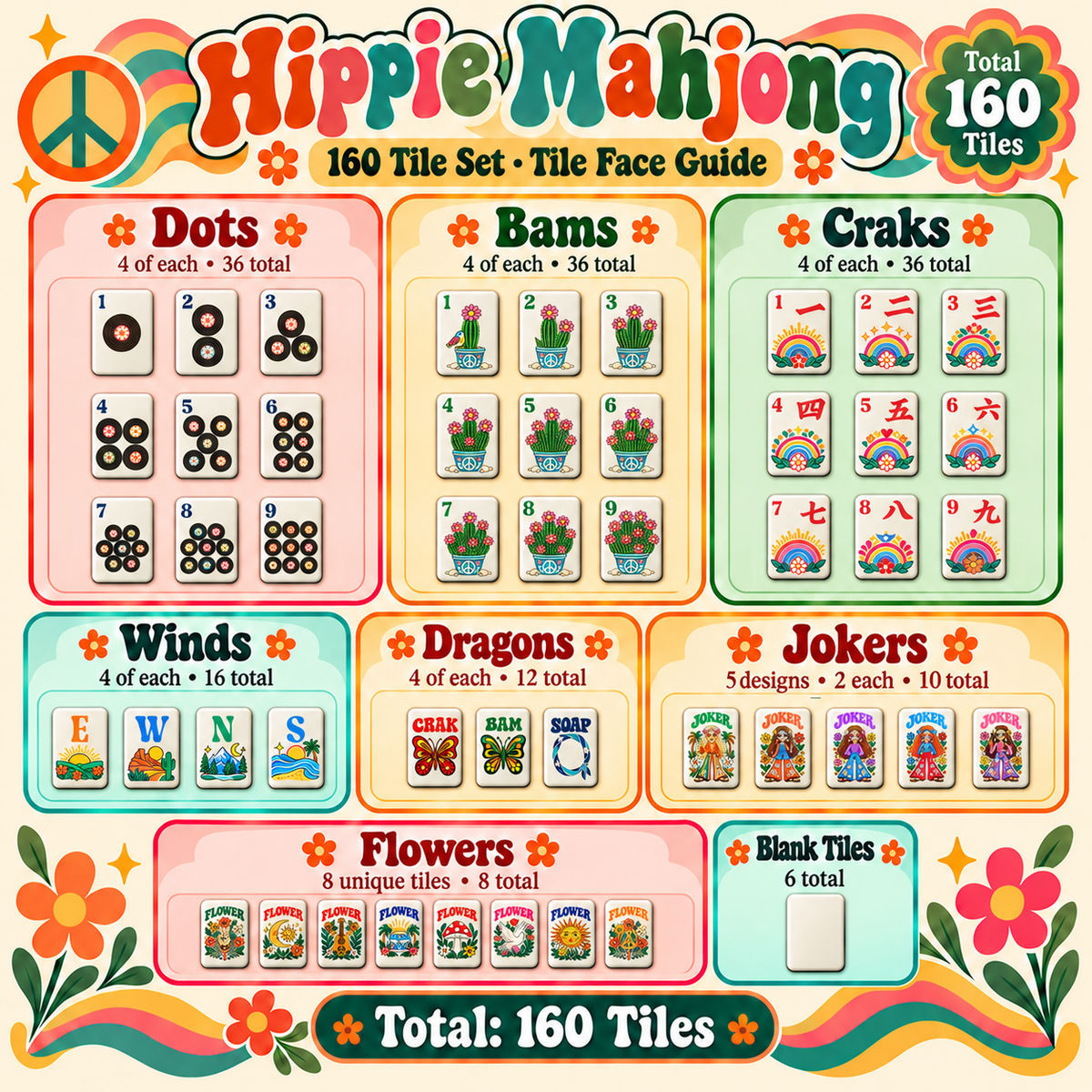
Cantonese mahjong (also called Hong Kong mahjong) uses 144 tiles: three number suits (1–9, four of each) plus Honors (winds and dragons, also four of each). Players draw and discard one tile per turn, building melds—pungs (three identical), kongs (four identical), chows (three consecutive same suit, e.g., 4–5–6 Bams), and eyes (a pair)—on the table as they form them, unlike American mahjong where you hold tiles hidden until ready. A standard game ends when one player declares "mahjong" (a complete hand of melds plus a pair); winning is based on point multipliers tied to meld types and hand patterns. Setup requires no special card; players agree on betting limits and a seating order, and each draws from a shared wall. Cantonese mahjong moves faster than American and emphasizes quick decision-making. Beginners can learn with the same best-selling mahjong sets used for American play, since tile suits and counts are compatible—only the rules and scoring differ. 🀄 Shop best-selling mahjong sets →
What tiles are in Cantonese mahjong?
Cantonese mahjong starts with exactly 144 tiles: 108 number tiles across three suits (Bams, Craks, Dots—each with numbers 1–9, four copies of each), plus 28 Honors split into four winds (North, East, South, West—four of each) and three dragon colors (Red, Green, White—four of each), plus eight flower tiles that usually sit out during play. Every tile has one matching set of three identical copies you can form a pung from, and eight tiles appear four times each. If a set lists 152 or 160 tiles, the extra tiles are spare jokers or blanks—not used in the 144-tile layout. Cantonese rules don't use jokers as wild cards the way American mahjong does; jokers are not part of traditional Cantonese play, though some casual groups add them for fun or use them during teaching rounds.

How do you set up a four-player Cantonese game?
Four players sit around a table, each taking a side: typically East (dealer), South, West, North, drawn by lot or agreed beforehand. Each player shuffles their own set of 34 tiles facedown in front of them (called "walls"), then each wall is stacked into two rows of 17 tiles, two tiles high. The dealer (East) rolls two dice to determine where breaking the wall starts—that player breaks at the indicated stack and draws the first tile from the top. Players draw counterclockwise around the wall in rotation. Each player draws one tile per turn and discards one faceup into the center—the discard pile tells everyone what's still available. On your turn, you draw a tile, form melds by laying them on the table faceup (a chow of 4–5–6 Bams exposed to the table counts as a single meld), and then discard a tile you don't need. Other players can claim a discard to complete a pung, kong, or chow (called "calling" or "claiming"), which interrupts the turn order until that meld is laid and the next player draws. Play continues until someone completes a hand—all melds plus a pair—and declares "mahjong" to win the hand.
What's the difference between Cantonese and American mahjong setup?
Aspect | Cantonese (Hong Kong) | American |
Tile count | 144 tiles | 152 tiles (plus jokers) |
Jokers | Not used (traditional) | 8 jokers, used as wildcards |
Melds | Chows (sequences) visible on table; can call them | No chows—pungs, kongs, quints, sextets only |
Hand reference | Agreed rules or memory | Current year's National Mah Jongg League card only |
Play style | Fast, simultaneous claiming, visible melds | Turn-based, hidden tiles until hand declared |
Scoring | Point multipliers per meld type | Fixed hand values from card |
Pause between hands | Brief reshuffle | Charleston (tile exchange ritual) |
American mahjong is slower and more strategic—you hold tiles hidden, plan a hand from the current League card, and execute the Charleston before each round. Cantonese is faster and more reactive; melds go on the table immediately, others can claim your discard, and scoring happens live. If you've played American mahjong and want to try Cantonese, you can use the same tile set—the tiles are identical—but plan to learn a new rule book and scoring table. Many players enjoy both; a best-selling mahjong set works for either variant, and adding a quality mahjong mat gives you a smooth surface and clear discard zones for the faster Cantonese pace.
🎁 See our most-loved mahjong sets & accessories →
How does Cantonese winning and scoring work?
In Cantonese mahjong, the goal is to complete a hand of 14 tiles: four melds (12 tiles) plus one pair (2 tiles). A winning hand can include any combination of chows (sequences: 4–5–6 Bams counts as one chow), pungs (three identical tiles: three 7 Dots), kongs (four identical tiles), or eyes. When you have a complete hand, you discard the last unwanted tile, announce "mahjong," and flip your hand faceup. Points are then calculated based on the melds inside—each chow is worth 1 point, each pung is worth 2 points, a kong is worth 4 points, a pair is worth 2 points, and scoring bonuses apply for self-drawn wins, concealed melds, or specific hand patterns (called "fans" or "doubles"). A basic hand might be worth 1 or 2 points before multipliers; premium hands with rare patterns multiply by 2, 4, 8 or more, depending on the ruleset in play. Players agree on a base bet (per point) before the round starts. Unlike American mahjong, where hand values are fixed on the card, Cantonese scoring is calculated live at the table and varies by hand composition—a quick-forming chow is cheaper than a concealed kong of dragons, so strategy shifts second-by-second.

What mistakes do Cantonese beginners make?
The most common trap: confusing chows with pungs. A chow must be three consecutive numbers of the same suit—4–5–6 Craks is a valid chow, but 4 Craks, 5 Bams, 6 Dots is not. Beginners often try to grab discards for the wrong meld type. A second mistake is calling a discard too slowly; in Cantonese, if two players claim the same tile (one for a chow, one for a pung), the pung takes priority, and it happens fast—you must speak up immediately or lose the claim. Third: not tracking what's been discarded. Since chows are valid, watching the discard pile tells you what numbers are still in play and what patterns are now impossible—if all three 8 Bams have been discarded, no one can make an 7–8–9 chow. A fourth beginner stumble is misreading when a kong is complete; you declare a kong immediately (four identical tiles on the table), and then you draw a replacement tile from the wall—if you wait too long, someone else draws and the turn passes. Finally, forgetting that melds stay on the table—you don't pick them up like American mahjong; other players see your pungs and chows and can calculate your hand progress, so bluffing is limited. To avoid these, play a few practice rounds with a patient group, keep your hand visible, call claims loudly, and count the discards mentally as they pile up.
✨ Find your Mahstead set — free US shipping →
What do you need to get started with Cantonese mahjong?
At minimum: a 144-tile mahjong set (or a 152-tile set with spares removed), four players, a table, and a rulebook or player group that knows the house rules. A die helps randomize the dealer and wall-break, though you can draw lots. A mahjong mat is not required but makes managing the wall, melds, and discard zone much clearer—the printed grid keeps tiles organized so you don't lose track of what's been called or exposed. If players struggle holding 13 tiles comfortably, mahjong racks with pushers help keep melds visible and reduce drops. For travel or storage, a mahjong bag protects tiles and keeps all components together. Most players play Cantonese casually for social fun or as a warm-up before American mahjong; no League card or complex setup is needed. Start with what you have, add comfort gear (mat, racks) only when the group grows or plays regularly, and invest in a rulebook that matches your group's preferred regional style—Guangzhou rules, Singapore rules, and Hong Kong rules each have small scoring differences, so clarify before the first tile is drawn.
Before you buy: What to check
Tile quality & size: Cantonese play is fast, so tiles must be easy to grip and shuffle. Check that tiles are acrylic (durable, won't chip easily) and printed clearly so suit marks and numbers are readable under table light. Smaller hands need tiles no smaller than 0.75 inches.
Set completeness: Confirm you're getting 144 playable tiles plus any spares. If buying a 152-tile set for Cantonese, the eight extra joker or blank tiles won't be used in the standard 144-tile layout—set them aside for future teaching rounds.
Storage plan: Cantonese tiles are shuffled hard and often. A padded mahjong bag extends the life of your set if you travel to other players' homes or play at clubs. A mat protects your table and makes wall-building cleaner, especially if your playing surface is uneven.
Ruleset clarity: Before buying, ask your group whether you're playing Guangzhou (most common in North America), Singapore, or another regional variant—rules for scoring fans and bonus melds differ slightly. A printed rulebook for your variant is worth the small investment; disagreements mid-game stall play fast.

FAQ
Can I use an American mahjong set to play Cantonese mahjong?
Yes. Both use the same 144 base tiles—suits, winds, dragons, and flowers are identical. The difference is rules and scoring, not the tiles themselves. Simply set aside the jokers and play by Cantonese rules. Many players own one set and play both variants by changing rule systems.
Do I need eight jokers for Cantonese mahjong?
No. Traditional Cantonese mahjong uses exactly 144 tiles with no jokers as wild cards. Some casual groups add jokers for faster learning rounds, but standard Cantonese play does not include them. If your set has jokers, leave them in the box.
What is the most common mistake when calling a chow?
Trying to call a chow with non-consecutive numbers or mixed suits. A chow must be three consecutive numbers of the same suit—2–3–4 Bams, 5–6–7 Dots, etc. Calling 2 Bams, 3 Craks, 4 Dots is invalid and will be caught immediately by other players.
How long does a Cantonese mahjong game usually take?
A single hand (one round) takes 10–20 minutes on average; a full game of four rounds is 40–90 minutes. Cantonese play moves faster than American mahjong because melds are visible on the table and decisions happen quickly. Experienced players finish hands in 8–10 minutes.
Is Cantonese mahjong played only in Hong Kong or China?
No. Cantonese (Hong Kong) mahjong is played across Southeast Asia, North America, and Australia—wherever Cantonese speakers and mahjong enthusiasts gather. Different regions (Guangzhou, Singapore, Malaysia) have small scoring rule variations, but the core tile setup and meld types are consistent.
What if I draw a tile I don't want and everyone calls it?
The call priority is: pung or kong first, then chow. If two players claim the same tile, the pung/kong holder gets it. The fastest claim wins ties. This is why loud, quick calls matter—you must announce your claim before the next player draws, or you lose the tile forever.


View More
View More
View More
