
American Mahjong vs Riichi Mahjong: Rules & How to Choose
Last updated: Nov 23, 2026
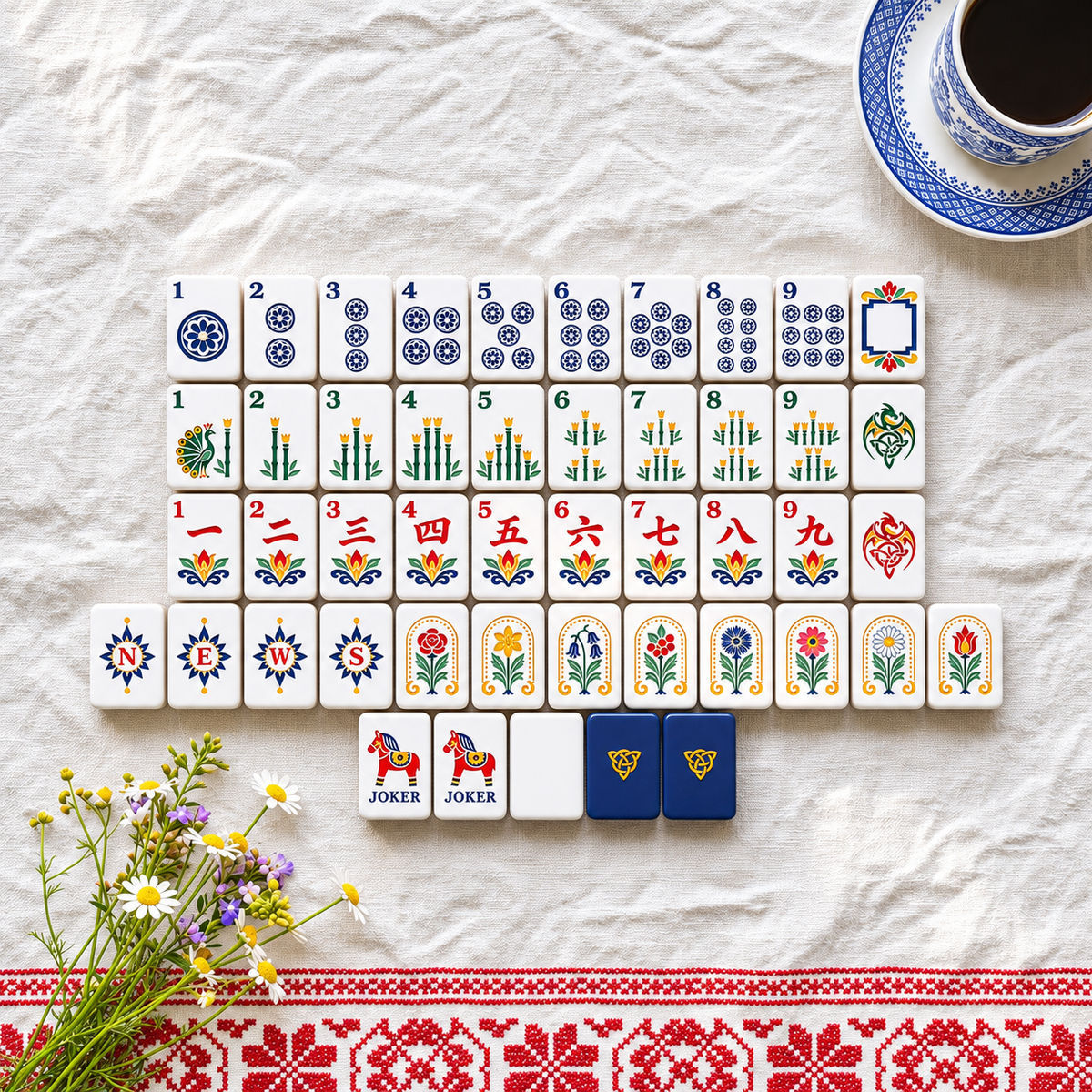
American mahjong uses a deck of 152 tiles (plus 8 jokers) and requires players to build hands that match patterns on the current year's National Mah Jongg League card—a laminated guide that changes annually. Riichi mahjong, popular in Japan and worldwide, uses 136 tiles and has no card; instead, players memorize seven standard hand categories (pairs, sequences, triplets, honor hands, and combinations thereof) and declare "Riichi" when one tile away from winning. American play is social and structured: partners, a Charleston (tile-passing ritual), and the card prevent collusion and let players of any memory level compete equally. Riichi is strategic and individual: pure skill through mental math, reading opponents, and hand management. Neither is "easier"—they reward different strengths. American games run 1–2 hours; Riichi rounds are often 30 minutes per player. If you enjoy following rules and community, try American; if you prefer memorization and one-on-one tactics, Riichi suits you. Both are best learned in person and practiced at tables equipped with proper tiles, mats, and racks. 🀄 Shop best-selling mahjong sets →
What tiles do each game use?
American mahjong plays with exactly 152 tiles: three suits (Bams, Craks, Dots) numbered 1–9 with four copies each, 16 winds (four each of North, East, West, South), 12 dragons (four each of Red, Green, and White), and 16 flower/season tiles. Games add 8 jokers for a total of 160 tiles in play. Riichi uses 136 tiles without jokers: three suits numbered 1–9 (four copies each = 108), plus 16 winds and 12 dragons (seven honor tiles repeated four times). The core difference: American jokers act as wild cards in melds; Riichi has no wildcards, so every combination must be exact. This makes Riichi tile recognition faster—players scan for known patterns—while American players glance at the card to confirm combinations. Both games require sharp focus, but the tile constraint shapes strategy entirely.

Can you use the same set for both games?
Technically yes; practically, no. An American set has 160 tiles (152 base plus 8 jokers); Riichi needs 136. If you use an American set for Riichi, you'll have 24 extra tiles sitting unused, which is wasteful and confusing during setup. American sets also show suits as Bams (sticks), Craks (circles), and Dots on each tile face in a way that reflects the NMJL card conventions; Riichi tiles use Japanese kanji and symbols (Manzu, Pinzu, Souzu) and look markedly different. Jokers—essential to American gameplay—are useless in Riichi; seeing them on the table breaks focus. If you're serious about both games, buy dedicated sets. Our best-selling mahjong sets are American-standard; Riichi sets are purpose-built by specialists outside the US market. Mixing games at the same table causes misdeals and frustration—two different sports, two different uniforms.
How does hand-building differ?
American hands are combinations bound to the card. On any given season (roughly mid-March to mid-June), the NMJL releases a card with 88 winning hand patterns. A legal hand must match one of these patterns exactly: for example, a pattern might specify "2024 Bams and 2024 Craks, two pairs, one pung"—and you build tiles to that template. Jokers can replace any tile in any meld (pung, kong, quint, sextet) except in a pair or single. Hands are called aloud; other players can verify them on the card.
Riichi hands are memorized categories played to points. The seven fundamental hand types (Tanyao, Pinfu, Iipeikou, Toitoi, Honroutou, Chitoitsu, Ryuuiisou—names and definitions shift between house rules and regional variants) guide play, but winning combinations depend on melds built during the round. Sequences (Chow: 1-2-3, 4-5-6, etc.) are legal and called routinely; in American mahjong, sequences don't exist—only identical triplets and higher multiples. Riichi players declare Riichi (a one-tile-away state) to freeze their hand and double or triple the final score; American has no such declaration.
Comparison: American = card-driven, predictable, allows jokers. Riichi = memory-driven, abstract, pure tiles only.

Which is easier to learn?
American mahjong feels harder at first—the card seems like a third language—but becomes intuitive after 3–4 games. The rules are absolute: if it's on the card, it's legal; if not, it's dead. Beginners don't need to memorize hand shapes because the card is always there. Experienced players read the card faster than newcomers, but the playing field is fair.
Riichi demands upfront memorization of hand categories, counting rules (fu and meld values), and scoring tables. The first session is overwhelming; most players need 10–20 sessions to feel competent. However, Riichi has deeper strategic layers: reading which tiles opponents need, timing your declarations, managing your discard pile psychologically. The learning curve is steeper but the ceiling is higher.
Choose American if you want to play immediately without a 50-hour study phase. Choose Riichi if you enjoy gradual mastery and mental calculation.
Aspect | American | Riichi |
Setup time | 15–20 minutes (Charleston included) | 5 minutes (no passing) |
Game length | 60–90 minutes | 15–30 minutes per player |
Memory demand | One-time card lookup each season | Ongoing (7+ hand types, scoring tables) |
Tile wildcards | Yes (8 jokers) | No (136 exact tiles) |
Hand building | Card-defined patterns | Memorized categories + sequences |
Legal melds | Triplets, quads, quints, sextets only | Triplets, quads, and sequences |
Best for | Social play, even skill levels | Strategic depth, individual skill |
How do these games shape your home mahjong space?
American games thrive in weekly or monthly gatherings—four players, snacks, time to chat during play, someone managing the card. You'll want a mahjong mat with scoring trackers and clear zones for your hand, discards, and the kitty. Racks with pushers keep tile faces hidden and make long hands easier to manage. A durable travel bag or case protects your set if you rotate hosting duties. Riichi, by contrast, is often faster and more tactical—designed for tournaments or shorter sessions. You'll benefit from speed and accuracy more than comfort: a simple mat (no scoring zones needed), smaller racks, and a sturdy bag. If you host both, an American-focused setup (mat with scoring, full racks, spacious layout) serves 90% of casual Riichi play anyway.
One honest note: American mahjong is heavily Westernized, urban, and strongest in major US cities; Riichi is global, with active communities in Japan, Europe, and online. Neither is "superior"—they're separate traditions. Host whichever matches your circle's taste.
🎁 See our most-loved mahjong sets & accessories →
What to check before you buy
Tile count. American = 160 (152 play tiles + spares). Riichi = 136 (no jokers). Don't mix.
Suit markings. American tiles use Bams, Craks, Dots. Riichi uses Japanese kanji. Confirm before purchase.
Mat and rack fit. If you own an American set, ensure your mat has dedicated scoring areas; Riichi mats are often simpler.
Who you'll play with. Ask your local club or meetup group which game they favor, then buy accordingly. Switching between both is possible—just use separate sets and track them clearly.
Your learning style. American = visual, card-driven. Riichi = memory + pattern recognition. Honest: if you hate memorization, don't start Riichi.
✨ Find your Mahstead set — free US shipping →

FAQ
Can I play American mahjong with Riichi rules, or vice versa?
No. American rules require the current year's NMJL card and jokers as wildcards; Riichi forbids jokers and uses memorized hands. Mixing rules breaks both games. Use the correct set and rulebook for each.
Which game is played more in the United States?
American mahjong dominates casual play in the US, especially in multigenerational households and clubs. Riichi is growing through online platforms and tournaments but remains niche outside dedicated communities.
Do I need to buy a new American mahjong set each year?
No. Your tiles never change—only the hand patterns on the card change each season. Buy one quality set and replace the card annually (cards are inexpensive). Mahstead sells American mahjong sets designed to last through decades of play.
How long does a typical Riichi game take?
A single round (one player's turn as dealer) is 15–30 minutes. A full session is often 3–4 rounds per player, so 1–2 hours total—comparable to American in group time, but the individual rounds are faster.
Can I use jokers in Riichi mahjong?
No. Riichi uses 136 tiles with no wildcards. Every combination must be built from exact tiles. If your set has jokers, they stay in the box during Riichi play.
Which game should a beginner start with?
American mahjong if you want to play the same day you learn; no memorization required, just card-reading. Riichi if you're willing to study 20–30 hours and enjoy mathematical puzzles. Neither choice is wrong—only different paths.


View More
View More
View More
