
American Mahjong vs Chinese Mahjong: Rules, Tiles, and Play
Last updated: Nov 23, 2026
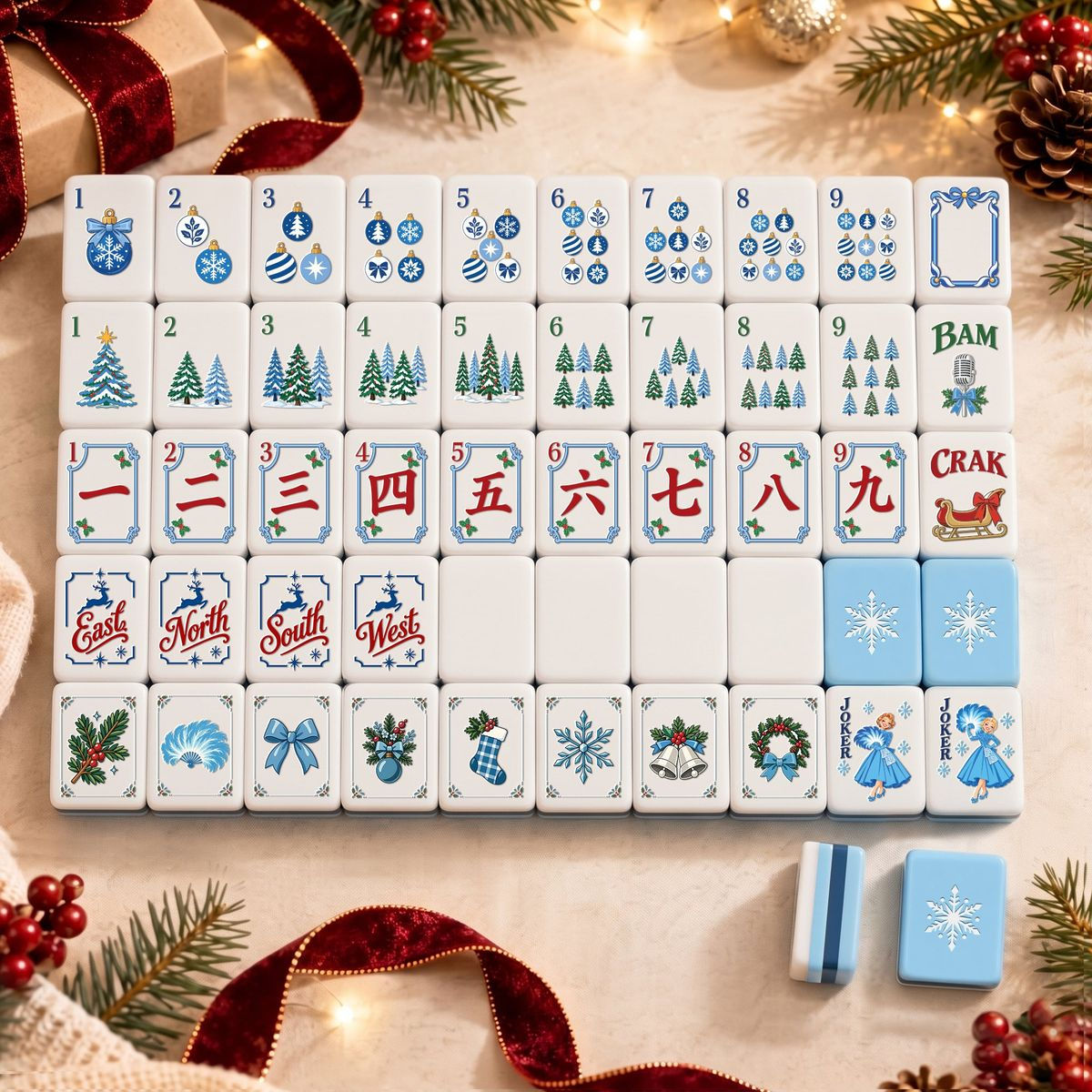
American mahjong uses 152 tiles (36 per suit: Bams, Craks, Dots × 1–9 × four copies each, plus 16 winds, 12 dragons, 8 flowers, 8 jokers) and requires hands from the current year's National Mah Jongg League card. Chinese mahjong uses 144 tiles (no flowers, no standard jokers) and allows you to build any melds you choose. American play forbids chows (sequences); you expose only pungs (three identical), kongs (four), quints (five), and sextets (six). Chinese allows chows: a pung is three identical, a chow is three consecutive tiles in one suit (like 3–4–5 Dots). Scoring differs dramatically: American uses the League card for fixed point values; Chinese multiplies by fans (doubler sets based on hand type). American hands must match the card exactly; Chinese hands have no predefined patterns. Both are played four players, but the rhythm and strategy diverge fundamentally.
Why does American mahjong have 152 tiles when Chinese has 144?
American mahjong adds flowers (8 tiles) and jokers (8 tiles) to the 136-tile Chinese base. The American National Mah Jongg League standardized these additions in the 1930s to increase variety and permit flexible hand design. Flowers in American sets are usually numbered 1–8; jokers are blank or joker-marked and function as wild tiles within melds. Chinese mahjong kept the older 144-tile format (no flowers added after the original design) and traditionally uses no jokers at all, though some players add them house-rules. The extra American tiles mean more meld options and longer decision trees—but also steeper learning curves for beginners.

How does the National Mah Jongg League card define American hands?
The League issues one card per year (spring) that lists all valid winning hands for that season. Each hand is a fixed combination of melds—for example, "three 5 Crak pungs, one 2 Dot pung, one Soap pair" plus dragons or winds. You cannot win on a hand not in the card. This is the core rule: American mahjong is hand-constrained, meaning you must match the pattern exactly. Chinese mahjong has no such card; instead, you follow loose pattern rules (one pair, four melds) but build from memory and house rules. The American system removes ambiguity and makes scoring mechanical: every winning hand on the card carries a printed point value. For American beginners, learning to read the card is Step One. We host weekly games using the current card, and new players spend their first session just flipping through it.
🀄 Shop best-selling mahjong sets →
Can you use sequences (chows) in American mahjong?
No—American mahjong forbids chows entirely. You may expose and play only pungs (three identical tiles), kongs (four identical), quints (five), and sextets (six). Jokers can substitute within these melds but can never form a pair or stand alone. Chinese mahjong allows chows: a chow is exactly three consecutive tiles of the same suit (1–2–3, 4–5–6, etc.). This rule difference reshapes strategy fundamentally. In American play, you hunt for duplicates and rely on pungs; in Chinese play, you hunt for consecutive runs and pungs, opening far more hand combinations. Many American players who switch to Chinese find it liberating at first—more hands feel "alive"—but then struggle with the higher complexity and lack of a fixed reference card.
What's the scoring difference between American and Chinese mahjong?
American scoring is deterministic and printed: the League card lists every hand's exact point value. You win, consult the card, receive the points. No calculation, no negotiation. Chinese scoring is multiplicative and pattern-based: you earn a base of 20 or 30 points (depending on house rule), then multiply by fans—doubler sets awarded for hand characteristics like "all one suit," "honors and terminals only," "all pungs," "concealed hand," etc. A Chinese hand with many fans multiplies to hundreds of points; a plain hand is worth 20. This means Chinese demands strategic reading (will this hand score high?) while American is more mechanical (does it match the card?). Neither is harder; they reward different minds. American suits pattern-matchers; Chinese suits intuitive multipliers.

Which variant should your group learn first?
Player Type | Better Fit | Why It Works | Learning Curve |
Rule-followers, pattern-lovers | American | Card-based hands, fixed scores, clear yes/no wins | Moderate (card reading takes practice) |
Intuitive builders, freestyle players | Chinese | Build any meld combo, no card, high-score strategy | Steep (fans and concealment rules vary) |
Brand new to mahjong | American | Rigid structure removes endless "what if?" decisions | Easier first month; card always clarifies |
Experienced card players (Rummikub, etc.) | American | Melds are fixed patterns, not open-ended sequences | Quick translation from other games |
Players who like math/puzzles | Chinese | Fans multiply exponentially; deep optimization possible | Very steep (dozens of fan combinations) |
Start with the variant your group or local club already plays. Switching mid-season wastes energy. If you're building a new group from scratch, American is our recommendation: the card makes disputes disappear, and new players feel confident fast. Chinese rewards mastery over many years and suits groups that already know American and crave deeper puzzle-solving.
What do you need to get started in each variant?
For American mahjong: A 152-tile set (eight jokers included), the current-year National Mah Jongg League card, a mat for tile organization, and racks or a pushers guide if you use them. A mat helps, especially if you're playing on a soft surface. Our engraved American mahjong sets let you personalize your gear, and a mahjong mat organizes tiles beautifully and protects your table.
For Chinese mahjong: A 144-tile set (no flowers or jokers unless you add house-rule jokers). Many Chinese sets include racks built into the box. You do not need a League card—your group agrees on fan values and hand patterns, usually via a chart or memory. You'll play faster once learned, but the learning curve is higher.
If you're hosting four players and want foolproof American play, grab a best-selling set with a mat and have the current League card on hand before the first game. Invest five minutes upfront teaching card-reading, and disputes evaporate.
🎁 See our most-loved mahjong sets & accessories →
Common beginner mistakes: American vs Chinese confusion
Mistake 1: Assuming chows exist in American. New American players sometimes try to expose 3–4–5 Dots as a meld. Wrong. American has no chows. Only identical-tile melds count. The card clarifies this, so use it.
Mistake 2: Playing Chinese without agreeing on fans first. Chinese players must align on fan definitions before play starts. Different regions (Hong Kong, Taiwan, Mainland) score fans differently. Without a house agreement, chaos reigns. Write your fan chart down.
Mistake 3: Mixing joker rules. American jokers substitute inside melds only—never in pairs, never alone. Chinese traditionally has no jokers, but if your group adds them, decide: do they count as any tile, or only as tiles within melds? Consistency prevents arguments.
Mistake 4: Using an old American League card. The card changes every spring. Playing with last year's card means you're playing an outdated rule set. Use the current year's card only.
What to check before you buy
Tile material and size. American sets often use acrylic (durable, loud) or bamboo/bone (softer sound, classic feel). Check the set description for dimensions—most acrylic tiles are about 1 by 1.5 inches. Larger hands prefer bigger tiles; tight hands prefer smaller.
Joker count. American sets must include 8 jokers. Some sets marketed as "160-tile" include extra jokers as spares—that's fine, but never add spares to play. A game always uses exactly 152 tiles and 8 jokers.
Tile weight and feel. Thicker, heavier tiles feel premium and shuffle smoothly. Thin, light tiles feel cheap and can warp. Ask for weight or thickness in the product description.
Case or bag included. A padded case or travel bag protects tiles from damage and makes hosting easier. Check if included or sold separately.
Card included? Most sets don't include the current League card. Buy it separately or print it. We assume you own the current card.
✨ Find your Mahstead set — free US shipping →
We've hosted hundreds of games across both variants. American mahjong is more predictable and beginner-friendly; Chinese mahjong offers endless depth once you've mastered the basics. Choose based on your group's appetite for structure versus freedom. Then explore mahjong sets and mats that match your choice, and invite three friends to your first game.

FAQ
Can I play American mahjong without the League card?
Technically yes, but you lose the entire rule system. Without the card, you'd have no definition of a winning hand, no point value, and endless arguments. American mahjong is the card. Get the current year's card from the National Mah Jongg League (online or at clubs) before your first game.
Is Chinese mahjong harder than American?
Harder to learn, not harder to play. American has rigid structure (the card), so beginners feel confident fast. Chinese requires memorizing fan multipliers and building hands freely, which takes months. Once learned, Chinese is equally fun but rewards deeper strategy. Start with American if new to mahjong; switch to Chinese after a season.
Do I need jokers for Chinese mahjong?
Traditional Chinese mahjong uses no jokers. The game plays perfectly with 144 tiles alone. Some modern groups add jokers as house rules, but it's optional and uncommon in formal play. American mahjong requires jokers (8 tiles, non-negotiable).
Can I use an American set to play Chinese?
Only if you remove the flowers and jokers first, leaving exactly 144 tiles. American sets include 8 extra flowers; Chinese games don't use them. It's clumsy. Better to own one set per variant if you plan to play both regularly.
What's the difference between Hong Kong and Taiwanese mahjong?
Both are Chinese variants with different fan systems and regional hand patterns. Hong Kong mahjong emphasizes concealment and bonus fans; Taiwanese uses slightly different multipliers. Neither is "more American." If you're in a Chinese-speaking community, ask locals which variant they play and follow that. Both use 144 tiles and allow chows.
Do I need special tiles for American mahjong?
No. Any 152-tile American set works—acrylic, bamboo, bone, plastic. Tile material doesn't affect rules. Pick based on feel, sound, and durability. We offer best-selling sets in various materials; all play identically.


View More
View More
View More
