
Taiwanese Mahjong Terms & Glossary: A Player's Guide
Last updated: Nov 23, 2026
Taiwanese mahjong is played with 136 tiles (4 copies each of Bams, Craks, Dots 1–9; winds N/E/W/S; dragons; and flowers), no jokers, and no hand card. Core terms include "胡" (hú—winning hand), "碰" (pèng—pung/exposed three identical), "杠" (gàng—kong/four identical), "吃" (chī—chow/sequence of three consecutive numbers in one suit, unique to Taiwanese and Chinese variants—American mahjong has no chows). Scoring is based on pattern difficulty and tile count, not a fixed card. Hands are memorized or learned through play. Taiwanese mahjong typically plays with four players, one hand per player, and aims to complete a winning hand faster than American mahjong. If you host Taiwanese games alongside American ones, keep separate tile sets, since tile composition and calling rules differ significantly.
Taiwanese mahjong feels familiar if you play American mahjong—same tiles, same four players, same table etiquette—but the ruleset, hand-building logic, and vocabulary are fundamentally different. We've played enough Taiwanese games at home to know the common confusion points. Here's a practical glossary and the mechanics that matter.
What is "胡" and when do you win?
胡 (hú) means "win"—you've completed a legal hand. In Taiwanese mahjong, a winning hand always contains four melds (each three or four tiles) plus one pair, totaling 14 tiles. Unlike American mahjong, you don't need to match a card; any 14-tile combination that follows the pattern rules counts. You win by either drawing a tile from the wall (自摸, zìmō) or calling a discard someone else played (胡牌, húpái). Winning immediately ends the hand—no robbing the kong or waiting for jokers to settle.

How do "碰," "杠," and "吃" work in play?
These three terms describe the exposed melds you build during play:
碰 (pèng—pung): three identical tiles. You announce "pèng," lay them face-up on the table, and draw a replacement from the wall.
杠 (gàng—kong): four identical tiles. You announce "gàng," lay them face-up, and draw from a special kong stock (not the regular wall). If a player plays a pair and someone calls 碰 on it, they cannot then call 杠 on the third tile—a key timing rule.
吃 (chī—chow): a sequence of three consecutive numbers in the same suit (e.g., 3–4–5 Bams). Only the player to the discarder's left can call 吃. You cannot 吃 from a discard unless it completes your hand or forms part of an exposed meld.
These calls happen during play, not at the end. A player can also choose not to call on a discard, even if they could—strategy is built into each moment.
What's the difference between "自摸" and "胡牌"?
Both are winning calls, but they score differently:
自摸 (zìmō—self-drawn): you draw the winning tile from the wall. All three other players pay you the full hand value.
胡牌 (húpái—win off a discard): someone else plays the tile that completes your hand. Usually only the discarder pays you; in some regional rules, all three pay a reduced share.
Self-drawn wins are considered slightly more skillful and often reward higher payouts. Some Taiwanese players also distinguish 和牌 (hépa), a draw with no winner—the hand resets and play passes.
How does scoring work without a card?
Unlike American mahjong scoring, Taiwanese scoring is rule-based and memorized. Points come from pattern multipliers (e.g., "all pungs" = 2x, "all one suit" = 3x, "honor tiles only" = 4x) and tile count bonuses. Your winning hand announces its own pattern category; other players calculate what they owe based on the pattern and base payment (often a fixed point value per game). Regional variations exist—Fujian rules differ from Shanghai rules, which differ from Hong Kong rules. Before playing with a new group, ask: "What's the reference ruleset?" or "Can you show me a scoring sheet?" This prevents disputes.
What regional rule variations should you know?
Taiwanese mahjong has no single international standard. Major variants include:
Region | Chow rules | Kong draw | Discard payout | Notes |
Standard Taiwanese | Left player only | Special kong stock | Discarder pays full or shared | Most common in casual play |
Shanghai | Any player can chow | Regular wall | Discarder pays full | Faster gameplay |
Fujian | Limited chow conditions | Special kong stock | Discarder pays 1/3 each | Stricter hand patterns |
Hong Kong | Any player can chow | Regular wall | Discarder pays full or 1/3 | Chows and pungs mix freely |
If you're learning from a player who learned in Shanghai or Fujian, their rules are correct in that context—but they differ from Taiwanese Standard. Ask, listen, and adapt. Most friendly games clarify these upfront.
Why does Taiwanese mahjong feel "faster" than American?
Three mechanical reasons. First, no hand card means every winning combination is legal—you chase patterns you see, not patterns on a card. Second, no jokers simplifies tile value (every tile is just what it is). Third, exposed melds move faster because chows are allowed mid-play, not just declared at the end. American mahjong forces you to hold and conceal all 13 tiles until you meld—Taiwanese mahjong exposes building blocks immediately. For players switching between the two, this speed can feel disorienting at first. We recommend playing one variant per session to stay sharp.

"清一色," "碰碰胡," and other winning patterns—what do they mean?
These pattern names describe specific hand compositions and score multipliers:
清一色 (qīngyīsè—pure): all tiles from one suit (e.g., all Bams). High multiplier.
碰碰胡 (pèngpènghú—all pungs): four pungs and one pair, no chows. Often a 2x or 3x multiplier.
龙 (lóng—dragon): three dragons (Red, Green, White). Often 1x.
风 (fēng—wind): specific wind patterns. Varies by ruleset.
花 (huā—flower): hands using flower tiles strategically. Rare.
Learning these names helps you chat at the table and understand why a hand is worth what it's worth. Every region has 20–40 named patterns; ask for a sheet or learn through play.
🀄 Shop best-selling mahjong sets →
Setting up for Taiwanese vs. American play at home
If you host both games, we keep two sets on hand. Taiwanese play uses 136 tiles (no flowers in some regional rules, no jokers ever). American mahjong uses 152 tiles plus 8 jokers. Never mix them mid-game; accidentally including a joker in a Taiwanese hand creates instant confusion. We label one set "American" and one "Taiwanese" on the bag or case to avoid grab-and-go errors. A quality set with clear markings and a secure bag makes this transition seamless.
What to check before you buy a set for Taiwanese play
Tile count: confirm it's 136 (or 144 with blanks for learning). American 152-tile sets won't work.
Joker presence: Taiwanese mahjong uses zero jokers. If a set includes them, you'll set them aside every game.
Tile size and grip: Taiwanese games often last longer than American rounds. Larger tiles (0.75"–0.80") reduce hand fatigue over a 2–3 hour session.
Suit clarity: Taiwanese play relies on quick visual recognition. Make sure Bams, Craks, and Dots are distinct and readable under low table lighting.
Case or bag durability: frequent tile swaps between variants means your set travels. A reinforced bag protects tiles from cracks and jokers from rolling under the table.
Our best-selling sets are designed for American mahjong (152 tiles), so if Taiwanese is your main game, ask the retailer for composition details. Some shops stock dedicated 136-tile Taiwanese sets; others sell American sets expecting you to remove jokers. Know what you're getting.
Common vocabulary for casual Taiwanese play
Even if you don't memorize scoring patterns, these words come up every hand:
摸牌 (mōpái): draw a tile from the wall.
出牌 (chūpái): discard a tile.
台 (tái): the "round" or "hand"—"我们已经打了三台" = "we've played three hands."
番 (fān): multiplier or "double." "一番" = 1x, "二番" = 2x.
点 (diǎn): points or unit of payment. Often tied to a base point value agreed before play starts.
平手 (píngshǒu): a draw (no winner).
胡不起来 (húbuqǐlái): "I can't make a win"—you've drawn tiles that don't form a legal hand.
Memorizing 10 words and asking "Why is that hand worth 4 points?" gets you fluent faster than reading a rulebook.
🎁 See our most-loved mahjong sets & accessories →
Hosting Taiwanese mahjong at your table
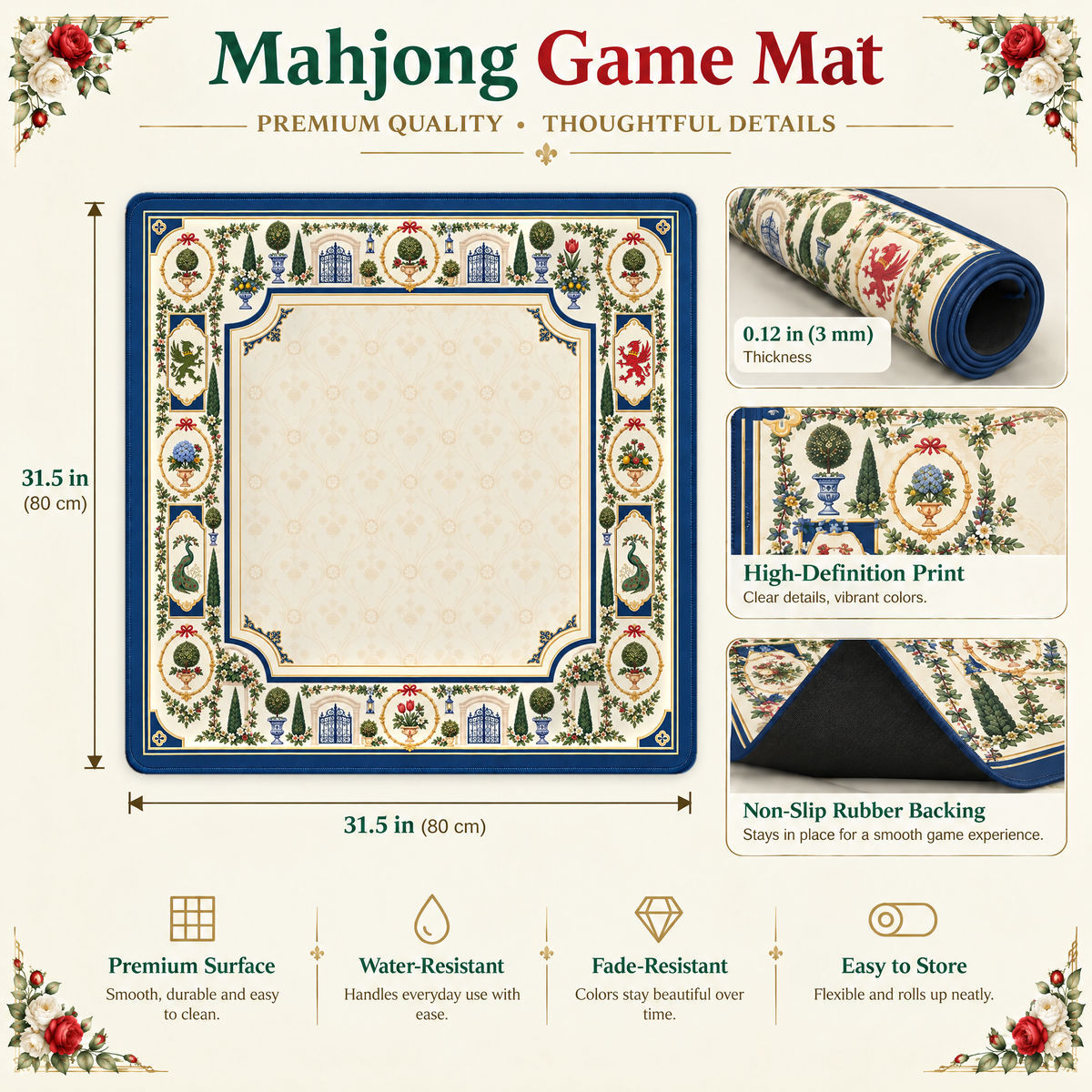
Taiwanese players appreciate clear tiles, a smooth surface, and room to lay four melds horizontally without crowding. A padded mat with clear suit zones helps beginners track exposed melds and keeps tiles from sliding during long sessions. If your group rotates between Taiwanese and American games, a mat with neutral markings works best. Taiwanese play doesn't use racks with pushers the way American players do—many Taiwanese players hold tiles in hand or stand them on the table edge—but Western players adapting to Taiwanese rules often prefer a rack to keep 14 tiles organized. Test what your group likes and adjust.

FAQ
Can I use an American mahjong set to play Taiwanese mahjong?
Technically yes if you remove the 8 jokers and 8 flowers, leaving 136 tiles. However, you'll have 8 unused tiles every game, which is wasteful. Buy or borrow a dedicated 136-tile Taiwanese set if you play regularly.
Do I need to memorize all the winning patterns to play?
No. Start by learning 5–6 common patterns (all one suit, all pungs, honor-only). Ask other players to name each winning pattern as hands finish. You'll absorb the rest through repetition over 10–20 games.
Why can Taiwanese players call "吃" on a discard but American players can't?
American mahjong has no sequences (chows) at all—hands are always pungs, kongs, and pairs. Taiwanese mahjong incorporates sequences as core melds. The games built on completely different strategic foundations.
Is Taiwanese mahjong faster than American mahjong?
Often yes. No hand card and no jokers mean fewer decision delays. Exposed melds also accelerate play. A Taiwanese hand typically finishes in 20–40 minutes; American hands average 30–50 minutes.
What's the most common beginner mistake in Taiwanese play?
Calling 碰 or 杠 on tiles you shouldn't touch yet—timing matters. If a tile has already been discarded and another player played a meld before you, you cannot claim it retroactively. Stay alert when tiles leave the wall.
Do all Taiwanese regions play by the same rules?
No. Shanghai, Fujian, and Hong Kong variants exist. Always ask "What ruleset are we playing?" before the first hand. Clarify chow permissions, kong draw source, and payout splits.


View More
View More
View More
