
What to Look for in a Large Print Mahjong Set
Last updated: Nov 23, 2026
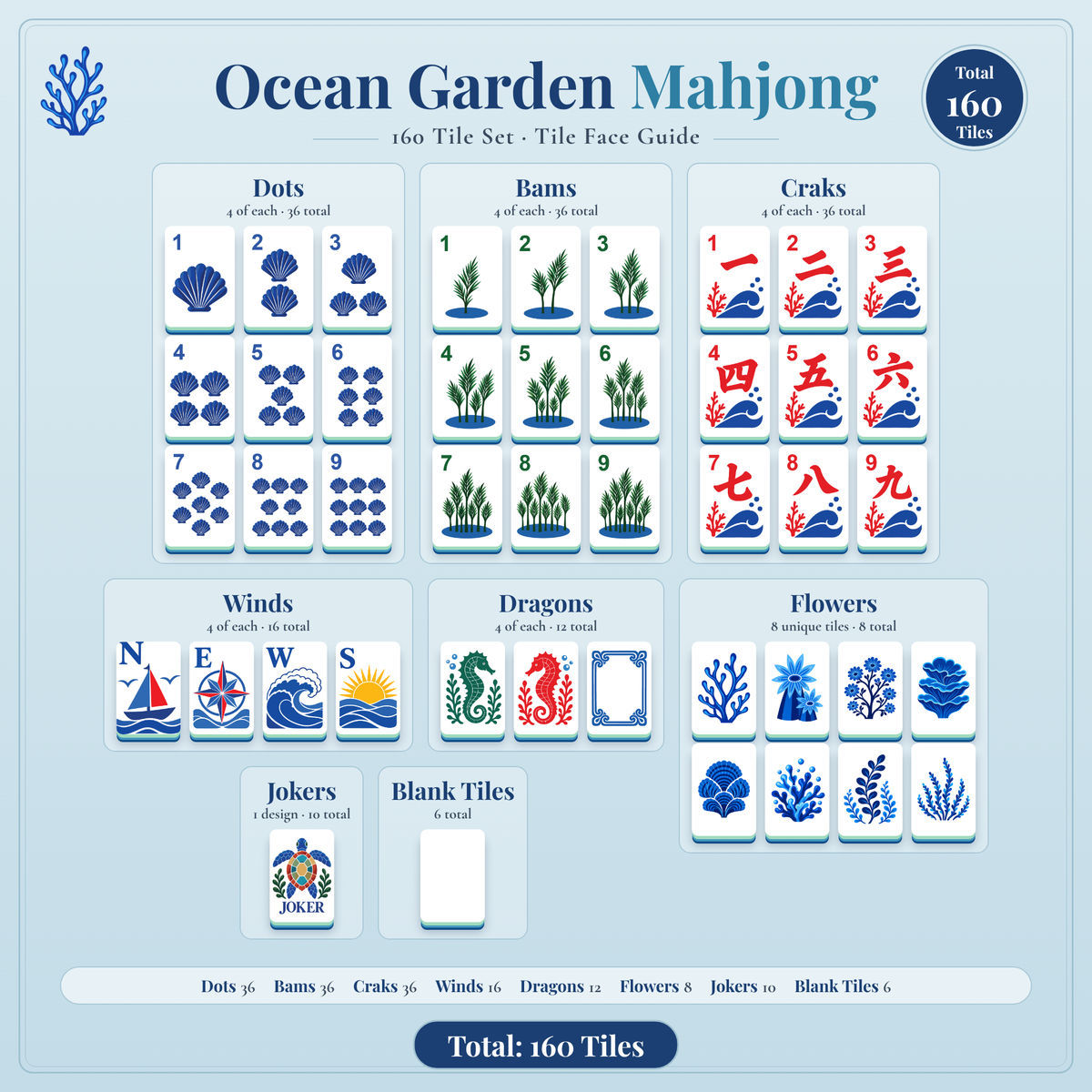
Large-print mahjong sets feature tiles with enlarged numerals, suit symbols, and wind/dragon characters—typically at least 25% larger than standard tiles—so you can read them from across the table without squinting or holding them inches from your face. American mahjong sets contain exactly 152 playing tiles (three suits, winds, dragons, flowers, jokers) and include a rack system to organize your hand. A complete large-print set pairs oversized tiles with an acrylic or wooden rack designed to accommodate bigger pieces, often bundled with a carrying bag and mat. Tile thickness, acrylic clarity, and embossing depth all affect legibility; engraved sets tend to offer superior durability over printed ones. Quality large-print sets range widely in cost depending on material—acrylic vs. resin, hand-engraved vs. mass-produced—and whether you're buying just tiles or a full package with racks, mat, and bag. At Mahstead, we design engraved American mahjong sets with oversized markings that remain crisp after years of play, backed by free US shipping on all orders.
Why does tile size matter more than you'd think?
Bigger tiles aren't just about comfort—they're about speed and accuracy at game time. When numerals are small, you misread a 5 Bam as a 3, delay the game while you search your rack, or miss a winning hand because you miscounted. Large-print tiles eliminate that friction. Engraved markings stay legible even after thousands of shuffles; printed labels fade or peel. The psychological win is real: players report fewer mistakes, faster decision-making, and genuinely enjoying the ritual of organizing their rack instead of treating it as a chore. If you play weekly—or hope to—a large-print set pays dividends within the first month.

What's the difference between acrylic and resin large-print tiles?
Acrylic tiles (made from cast or molded plastic) are lighter, easier to shuffle by hand, and break cleanly if dropped. Resin tiles are denser, heavier, and develop a richer patina over time but are more brittle at the edges. For large-print designs, acrylic is the better choice: the material accepts deep engraving without splintering, keeps embossed text sharp, and won't yellow or cloud over five years of weekly play. Resin excels if you value traditional weight and sound, but acrylic dominates large-print sets because the surface area lets you engrave bigger without sacrificing legibility. Our best-selling mahjong sets use cast acrylic specifically because it holds oversized numerals and suit symbols with zero degradation.
🀄 Shop best-selling mahjong sets →
How do you evaluate a rack system for large tiles?
A rack designed for large-print tiles must hold them at an angle steep enough to read the numbers but shallow enough that they don't topple. Standard racks are often too narrow; your oversized tiles will tilt or stick. Look for racks with a spread of at least 8–9 inches and a back wall at least 2 inches tall. Pushers (small wooden or acrylic sticks) should be proportional to tile thickness—flimsy pushers bend under weight and leave tiles jammed. Test that the rack legs don't splay outward under the weight of fourteen large tiles. Many players skip the rack entirely and use a dedicated mahjong mat with built-in tile edges or buy racks with pushers engineered for oversized tiles. A properly sized rack becomes invisible—you never think about it, and tiles feel stable the instant you set them down.
Should you buy a mat separately, or does it come in the set?
Most large-print sets bundle a mat, but bundled mats are often generic vinyl or felt that curls at the edges after six months. A dedicated mahjong mat is worth the investment: quality mats grip tiles so they don't slide, have reinforced seams at corners, and roll flat for storage. Cotton or microfiber surfaces are quieter and kinder to tile edges than cheap vinyl. If your set comes with a mat, inspect it before your first game—if it's thin, wrinkled, or has loose edges, replace it immediately. The mat is where you spend the most time; a poor mat makes every hand feel chaotic. Measure your table before ordering: a standard mat is 27–30 inches square, enough for four players and a centered discard area. Oversized sets with large-print tiles benefit even more from a quality mat because the tiles move more, and friction matters.
🎁 See our most-loved mahjong sets & accessories →

What's the real checklist before you buy?
Use this framework when comparing large-print sets:
Feature | What to Check | Why It Matters |
Numeral size | ≥0.5 inch tall on Bams/Craks/Dots | Readable from 3+ feet away |
Suit symbols | Distinct bamboo, coin, dot forms (not just colors) | Color-blind players need shape cues |
Engraving depth | Embossed or carved (not printed stickers) | Survives 1000+ shuffles without fading |
Tile edges | Rounded, not sharp; acrylic, not brittle resin | Comfortable to handle; won't cut hands |
Rack fit | Holds all 14 tiles at 45°+ angle | Prevents tile spill during play |
Carrying bag | Padded, with handle or shoulder strap | Protects set between games |
Joker clarity | Jokers marked distinctly from other tiles | Prevents illegal plays; critical in American mahjong |
Before you order, ask the seller: Are numerals engraved or printed? Will the rack hold large tiles stable? Does the set include a mat? Can I return it if the print fades after two months? If they avoid the question or say "most people don't ask," that's a red flag. At Mahstead, we answer these questions head-on because we host weekly games ourselves and know which features matter.
Pairing accessories with your large-print set
A large-print set is only half the story. You'll want a travel bag or case that protects oversized tiles during transport—vinyl bags stretch; padded cases absorb shock. If you travel between homes or venues, a case keeps your investment safe. Racks with pushers engineered for larger tiles are non-negotiable if you're playing at a table without a dedicated mat. And consider dice: oversized dice (about 0.75 inch square) match the visual weight of large-print tiles and make the ritual of seating and counting more satisfying. A complete system—set, mat, rack, bag, dice—costs more upfront but eliminates frustration and keeps your game flowing.
✨ Find your Mahstead set — free US shipping →
A final honest word: Is large-print right for you?
Large-print sets aren't for everyone. If you play casually and have no vision concerns, standard tiles work fine. But if you play weekly, have presbyopia (age-related vision change), or have guests who squint, a large-print set transforms the experience. The tiles feel heavier in your hand, numerals are unmissable, and you'll shuffle with confidence instead of doubt. The cost is higher—sometimes significantly—but you're buying years of games without the friction of miscounts or misreads. We've seen players who were ready to quit mahjong pick up a large-print set and discover they loved the game all over again. That's worth the investment.

FAQ
Can I use large-print tiles in a set with standard racks?
Not comfortably. Large tiles are too wide; they'll tilt or overlap in a standard rack. You'll need racks designed for oversized tiles or a mat with a lip to prop them upright.
Do engraved large-print tiles cost significantly more than printed ones?
Yes. Engraving takes longer and uses more precise tooling. But engraved tiles last 10× longer; printed labels fade within a year of weekly play, making reprinting necessary.
Can I use large-print tiles for Riichi or Chinese mahjong?
No. Large-print tiles are designed for American mahjong (152 tiles, specific suit structure). Chinese and Riichi sets have different tile inventories and aren't compatible.
What's the minimum table size for a large-print set with mat?
A 48-inch square table is ideal. Large-print mats are typically 27–30 inches square; the mat should fit in the center with room for racks and discard piles on all sides. Smaller tables create clutter.
If my large-print set comes with a mat, should I always use it?
Ideally yes. Even a basic bundled mat prevents tiles from sliding. But if the bundled mat is thin or damaged, upgrade it immediately—a poor mat turns a great set into a frustrating experience.


View More
View More
View More
