
What Set Do You Need for Hong Kong Mahjong
Last updated: Nov 23, 2026
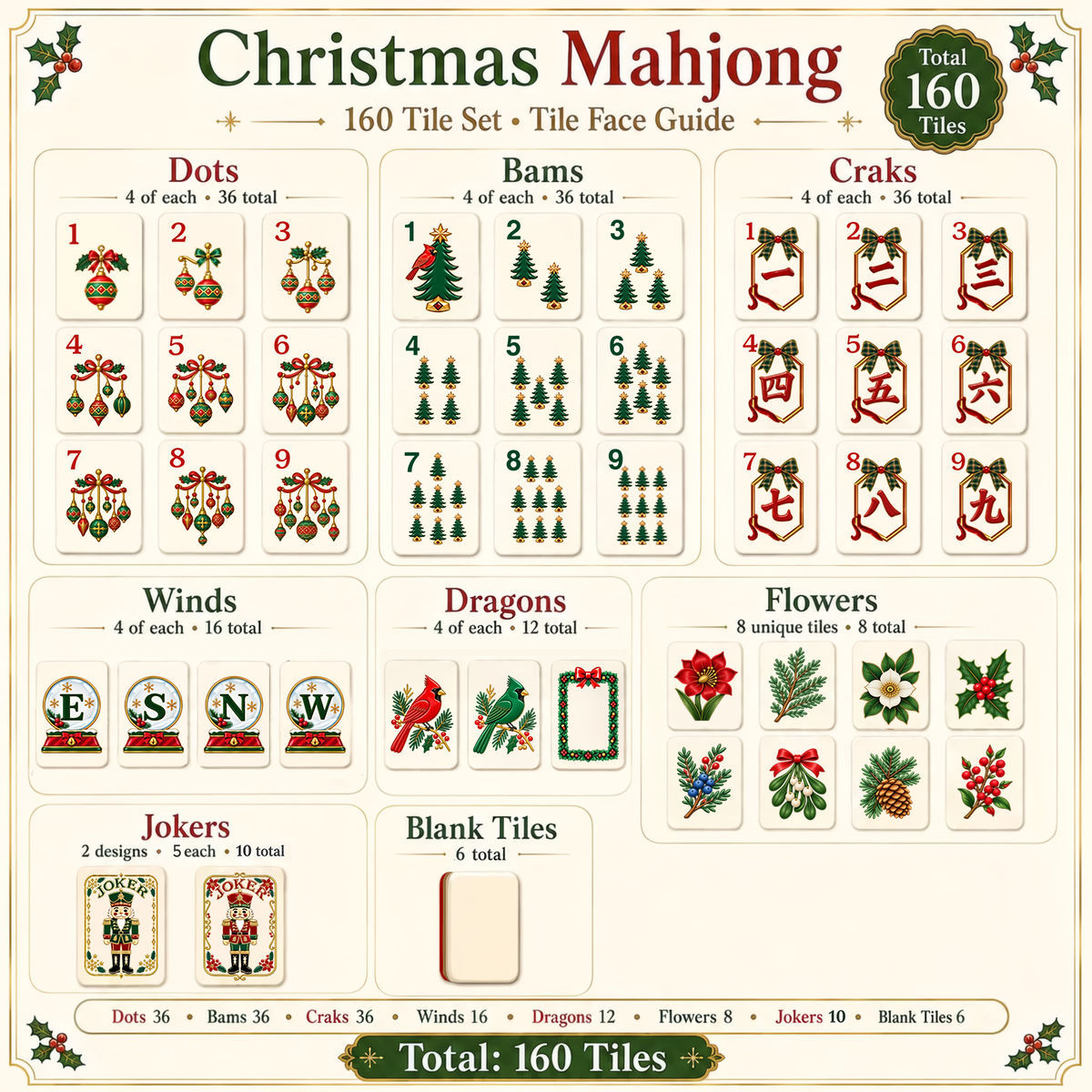
Hong Kong mahjong requires a 144-tile set—smaller than American mahjong's 152 tiles—with three suits (Bams, Craks, Dots numbered 1–9), honors (winds and dragons), and no flowers or jokers. The game plays with four players and hand patterns that differ significantly from American mahjong: Hong Kong uses chows (sequences like 1-2-3), pungs (three identical tiles), and kongs (four identical), all of which can be called or exposed during play—a core difference from American, where only pungs, kongs, quints, and sextets are valid exposed melds and chows are forbidden. Winning hands often rely on specific combinations like "all pungs" or "all simple tiles," and the point system is simpler than American scoring. Most Western players learning Hong Kong rules start with a standard bone-and-bamboo set; Mahstead's best-selling mahjong sets include American 152-tile sets, but if you're committed to Hong Kong play, sourcing a dedicated 144-tile set designed for that variant is clearer than adapting an American deck. 🀄 Shop best-selling mahjong sets →
How is Hong Kong mahjong different from American mahjong?
American mahjong, played with 152 tiles and 8 jokers, allows only pungs, kongs, quints, and sextets as melds—never chows. Hong Kong mahjong, using 144 tiles with no jokers or flowers, permits chows (sequences) and requires all exposed melds to be called when drawn from the wall or another player's discard. In American play, you reference the current year's National Mah Jongg League card for hand patterns; Hong Kong hands follow loose traditional patterns focused on combinations like "all honors," "all terminals," or "seven pairs." The pace is often faster, and blocking (preventing opponents' hands) plays a heavier strategic role in Hong Kong than in American casual club play.

Can you use an American mahjong set for Hong Kong?
Technically, yes—but it's messy. An American 152-tile set contains 8 extra jokers and flowers (not in Hong Kong play), and jokers cannot be used in Hong Kong. You'd have to exclude them, reducing your deck to about 144 usable tiles, but the extra flowers create confusion on the table. More importantly, American sets usually feature the National Mah Jongg League card reference engraved on racks or cases—useless for Hong Kong play. If you're hosting weekly Hong Kong games, investing in a proper 144-tile Hong Kong set sidesteps errors and confusion; it signals to players you're serious about the variant's rules and speeds up games because no one wastes time asking whether flowers or jokers count.
What's the ideal tile size and material for Hong Kong play?
Hong Kong sets typically use tiles 30–32mm wide, slightly smaller than some American set tiles. Bone-and-bamboo remains the gold standard: bone (cattle bone or synthetic) forms the face and sides, bamboo the back. Acrylic sets are durable and water-resistant but less traditional and can feel slick when shuffling. Bakelite (a vintage plastic) offers a middle ground—authentic feel, lighter than bone—but is harder to find and can crack. For weekly home games, a quality bone-and-bamboo 144-tile set lasts decades; for travel, mahjong bags and cases protect either material. Heavier tiles (bone or bakelite) resist wind and stay put on the wall, a practical advantage if your game table is near open doors or an AC vent.

Where should you buy a Hong Kong mahjong set?
Hong Kong mahjong sets are less common in the United States than American sets; most come from importers specializing in Chinese or Southeast Asian games, online Asia-focused retailers, or specialty game shops in areas with large Chinese communities. Local sources include community centers, libraries, or cultural associations hosting mahjong groups—often someone in the circle can recommend a trusted importer or lend a catalog. If you live near a Chinatown or Asian district, brick-and-mortar game and gift shops often stock 144-tile sets at competitive prices. Online, search for "144-tile mahjong set" or "Hong Kong mahjong" to filter out American variants; read product descriptions carefully to confirm no jokers or flowers are included. Shipping times from overseas suppliers can be 2–4 weeks, so plan ahead if you're setting up a regular game.
🎁 See our most-loved mahjong sets & accessories →
How do tile count and hand patterns affect your choice?
The 144-tile count is non-negotiable for Hong Kong rules—it determines the number of tiles in the wall (the pool from which players draw), Kong box sizes, and total hand length. American 152-tile sets have an extra 8 tiles (the jokers), which compress the wall slightly and change winning probability. Hand patterns in Hong Kong are looser and more flexible than American patterns tied to an annual card; players often reference a small printed guide or play from memory. If your group is new to Hong Kong, starting with a set that comes with a quick-reference card (hand types, scoring) helps avoid disputes. Consider how many players you host: a standard 144-tile set plays four players; if you ever want 2- or 3-player variants, confirm whether your set's composition (tile ratios, honors count) supports house rules for fewer players, or plan to buy a supplemental set for mixed-player nights.
Aspect | American Mahjong | Hong Kong Mahjong |
Tile count | 152 + 8 jokers | 144 (no jokers or flowers) |
Melds allowed | Pungs, kongs, quints, sextets only | Pungs, kongs, AND chows (sequences) |
Hand reference | Current year's NMJL card (fixed patterns) | Loose traditional patterns (flexible) |
Joker role | Can substitute any tile except pair | Not used |
Speed | Moderate (hand verification slows play) | Often faster (simpler hand checking) |
Best for | Casual club play, social games | Competitive, strategy-heavy sessions |
Sourcing difficulty | Widely available in US | Harder to find; requires specialty import |
What to check before you buy
Tile composition: Confirm the listing specifies 144 tiles and zero jokers or flowers.
Material: Decide between bone-and-bamboo (traditional, durable), bakelite (lightweight, vintage feel), or acrylic (water-resistant, less authentic). Ask the seller if bone is natural or synthetic.
Accessories: Check whether racks, pushers, dice, and a reference guide are included. Hong Kong sets often ship with minimal accessories; you may need to buy racks and mahjong mats separately.
Weight and balance: Heavier tiles are easier to manage on a wall and resist shuffling errors. Ask for photos or watch unboxing videos to gauge tile feel.
Seller return policy: If ordering from overseas, confirm the seller accepts returns and covers shipping if tiles arrive damaged—bone can chip in transit.
Size consistency: All 144 tiles should be uniform; measure a sample tile width (typically 30–32mm) and compare against photos.
Language on guides or cases: If the set includes a scoring guide or rules card, confirm it's in English or a language your group reads fluently.
✨ Find your Mahstead set — free US shipping →
If you're hosting both American and Hong Kong games, owning two sets prevents confusion and speeds up variant switching. Mahstead specializes in American mahjong equipment; for Hong Kong sets, partner with importers focused on that variant, then use mahjong bags and cases and shared accessories (mats, racks) across both games to save space.

FAQ
Do I need a different mat or rack for Hong Kong mahjong than American?
Racks and mahjong mats are universal—both variants use the same 13-tile hand layout and wall structure. Any standard mat or rack works; the difference is the tile set itself, not the playing surface.
Can I play Hong Kong mahjong with fewer than four players?
Yes, but 2- and 3-player variants require house-rule adjustments to wall size, tile draws, and hand length. Standard 144-tile sets assume four players; confirm with your group how to adapt before buying, as some Hong Kong sets have specific honor-tile ratios optimized for four.
What's the scoring system in Hong Kong mahjong?
Hong Kong scoring is simpler than American: most hands are worth 1 point (called a "fan"); bonus points (called "faan" or "fan") add based on hand type (all pungs, all honors, etc.). A player's winning hand often earns 2–8 points depending on difficulty; losers typically pay equal shares to the winner, not the complex per-player American calculation.
How fast do Hong Kong games play compared to American?
Hong Kong games are often 20–40% faster because hand checking is straightforward (no card reference needed) and plays rely more on speed and memory. American games can stretch longer due to card verification and scoring disputes; both variants are social, but Hong Kong favors quicker, more aggressive play.
Should I buy a vintage bone-and-bamboo set or a modern acrylic one?
Vintage bone-and-bamboo offers authenticity and durability but may be chipped or cracked after decades of use; verify condition before purchasing. Modern acrylic is uniform, water-resistant, and worry-free for casual play but less traditional. For weekly home games, bone-and-bamboo is worth the investment; for travel or beginners, acrylic works fine.
Where do I find an English-language rules guide for Hong Kong mahjong?
Most sets include a printed guide in Chinese or minimal English. Seek online communities (Reddit mahjong forums, Discord groups) or books on Hong Kong rules; many players learn from watching videos on YouTube channels focused on Asian mahjong variants. Ask in local mahjong groups—experienced players often mentor newcomers.


View More
View More
View More
