
What Does the South Wind Tile Look Like in Mahjong?
Last updated: Nov 23, 2026
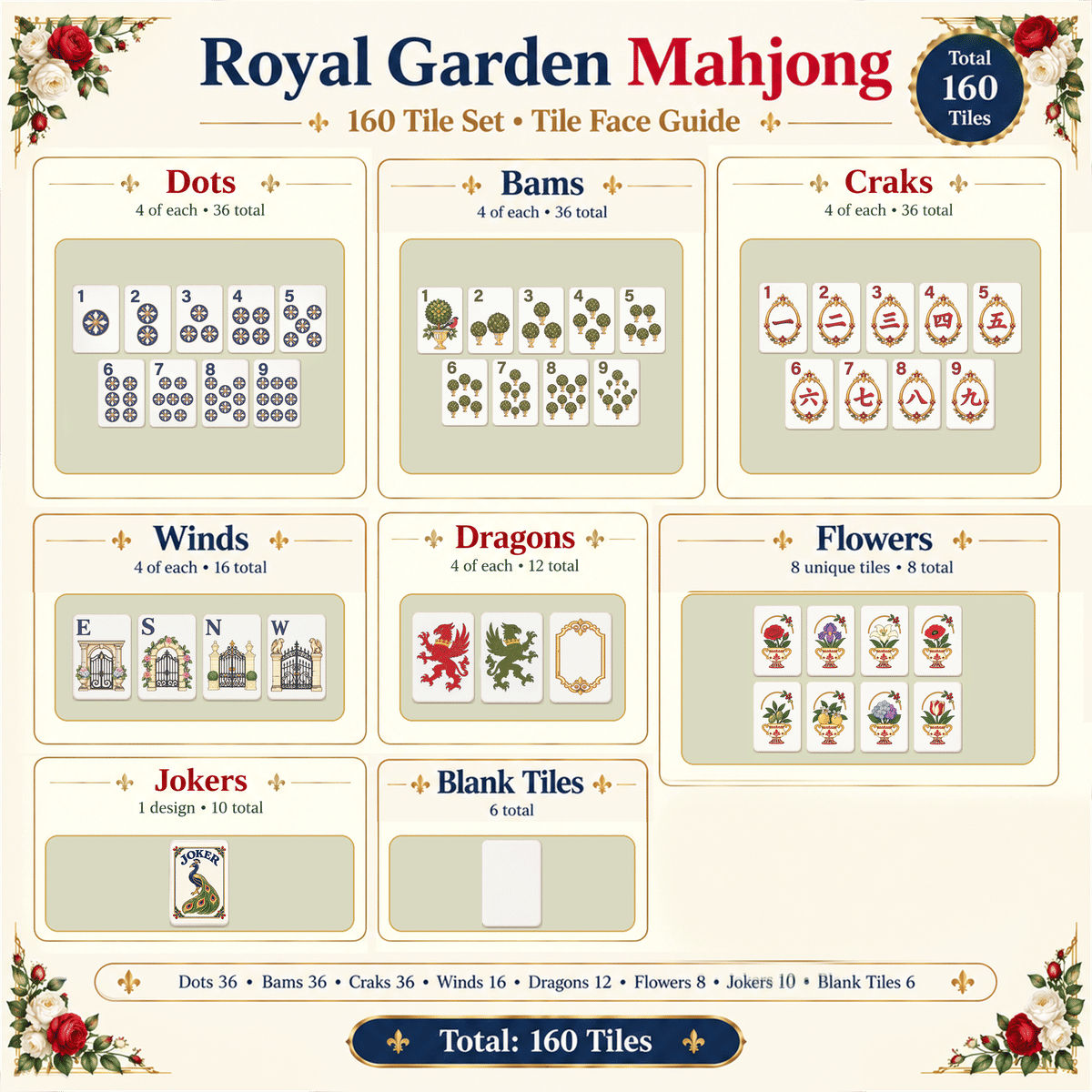
In American mahjong, the South Wind tile displays the Chinese character for "south" (南, pronounced "nán"). On most acrylic sets, this character appears centered on a white or light background tile, often in black or dark print. The South Wind belongs to the Wind family—four tiles total (North, East, West, South), each with its own character. During play, South Wind sits in the same role as other winds: it can form pungs (three identical tiles), kongs (four identical tiles), or pairs. Unlike Bams, Craks, or Dots, winds have no number value and no suit affiliation, making them uniquely valuable for completing hands that call for specific wind combinations. All four wind tiles appear four times in a standard 152-tile American mahjong set, giving you sixteen wind tiles total. Beginners often confuse winds with flowers or dragons at first glance—the character itself is the only marking, so learning the four wind symbols upfront saves confusion at the table. 🀄 Shop best-selling mahjong sets →
How do I identify South Wind among all the winds?
The South Wind character (南) looks distinctly different from North (北), East (東), and West (西). Each wind has its own unique stroke pattern. Spend two minutes studying all four wind tiles together before your first game—you'll recognize South instantly. Most players memorize the character shape rather than trying to translate or sound it out mid-play.

Why do winds matter in American mahjong strategy?
Winds often complete hands faster than suit tiles because they carry no numerical sequence. A hand might call for "Pung South, Pung East, Kong Dots"—matching those exact tiles wins the hand outright. Because only four of each wind exist, they're rarer than most numbered tiles, making wind-heavy hands more challenging to build but also more rewarding when you complete them. Learning which hand patterns reward wind tiles helps you decide whether to discard or hold them during play.
What's the difference between South Wind and other tile families?
American mahjong has three main tile families: Bams (1–9 bamboo stalks), Craks (1–9 circles), Dots (1–9 dots), plus three special families: Winds (North, East, West, South), Dragons (Red, Green, White), and Flowers (generic or numbered 1–8). Unlike suits, winds carry no number—there's no "3 South" or "7 South," only "South." This makes winds simpler to count but harder to complete in sequence-based patterns. Winds pair best with other winds, pungs of dragons, or specific suit combinations that the season's National Mah Jongg League card lists.
Can beginners use winds to simplify their first hands?
Absolutely. Many hands on the card use at least one wind pung or kong, making winds beginner-friendly. Start by picking a hand that calls for one wind pung (like "Pung South, Pung North, Kong White, sequence Dots") to build comfort. You'll collect wind tiles naturally during the game—they're not rarer than you'd think, just less familiar. Keeping one eye on which winds you hold helps you plan which hands remain possible.
How does acrylic tile thickness affect recognizing South Wind?
Our best-selling acrylic sets use consistent 20mm tiles with printed characters, making the South Wind character equally legible from any angle and distance. Thinner tiles or poor printing can blur the character, forcing you to pick up the tile to read it—a slower, frustrating mistake. When shopping, inspect sample tiles to ensure the wind characters are crisp and large enough to read at arm's length while stacked in your rack.

What tiles belong in a complete 152-tile set?
Tile Family | Count | Per Tile | Total | Role |
Bams (1–9) | 9 | 4 copies | 36 | Suit; sequences + pungs |
Craks (1–9) | 9 | 4 copies | 36 | Suit; sequences + pungs |
Dots (1–9) | 9 | 4 copies | 36 | Suit; sequences + pungs |
Winds (N/E/W/S) | 4 | 4 copies | 16 | Pungs, kongs, pairs only |
Dragons (R/G/W) | 3 | 4 copies | 12 | Pungs, kongs, pairs only |
Flowers (1–8) | 8 | 1 copy | 8 | Bonuses; drawn separate |
Jokers | — | — | 8 | Wild tile substitute |
Total | — | — | 152 | Playing tiles + jokers |
South Wind appears four times in the Winds row—once per player, roughly, across a full table draw. This 16-tile wind total (four winds × four copies each) means winds are neither rare nor abundant; skilled players track which winds remain in the wall.
🎁 See our most-loved mahjong sets & accessories →
Why do some players use engraved or custom sets to learn wind tiles faster?
Custom engraved mahjong sets with large, bold characters or even subtle color coding for wind tiles help players—especially those new to the game—recognize tiles faster under low light or stress. Some players favor sets with minimal design, while others appreciate sets where wind tiles stand out visually. Choosing a set that matches your learning style (large print vs. artistic design) accelerates recognition and confidence. Many seasoned players find that investing in a quality set they enjoy holding actually improves their game enjoyment and retention.
How does the seasonal mahjong card affect which winds you'll use this year?
The National Mah Jongg League card, issued every spring, lists all legal hands for that season. Some seasons favor wind-heavy patterns (multiple hands with Wind pungs); others emphasize suits. You cannot play a hand that isn't printed on the current year's card. Before the season starts, skim the card to spot wind patterns—this preps your eye to recognize South (and other winds) in context. Many players keep a laminated card at the table, marked with highlighter to flag their preferred hands.
What's the best way to organize your hand when South Wind appears?
Arrange tiles in your rack by family: Bams left, Craks center, Dots right, then Winds, Dragons, and Flowers far right. South Wind sits with the other three winds, making it easy to check for matching wind patterns without moving the entire rack. This organization applies regardless of whether you use a standard rack or a premium rack with pushers—the principle stays the same. A clean rack layout lets you spot South Wind at a glance and speeds your decision to keep, hold, or discard it.
What to check before you buy a mahjong set
Character legibility: Can you read the wind character (南) clearly from six inches away, in indoor light?
Tile thickness: Standard tiles are around 20mm; thinner tiles may show printing blur or cracks under regular shuffling.
Complete inventory: Confirm the set includes all 152 playing tiles (three suits × 36, four winds × 4, three dragons × 4, eight flowers, eight jokers) plus spares.
Condition on arrival: Inspect tiles for cracks, faded print, or misaligned characters immediately upon delivery.
Consistency: All South Wind tiles in the set should look identical; variations hint at mixed batches or print defects.
✨ Find your Mahstead set — free US shipping →
We've hosted countless weekly games, and one common beginner mistake is confusing South Wind with the Green Dragon or a numbered Dot tile—it happens to everyone once. The fix is simple: spend five minutes before your first game laying out all four winds in a row and saying each character aloud. Muscle memory kicks in fast. If you're building your collection, pair your new set with a mahjong mat and a travel bag so you can carry your game anywhere and play in comfort. Most games happen at home around a table, but having a portable setup means you're always ready to join a game night—whether at a friend's house, a community center, or a local game club.

FAQ
Is South Wind the same in Chinese and American mahjong?
The South Wind character (南) is identical in both games. However, American mahjong uses winds only in pungs, kongs, and pairs—not in sequences. Chinese variants may integrate winds differently into hand patterns or scoring.
Can I use a South Wind tile as a joker?
No. In American mahjong, jokers are separate tiles (often marked with a smiley face or star) and are the only tiles that substitute for others. Wind tiles always remain winds and cannot substitute or be counted as wildcards.
How many South Wind tiles do I actually draw in one game?
You'll typically draw one or two South Wind tiles per game, though this varies by how many are discarded before reaching your hand. With four South Winds in the 152-tile set, you're statistically likely to see at least one during a full four-player round.
Do beginners need to memorize all wind characters before playing?
Yes, memorizing all four winds (North, East, West, South) before your first game prevents mid-play confusion and keeps the game flowing. Spend five minutes studying them; the characters become automatic within one or two games.
What if my set's South Wind character looks faded or smudged?
Faded or smudged characters signal poor printing or storage damage. Contact the seller immediately—quality sets should have crisp, legible tiles across all 152 pieces. A good set remains readable after years of shuffling and humid storage.


View More
View More
View More
