
Two Player Mahjong Scoring Chart Explained
Last updated: Nov 23, 2026
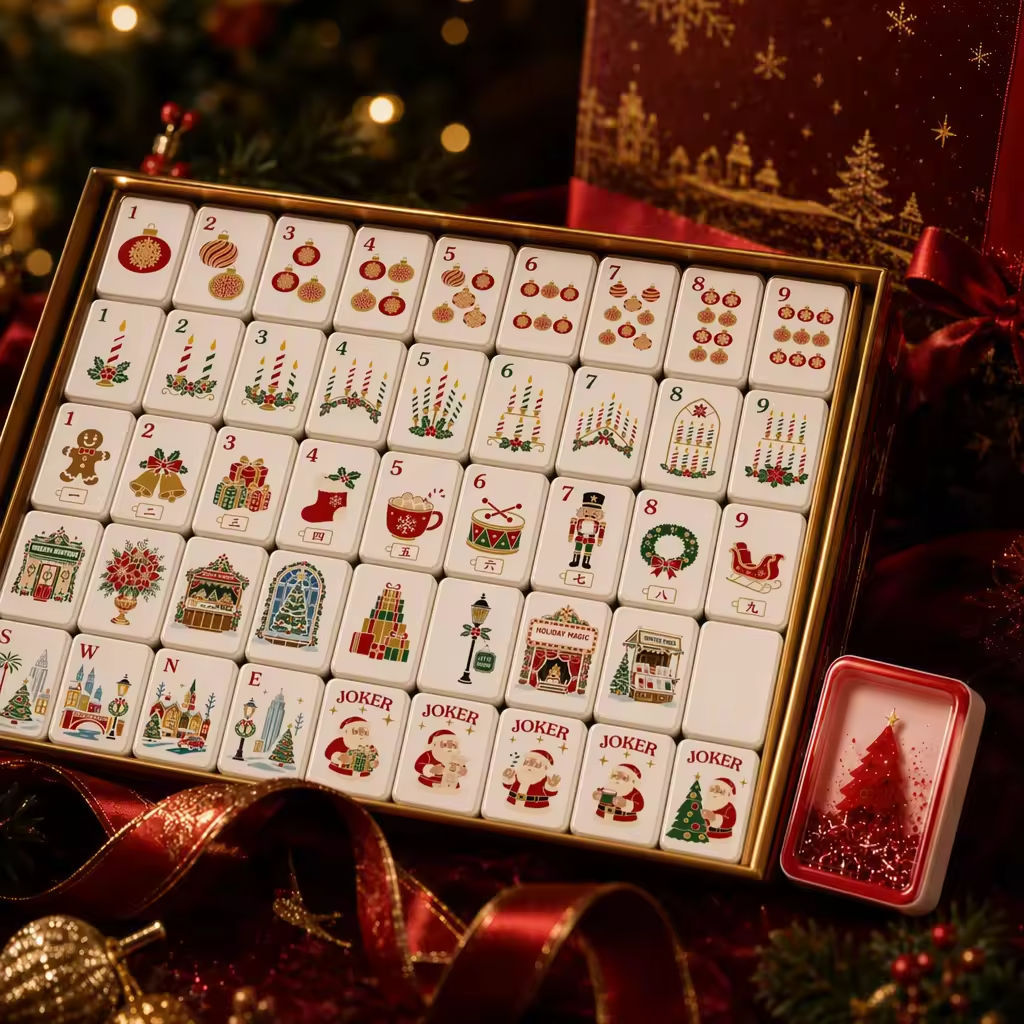
Two-player American mahjong follows the standard National Mah Jongg League hand card, but scoring changes because there's no discard exchange between pairs of players. Each hand is worth points based on the tile combination shown on the current year's card—typically ranging from 20 to 160 points. When you win, both opponents pay you the full hand value (not split as in four-player); losers pay the winner, and if you have bonus points (doubles), the payment multiplies. The 152-tile deck, wind rotations, and hand requirements remain identical to four-player games. Unlike casual variants, American mahjong strictly forbids sequences (chows) in play—only exposed pungs, kongs, and higher combinations count. Scoring charts from the official card list hand values by pattern type; most players print or laminate the current card for quick reference during play. We recommend having our best-selling acrylic sets on hand along with a scorepad to track cumulative points across multiple rounds.
How does two-player payment differ from four-player?
In four-player mahjong, when you win, one player discards and pays you; the other two pay half value each. Two-player mahjong has no position advantage: both players pay the full hand value when you win. If your hand is worth 40 points and doubles (80 total), your opponent pays 80, not 40. This simplifies calculation but increases stakes per hand—a significant shift for players accustomed to four-player dynamics. Always clarify payment rules before starting.

What hand values appear on the official card?
The National Mah Jongg League card lists every legal hand for the current year and assigns a point value to each pattern. Values typically range from 20 points (simple combinations like 1 Bam–9 Bam mixed pung and sequences) to 160 points (rare all-honor or all-joker patterns). Hands are grouped by type: Like Numbers (same number across suits), Pairs, Consecutive Sets, and Bonus sections. Each pattern shows its base point cost; if you achieve a "double" bonus (two matching sets within the hand), you multiply the value by two. Most players photocopy or laminate the official card to reference during play—it's essential for both variants. Understanding hand sections and bonus multipliers is crucial before your first two-player game.
How do doubles and bonus multipliers work?
A "double" in American mahjong occurs when your winning hand contains two identical sets of three or more tiles. For example, three 1 Dots and three 1 Craks in the same hand triggers a double; the base hand value is multiplied by two. A "triple" (three identical sets) multiplies by three, and a "quint" or higher pattern multiplies accordingly. These bonuses are always listed on the card next to each hand pattern. If your hand shows 60 points and you hold a double, you score 120 points—your two-player opponent pays the full 120, not split. Jokers do not count toward doubles (they can substitute for missing tiles in melds but never appear as the doubled unit). Track bonuses carefully; many scoring errors stem from missed or miscalculated multipliers.
What mistakes do new two-player players make with scoring?
New players often assume two-player scoring is identical to four-player, leading to underpayment disputes. Common errors include: (1) splitting the hand value between two opponents instead of collecting full payment from one, (2) forgetting that jokers cannot appear in pairs or single tiles, (3) misreading the card and claiming a hand that isn't listed for that year, (4) failing to track cumulative scores across rounds, and (5) confusing bonus multipliers with pung/kong exposure rules. Before each hand, verify the card section together and confirm the hand value aloud. Many disagreements arise from silent assumption; speaking up prevents frustration. Keep a scorepad visible so both players see the math in real time.
Which scoring chart should we use—American, Chinese, or Hong Kong rules?
American mahjong uses the official National Mah Jongg League card and scoring system, which differs fundamentally from Chinese, Hong Kong, and Riichi variants. Chinese and Hong Kong mahjong calculate points based on tile combinations, pattern complexity, and wind/dragon bonuses—no single "card" exists. Riichi mahjong (Japanese) uses fu (base points) and han (hand value) multiplied by wind position. Two-player American mahjong sticks to the annual League card; two-player Chinese or Hong Kong games adapt traditional rules but vary by region. If playing with players trained in different systems, agree in writing before the first hand. American mahjong's card-based system is most accessible for beginners because all hands, values, and bonuses are explicit and unchanging year-to-year (only the card refreshes each spring). Mixing systems mid-game creates chaos.
Variant | Hand Reference | Point Basis | Doubles/Bonuses | Two-Player Fit |
American | Official annual card | Card-listed values (20–160) | Explicit on card | Excellent; clear, deterministic |
Chinese | Tile pattern recognition | Fan (complexity) + fu (base) | Region-specific | Fair; requires experience |
Hong Kong | Similar to Chinese | Tile pattern + wind/dragon bonuses | Variable | Fair; less standardized |
Riichi | Tile pattern + winning condition | Fu × han × multiplier | Position-based | Poor; designed for four players |
🀄 Shop best-selling mahjong sets →

Step-by-step scoring calculation for a two-player hand
Step 1: Confirm the hand is on the card. Read the current year's National Mah Jongg League card and locate your tile combination in the appropriate section (Like Numbers, Pairs, Consecutive Sets, etc.).
Step 2: Note the base point value. The card lists a number next to each valid pattern—this is your starting value before bonuses.
Step 3: Check for doubles or higher multipliers. Does your hand contain two identical melds (same tiles, same quantity)? If yes, multiply the base value by two. Three identical melds = triple, and so on.
Step 4: Add any wind or dragon bonus (if the card version includes them—modern American cards often do not, but verify). Some hands earn bonus points for East wind or Red Dragon; these are additive or multiplicative based on the card's notation.
Step 5: Calculate opponent payment. Your opponent pays you the final multiplied total. Record this in your scorepad.
Example: You hold three 3 Bams, three 3 Craks, three 3 Dots, and a pair of White Dragons. The card shows this pattern as "Like Numbers" worth 40 points—and because you have three identical sets of 3s, it's a triple, multiplying the value by three: 40 × 3 = 120 points. Your opponent pays you 120 points in full (not split).
🎁 See our most-loved mahjong sets & accessories →
What to check before you buy a scoring chart or scorepad
– Confirm the chart matches the current year's official card (the National Mah Jongg League releases a new card every spring; old cards are invalid). – Verify the chart lists hand values, not just patterns—a visual reference without numbers is incomplete. – Ensure the chart distinguishes between base values and multiplied values so you don't misread a doubled hand. – Check if your scorepad has enough rows for multi-round sessions (most games play five to ten hands per sitting). – Print or laminate the official card itself rather than relying on a third-party summary; the card is the final authority.
For two-player games, we recommend pairing the best-selling acrylic sets with a laminated mahjong mat to keep tiles organized and a rack with pushers so each player can manage their hand clearly. Clear tile visibility prevents scoring disputes.
How do we resolve a scoring disagreement?
If you and your opponent disagree on a hand's point value, stop play and consult the official card together. Read the pattern section aloud to confirm the hand is listed. Verify the base value is correct. Check whether a double or bonus applies—this is where most disputes arise. If the hand isn't on the card, it's invalid; the player must draw new tiles and play continues. If the card is ambiguous or you own a chart from a prior year, download the current National Mah Jongg League card (published each April) and refer to that as the sole authority. Many players photograph or bookmark the official card on their phone for quick reference. Never guess—verify with the source document every time.
What additional equipment helps two-player scoring run smoothly?
Two-player games benefit from clear tile organization and visible scoring. A mahjong mat provides a neutral play surface and organizes discard piles; racks with pushers let each player hold and manage their 13 tiles in hand without crowding. A dedicated scorepad—or laminated sheet with hand-written totals—tracks cumulative points across multiple rounds so neither player loses mental track mid-game. Dice determine who goes first each hand. We suggest printing the official card in large type and keeping it centered on the mat so both players can reference it instantly. Our best-selling sets include tiles in clear, legible acrylic that photograph well under indoor light, reducing misreads that trigger scoring arguments.
✨ Find your Mahstead set — free US shipping →

FAQ
Can I use a four-player scoring chart for two-player mahjong?
No. Four-player scoring splits payments among three opponents; two-player requires the full hand value from one opponent. Use the official National Mah Jongg League card directly, which lists values for all legal hands. The card itself works for both; only the payment structure changes.
Do we rotate winds in two-player mahjong like we do in four-player?
Wind rotation in two-player mahjong varies by house rule. Some players rotate East and West between rounds to ensure balance; others keep the same player as East for the entire session. Agree on wind rotation (or skip it) before the first hand. The hand values on the card don't change regardless of wind position in American mahjong.
What if one player reaches a higher cumulative score—do they win immediately or play a full round?
You must agree on a target score before play begins. Common targets are 500, 1,000, or 2,000 points cumulative. Play continues until one player reaches the target, then that player wins. If no target is set, play a predetermined number of hands (e.g., ten) and tally at the end. Document the rules on your scorepad.
Can jokers be used in two-player mahjong the same way as four-player?
Yes. Jokers substitute for any missing tile in an exposed pung, kong, or higher set. Jokers can never form pairs, appear as single tiles, or appear in an unexposed hand. Two-player and four-player joker rules are identical; only the payment and discard exchange differ.
Is two-player American mahjong easier to learn than four-player?
Two-player gameplay is simpler because fewer discard exchanges occur and turn order is linear. However, scoring is equally complex—the National Mah Jongg League card, hand patterns, and multipliers apply in both. If you're new to American mahjong, start with a shorter session (three to five hands) and use a printed card on the table before attempting longer games. ---


View More
View More
View More
