
Toitoi in Riichi Mahjong Explained: Rules and Winning Hands
Last updated: Nov 23, 2026
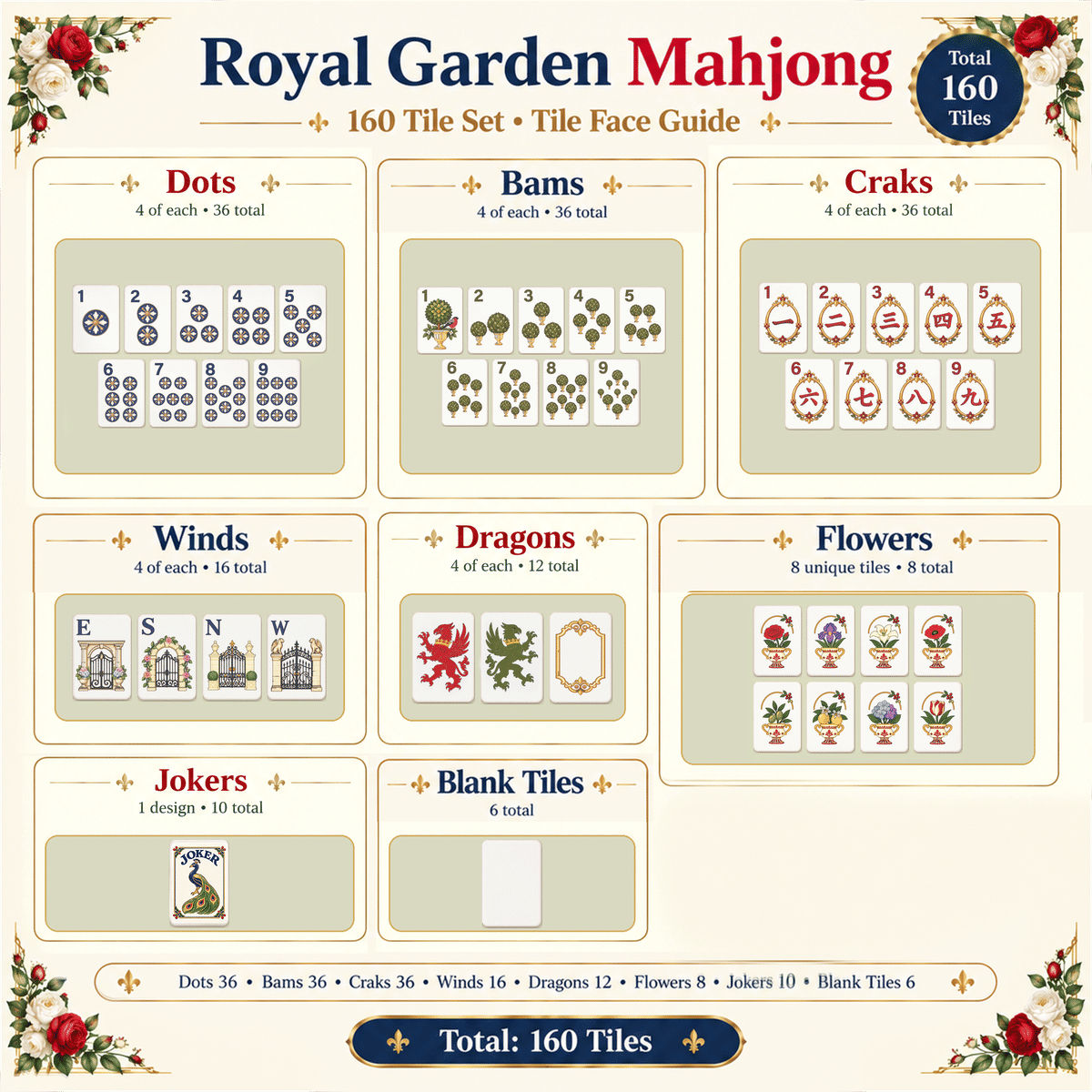
Toitoi (all pungs) is a riichi mahjong yaku—a winning hand pattern—in which all four melds are identical-rank groups (pungs or kongs of the same rank, like three 5 Dots, three 5 Bams, three 5 Craks, plus one pair). The pair must be a different rank or dragon. In riichi, you win by declaring "ron" (stealing another's discard) or "tsumo" (drawing your winning tile). Toitoi scores 2 fu base and counts as one yaku in the final point calculation. Unlike American mahjong, which uses a fixed yearly card, riichi players memorize ~40 yakus. Toitoi appears in most modern riichi rulesets (JPML, WRC). It's rare because rank concentration is hard to build, and many riichi players practice via apps or in-person clubs before playing for points.
Toitoi is a hand where every meld is a pung (exactly three identical tiles) or kong (exactly four identical tiles). Your pair must be a different rank—for example, three 2 Bams, three 2 Craks, three 2 Dots, three 2 Winds, plus a pair of Dragons. The pair cannot be another 2-rank group. This creates a "all-the-same-number" visual, which is why riichi players call it toitoi (literally "all"). It's instantly recognizable and harder to build than, say, an open hand where you can mix ranks freely.
What is a yaku in riichi mahjong?
A yaku is a scoring pattern—a hand structure that proves you've earned points. Riichi has roughly 40 yakus; American mahjong has zero, because American hands come only from the League card each year. Without yakus, you cannot win in riichi. Each hand must contain at least one yaku. Toitoi is one of the most prized yakus because it's worth at least 2 fu and often combines with others (like tanyao, all simples) to raise your payout. Learning yakus is how riichi players move from casual to competitive.

How does toitoi score in riichi mahjong?
Toitoi is worth 2 fu and 1 yaku. The final score (mangan, haneman, baiman, sanbaiman, or yakuman) depends on total yaku count and fu added at winning. If you win with toitoi alone and 30 fu, that's typically a "haneman" or half-limit hand (18,000 points base to the discarder in a four-player game with typical dealer bonuses). If toitoi combines with another yaku—say, honor (winds or dragons make up the hand)—the fu and yaku multiply, raising your payout. Dealer status and who discarded also matter. This multi-layer scoring makes riichi deeper than American mahjong's single-card or single-hand payout.
Where do toitoi and other yakus come from?
Riichi yakus developed in Japan starting in the 1920s. Different regions and eras created different yaku lists; modern riichi (JPML standard, World Riichi Championship rules) codifies ~40 yakus. Toitoi appears in almost all modern lists because it's a core hand type. In contrast, American mahjong (born in China, adapted in 1920s USA) standardized around the National Mah Jongg League card in 1937 and never adopted yakus—each year the League prints a new card with specific hand sequences and patterns. If your hand doesn't match that card exactly, you cannot win. This is why riichi and American mahjong feel like different games: riichi rewards memorized patterns; American rewards pattern-matching to a printed guide.
Aspect | Riichi Mahjong | American Mahjong |
Hand types | ~40 yakus (toitoi, tanyao, honor, etc.) | Annual League card only |
Pair rule | Any honor or terminal (1, 9) in pair | Specific pair per hand on card |
Melds | Pungs, kongs, chows (sequences); all exposed | Pungs, kongs, quints, sextets only; no chows |
Jokers | None; pure tile logic | Eight jokers per 152 tiles; used in melds |
Winning | Ron (steal), tsumo (draw) | Mahjong only (draw from wall or discard) |
Scoring | Fu + yaku count = points | Single payout per hand |
Learning curve | 6–12 weeks to play; years to master yakus | 4–8 weeks to play; 2–3 seasons to fluency |
Is toitoi common or rare in real games?
Toitoi is rare. A typical four-player riichi game might see one toitoi every 4–6 hours of play. Why? You must collect three copies of one rank AND one pair of a different rank before anyone else. Since four players are also discarding, blocking your rank, it's mathematically harder than, say, tanyao (all simples, any ranks) or yakuhai (one or more wind/dragon pairs). Many riichi players go months between playing toitoi hands. This rarity makes it satisfying to win and means newer players shouldn't expect toitoi as their bread-and-butter. Hands like tanyao or "pinfu" (all simples + no honor = clean pattern) happen more often and teach discipline faster.
How does toitoi differ from American mahjong hand patterns?
American mahjong has no yakus. Instead, hands are fixed by the League card each year. The card shows patterns like "2468 like/like/like" (meaning all pungs of 2s, 4s, 6s, 8s) or "Quint-Pung-Pung-Pair" in a specific suit. You study the card, spot the pattern in your tiles, and declare the exact hand name. Jokers are wild and appear in most hands. If your tiles don't match a card pattern exactly, you cannot win—period. In riichi, toitoi is one option among 40+; you're not forced to play it. The card provides certainty; yakus reward memory and judgment. Many players prefer American mahjong's structure; others love riichi's flexibility and the thrill of seeing yakus unfold in their hand.

What tile setup do riichi players use to practice toitoi?
Riichi players practice on apps (Mahjong Solitaire, Riichi City, online clubs) or with tile sets identical to tournament standards: 34 unique tiles × 4 copies each = 136 tiles, with no jokers or flowers. This is different from American mahjong's standard 152-tile best-selling mahjong sets. If you're learning riichi seriously, you'll need a pure riichi-spec tile set (no jokers, no extra blanks) for consistent practice. Many clubs provide them; if you buy your own, look for acrylic or plastic sets labeled "riichi" or "Japanese" with clear Chuugoku-style numerals. American mahjong sets have jokers and larger tiles, making riichi play confusing. Online is often faster for beginners because the app enforces rules and counts fu automatically.
🀄 Shop best-selling mahjong sets →
What mistakes do new riichi players make with toitoi?
Mistake 1: forgetting the pair must be a different rank. New players sometimes think "all fours" means three 4-Dots + one 4-Winds = toitoi. It doesn't. The pair must be a different rank—three 4-Dots + three 4-Winds + three 4-Craks + pair of Dragons works; three 4-Dots + three 4-Winds + three 4-Craks + one 4-Bam does not.
Mistake 2: confusing toitoi with chinroutou (all terminals and honors). Chinroutou uses only 1s, 9s, winds, and dragons. Toitoi uses any ranks. Both are rare, but the rules are different.
Mistake 3: assuming toitoi + tanyao cancel out. Toitoi (all pungs of the same rank) and tanyao (no terminals) can coexist—e.g., three 3-Dots, three 3-Bams, three 3-Craks, pair of 3-Winds is toitoi + tanyao. Yakus stack; they don't block each other.
What to check before you buy a riichi tile set: Make sure the set specifies "136 tiles, no jokers" or "riichi-standard." Some sellers offer 144-tile sets (adds flowers) which won't affect toitoi play but aren't standard for competitions. Look for clear numeric or pip marking (especially if you're colorblind). Store the set in a padded case to prevent tile chipping during transport or at clubs.
Connecting riichi play to your setup at home
If you're hosting weekly riichi games, you'll want a dedicated mat with clear zone markers (dealer position, discard river) and tile racks with pushers to speed play. Mahjong mats and racks with pushers from Mahstead are designed for American mahjong but work equally well for riichi once you remove the jokers before dealing. A good mat protects tiles from wear and speeds recognition of the river. Racks let players organize tiles neatly and draw/discard faster. If you're learning toitoi on a casual home table (no club structure), a mat and racks make the game feel more legitimate and let you focus on yaku patterns instead of tile chaos.
🎁 See our most-loved mahjong sets & accessories →
Why learn toitoi if it's rare?
Toitoi teaches you the discipline of tile management. Because rank concentration is hard, you learn to recognize when a rank is "dead" (the other three copies are visible in the river or others' discards) and pivot. You also learn that yakus don't always need to be flashy; a simple toitoi + tanyao win is often better than a risky triple-yaku hand that never forms. Many riichi coaches recommend studying toitoi as a foundational yaku alongside tanyao and pinfu. Mastering toitoi—knowing when to chase it and when to fold—separates casual players from intermediate ones. If you play riichi weekly, expect to see toitoi maybe once a month; when you win it, you'll understand why the game rewards patience and observation.
✨ Find your Mahstead set — free US shipping →

FAQ
Can toitoi be won with a chow (sequence)?
No. Toitoi requires all four melds to be pungs (three identical) or kongs (four identical). Chows (sequences like 1-2-3) cannot be part of a toitoi. A hand with even one chow is not toitoi, though it may be another yaku like tanyao or pinfu.
What's the difference between toitoi and toitoi hon'ichi (all terminal or honor pungs)?
Toitoi allows any rank. Toitoi hon'ichi requires all four melds to be 1s, 9s, winds, or dragons—no simple ranks (2–8). Toitoi hon'ichi is rarer and scores higher (yakuman or half-yakuman depending on ruleset).
If I draw the winning tile myself (tsumo), does toitoi score differently?
No. Toitoi is worth the same fu and yaku whether you win by tsumo or ron. However, the payout differs: tsumo wins split points from all three opponents; ron wins the full payout from the discarder. Toitoi yakus don't change, but your total payout does.
Can I use jokers in a riichi toitoi hand?
No. Riichi tiles have no jokers. A riichi tile set is pure—136 tiles only. If you're playing on an app or in a club, jokers are removed before the hand starts. American mahjong uses jokers; riichi doesn't.
How do I know if I've seen all three copies of a rank discarded?
Watch the discard river carefully. In riichi, players arrange discards in a grid so you can count. If you see 1-2-3 of a rank in the river or in other players' open melds (called "on the board"), the fourth copy is either in the dead wall or someone's hand. Stop chasing that rank for toitoi. Experienced players keep a running tally mentally; beginners write it down during practice.
Is toitoi worth learning if I play American mahjong mostly?
Yes, if you want to explore riichi later. Toitoi teaches you rank discipline and visual pattern recognition that transfers to spotting American hands on the League card. Both games reward observation; riichi yakus just demand more memorization upfront. Many American players enjoy both, and switching between them keeps the game fresh.


View More
View More
View More
