
Taiwanese Mahjong Scoring: How to Count Points Step-by-Step
Last updated: Nov 23, 2026
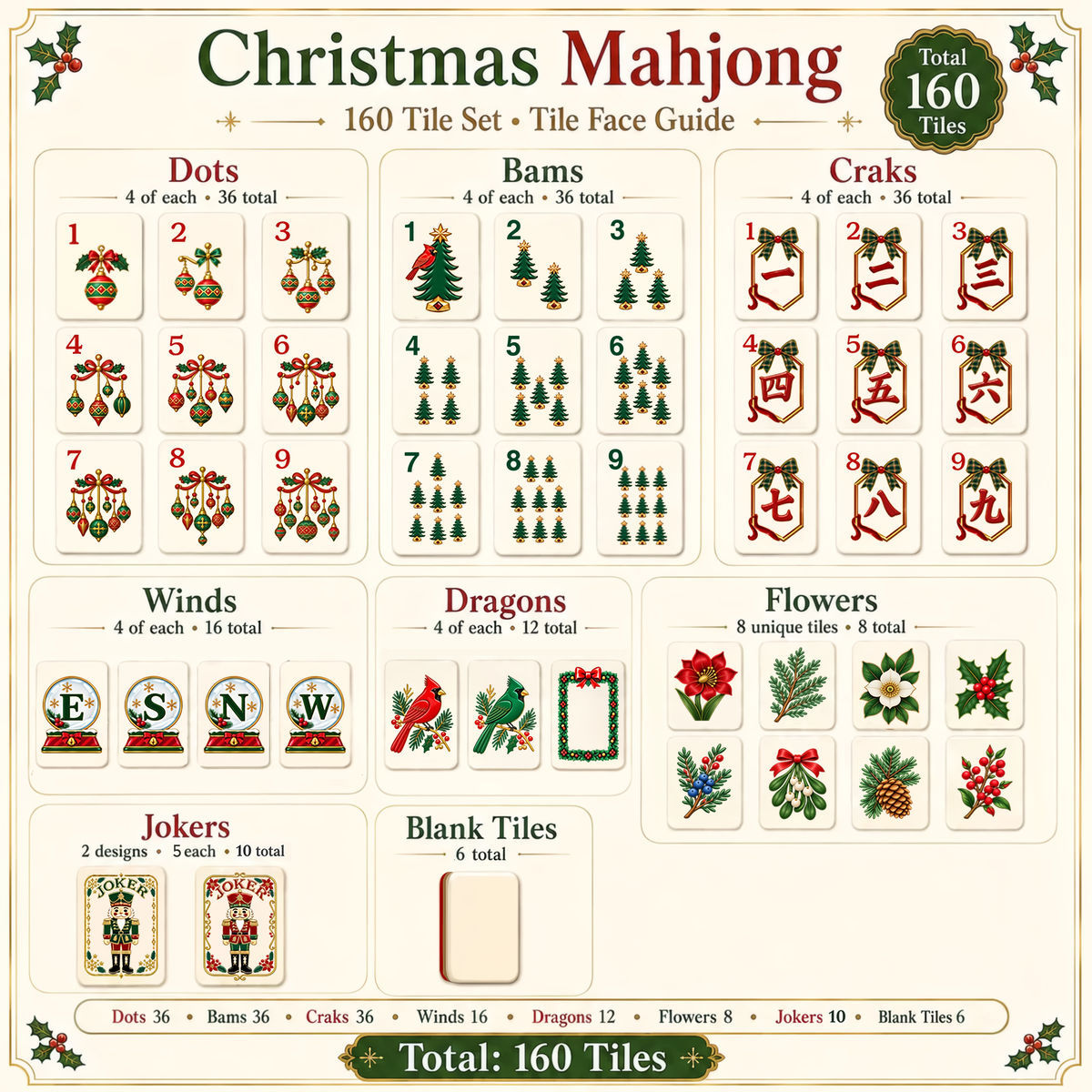
Taiwanese mahjong scoring awards points based on fan (手 or levels of hand complexity), not a flat value system. A hand earns fan by meeting specific patterns: self-drawn winning tiles, all pungs, honor tiles, terminal tiles, or mixed suits—each combination adds fan. Once you determine total fan, you multiply a base point value (usually 20, 30, or 40 depending on winning method) by 2 for each fan level, then multiply by player count. For example, a self-drawn hand worth 3 fan on a 30-point base = 30 × 2³ = 240 points per player. The exact formula varies by region (Hong Kong, Taiwan, Fujian) and house rules, so always confirm your table's variant before play. Unlike American mahjong scoring, which follows a printed card, Taiwanese relies on pattern recognition and mental calculation—a skill that rewards practice and attention to tile combinations.
Taiwanese mahjong scoring rewards complexity: the more patterns your hand contains, the more fan you earn, and fan translates directly to exponential point growth. Unlike American mahjong's fixed point values tied to a seasonal card, Taiwanese mahjong is rule-light and adaptable—which means your table decides the starting point value and fan limits. We've sat through hundreds of hands at Mahstead game nights, and we've learned that scoring confusion kills momentum. Let's break down exactly how fan works, how to calculate payouts, and what house rules to set before the first tile hits the table.
What exactly is a "fan" in Taiwanese mahjong?
Fan is a tier of hand value, earned by completing specific tile patterns or winning conditions. Each pattern adds one fan; a hand can have 1 fan (the minimum to win) up to 8+ fan depending on region. A 1-fan hand might be a simple pung-based winning hand with no special patterns. A 3-fan hand might include an all-pung structure plus a self-drawn winning tile. Fan is cumulative—if your hand qualifies for three different patterns, you count 3 fan total. The Taiwanese system rewards pattern stacking, not tile scarcity as in American mahjong.

How do you calculate total points from fan?
First, determine your base point value—typically 20, 30, or 40 (agreed beforehand by your table). Then multiply by 2 for each fan level. A 2-fan hand on a 30-point base = 30 × 2 × 2 = 120 points. A 4-fan hand on the same base = 30 × 2⁴ = 480 points. Next, multiply by player count: in a 4-player game, the non-winning players each pay the winner. If the winner drew their own tile (self-drawn), payouts may differ—some regions pay double from the discarder, half from others. Always confirm whether self-drawn winners collect from all players equally, or if the discarder pays a larger share. This exponential scaling means a 5-fan hand can be worth thousands of points; high-fan hands dominate Taiwanese play.
🀄 Shop best-selling mahjong sets →
What are the most common fan patterns in Taiwanese mahjong?
Below is a reference table of standard patterns (rules vary by region—confirm with your group):
Pattern | Fan Count | Example |
Self-drawn win | 1 | You draw the winning tile yourself |
All pungs (no chow) | 1 | All three-tile groups; no sequences |
No terminals/honors | 1 | Only Bams, Craks, Dots 2–8 |
All terminals/honors | 2 | Only 1, 9, and honor tiles |
All one suit (cleanhand) | 1 | Entire hand is one suit only |
All honors (big three dragons) | 3+ | Only winds and dragons |
Four kongs | 4+ | Four four-tile groups in hand |
Seven pairs (regional variant) | 2–3 | Seven two-tile matching groups |
Each table interprets these differently. The Taiwanese Mahjong Association publishes standards, but casual play adapts rules by mutual agreement. Some tables add patterns for consecutive pungs or specific suit combinations. Write down your house rules before play begins—don't debate scoring mid-game.
How do discard vs. self-drawn wins affect payouts?
A discard win (ロン in Japanese terminology, or 抢和 in Mandarin) means you call "win" on another player's discard. That player pays you the full hand value multiplied by fan. The other two players typically pay nothing. A self-drawn win (ツモ or 自摸) means you drew your winning tile from the wall yourself. All three non-winning players contribute, but payment splits vary: some tables have all three pay equal shares, others have the player whose turn came before you pay slightly more, and a few have all three pay full value to you (rare, very expensive). Some regional rules add 1 fan to self-drawn hands automatically as a bonus. Confirm your table's rule: "On a self-drawn win, does each player pay the full value, or do we split three ways?" The answer changes payouts dramatically.
🎁 See our most-loved mahjong sets & accessories →

What's the difference between Taiwanese, Hong Kong, and Fujian scoring?
Taiwanese mahjong (traditional Taiwanese rules) uses a base point of 20 or 30 and fan usually capped at 5–7. Hong Kong mahjong (麻將) uses a different fan definition, often caps fan at 3, and has unique patterns like "all simples" and "all melded hand." Fujian mahjong (闽南麻将) uses yet another scoring table with different base values and pattern definitions. Here's the practical difference: if you learn Taiwanese scoring and sit at a Hong Kong table, your fan calculations will be wrong because the pattern definitions don't match. American mahjong uses none of these systems—it's tile-matching against a printed card, not pattern-based calculation. Before you join a new group, ask: "Which variant do you play, and do you have a scoring chart?" Regional differences aren't just academic—they double or halve payouts.
What common mistakes should you avoid when scoring?
Forgetting to confirm base points and fan cap before game start. We've seen arguments erupt over whether fan maxes at 5 or 8—set this upfront. Miscounting fan patterns. A hand with all pungs and self-drawn win is 2 fan, not 1—each pattern is separate. Applying regional rules inconsistently. If your first hand counts self-drawn as +1 fan, do it for every hand. Paying the wrong player direction on self-drawn wins. Clarify: does the discarder pay more, or do all three split equally? Forgetting joker/wild tile rules. Some variants allow jokers in winning hands, changing pattern eligibility—confirm whether your hand is still "all pungs" if one pung uses a joker. Mixing up discard vs. self-drawn payout math. A 3-fan self-drawn hand on a 30-point base is 30 × 2³ = 240 per player, not 240 total. The exponential math trips up even experienced players when they're tired—write it down.
How does fan cap work, and why do tables use it?
Most casual Taiwanese mahjong tables set a fan limit (often 5, 7, or 8 fan maximum) to prevent one hand from bankrupting the table. A hand worth 8 fan on a 30-point base is 30 × 2⁸ = 7,680 points per player—ruinous in casual play. By capping at 5 fan, the maximum payout becomes 30 × 2⁵ = 960 per player, manageable for a friendly game. Some tables use a payment cap instead: any hand worth more than X points pays out that X instead. For example, "All payouts cap at 500 points"—a 6-fan hand still pays 500, not 1,920. Decide your cap before play: "How many fan do we allow, or what's the max payout per hand?" Write it on a notecard and tape it to your mat. This single rule prevents debates and keeps friendships intact.
✨ Find your Mahstead set — free US shipping →
What to check before you buy a set for Taiwanese mahjong
If you're hosting or joining Taiwanese mahjong games, you'll want a high-quality set from our best-selling collection with clear, readable tiles—pattern recognition is central to this game. American mahjong sets work for Taiwanese play because the tiles are identical; the only difference is how you score, not which tiles you use. Look for:
Tile clarity: Bam, Crak, and Dot symbols must be instantly recognizable to count patterns quickly.
Tile weight and feel: Heavier tiles (made from acrylic or stone composite) feel more authentic and discourage accidental knocks.
A quality mat to keep tile arrangement visible and organized—essential when you're calculating fan patterns.
Racks with pushers if you're keeping score or need to manage a large hand during complex pattern counting.
Taiwanese mahjong games move fast once scoring is clear, so legible tiles save time and argument.

FAQ
Can I use an American mahjong set to play Taiwanese mahjong?
Yes. Both use identical tile sets (152 tiles plus jokers). The only difference is scoring: American uses a printed card with fixed hand values; Taiwanese uses fan-based calculation. Same tiles, different rulebook.
What happens if two players win on the same discard?
Taiwanese mahjong typically assigns the win to the player closest to the discarder (moving clockwise or counterclockwise per house rule). Some tables void the hand and redeal. Confirm this rule before play—it's rare but causes arguments.
Is there a maximum fan a hand can earn?
Most casual tables cap fan at 5–7 to prevent excessive payouts. Competitive play or tournaments may allow higher caps (8+). Always agree on the fan limit before the first hand.
How do I know if my hand qualifies for a pattern?
Write down your group's fan patterns or print a reference chart. Patterns like "all pungs," "all one suit," and "self-drawn win" are standard, but specific definitions vary. Laminate a scoring card and keep it on the table.
What's the difference between calling "win" on a discard versus drawing your own winning tile?
On a discard (ロン), only the discarder pays you the full hand value. On a self-drawn (ツモ), all three non-winning players contribute—typically an equal share, but some tables have different splits. Ask your table which rule applies.
Can I mix American and Taiwanese mahjong players at the same table?
Not comfortably—they use different scoring entirely, and confusion will slow the game. Play one variant per session. If players want to learn both, schedule separate games or agree to play by one ruleset and teach the other offline.


View More
View More
View More
