
Siamese Mahjong Rules: How to Play Thai Mahjong
Last updated: Nov 23, 2026
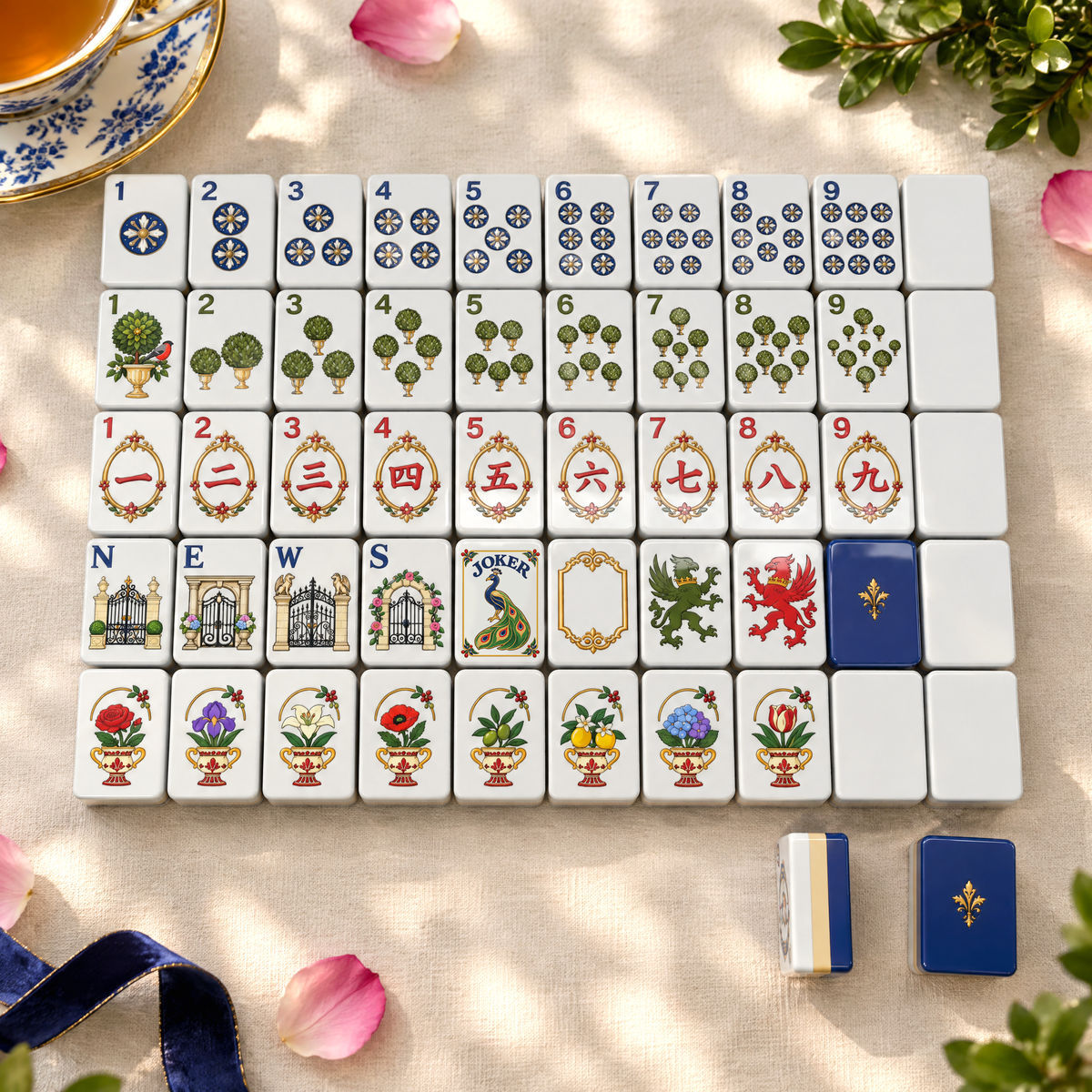
Siamese mahjong, also called Thai mahjong, uses 144 tiles and plays with sequences and triplets rather than American pungs and kongs only. The game uses one suit each in three colors (Dots, Bams, Craks), winds, dragons, and flowers, with identical tile distribution to Hong Kong variants. Players draw and discard in turn, building melds (chows and pungs), and win by completing a hand of four melds plus a pair, typically within 16 rounds. Hands can include sequences (chows: 1-2-3, 5-6-7) alongside triplets—a fundamental difference from American mahjong, which forbids exposed chows entirely. Scoring varies by hand type and difficulty; flowers and honors count as bonuses. Unlike American games that rely on a yearly card, Siamese mahjong follows traditional open-hand rules where any completed meld can be exposed and claimed by other players.
How does Siamese mahjong tile setup differ from American play?
Siamese sets contain 144 tiles total: Dots, Bams, and Craks numbered 1–9 (four copies each = 108), plus 16 winds (4 each: North, East, West, South), 12 dragons (4 each: Red, Green, White), and 8 flowers (4 Plum/1 Orchid, 4 Bamboo/2 Plum—variants exist). American mahjong adds 8 more jokers and uses 152 tiles with no valid chows, making the entire hand structure incompatible. To start, one dealer scatters tiles face-down; players build walls. The dealer begins play. Siamese rules allow any player to claim a discard to complete a meld (not just the next player), creating faster-paced claiming than some American formats. The core difference: Siamese embraces traditional open melds; American restricts melds to closed (pungs, kongs, quints, sextets) plus one exposable set per hand under specific NMJL card patterns.

What hand combinations count as valid melds in Siamese mahjong?
In Siamese mahjong, valid melds are chows (three consecutive numbers like 4-5-6 Dots) and pungs (three identical tiles like three Green dragons). Sequences must use the same suit; you cannot mix Dots with Bams. A complete winning hand has four melds plus a pair. Unlike American mahjong—where sequences are forbidden and melds must be drawn privately or stand as closed pungs—Siamese allows you to immediately show any completed chow and exposes it to the table. For example, if you hold 1 Bam, 2 Bam, 3 Bam and another player discards a tile you need for a different meld, you declare "meld" and expose the chow face-up. This open-play rule speeds claiming and changes hand-building strategy significantly. Common winning patterns include "all pungs," "all chows," or mixed combinations. Flowers and honors (winds, dragons) do not form chows—only triplets.
🀄 Shop best-selling mahjong sets →
How does scoring work in Siamese mahjong variants?
Siamese mahjong scoring depends on hand composition and regional custom. Most commonly, hands score based on: meld type (all chows, all pungs, mixed), presence of honors (winds, dragons, flowers), and whether the winning tile came from the wall (self-drawn) or a discard (claimed). A self-drawn win on an all-pung hand scores higher than a claimed win with mixed melds. Flowers add bonus points. Some regions use doubling for "limit hands" (rare, high-value combinations); others play flat scoring. The dealer typically scores double. Unlike American mahjong—which references a seasonal card and awards fixed hand values—Siamese play uses arithmetic calculation at the table. Before beginning, confirm whether your group plays "simple" (basic pung/chow scoring) or "complex" (bonuses, doubles, payment multipliers). Scoring sheets or a reference card help avoid disputes.
What are the key rule differences between Siamese and American mahjong?
Aspect | Siamese | American |
Tile count | 144 tiles | 152 tiles (includes 8 jokers) |
Sequences allowed | Yes—chows (1-2-3, etc.) exposed | No—sequences forbidden entirely |
Triplet melds | Pung or kong (3 or 4 identical) | Pung, kong, quint, sextet (no chows) |
Claiming rules | Any player can claim a discard | American play varies; consult NMJL card |
Hand reference | Traditional open rules | Annual National Mah Jongg League card |
Jokers | Rarely used (if at all) | 8 jokers standard; can replace any tile |
Pair rule | One pair required; no double pairs | One pair; special patterns per card |
Game duration | Typically 16 rounds | Varies; often 4 rounds per dealer |
🎁 See our most-loved mahjong sets & accessories →

What mistakes do players make when switching from American to Siamese rules?
First mistake: forgetting that chows are legal and valuable. American players instinctively hoard tiles hoping for American-style melds, wasting turns. Siamese play rewards rapid exposure of sequences. Second: overestimating jokers. Siamese games use few or no jokers, so expecting wildcards for every incomplete meld leads to frustration. Third: miscalling melds. In American mahjong, you carefully read the year's card and declare only valid patterns; Siamese requires on-the-fly meld validation and immediate exposure, leaving no time for reference cards. Fourth: misunderstanding the claiming window. In American mahjong, typically only the player who would go next (or in some variants, just the dealer) can claim a discard; Siamese allows any player to interrupt and claim simultaneously, creating complex dispute resolution (usually "first to speak wins"). Fifth: confusing pair rules. Some Siamese variants allow pairs of any tile; others forbid pairs of flowers. Always clarify local rules before play begins.
Where can you learn and practice Siamese mahjong?
Community centers, temples, and cultural organizations in areas with Thai, Laotian, or Vietnamese populations often host weekly games or can recommend teachers. Libraries sometimes list meetup boards or local mahjong groups. Online forums dedicated to Southeast Asian mahjong variants can direct you to video tutorials and regional rule guides, though in-person play is invaluable for learning nuanced claiming and scoring disputes. Consider attending beginner sessions if available; experienced players are usually willing to coach newcomers on hand-building and claiming protocols. Many regions have casual "home games" advertised through community networks—a low-stakes, forgiving environment for practicing. If you play American mahjong already, approach Siamese as a fresh game rather than a variant, since the underlying philosophy (open melds, sequences, rapid claiming) differs fundamentally. Expect a 2–4 week learning curve to play comfortably.
✨ Find your Mahstead set — free US shipping →
What to check before you buy a Siamese mahjong set
Before purchasing, confirm your local play format uses standard 144-tile distribution. Some regions add jokers or blank tiles; know your group's preference. Look for sets with clear Arabic numerals and suit symbols (Dots, Bams, Craks) so you can quickly identify tiles during rapid-paced play. Ensure the set includes all four copies of each numbered tile and all honor tiles (16 winds, 12 dragons, 8 flowers). Check tile size: slightly larger tiles (around 1.25 inches) reduce fumbling and speed play. Many best-selling mahjong sets include a convenient mat and racks with pushers, which are invaluable for managing your hand during fast claiming exchanges. If you plan to travel between play locations, a padded mahjong bag or case protects your investment. Acrylic tiles are more durable and easier to clean than bamboo, especially in humid climates where mold can damage natural materials.

FAQ
Can I use an American mahjong set to play Siamese rules?
No. American sets contain 152 tiles (including 8 jokers designed as wild cards), whereas Siamese uses 144. The extra tiles and joker substitution rules make American sets incompatible with traditional Siamese hand-building and claiming. You need a dedicated 144-tile set.
Is Siamese mahjong easier or harder than American mahjong?
Neither is objectively easier; they reward different skills. Siamese demands faster claiming decisions and sequence recognition because all players can interrupt. American requires memorizing the annual hand card and understanding complex meld restrictions. Most players find Siamese more intuitive at first but American more strategic over time.
Do Siamese mahjong players use jokers?
Rarely. Traditional Siamese play does not include jokers. Some regional variants have introduced them, but the classic game relies on fixed tiles and open-play claiming to create strategy. If your group uses jokers, clarify whether they replace any tile or only certain suits.
How long does a typical Siamese mahjong game last?
A full session usually runs 16 rounds (four rounds per player as dealer), taking 45 minutes to 2 hours depending on group pace and experience. Rounds average 3–8 minutes. Casual games may play shorter sessions or stop after a set time.
Can I learn Siamese mahjong online?
Video tutorials exist, but in-person play is essential. Claiming speed, live tile recognition, and dispute resolution are best learned at a table with experienced players. Use online resources to study hand patterns and basic rules, then join a community game to practice.


View More
View More
View More
