
Riichi Mahjong Ura Dora Rules: Hidden Bonuses Explained
Last updated: Nov 23, 2026
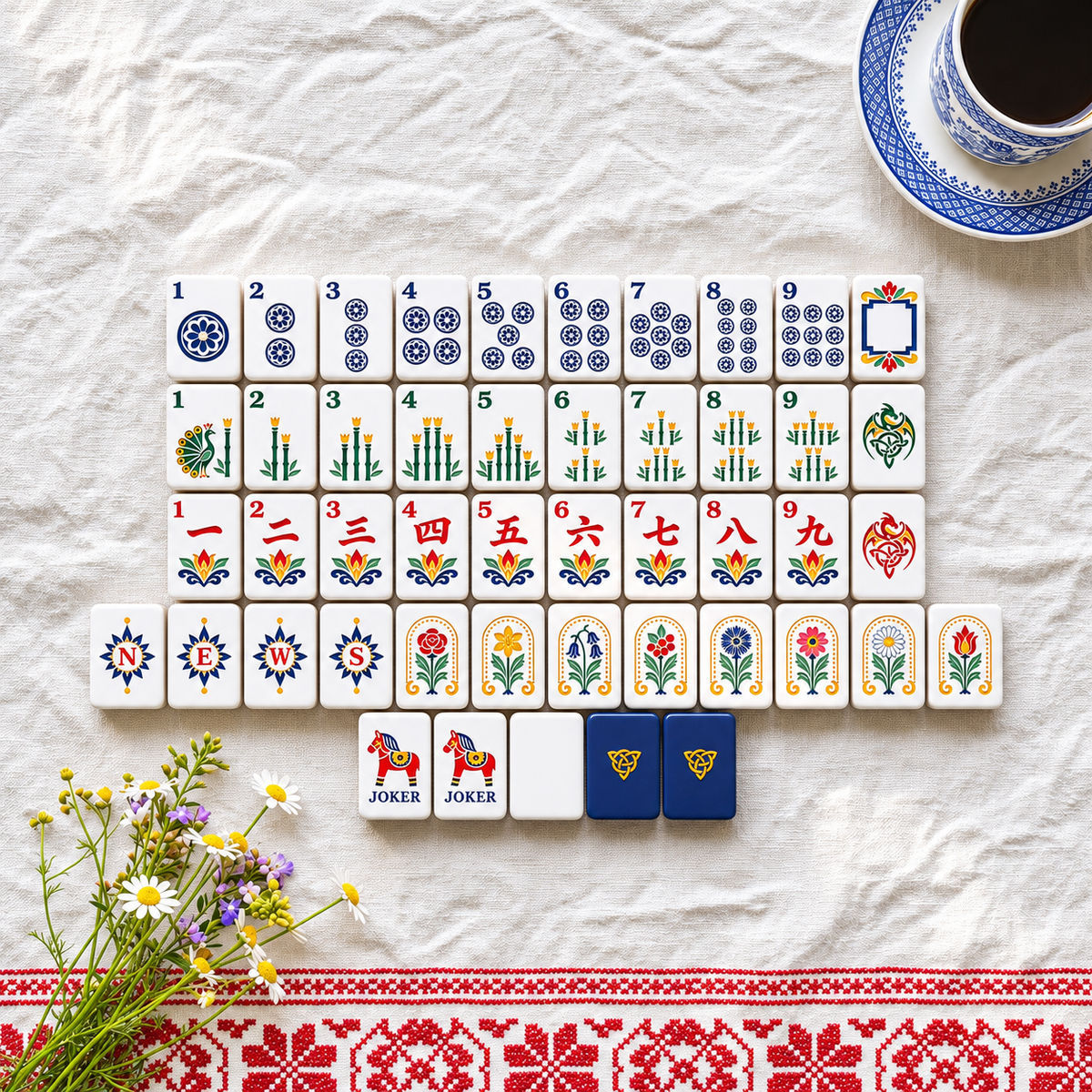
Ura dora (裏ドラ) are concealed bonus tiles in Riichi mahjong that remain face-down beneath the dora indicator until a hand wins or a riichi is called. When revealed, each ura dora tile matching the tile immediately after the dora indicator on the wall adds 1 point value to your hand—exactly like dora, but hidden. You reveal ura dora only after winning or declaring riichi; they never appear during regular play. In a standard four-player game, there are typically 4–5 ura dora tiles active per round, stacked beneath visible dora indicators on the dead wall. Riichi mahjong scoring depends heavily on dora and ura dora: a hand worth 3,900 points might jump to 5,200 with even one ura dora. Unlike American mahjong's fixed hand patterns from the yearly card, Riichi mahjong uses dynamic scoring where ura dora creates unpredictable, high-variance outcomes. If you're learning Riichi after American mahjong, ura dora is the mechanic that makes draws and winning moments thrilling—and risky.
Ura dora (裏ドラ, "reverse dora" or "back dora") are the engine of surprise in Riichi mahjong. Unlike American mahjong, which relies on matching hand patterns to a fixed yearly card, Riichi mahjong uses a dynamic point system where ura dora tiles magnify the value of winning hands. They sit hidden in the dead wall until a win is declared, then flip to reveal bonus points that can swing the entire game.
If you've played American mahjong, you know every hand is either valid or not—scoring is binary. In Riichi mahjong, the same winning hand can be worth 2,000 points or 8,000 points depending on how many dora and ura dora align with your tiles. That's why Riichi players talk obsessively about ura dora: they're not just scoring; they're the source of dramatic comebacks and brutal losses.
We host weekly games with players who've learned both systems, and the transition from American to Riichi always stumbles at ura dora first. The concept is simple, but the emotional weight is massive. Let's break it down.
What exactly is an ura dora indicator?
An ura dora indicator is a tile lying face-down beneath the visible dora indicator in the dead wall. When the game begins, the dealer flips one tile from the dead wall to reveal the dora indicator—say, a 5 Bam. The next tile in that same stack stays face-down: that's your ura dora indicator. If you win a hand (or call riichi), the ura dora indicator flips, revealing which tile matches as a bonus. Riichi mahjong typically holds 4–5 ura dora tiles in play at once, layered one below each dora, so every round has multiple hidden opportunities waiting.
The dora indicator itself doesn't have to be a winning tile in your hand. If the dora indicator is a 5 Bam, then all 6 Bams in play become dora (one rank higher). The same rule applies to ura dora: you count matching tiles, not the indicator tile itself. Jokers are never used in Riichi mahjong (unlike American sets), so you cannot fake a dora with a wild card—every point earned is from real, honest tiles.

How are ura dora revealed during play?
Ura dora remain face-down and hidden from all players until one of two moments: (1) someone wins a hand, or (2) someone declares riichi. If a player calls riichi, the ura dora indicator flips immediately, letting everyone see what bonus was lurking. If no one calls riichi before the hand ends in a win, the ura dora flip only after the winner reveals their hand. If the hand ends in a draw (abortive draw or exhaustive draw—the round runs out of tiles with no winner), ura dora never flip; they stay hidden and roll into the next round, adding one more layer to the dora count.
Here's the practical catch: if you're considering riichi, you're gambling that ura dora will help more than it hurts. Flip early and you show your opponents which tiles are now bonus—they'll adjust their discards and defense. Wait until you win, and you keep the mystery, but you've given riichi declarers a chance to see your threat. Ura dora create tension because they're invisible leverage, and timing their reveal is a strategic choice, not just a rule.
How does ura dora scoring actually work?
In Riichi mahjong, each dora or ura dora tile matching your hand adds 1 fu (minipoint). This is separate from your hand's base fu and melds. If your hand is worth 2,000 points and you have three ura dora tiles in your hand (all matching), you've added 3 fu—roughly 500 additional points depending on your hand's other factors. The math is non-linear; Riichi scoring tables multiply based on fu and han (hand value), so ura dora can shift you from one tier to the next.
Example: You win with a hand worth 1 han and 30 fu (base 1,000 points). You have no regular dora. But after you win, the ura dora indicator flips and shows that three of your tiles are now ura dora. You now have 1 han and 33 fu (base 1,300 points). Your payout nearly increased by 30% from those hidden tiles alone.
Contrast this with American mahjong: your hand is either on the card or it isn't. There's no "almost" and no hidden multiplier. American sets are structured, predictable, and fair in that sense. Riichi mahjong is volatile—and that volatility is by design. Experienced Riichi players debate whether to push for a win knowing ura dora might be a 9 Honors (a dead tile that won't help) or a 1 Bam (a tile in most hands). That uncertainty is the game.
Why does riichi mahjong use ura dora but American mahjong doesn't?
American mahjong was standardized in the 1920s by the National Mah Jongg League to make the game reproducible and fair across different tables and seasons. A fixed yearly card and explicit hand patterns meant any two players knew they were playing by identical rules. Scoring is transparent: you either matched a pattern or you didn't.
Riichi mahjong (Japanese mahjong), codified in the 1950s–1970s, evolved differently. It prioritized skill depth and hand-by-hand scoring complexity. Dora and ura dora exist to reward good fortune and timing, but also to punish careless play. A mediocre hand becomes a big hand if ura dora align. That means every draw, every discard, and every decision carries weight—and every round can surprise you.
For American players learning Riichi, this is the biggest mental shift: American mahjong is about pattern recognition and tile management within a known frame. Riichi mahjong is about probability, hand calculation, and reading your opponents' fear of ura dora. Both are mahjong; both are skill-based. They're just different philosophies.
What mistakes do Riichi players make with ura dora?
Mistake 1: Forgetting ura dora exist after discarding riichi. Once you call riichi, the ura dora indicator flips. Many new players assume they can still discard freely—but opponents now see which tiles bonus, so your safety tiles have changed. Any tile matching ura dora becomes riskier to throw.
Mistake 2: Ignoring ura dora when calculating winning probabilities. A hand worth 3,000 points might jump to 5,000 with ura dora. New players calculate their win as 3,000 and are shocked when a 5,000-point hand is paid. Always add ura dora to your mental math.
Mistake 3: Calling riichi too early without checking the dora indicator first. If the dora indicator is a 9 Honors (a dead tile), ura dora might also be a 9 Honors. Flipping a useless ura dora and then losing is painful. Experienced Riichi players glance at the dora first—if it's bad, they're more cautious about riichi.
Mistake 4: Overvaluing ura dora mystery. Some players refuse to call riichi because they want to "see" ura dora first. But ura dora only exist if you win or declare riichi—if you never declare riichi and never win, you never see them. Hesitation loses rounds.

Dora vs. Ura Dora: Quick Comparison
Aspect | Dora | Ura Dora |
Visibility | Face-up, visible from start | Face-down, revealed only at win or riichi |
Timing | Active all round | Active only after riichi or win |
Count | Usually 1–2 dora per round | Usually 1–3 ura dora per round |
Strategic use | Opponents know which tiles bonus; adjust defense | Hidden until too late; creates tension |
Score impact | Immediate calculation | Surprise bonus or disappointment |
When you're learning Riichi after American mahjong, think of dora as the visible scoring rule and ura dora as the plot twist. Both multiply points; dora is transparent, ura dora is a gamble. Riichi mahjong is built on this asymmetry—it rewards bold plays and punishes passive ones.
Playing Riichi mahjong: What to check before you buy
If you're interested in Riichi mahjong and want to host games at home, you'll need a different tile set than American mahjong. Riichi sets use 136 tiles (standard: 34 unique tiles × 4 copies each), while American sets use 152 tiles. Riichi sets have no flowers, no extra jokers, and a different suit arrangement. More importantly, you'll want a smooth playing surface and reliable racks—Riichi play is fast, and loose tiles or poor mat grip slow the game.
Our best-selling mahjong sets are all American mahjong, built for the 152-tile format and the yearly card system. They're acrylic, durable, and ideal for American games. However, if you're exclusively playing Riichi or switching between variants, you'll need a dedicated Riichi set—which is a separate purchase from a dedicated American set. We don't currently offer Riichi sets, but we do stock mats and racks that work beautifully with any tile size.
A quality mahjong mat with a non-slip backing is essential for both systems. Riichi games move quickly, and tiles slide around on bare wood or glass. A good mat keeps your tiles organized and your draws smooth. Pair that with racks and pushers designed for easy tile manipulation, and you've built a Riichi-ready table.
🀄 Shop best-selling mahjong sets →
The emotional reality of ura dora
After a few weeks of Riichi play, you'll understand why players describe ura dora as "the heartbeat of the game." You call riichi, the indicator flips, and suddenly you're either elated or crushed. A player you thought was losing draws a huge tile and wins because ura dora stacked in their favor. That's not luck alone—it's part of the design. Riichi mahjong treats good fortune as a real, scorable asset.
American mahjong players often find this chaotic at first. In American games, a hand is either valid or not; there's no hidden multiplier changing the outcome between your calculation and the payout. But once you've lived through two or three Riichi rounds with unexpected ura dora reversals, you see the depth: the skill isn't just tile management, it's reading probability, managing risk, and knowing when to push or fold.
How American and Riichi mahjong differ on hidden scoring
Feature | American Mahjong | Riichi Mahjong |
Tile count | 152 tiles + 8 jokers | 136 tiles; no jokers |
Hand validation | Matched to yearly card | Calculated by han + fu |
Dora system | No dora or ura dora | Dora (visible) + ura dora (hidden) |
Scoring transparency | Predetermined; visible on card | Dynamic; calculated after win |
Skill depth | Pattern recognition, tile flow | Probability, hand math, psychology |
Session length | 8 rounds typical | 4 rounds (east and south) |
🎁 See our most-loved mahjong sets & accessories →
If you're straddling both worlds—American mahjong at home and Riichi when you travel or play online—ura dora will remain one of those mechanical differences that feels alien until it suddenly clicks. The first time you call riichi, watch the ura dora flip, and find three tiles matching your hand, you'll feel the game shift under you. That moment is why Riichi mahjong exists. And that moment is why players keep playing.
✨ Find your Mahstead set — free US shipping →

FAQ
Can you use ura dora in American mahjong?
No. American mahjong has no dora system. Hands are validated against the National Mah Jongg League card; scoring is fixed once you match a pattern. Ura dora is exclusively a Riichi mahjong mechanic.
What happens to ura dora if nobody wins the hand?
Ura dora indicators remain hidden. They don't flip and don't score. They stay in the dead wall and carry over to the next round, adding one more dora to the new round's count. This builds tension across consecutive draws.
If I have four of the same ura dora tile in my hand, how many points do I get?
Each ura dora tile matching the indicator adds 1 fu. If all four tiles are ura dora, you add 4 fu to your hand's base score. The multiplier depends on your hand's han value and the scoring table.
Why do experienced Riichi players hesitate before calling riichi?
Because calling riichi flips the ura dora indicator immediately, showing opponents which tiles are now bonus—which changes their defense strategy and your safety tiles. Hesitation is strategy: waiting to see if you naturally win (and only then flip ura dora) might be safer than declaring riichi early.
Is ura dora the reason Riichi mahjong is harder than American mahjong?
Not harder—different. American mahjong requires pattern memory and tile flow management. Riichi mahjong adds probability calculation and hidden-information psychology. Ura dora is one reason Riichi feels riskier and more dramatic than American, but both games reward skill and experience equally.


View More
View More
View More
