
Riichi mahjong terms and glossary for Western players
Last updated: Nov 23, 2026
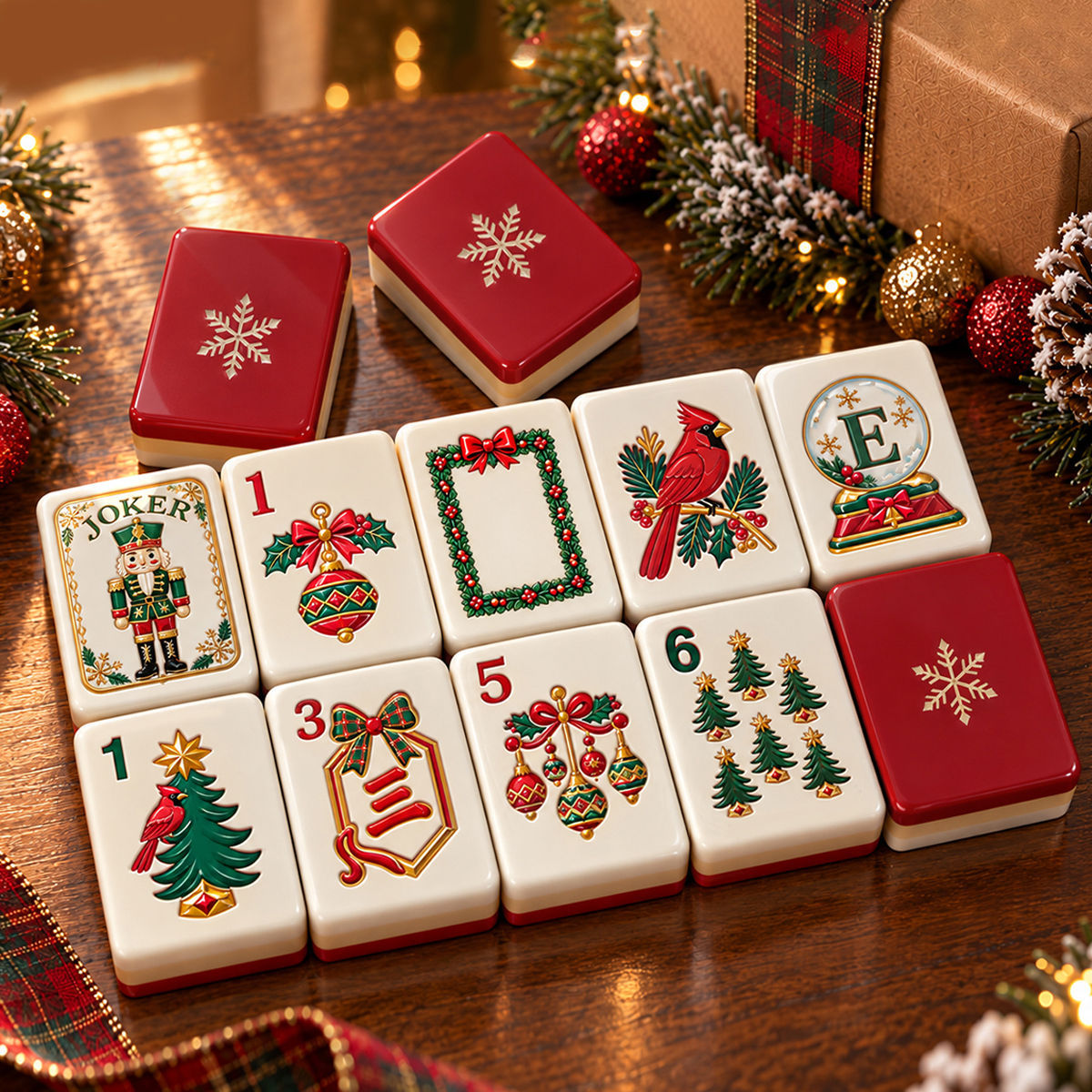
Riichi mahjong (Japanese mahjong) uses distinct terminology rooted in game mechanics: yaku are hand patterns that earn points; dora are bonus tiles that increase hand value; tsumo means self-draw win, ron means win off discard; riichi is a formal one-tile-away declaration; melds are exposed pungs, kongs and sequences (unlike American mahjong, which permits only pungs, kongs and quints). Rounds cycle through four winds over 16 hands. Scoring is point-based per hand, not yearly card-dependent like American mahjong. Key difference: riichi allows chows (1-2-3 sequences) and concealed melds in winning hands; American mahjong does not. Learning riichi terminology opens play across Asia—China, Hong Kong, Taiwan and Korea all use variant rule sets and overlapping vocabulary. We recommend starting with a riichi-friendly set from our best-selling collection because you'll need precision tile recognition during fast play.
What is yaku and why does it matter?
Yaku are named hand patterns that unlock winning potential. Each yaku has a point value (fu and han—base points and multiples). Without a yaku, you cannot win; every legal hand must satisfy at least one yaku requirement. Common yaku include tanyao (all simples: 2–8, no terminals or honors), pinfu (no melds, open wait, pure sequence set), and yakuhai (pung of dragons or seat wind). Mastering yaku is the bedrock of riichi strategy.
🀄 Shop best-selling mahjong sets →

How do dora and ura-dora change your hand value?
Dora are bonus tiles drawn at the start of each hand. The dealer reveals one indicator tile, and the tile numerically next to it becomes dora—for example, if 3 Dots is shown, 4 Dots is dora. Each dora tile in your winning hand adds one han (doubling multiplier). Ura-dora (hidden dora) are concealed bonus tiles revealed only if you win; red fives (aka 5 tiles in each suit) are automatic dora. Dora reward player luck but also force opponents to discard cautiously near the end of the round. This mechanic does not exist in American mahjong, where tile value is fixed by the annual card.
What's the difference between tsumo and ron?
Tsumo means winning on self-draw from the wall; ron means winning off an opponent's discard. The two wins trigger different scoring: tsumo usually pays a smaller base point but all three opponents contribute. Ron typically pays a single opponent more, as that player "dealt in" (called houjuu or damaten if undeclared). Declaring riichi commits you to a one-tile-away hand and locks your discard pattern; if you tsumo while in riichi, your payment is higher. The decision to pursue tsumo or stay open for ron shapes mid-game tactics and tile retention.
How does riichi declaration work?
Riichi is a formal announcement that you are one tile away from winning. After discarding, you say "riichi" and place a stick in the center pot. Your hand becomes locked: you cannot add melds, and discards must follow a strict pattern (no tile can improve your hand except the winning tile). Declaring riichi costs 1,000 points but grants +1 han. If you tsumo while in riichi, you earn bonus payment (riichi tsumo). If another player wins after your riichi, you pay extra. Beginner mistake: declaring riichi too early on a hand with multiple winning tiles—riichi only works when you have exactly one winning tile.
What are melds, and how do they differ from American mahjong?
Melds are exposed tile groups on the table: pon (pung of three identical), kan (kong of four identical), and chi (chow: sequence like 3-4-5). Unlike American mahjong, riichi permits chi—sequences of consecutive numbers in the same suit. You can steal a chow from a discard, but stealing is riskier than American pungs because the table sees your winning direction. Concealed melds (anko) are hidden sets in your hand at win—these carry bonus points. Open melds (menko) reduce your hand value. Some yaku require tanyao (all melds and pair from simples 2–8), which combines sequence strategy with American-style pung-hunting.
✨ Find your Mahstead set — free US shipping →
How do han and fu calculate your final payment?
Han (multiples) and fu (base points) are two scoring axes. Fu range from 20 to 110 (increments of 10); han range from 1 to 13+. Together they generate a point total: 1 han 30 fu = 1,000 points; 2 han 30 fu = 2,000; 3 han 30 fu = 3,900. At 5 han or higher, scoring jumps to mangan (8,000) or haneman (12,000). This math-heavy system differs completely from American mahjong, where hands are static (no han/fu), card-locked, and win/lose as binary outcomes. Riichi scoring rewards aggressive play and penalizes weakness—sitting in riichi locks you into a single path, creating psychological tension.
Quick Riichi Glossary Table
Term | Meaning | Example |
Yaku | Hand pattern that qualifies for win | Tanyao (all 2–8) |
Dora | Bonus tile that adds point value | 4 Dots if 3 Dots is indicator |
Tsumo | Win by self-draw from wall | Draw your waiting tile on your turn |
Ron | Win off opponent's discard | Opponent discards your waiting tile |
Riichi | One-tile-away declaration (+1 han) | Announce and place 1,000-point stick |
Pon | Pung (three identical tiles) | Three 7 Bams |
Chi | Chow (sequence like 3-4-5) | 3 Dots–4 Dots–5 Dots |
Kan | Kong (four identical tiles) | Four 2 Craks |
Fu | Base points (20, 30, 40…) | 30 fu + 1 han = 1,000 points |
Han | Point multiplier (1, 2, 3…) | 5 han = mangan (auto 8,000) |
Mangan | Auto win value (8,000 points) | Any hand with 5 han or 40 fu × 3 han |
Honra | Final hand of round | 16th hand in East wind |

Hands-on: Reading a riichi hand in real play
When you sit at a riichi table, you'll hear rapid calls: "Pon!" (someone stole a pung), "Chi!" (someone stole a chow), "Tsumo!" (someone self-drew), "Ron!" (someone won off discard). Here's how to track it:
Count your melds: Open melds visible on table = fewer han at win. Concealed melds hidden in hand = more han.
Spot dora: The indicator tile (shown at round start) plus one more per additional dora tile in your hand. Red fives are automatic dora.
Check yaku: Does your hand satisfy at least one yaku pattern (tanyao, pinfu, yakuhai, etc.)? No yaku = no win, even if you have four groups + pair.
Declare riichi only when: You have exactly one tile that wins, and you've timed it for maximum bonus payout.
Watch discards: After riichi, opponents discard more carefully; discard patterns signal their hand.
Riichi play is faster and more psychologically intense than American mahjong because every hand resets and scoring is live. The terminology becomes second nature after 5–10 hands.
What to check before you buy a set for riichi play
Tile size & grip: Riichi uses standard 30 mm tiles. Smaller hands may struggle with speed during rapid melds. Our best-selling sets balance durability and comfort for extended sessions.
Visibility: Clear numbering and suit symbols are essential—you'll call melds fast and squint at small indicators. Acrylic tiles eliminate glare better than bamboo under bright table lights.
Storage for extras: Most riichi sets include spare tiles. Check your bag or case fits the full set plus jokers.
Meld markers: Some riichi players use racks to organize concealed melds. Racks are optional but speed up play if you manage a large hand.
🎁 See our most-loved mahjong sets & accessories →
Common riichi terminology mistakes (and how to avoid them)
Mistake 1: Confusing han with hu (anagram trap).Han = multiplier (1 han, 2 han). Hu does not appear in riichi (some older texts use it; ignore). Fu = base points. Say "one han" out loud to lock it in.
Mistake 2: Thinking riichi means you've won. Riichi is a declaration only—you still need your waiting tile. Opponents can block you by winning first. Riichi just adds +1 han and forces your hand lock.
Mistake 3: Stealing a chow when you're not paying attention. In riichi, if you say "Chi!" and steal a discard for a chow, you're committing to that meld publicly. Beginners accidentally call chi on tiles they don't need, revealing their hand. Check your waiting tile first.
Mistake 4: Discarding a dora too early. Dora are valuable and rare. Keep them until mid-round unless forced to discard. Holding dora past safety is a common beginner trap—opponents see your discards and assume you're thinning hand, not hoarding.
Mistake 5: Ignoring ura-dora. If you win, ura-dora tiles (hidden dora under the indicator) reveal and flip your score upward. If you don't win, they stay hidden. Some hands are worth little openly but spike when ura-dora flip—don't low-ball your hand's potential.
How riichi terminology maps to American mahjong
Riichi | American | Difference |
Yaku (hand pattern) | Annual card hand | Yaku is structural; card hands are yearly, card-locked |
Dora (bonus tile) | No equivalent | Riichi rewards luck; American mahjong does not |
Tsumo / Ron | Mah jongg (win) | American doesn't separate self-draw vs. discard |
Riichi (declaration) | Charleston (tile pass) | Riichi is mid-hand; Charleston is pre-game |
Han / Fu (scoring) | Points only (card-based) | Riichi recalculates per hand; American is card-static |
Chow (sequence) | No chows | American uses only pungs/kongs/quints |
Pon / Chi / Kan | Pung / Kong / Quint | Names differ; riichi allows sequences |
Open meld | Exposed pung | Both use exposed melds; riichi calculates penalty |
Honra (final hand) | Last hand of season | Season ≠ round; riichi cycles faster |
Where to learn riichi rules in depth
Online communities like Riichi City and Tenhou (free-to-play online riichi) offer live play and tutorials. Riichi rulebooks by the World Riichi Mahjong Association (WRMA) are the global standard. Local Japanese culture centers sometimes host riichi nights. Start with a Mahstead set to keep tiles at home while you practice online—precision tiles eliminate confusion when learning hand recognition.

FAQ
Can I use American mahjong tiles to play riichi?
No. American mahjong has 152 tiles (plus jokers); riichi uses 136 tiles (4 of each 1–9 in three suits, 16 winds, 12 dragons, 8 flowers—no jokers, no blanks). Tile counts and meanings differ. Buy a riichi set if you play both games regularly.
What does "damaten" mean?
Damaten is a concealed win—you go riichi, your hand stays hidden, and you tsumo or ron without revealing your yaku until you win. It's riskier than open play but awards bonus points if it succeeds.
Is riichi harder than American mahjong?
Different, not harder. Riichi requires hand pattern memory and speed; American mahjong requires annual card mastery and strategic tile passing. Both take 10–20 hours to play competently. Riichi resets every hand; American shifts with seasonal card changes.
How do I know if a tile is dora?
The dealer reveals one indicator tile (and typically covers it with a tile face-down beneath it). The next numerical tile is dora. If 2 Bam is indicator, 3 Bam is dora. If 9 Bam is indicator, 1 Bam is dora (wraps around). Ura-dora stay hidden until you win.
What's the most common yaku beginners should memorize?
Tanyao (all simples 2–8, no terminals or honors), pinfu (all sequences, no melds, open wait), and yakuhai (pung of your seat wind or any dragon). These three cover roughly 30% of winning hands in casual play.
Does riichi have a "joker" like American mahjong?
No. Riichi uses only the 136 standard tiles. No jokers, no wild tiles, no blanks. Every tile is fixed. This makes hand reading and discard prediction more precise—a beginner advantage if you're learning both variants.


View More
View More
View More
