
Mahjong Solitaire vs. Real Mahjong: What's the Difference?
Last updated: Nov 23, 2026
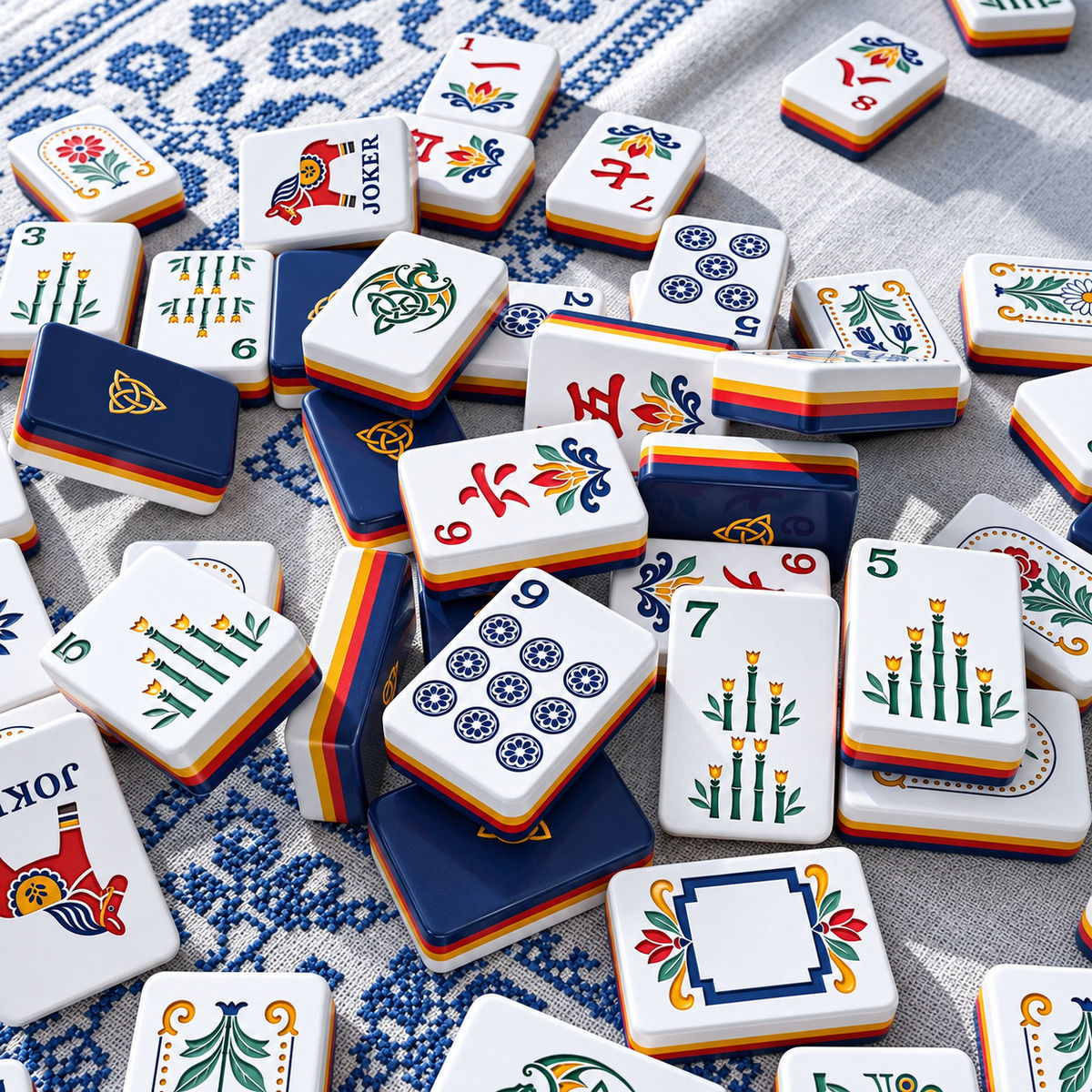
Mahjong solitaire is a one-player tile-matching puzzle where you remove pairs from a fixed layout until all tiles are gone; it requires no skill beyond matching, has no strategy, and you can play endlessly on free apps. Real mahjong—specifically American mahjong, the four-player social variant we play weekly—uses 152 tiles, a hand of 13, and a yearly updated card listing legal winning hands; you draw and discard in turn, combine tiles into sets (exposed pungs, kongs, quints, sextets), and win by completing a pattern before your opponents, with scores calculated by hand complexity and tile type. Solitaire teaches nothing about real mahjong rules, hand-building, or reading opponents; real mahjong requires memory, probability judgment, risk management, and full table attention. If you're drawn to the game of mahjong—competition, table culture, friendships—start with real mahjong; if you want a relaxing puzzle to solve alone, solitaire is free online. Most people who learn American mahjong find solitaire too simple once they've felt the social draw of a real table.
Mahjong solitaire and real mahjong share a name and tiles, but they are entirely separate games—one is a solo puzzle, the other a four-player strategic contest. Understanding the difference saves you time and points you toward the version that will actually engage you.
Can you learn real mahjong from playing solitaire?
No—solitaire teaches almost nothing about real mahjong rules, hands, or strategy. Solitaire is about spatial pattern-matching: remove pairs of identical tiles from a stacked layout until the board clears. Real mahjong requires you to memorize legal hand patterns from the annual National Mah Jongg League card, read opponents' discards, calculate probabilities, and manage risk under time pressure. Solitaire has no turns, no opponents, no card, no winning condition beyond "clear all tiles." If you've played solitaire for months, your first real game will feel like you're learning a new game altogether.

What happens in a real mahjong game that solitaire never has?
Real mahjong includes the Charleston—a tile-passing ceremony where you swap tiles with each player before anyone draws, which sets the table's psychology and often determines who wins. Then play proceeds: you draw a tile, discard one, and work toward one of dozens of legal hand patterns while blocking opponents from winning. You expose sets (pungs, kongs) face-up on your rack, so other players see your progress and adjust their strategy. Solitaire has none of this: no opponent, no hidden information, no advantage to deception, no moment when the table goes silent because someone is one tile from winning. A real game lasts 30–60 minutes per hand, with tension that builds as players approach completion; solitaire is task-completion with no stakes.
How long does a real game take versus solitaire?
A single hand of four-player American mahjong takes 30 to 60 minutes, depending on players' speed and the hand's difficulty; a full mahjong session is typically 2–4 hours. One solitaire round takes 2–10 minutes, and you can play as many as you want instantly. If you're looking for quick breaks during work, solitaire fits; if you're building a weekly habit with friends, real mahjong is the commitment worth making.
What tiles and equipment do you need for each?
Mahjong Solitaire uses a digital or printed layout (no specific tile set required) and costs nothing on mobile. Real American Mahjong requires a 160-tile set (152 playing tiles + spares), a mat for holding tiles, a rack to organize your hand, and the current year's hand card from the National Mah Jongg League; you'll also want a travel bag if you host or visit other tables. Our best-selling mahjong sets include everything you need to start, and many come as engraved acrylic designs you'll actually want to display between games.
🀄 Shop best-selling mahjong sets →
Activity | Setup Time | Players | Equipment Cost | Skill Floor | Social Value |
Solitaire | 2 min | 1 | Free | None—match identical tiles | None—solo |
Real Mahjong | 15 min | 4 (sometimes 2–3) | Set, mat, rack, card | High—memorize hands, read table | Very high—weekly tradition |

How do you actually win at real mahjong?
You win by being the first to complete a legal hand pattern (one of dozens shown on the League card that year) using 14 tiles—13 in hand plus 1 drawn from the wall. Your hand must contain specific sets: maybe three pungs (identical triplets), one quint (five of the same), and a pair—and the pattern must appear on that year's card in the exact category you're shooting for (e.g., "Consecutive Sets," "Like Numbers," "Pair Hands"). You score based on your hand's rarity and the tiles involved; higher-value tiles (dragons, winds) and more complex patterns score more. In solitaire, you "win" by clearing the board, which has no strategy—just remove the only two matching tiles available at any moment until the layout is gone.
What's the real reason to choose one over the other?
Choose solitaire if you want a free, endless mental puzzle with zero social commitment. Choose real mahjong if you want to join a multigenerational game culture, build a weekly routine with friends, and experience the thrill of reading a table and outsmarting opponents. We play real mahjong because it's where community lives: the jokes during the Charleston, the audible gasp when someone draws a critical tile, the post-game hand review. Solitaire is a fine way to kill time in an airport; real mahjong is a way to spend Thursday nights with people you actually care about.
🎁 See our most-loved mahjong sets & accessories →
What to check before you buy a real mahjong set
If you decide to play real mahjong, avoid cheap plastic sets with illegible tiles—tile clarity saves your eyes and your game. Check that the set includes the current year's card, or buy one separately from the National Mah Jongg League; without it, you cannot identify legal hands. Make sure your set has exactly 152 playing tiles plus spares; sets sold as 160 or 166 tiles include extra jokers and blanks for durability, not extra gameplay. If you travel to other tables, invest in a quality mat and rack set to keep your tiles organized and signal that you take the game seriously. Many players choose engraved acrylic mahjong sets because they're readable, durable, and beautiful enough to leave on a shelf between games—worth the investment for someone who plans to play weekly.
For deeper guidance on real American mahjong rules, hand-reading, and how the Charleston works, see our mahjong for beginners guide.
✨ Find your Mahstead set — free US shipping →

FAQ
Can I play real mahjong alone with a solitaire setup?
No. Real American mahjong requires exactly four players (or adapted rules for two or three). The game's strategy depends on reading what your opponents discard, block, and expose. Solo play defeats the entire design. If you're alone, play solitaire or wait for a game night.
Do I need to buy a physical set, or can I play real mahjong on an app?
You can play on apps, but the table-culture experience—handling tiles, face-to-face reads, the physical Charleston—is lost. Most regular players prefer physical sets and quality mats because they force presence and strengthen friendships.
What's the hardest part of switching from solitaire to real mahjong?
Memorizing legal hands from the annual card. Solitaire has one rule (match pairs); real mahjong has dozens of valid patterns that change yearly. Plan to carry the card to your first five games and refer to it frequently—that's completely normal.
How much does a decent real mahjong set cost?
See current price on the product page for our best-selling sets. Quality matters: cheap sets have tiles that stick, crack, or blur over time. A good acrylic set plus mat and rack lasts decades and improves every game.
Is real mahjong more fun than solitaire?
For solo relaxation, solitaire is simpler. For weekly social play, competition, and building a hobby with friends, real mahjong is incomparably richer. The difference is the same as chess alone versus playing chess at a club—one is fine, the other is life.
Can I teach someone real mahjong if they've only played solitaire?
Yes, but start from scratch. Solitaire knowledge confuses beginners because the rules bear almost no resemblance. Have them read the current year's card, watch one hand, then sit in as East (first dealer) where you can guide them. By hand three, the logic clicks.


View More
View More
View More
