
Mahjong Competition Rules Setup: American Standards Explained
Last updated: Nov 23, 2026
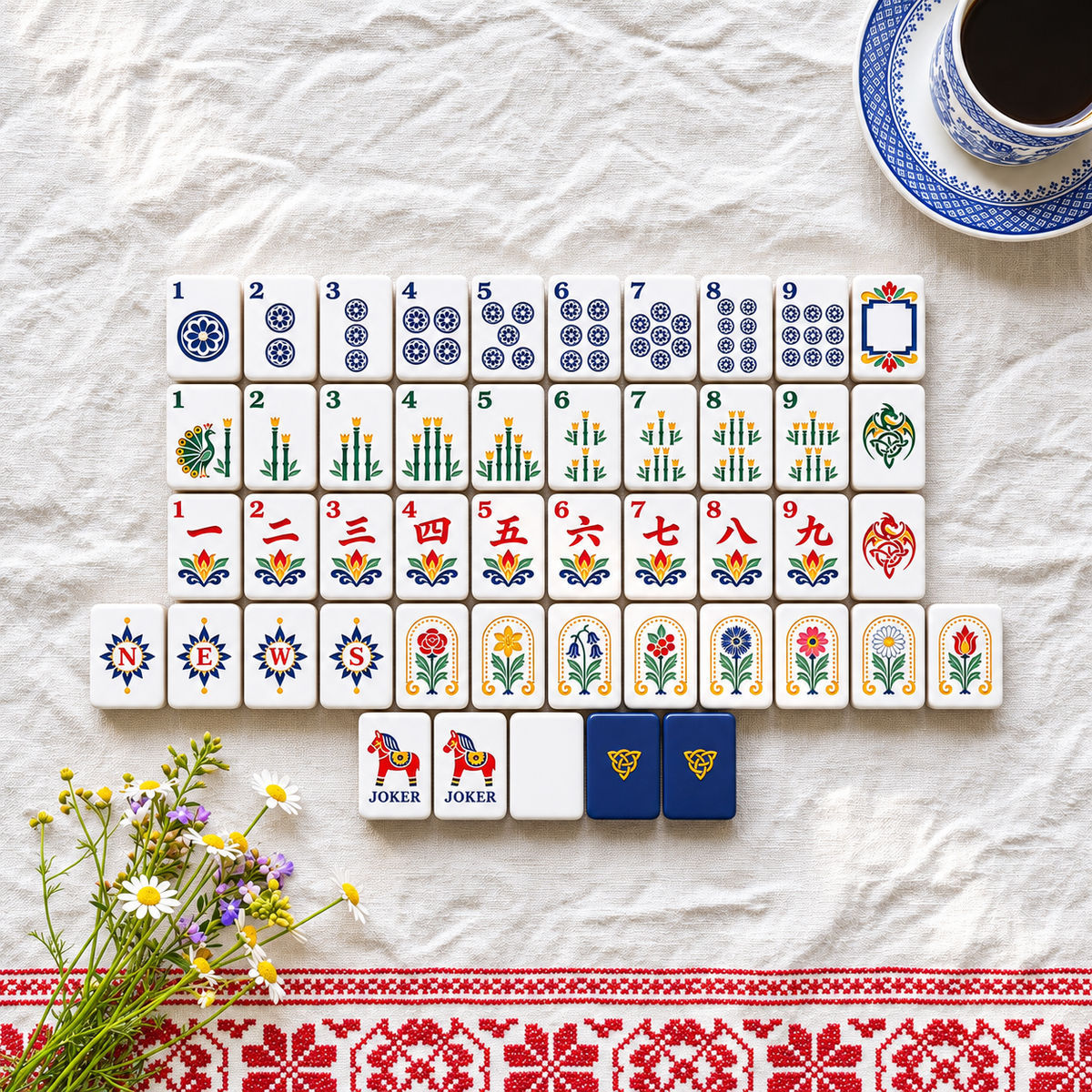
American competition mahjong uses exactly 152 playing tiles plus 8 jokers: three suits (Bams, Craks, Dots) × 1–9 × four copies each; 16 winds; 12 dragons; 8 flowers. Players must draw from the current year's National Mah Jongg League card only—no hand is valid unless it appears on that card. Setup begins with a Charleston (tile pass ritual), walls built in standard formation, and dealer selection via dice roll. A game lasts roughly one to two hours. Common setup mistakes include using old card years, forgetting joker placement rules (jokers cannot fill a single tile or pair), or miscounting tiles. You'll need a full 160-tile set with all 152 playing tiles plus spares, a flat mat for wall and discard organization, racks to organize your hand clearly, and a card holder so everyone sees the same year's reference simultaneously.
What is the official American mahjong tile count?
The National Mah Jongg League standard is exactly 152 playing tiles. You'll see acrylic sets marked as 160 or 166 tiles; the difference is spare tiles (extra jokers and blanks) packed for replacements. Never add those spares to the game. The 152 count breaks down: 108 suited tiles (Bams, Craks, Dots 1–9, four of each), 16 winds (N, E, W, S, four each), 12 dragons (Red, Green, White "Soap," four each), and 8 flowers. Eight jokers complete the official set. A misdeal or tile shortage invalidates the hand, so verifying the count before Charleston starts is non-negotiable.

How do you set up the table before the first hand?
All 152 tiles face down in front of you. East player (determined by dice roll) shuffles first, then players take turns pushing piles and building the wall in a specific pattern: East builds the wall to their right. Each player then draws a wall section and arranges it into two stacks of pairs. After shuffling is complete, the Charleston begins—players pass their tiles in fixed directions (to the right, across, to the left) in three rounds, exchanging 14 tiles at a time. Once Charleston ends, players draw tiles in order of East's dice roll, then pick from the wall one at a time. The game begins when Comps (dead wall) are drawn and the hand is discarded into the center.
What hands are legal in competition play?
Only hands shown on the current year's National Mah Jongg League card are legal. Competition hands consist of tiles grouped into melds: pungs (three identical tiles), kongs (four identical), quints (five), or sextets (six)—never sequences or chows. Jokers can substitute for any tile except a single tile or a pair. A complete hand is 14 tiles: either a pair plus four melds, or seven pairs (all pungs and pairs). Before calling "Mahjong," you must verify your hand against the card visually. If a discard completes your hand, you call immediately. If you pick from the wall and declare, you win. False declarations or incomplete hands result in penalties and play continues.
How do joker placement rules affect competition setup?
Jokers are wild and can replace any tile in a pung, kong, quint, or sextet—but never in a single tile or pair. If a hand needs four Craks and three jokers, the jokers fill three of the Craks; you cannot use jokers for the pair or the fourth standalone Crak. This distinction matters: if you're holding six dots and want to claim a pung, you need at least one real dot and can fill the rest with jokers. Once placed in a meld and exposed on the table, a joker is locked in that role for that hand. Many new players lose hands by accidentally violating the pair rule—verify before exposing.
What table layout and equipment ensure fair play?
Competition tables need a sturdy, flat surface at least 36 inches square (round or octagonal preferred). A dedicated mahjong mat organizes the wall, discard area, and player zones clearly, reducing disputes over tile placement. Racks with pushers let each player organize their 13 tiles neatly and keep pushers visible for meld inspection. A wall must be built consistently: each player builds a segment, then segments are moved together. The dead wall (Comps—the last 16 tiles) sits to the dealer's right. A card holder or stand ensures all four players see the same reference card simultaneously, preventing hand disputes. Discard tiles pile in the center in neat rows of six so everyone can track calls and track which tiles are gone.
Setup Element | Why It Matters in Competition | What to Check |
Tile count (152 + 8 jokers) | Miscount voids the hand; one missing tile stops play | Count suits, winds, dragons, flowers before Charleston |
Current year's card | Hands not on card are void; old cards create disputes | Verify the card date matches the League's current issue |
Wall formation | Irregular walls confuse turn order and discard draws | Each player builds evenly; Comps sit consistently |
Joker rules (never pair/single) | Violating this is the most common illegal claim | Check joker placement before declaring "Mahjong" |
Flat playing surface | Tiles roll, displacing walls and creating false claims | Use a mat; avoid uneven tables |
Clear hand visibility prevents hidden tile disputes | Players can see all 13 tiles without picking them up |
🀄 Shop best-selling mahjong sets →

How do you verify a hand before calling Mahjong?
Pull out the current year's card. Find your hand pattern in the section that matches your meld count (pairs, pungs, kongs, quints, sextets). Read left to right: the card lists tile combinations. For example, if your hand is a pair of Red dragons plus four pungs of Bams and Craks, find that exact pattern on the card. If it matches, count your 14 tiles: one pair + four melds = 14. If any tile is missing or doesn't match, your call is void. Before declaring, whisper to the player who discarded (if you're calling off a discard) or call aloud if you picked from the wall. Once called, players inspect your hand to confirm the card match. Misreading the card is your responsibility—table rules will define penalties (often a replay or hand loss).
What are the most common setup mistakes in competition play?
Tile shortage: Dropping or misplacing one tile invalidates the hand; count before play begins. Wrong card year: Using last year's card creates disputes; verify the date before dealing. Joker misplacement: Placing a joker in a pair or single tile is an illegal hand; check before calling. Wall irregularity: If Comps aren't separated clearly, players pick from wrong spots, changing draws—rebuild walls if unsure. Not clearing discards: Leaving old hands' discards on the mat confuses the count—clear the center and count to zero before the next hand. Dealer confusion: If you don't assign dealer via dice roll first, turn order becomes ambiguous; always roll for East first. Concealing your hand: Keeping tiles facedown on the rack lets you hide melds; racks with pushers solve this by showing all tiles openly.
🎁 See our most-loved mahjong sets & accessories →
How do competition rules differ between American and other variants?
American mahjong (what we've covered) allows only the current year's card hands, uses 152 tiles + 8 jokers, and prohibits chows (sequences). Chinese mahjong uses 144 tiles, allows chows, has eyes (a different pair rule), and draws from traditional hand lists—not a card. Hong Kong mahjong uses 144 tiles, similar chow rules, and slightly different hand naming. Riichi mahjong (Japanese) uses 136 tiles, emphasizes concealment, and features a different scoring system. Taiwanese mahjong blends American and Chinese rules. If you're competing, confirm the variant with the organizer first. Most clubs in North America run American rules. Set rules before the game starts and stick to them for all hands.
✨ Find your Mahstead set — free US shipping →
What to check before you buy
Tile count: Confirm you're getting a full 160-tile set with all 152 playing tiles plus spares.
Tile size and weight: Competition tiles should be standard 1¼-inch acrylic with enough heft to slide smoothly on a mat.
Card holder or reference stand: Ensure your set includes a slot to hold the current year's card visibly.
Mat and rack compatibility: If buying separately, verify the mat fits your table and racks align with your tile size.
Joker and tile clarity: Tiles must be clearly marked; jokers should stand out visually so you don't accidentally play them as regular tiles.

FAQ
Can I use an old mahjong card for competition play?
No. Only the current year's National Mah Jongg League card is valid in competition. Hands not printed on that card cannot be called, even if they follow suit and meld patterns. Always verify the card date before the first hand.
What happens if I miscall a hand in competition?
Penalties vary by house rules. Common outcomes: you lose the hand, replay the hand, or pay a penalty to all players. Always verify your hand against the card before calling to avoid disputes and penalties.
Can jokers fill a pair or single tile in a meld?
No. Jokers can only substitute for tiles in pungs, kongs, quints, or sextets—never in a pair or single tile. Using a joker in a pair is an automatic illegal call.
How long does a competition game take?
A full four-player game (one East round) typically lasts one to two hours depending on player speed and skill. Tournaments may set time limits per hand.
Do I need a special mat or rack to play by competition rules?
A mat is strongly recommended—it keeps the wall, discards, and your hand organized and prevents disputes. Racks with pushers help you display your 13 tiles clearly so other players can verify them. Neither is mandatory, but both reduce errors and speed play.
What's the difference between a 152-tile set and a 160-tile set?
A 160-tile set contains all 152 playing tiles plus 8 spare tiles (extra jokers and blanks) for replacements if tiles crack or go missing. You only use 152 in each game; the spares stay in the box.


View More
View More
View More
