
Mahjong Bag for Tiles and Racks: What to Buy
Last updated: Nov 23, 2026
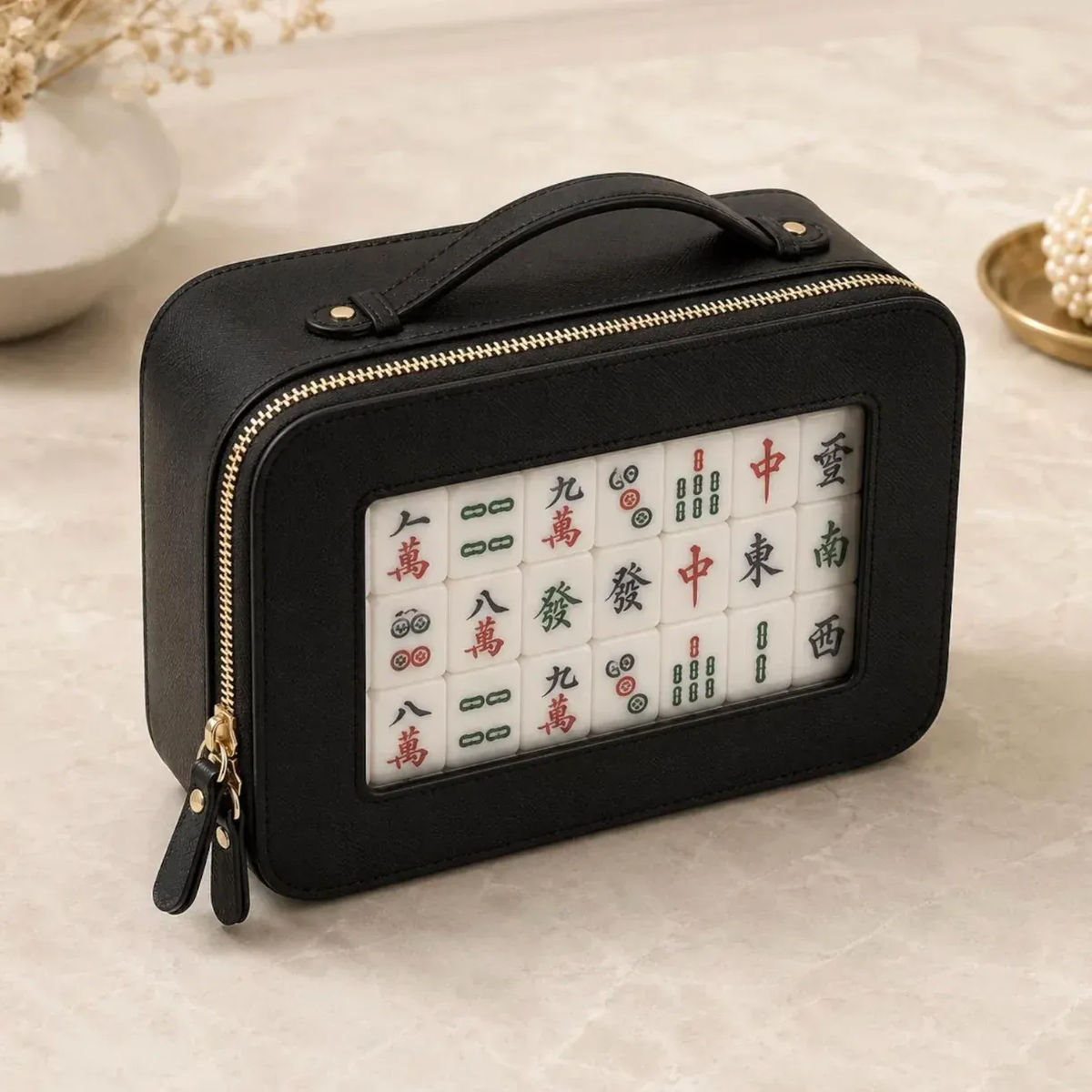
A mahjong bag is a carry or storage container designed to hold a 160-tile American mahjong set, racks with pushers, and often a mat. Soft bags are lightweight, fold flat, and cost less; hard cases offer maximum protection but weigh more and take up shelf space. Most bags fit a standard set plus one or two racks; mats usually require a separate mat bag or rolling case. Capacity matters: measure your racks (most are 8–10 inches long) and check the bag's interior dimensions before ordering. Mahstead's travel bag collection includes designs in various styles and sizes so you can choose based on how often you move your set and how much gear you carry to games. 🎁 See our most-loved mahjong sets & accessories →
Why does bag type matter for your game routine?
Your lifestyle decides the best bag format. Players who host weekly games in one room often use open storage shelves or a mat bag for occasional transport. Traveling players and those who rotate homes need a reinforced soft bag or hard case. Tournament players and dealers frequently choose hard cases because they stack neatly in vehicles and protect tiles from humidity and sun damage during long storage. The choice isn't about prestige—it's about how many times per month your set moves and whether it lives in a climate-controlled home or a car.

What size bag do you actually need?
Standard American mahjong set dimensions: a 160-tile set in its tray measures roughly 12 × 8 × 3 inches. Racks typically add another 10 inches of length when nested. A quality travel bag interior should be at least 14 × 10 × 5 inches to fit a set plus one rack without crushing the tiles. If you carry two racks, a mat, and joker chips, you need closer to 16 × 12 × 6 inches. Measure your gear first—don't guess. Many buyers underestimate how much space a mat takes; if yours rolls up to 4 inches in diameter and 12 inches long, you may need a dedicated mat bag or a two-compartment design. Check the product listing's interior dimensions before ordering; they're usually listed in inches.
Soft bag vs. hard case: which wins for you?
Feature | Soft Bag | Hard Case | Best For |
Weight | 1–2 lbs | 3–5 lbs | Home players (soft) vs. frequent movers (either) |
Protection | Good for bumps; not waterproof | Excellent; often waterproof | Tournament travel, car storage |
Folding | Packs flat when empty | Does not fold | Apartment storage (soft) vs. game room shelf (hard) |
Cost basis | Lower entry price | Higher upfront | Budget games (soft) vs. investment gear (hard) |
Lifespan | 3–5 years typical | 7+ years typical | Casual weekly games (soft) vs. serious players (hard) |
Carry comfort | Handles and straps | Built-in handles, sometimes wheels | Solo carry (soft) vs. car trunk (hard) |
Choose soft if you host most games at home and travel maybe twice a year. Choose hard if your set moves weekly or sits in a car. A hybrid—soft bag inside a hard case—costs more but works for players who alternate between home and travel venues every month.
✨ Find your Mahstead set — free US shipping →
What features protect tiles from humidity and damage?
Acrylic tiles are durable but sensitive to moisture and temperature swings. A bag with sealed seams and water-resistant exterior keeps humidity out; hard cases usually include a foam insert or divider that keeps tiles snug so they don't shift during transport. Ventilation matters too—if a bag is airtight and you store it in a humid basement, condensation can form inside, clouding acrylic tiles over months. Look for soft bags with breathable lining or hard cases with small drainage holes or a vapor-permeable lining. Avoid storing your set directly in a plastic bag without air gaps; use the manufacturer's bag or a cardboard-lined cloth bag instead. Keep your best-selling mahjong sets in a climate-controlled space (68–72°F, 40–50% relative humidity) year-round to prevent warping.
What else should fit inside your mahjong bag?
Your bag is more than tiles. Most players also carry racks with pushers, a score card, and a reference card. Some add a small pouch for joker chips, a wind marker, and dice. A few pockets inside the bag speed up setup. Estimate total volume: a 160-tile set (3 inches tall in its tray) + one 10-inch rack + dice in a small pouch = roughly 4 cubic feet of stuff. Soft bags with internal dividers or mesh pockets let you organize by suit or function; hard cases sometimes include removable trays. If you also carry a mat, it usually doesn't fit in the main bag—consider a separate lightweight roll case or a two-bag system. Players who own multiple mahjong racks with pushers often upgrade to a larger case or use a shallow storage box for game nights at home.
How do you know a bag is worth the money?
Quality indicators: reinforced stitching along the base and handles (seams should be double-stitched or welded), no loose threads, zippers that glide smoothly without snagging, and a interior lining that doesn't tear if you brush a tile against it. Check the product photos for close-ups of the zipper and corners; these fail first. Read the product description for material specifics—polyester weave, nylon blend, or canvas—and hardware type (metal vs. plastic zippers). A bag that costs more often lasts 2–3 times longer because of fabric weight and construction. Budget bags ($X at entry) work fine for casual home games; mid-range bags hold up to 2–3 years of weekly transport; premium bags justify their cost if you travel monthly or run a club. Warranty and return policy matter too: Mahstead offers free US shipping, so returns are the real cost consideration.
🀄 Shop best-selling mahjong sets →
What to check before you buy
Interior dimensions: Measure your set's tray and longest rack. Bag interior must be at least 2 inches larger in length and width.
Compartments: Count how many separate pockets you need (tiles, racks, mat, accessories). Soft bags with mesh pockets save setup time.
Carry style: Solo players choose backpack straps or top handles. Couples or group hosts may prefer rolling cases or large totes.
Zipper quality: Plastic zippers jam more often; metal or high-grade nylon zippers last longer under repeated use.
Moisture resistance: If your game room or car has temperature swings, prioritize sealed seams and breathable lining over fully waterproof.
Existing set compatibility: Bring dimensions (or order from travel bag to check product specs) to confirm fit before checkout.

FAQ
Can I fit two mahjong sets in one bag?
Rarely. Two 160-tile sets side by side measure roughly 24 inches in length. Most single bags top out at 16 inches. A large hard case (20+ inches) or two separate bags is the practical choice.
Do bags come with tile organizers or dividers?
Some do, some don't. Hard cases often include foam inserts or removable trays; soft bags usually don't. Check the product description or photos for internal structure before ordering.
Is a waterproof bag necessary for home storage?
Not if your game room stays 40–50% relative humidity and 68–72°F. Waterproof is essential for cars, basements, or garages where moisture or temperature swings occur.
How often do bag zippers fail?
Plastic zippers on soft bags can jam after 1–2 years of weekly use. Metal zippers on quality bags last 5+ years. Check the hardware type in the product specs.
Can I wash a mahjong bag?
Most soft bags tolerate gentle hand washing in cool water. Hard cases wipe clean with a damp cloth. Never machine wash. Check the care instructions on the product tag before attempting cleaning.
What if my mat doesn't fit in the bag?
Mats are typically 32–36 inches long. Dedicated mat bags or roll cases are a separate purchase; they nest on top of or beside your tile bag during transport.


View More
View More
View More
