
Japanese Mahjong Tips: Hand-Building & Tile Strategy
Last updated: Nov 23, 2026
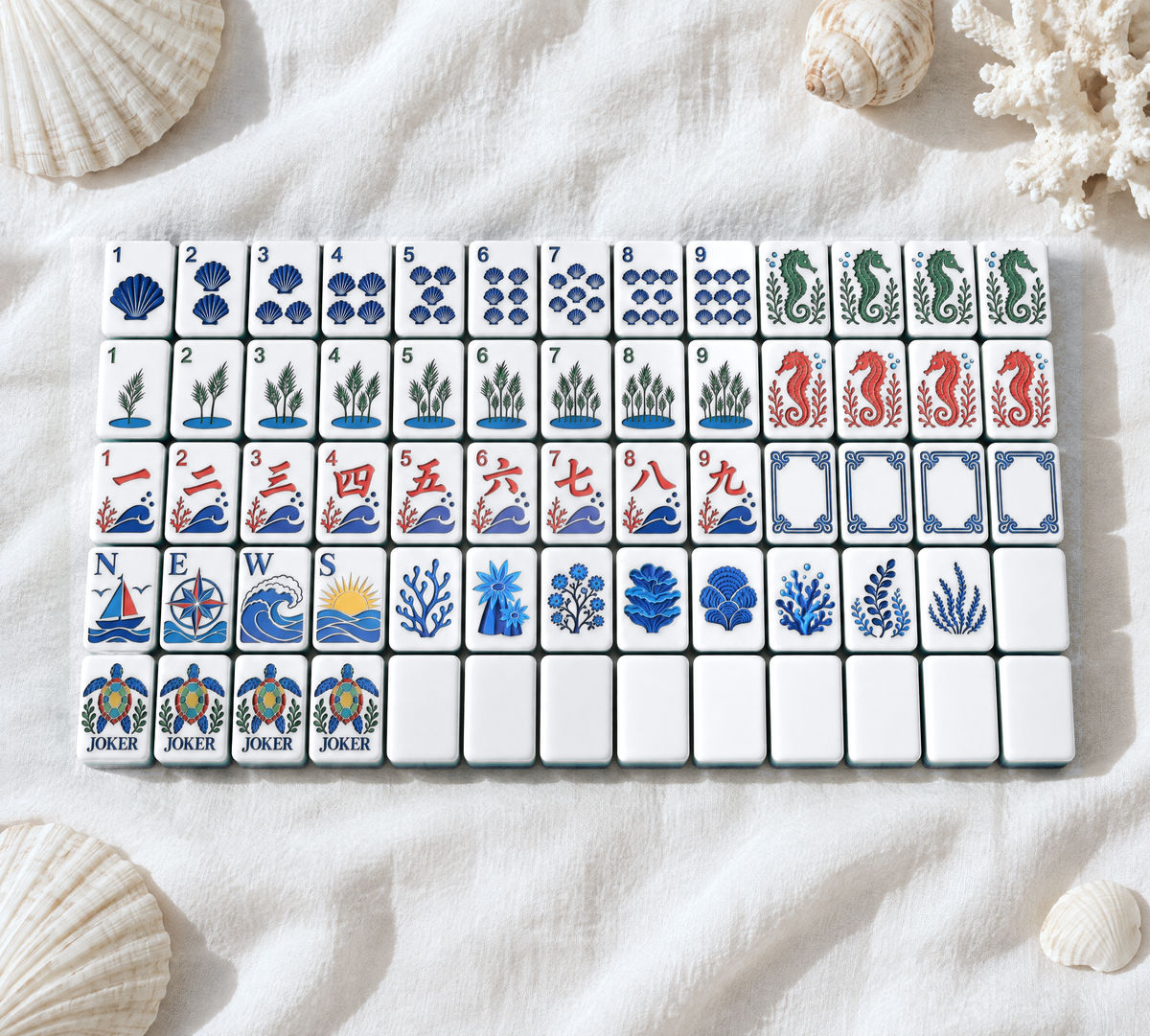
Japanese mahjong (riichi) uses 136 tiles (one suit, 1–9 × four copies, plus winds, dragons, and honors) and plays with a single drawn tile every turn—no passing or exchanging before play. Speed and hand concealment are core: you build in your hand, reveal nothing until you win, and must declare "riichi" (a ready hand betting move) to signal completion. Unlike American mahjong's set-based card hands, riichi rewards reading opponents' discards, spotting which tiles are safe, and calculating wait patterns (tanki, penchan, kanchan, ryanmen). A typical hand takes 15–18 draws. If you come from American mahjong, expect no chows, no jokers, no Charleston, and winning hands that follow simpler patterns: yakus (winning sets worth points) matter far more than face-value melds. Mahstead's best-selling mahjong sets include traditional tile collections suitable for learning multiple variants.
What is riichi and when do you declare it?
Riichi is a voluntary bet-declaration that signals you're one tile away from winning and commits you to a locked discard pattern. Once declared, you cannot change your hand shape—you must win exactly as announced or lose the riichi bet (typically 1,000 points). Declare riichi only when you're confident in your wait pattern and can sustain it through opponents' turns.

How do hand-wait patterns change your strategy?
Wait patterns determine which tiles win your hand. A tanki (single-tile wait) is risky—only one tile completes you. A ryanmen (two-end wait: 3-4-5, you wait for 3 or 5) is safer because two different tiles win. A kanchan (inside wait: 2-4, you wait for 3) is medium-safe. A penchan (terminal wait: 1-2 or 8-9) is narrow. Count your winning tiles in the live wall before declaring: if three 5-Dots remain and that's your only wait, riichi becomes a gamble. Safer patterns (ryanmen) let you riichi earlier and win more often.
Which tiles are safest to discard early?
In the opening round, honor tiles (winds and dragons) that match no one else's discard are safe. Mid-game, discard tiles no opponent has played—they signal weakness in that suit. Late-game, read your opponents' reveals and discard only tiles you know are in other players' hands or discarded already. Never discard from a suit where two or three players have drawn heavily; that suit likely contains winning tiles for at least one other hand. Track the "suji" (number sequence logic): if an opponent discarded a 3, they probably hold 2 or 4 as unsafe, so play 4 or higher if safe.
Wait Type | Winning Tiles | Risk Level | Riichi Timing | Best Use |
Ryanmen | 2 different numbers | Low | Earlier | Pair + two open suits |
Kanchan | 1 middle number | Medium | Mid-game | Tight pairs with one open suit |
Penchan | 1 terminal (1 or 9) | Medium-High | Late only | Last-resort hands |
Tanki | 1 single tile | Very high | Avoid | Emergency 1-2 draws left |
How do you read opponents' discards and avoid direct hits?
Each discard tells a story. A 1-Dot thrown early signals "I don't need Dots." If that player draws two turns later and keeps 3-Dot and 5-Dot, they may be building a Dot hand after all. Track sequences: opponent plays 2, 4, 6 Bams—they likely avoid 3 and 5. If you hold 3-Bam and they riichi, play 3-Bam only if another player already discarded 3-Bam (proof it's "dead"). Dangerous tiles include any number no one has discarded yet in the middle game, or any tile a riichi-player hasn't drawn themselves (they can't see it, so it's more likely in their hand). The suji rule: if 3-Bam is discarded and no 2 or 4-Bam has appeared, 2 and 4 are likely safe; bet on them before raw numbers.
What hand patterns (yakus) are easiest to win with?
Riichi mahjong has dozens of yakus, but three carry beginners home: tanyao (all 2–8, no honors or terminals), yakuhai (a pung of a dragon or your seat wind), and tsumo (self-drawn win on your turn, not called from discard). These combine easily and score consistently. Chanta (one terminal or honor in each meld plus a pair) and ittsuu (1-9 sequence in three suits) take more planning but yield mid-level scores. Avoid chasing high-point yakus early—focus on speed and finishing within 15 draws; every turn you stay alive, luck favors the ready hand. A fast tanyao beats a slow sanshoku.
🀄 Shop best-selling mahjong sets →

How does the wall work differently than American play?
Riichi uses a single 136-tile wall (no extra jokers or blanks). Players draw from the wall's live end in turn order, discard to the center (not a rack), and when the wall shrinks to 14 tiles (the "dead wall"), no more draws occur—remaining hands are dead. The dead wall also holds replacement tiles for kongs. There's no "quint" or "sextet" limit; a kong (four identical tiles) and a kong (four different shapes) can coexist. Jokers do not exist in riichi. Understanding wall scarcity—especially which suit tiles have been played—teaches you which tiles are "alive" (still in the wall) and which are "dead" (already discarded or played).
What mistakes do American mahjong players make in riichi?
Revealing your hand too early. In American mahjong, exposed melds are normal; in riichi, you hide everything until win. Showing interest in a suit by chasing it telegraphs your strategy. Declaring riichi on weak patterns. American players used to "one tile to win" hands get overconfident; riichi demands safer waits (ryanmen preferred). Ignoring honors early. In American mahjong, honors are secondary; in riichi, a single dragon-pung is a yaku and worth winning early. Not reading discards. American play follows a card; riichi requires constant inference. Playing too many hands. American sessions reward seat luck; riichi rewards folding dead hands and saving points. Fold (stop drawing, discard freely) when your hand has no yaku and the wall is half-gone.
🎁 See our most-loved mahjong sets & accessories →
Quick checklist: before your first riichi game
Know the 136 tiles. No jokers, no blanks—only honors and 1–9 in three suits (Bam, Crak, Dot).
Learn two yakus. Master tanyao and yakuhai so you can finish hands confidently.
Practice suji logic. If 3 is discarded, mentally mark 2 and 4 as safer later.
Count winning tiles. Before riichi, confirm at least two of your winning tiles are still in the live wall.
Track the wall. Watch how many tiles remain—if fewer than 20, dead hands should fold.
Play tight early. Discard honors, terminals, and unpopular numbers; build your hand invisibly.
✨ Find your Mahstead set — free US shipping →
What to check before you buy a mahjong set for riichi play
Traditional riichi sets use monochromatic or subtle tile designs. Look for sets with clear, non-reflective faces (easier to read from a distance). Some engraved tiles are customizable—ideal if you want to mark your set as riichi-dedicated. Check that the set includes exactly 136 tiles (one of each honor and number combination × four). Ensure jokers are absent and the bag is deep enough for upright wall-building. Acrylic sets hold their finish well through hundreds of games; bamboo and bone are traditional but require more care. Mahstead ships free across the US.

FAQ
Can I use an American mahjong set to play riichi?
Yes, if you remove the eight flowers, 16 extra winds beyond what you need, and all jokers—you'll have 136 tiles left. However, American sets are designed for 152-tile play; the tiles may be thicker or the suit symbols tuned for American viewing. A dedicated riichi set plays smoother. Mahstead's best-selling sets work for multiple variants if you're willing to set aside the extra tiles.
How long does a riichi game last compared to American mahjong?
A riichi hand (one complete round by one player) typically takes 15–18 draws, so 8–12 minutes per hand. A full four-player game (12–16 hands) runs 2–3 hours. American mahjong hands are usually faster (8–12 minutes per hand) because the card constrains patterns. Riichi feels slower because reads and waits demand more thought per turn.
What does "suji" mean and why is it critical for avoiding discards?
Suji (number sequence) is a tile-safety principle: if your opponent discarded 3-Bam, they likely discarded 3 to avoid 2-Bam or 4-Bam (which would be surrounded by 3 and unsafe). So 2 and 4 are safer plays. This logic extends: 1 and 4 are safer (they "sandwich" unsafe 2-3); 6 and 9 are safer (they sandwich 7-8). Suji reduces your chances of dealing a direct hit ("ho") on a waiting hand.
Should I riichi early if I have a tanyao hand?
Only if your wait is ryanmen (two tiles) and both are still in the live wall. Tanyao is common, so opponents will guess your shape once you riichi. Declare only when you're ahead in seat position or confident the wait is solid. If your wait is penchan (one terminal), fold and build a new hand rather than riichi and lose.
How do yakuhai (honor melds) change hand strategy?
A single pung of a wind (yours or the prevailing wind) or any dragon is an instant yaku, so your hand only needs one winning condition (two melds + pair + yakuhai pung). This speeds up completion. Build yakuhai early—don't wait for a third Dot to complete tanyao if you already have three White Dragons; declare tsumo riichi and take the win.


View More
View More
View More
