
How to Read Mahjong Dots: A Player's Visual Guide
Last updated: Nov 23, 2026
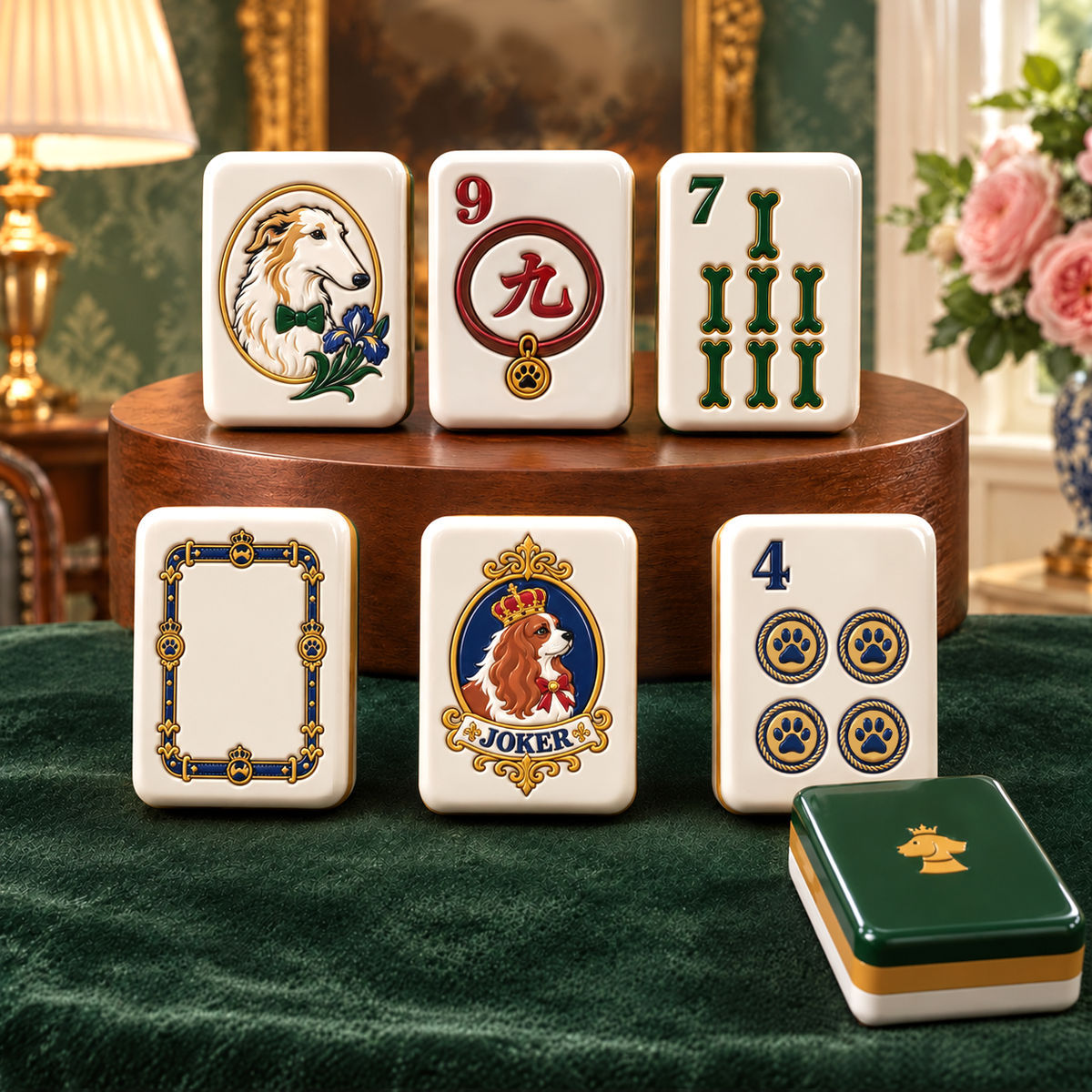
Reading Dot tiles is straightforward once you know what to look for. Every Dot tile displays a suit marker (usually a small circle or dot icon) and a number of small filled circles—called pips—that correspond to the tile's rank from 1 to 9. The 1 Dot has one pip, the 2 Dot has two, and so on through the 9 Dot. Most American mahjong sets use clear, embossed designs on acrylic tiles, making the pip count instantly visible even in low light or across a table. Each number appears four times in a standard set, so you'll see four copies of the 1 Dot, four 2 Dots, and so forth. Learning to scan Dots quickly—often in tandem with reading Bams and Craks—is essential for fast hand organization and decision-making during play. Most newer players master this within one or two game sessions. A best-selling mahjong set with high-contrast acrylic or engraved tiles makes the difference between squinting and reading confidently.
What exactly are Dots, and why is the suit called that?
Dots are one of three numbered suits in American mahjong, along with Bams (bamboo) and Craks (cracks). The name "Dot" comes from the visual—each tile in this suit is marked with a cluster of small filled circles. Historically, the Dot suit represented coins in Chinese mahjong, but modern American sets use stylized pips instead. The Dot suit is traditionally associated with the White dragon (also called Soap), though you'll encounter all four winds and three dragon honors separately in your hand. Dots are worth learning to read first because their design is usually the most uniform—just circles, no decorative elements—making them easier to spot quickly during play.
🀄 Shop best-selling mahjong sets →

How many pips are on each Dot tile, and how do I count them fast?
The pip count on a Dot tile always matches its number: a 1 Dot has one pip, a 2 Dot has two pips arranged in a diagonal line, a 3 Dot has three pips in a line, a 4 Dot has four pips in the corners (a square pattern), a 5 Dot has five pips with one in the center and four in the corners, a 6 Dot has six pips in two columns, a 7 Dot has seven pips, an 8 Dot has eight pips, and a 9 Dot has nine pips filling most of the tile. To count fast at the table, don't count each pip individually—instead, look for the pattern. A 5 Dot's center pip is a dead giveaway; a 4 or 6 is recognizable by its symmetry; higher numbers usually occupy a full grid. Most players report that after three or four games, they recognize tile numbers by shape and pattern rather than conscious counting. Keep tiles at arm's length or tilt them slightly toward the light if the engraving is subtle; on a mat with a dark playing surface, light tiles stand out well.
What's the difference between reading printed and engraved Dots?
Printed Dots are painted or stamped onto tile surfaces; they can wear or blur over time, especially on tiles handled frequently. Engraved Dots are carved into the acrylic itself, creating raised or recessed lines that catch light and remain legible for years. Engraved tiles are tactile—your fingers feel the pattern—which helps players with low vision and adds to the sensory experience of the game. Most premium American mahjong sets use engraving. If you're hosting weekly games or playing in clubs, engraved tiles prove worthwhile because they stay readable through dozens of games a year and don't fade or flake. Printed sets cost less initially but require replacement sooner if your group plays frequently. When shopping for a set, ask whether the pip marks are engraved or printed; if the product photos show deep texture in the design, that's usually engraving.
How do I organize my hand so I can read Dots quickly during play?
Group tiles by suit as you draw them: all Dots together, Bams in the middle, Craks on the far side. Stand each Dot tile with its number facing you at a consistent angle. Within the Dot group, arrange them in ascending order (1, 2, 3, 4, 5, 6, 7, 8, 9) or in the order they appear in your winning hand on the National Mah Jongg League card. A mahjong rack with pushers helps here—the pushers let you separate pips, Bams, and Craks into visual blocks so your eye doesn't have to hunt. Once your hand is sorted, reading and discarding become automatic. Many players sort their hand before the first draw, then maintain that order as tiles arrive. This habit cuts decision time roughly in half and prevents errors like forgetting you already have a tile.
Organization Method | Speed | Error Rate | Best For |
Random piles (no sorting) | Slow | High | Absolute beginners only |
Grouped by suit, no order | Medium | Medium | Casual weekly games |
Grouped and numbered 1–9 | Fast | Low | League players, weekly groups |
Rack with pushers, sorted | Fastest | Lowest | Fast-paced tables, competitions |

What common mistakes do new players make when reading Dots?
Confusing the 1 Dot with honor tiles: The 1 Dot has a single pip and looks minimal, but it's clearly marked with the Dot suit symbol. Honor tiles (winds, dragons, flowers) have no numbered pips at all—they're labeled with words or symbols. Take a moment to look for the pips first. Misreading a 6 Dot as a 5 Dot: The 6 Dot's two-column layout can blur if tiles are close together. Separate them by an inch or two. Forgetting that Dots are always circles, never lines or other shapes: If it has a line or bamboo stalk, it's a Bam. If it has a cracked line, it's a Crak. Once you internalize that rule, you'll never reach for the wrong suit. Holding tiles too close or at the wrong angle: Move tiles to arm's length; tilt them slightly if the light is flat. Poor lighting makes even clear engraving hard to read. Not using your rack: If you're playing on a table without a rack, use your hand to prop tiles at a viewing angle—don't lay them flat. Most experienced players always keep their 13 tiles standing upright and readable.
🎁 See our most-loved mahjong sets & accessories →
What tiles look like Dots but aren't, and how do I avoid mix-ups?
The White dragon (Soap) is the only honor tile that sometimes confuses new players about Dots. The White dragon is blank or has a border but no pips inside—it's associated with the Dot suit thematically but is not itself a numbered Dot. Check the tile face: if you see numbered pips (1–9 circles), it's a Dot. If the tile is blank or labeled with a word or symbol, it's an honor. Winds (North, East, West, South) have Chinese characters or letters—never pips. Dragons have names or colors—Red, Green, White. Flowers and seasons are separate honor tiles with their own markings. The surest rule: pips = numbered suit; no pips = honor. Once you've handled a full set two or three times, your brain locks in the difference instantly.
How does reading Dots help you during actual play?
Reading Dots quickly means you spot your winning hand, discard strategically, and respond to other players' moves in real time. If you're hunting for a specific tile to complete a pung or to discard safely, scanning your Dots in order cuts search time from seconds to under a second. Fast reads also help you avoid beginner tells—hesitation, re-reading, fumbling—that signal weakness to the table and influence discards from other players. Speed is especially important during the Charleston (the pre-game tile-pass), when you must swap tiles without accidentally passing your winning hand. Over weeks of play, reading Dots becomes as automatic as reading the word "red"—you see the pattern and know the number without thinking. Newcomers often ask how experienced players seem to make decisions so quickly; much of that speed comes from fluent tile recognition.
✨ Find your Mahstead set — free US shipping →
What to check before you buy a mahjong set for reading clarity
Before ordering, examine the product photos closely. Look for: Contrast between tile color and pip color. Light tiles with dark pips (or vice versa) are easier to read than low-contrast colors. Engraving depth. Photos showing clear texture and shadow in the pip area usually indicate engraving rather than printing. Tile size. Standard American mahjong tiles are roughly 1 inch × 0.75 inch. Smaller tiles are harder to read; verify dimensions before purchase. Lighting in photos. If the product photos were taken under bright light and pips are still hard to see, the tiles may be printed on a glossy finish that reflects glare—a common problem. Materials. Acrylic tiles with matt finishes (not glossy) tend to be easier to read at table than bone or bamboo, which can be slick. Check the product description for material and surface finish. If you're new to reading Dots, start with a best-selling set designed for clarity—high contrast, engraved, acrylic. Once you're fluent, you can enjoy less conventional designs or materials.

FAQ
Is the 5 Dot easier to read than other Dots?
Yes. The 5 Dot always has a center pip surrounded by four corner pips—a distinctive pattern. Most players recognize it instantly and use it as a mental anchor when counting pips on adjacent tiles.
Can I read Dots if I have low vision?
Yes, with the right set. Engraved, high-contrast acrylic tiles with large pips are readable by touch as well as sight. A mahjong rack with pushers separates tiles so each is individually accessible.
Why do some Dot tiles look different in color from others?
Some sets use a gradient or shade variation to help older players distinguish between higher and lower numbers. This is intentional and makes scanning faster. Check product photos to see whether the set uses this feature.
Do Dots look the same in American, Chinese, and Hong Kong mahjong?
In Chinese and Hong Kong mahjong, Dots (called Circles) have the same pip layout (1–9), but the overall tile design, symbols, and tile count differ. American mahjong Dots are always read the same way.
What's the fastest way to learn to read Dots?
Play one full game with a veteran player who explains suit markers. Then host or join a second game and organize your tiles by suit and number. Most players read Dots fluently by game three.
If I misread a Dot tile during the Charleston, is my pass invalid?
Not automatically. If the error is caught before play begins, most groups allow you to correct it and re-do the pass. Once play starts, the tiles stand as played. Slow down during the Charleston to prevent this.
Can engraved Dot tiles wear out or become unreadable?
Engraving is durable and lasts thousands of games. Printed Dot tiles can blur or flake after years of heavy play. Engraved sets remain readable for a decade or more with normal use.


View More
View More
View More
