
How to Play Shanghai Mahjong: Rules & Setup Guide
Last updated: Nov 23, 2026
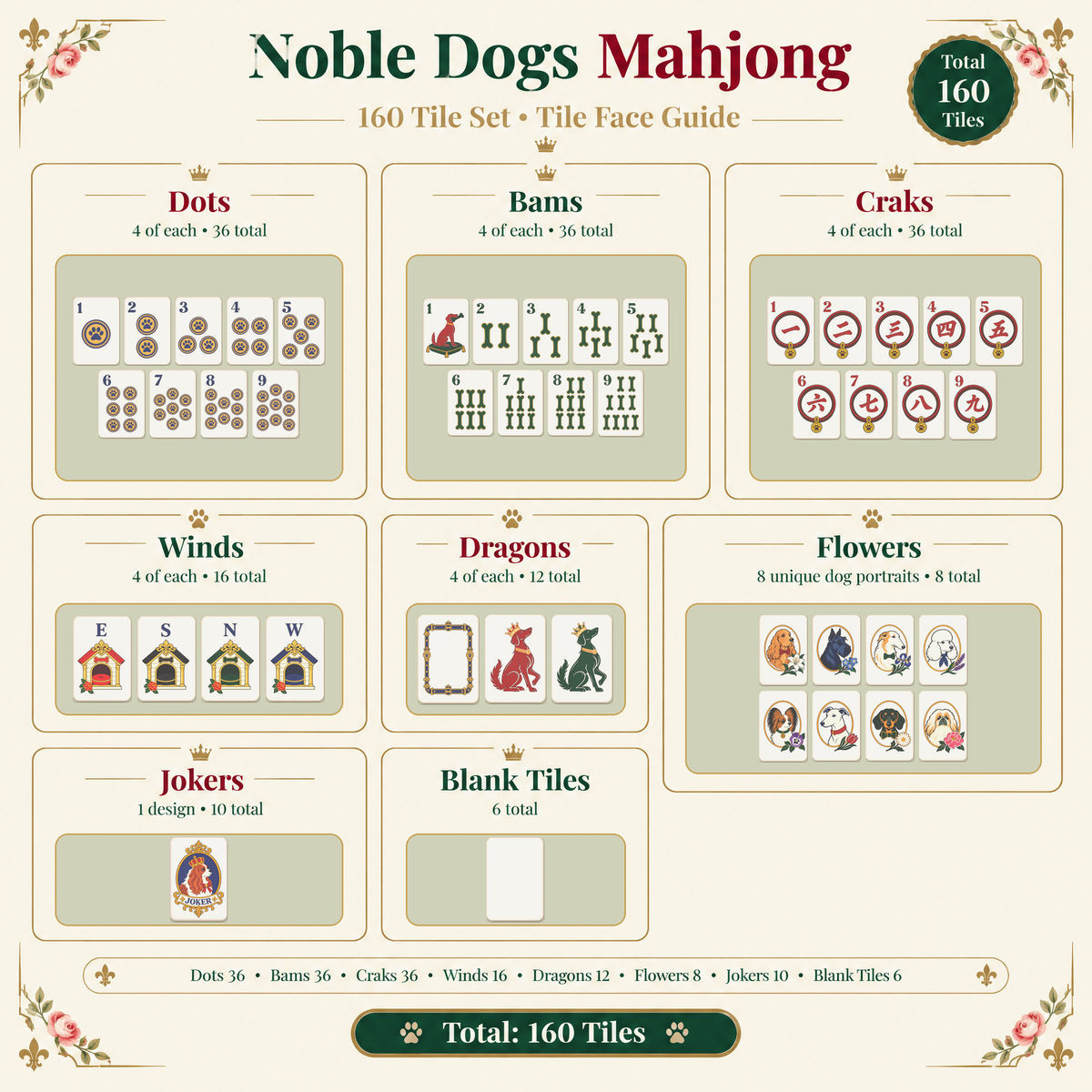
Shanghai mahjong uses 144 tiles (three suits—Bams, Craks, Dots—1–9 in each; winds; dragons; flowers) and plays in rounds with four players. Players draw and discard tiles to build complete hands of melds (pungs of three identical tiles, kongs of four, or sequences: 1-2-3, 4-5-6, etc.). Unlike American mahjong, sequences are legal and fully flexible; you win by declaring mahjong when you hold a winning pattern. A hand typically takes 5–10 minutes. Shanghai has no jokers, no special card, no Charleston passing. A game runs 4 rounds (East, South, West, North winds); scoring varies by region but often credits only the winner. You'll need a 144-tile set with wind and dragon indicators, mahjong tiles, and a mat to protect the playing surface.
Shanghai mahjong is a fast-paced Chinese variant using 144 tiles (three suits—Bams, Craks, Dots—1–9 in each; winds; dragons; flowers) and plays in rounds with four players. Players draw and discard tiles to build complete hands of melds (pungs of three identical tiles, kongs of four, or sequences: 1-2-3, 4-5-6, etc.). Unlike American mahjong, sequences are legal and fully flexible; you win by declaring mahjong when you hold a winning pattern. A hand typically takes 5–10 minutes. Shanghai has no jokers, no special card, no Charleston passing. A game runs 4 rounds (East, South, West, North winds); scoring varies by region but often credits only the winner. You'll need a 144-tile set with wind and dragon indicators and a mat to protect the playing surface.
What is Shanghai mahjong and how does it differ from American mahjong?
Shanghai mahjong is a Chinese regional game predating the American variant by decades. It uses 144 tiles versus American mahjong's 152, has no jokers or special card, and permits sequences (chows: 1-2-3, 4-5-6, etc.) as legal melds—the core difference. American mahjong requires an annual card listing legal hands and bans sequences except in rare cases; Shanghai plays free-form, winning patterns adapt to what tiles you draw. Shanghai rounds resolve faster (5–10 minutes per hand) because no Charleston ritual slows setup. Scoring in Shanghai rewards only the winner per round; American mahjong awards points to all players based on complexity. Both games require tiles, winds, dragons, and flowers, but Shanghai's simpler ruleset makes it ideal for casual players or those learning before tackling American rules.

How do you set up the wall and deal tiles in Shanghai?
To set up, shuffle all 144 tiles face-down and place them in a long wall (two rows of 36 tiles each) around the table center. Each of the four players sits at a compass point (East, South, West, North). The dealer (traditionally East) draws 14 tiles from the wall, arranging them into racks; the other three players each draw 13. All tiles rest on racks hidden from opponents so only the tile holder sees their hand. The dealer initiates play by discarding one tile face-up into the center. Play moves counterclockwise from the dealer. The wall shrinks as players draw; when the wall empties and no player has won, that round ends in a draw (called a "goulash" or "dead wall" game). Rebuilding the wall and passing the dealer seat East marks the start of the next round.
What hand patterns win in Shanghai mahjong?
A winning Shanghai hand contains 14 tiles: four melds (three tiles each—pung or chow—plus one pair, totaling 4 × 3 + 2 = 14). A pung is three identical tiles (e.g., three 5 Dots). A chow is a sequence: three consecutive numbers in one suit (e.g., 4-5-6 Bams). You may also use pairs of winds or dragons as a meld if the hand pattern permits, though most hands favor four pungs/chows plus a pair of any tiles. There is no hand card; patterns flow freely based on available tiles. Melds can be exposed (declared when another player discards a tile you need) or hidden (kept concealed until you win). An all-pung hand (fourteen tiles in four pungs plus a pair, with no chows) often earns bonus points in regional variants. A hand made entirely of sequences (chow hand) scores differently. Winning is simply matching any legal 14-tile pattern—parity matters only regionally.
Hand Type | Composition | Speed | Bonus Points? |
Standard | 4 melds + 1 pair | Fast to build | No |
All pung | 4 pungs + 1 pair | Moderate | Yes (most variants) |
All chow | 4 sequences + 1 pair | Varies | Possible |
All honors | Winds + dragons only | Rare | Yes |
Mixed | Pungs, chows, honors | Flexible | Regional |
How does play flow and what actions can you take?
On your turn, draw one tile from the wall. You now hold 15 tiles (or 14 if you drew when you had 13). Examine your hand and discard one tile face-up into the center. As soon as you discard, other players may claim that tile if they need it to complete a pung (three identical tiles) or a chow (if it's the middle or end of a sequence you hold). If multiple players want the discarded tile, the player closest in turn order wins it. When you claim a discarded tile, expose that meld face-up on your rack and declare it aloud. Your turn then ends, and the next player draws from the wall. If no one claims your discard, play passes to the left. You may also draw from the wall and declare mahjong immediately if your hand is complete (14 tiles in four melds plus a pair). In some variants, you may also steal a tile during another player's kong (drawing a replacement tile after revealing four identical tiles as a meld); this is called "robbing the kong" and wins the hand if you complete mahjong using the stolen tile.

What's the basic scoring system and how do you tally points?
Shanghai scoring varies by region, but the most common rule credits only the winner. When a player declares mahjong, the three other players each pay the winner a fixed stake (often one or two chips per round, or one-tenth of a yuan equivalent). Bonus scoring applies to certain patterns: all-pung hands earn a multiplier (2× or 3× the base stake), all-honors hands often earn maximum payout, and hands assembled entirely from discard claims (no tiles drawn from the wall except the winning draw) sometimes double payment. If a hand ends in a draw (wall exhausted, no winner), no one pays; the next round begins. In some regional variants, players tally cumulative scores across four rounds (one for each wind); the player with the highest total at the end wins the session. Most casual home games keep scoring simple: winner takes one chip per player, higher-scoring patterns take more. Agree on the rule set before play begins so disputes don't delay the game.
How do you avoid common mistakes when learning Shanghai mahjong?
Mistake: Confusing chow legality. In Shanghai, a chow must be three consecutive tiles in one suit (e.g., 4-5-6 Bams is legal; 4 Bams, 5 Craks, 6 Dots is not). Check before you discard that you aren't breaking a sequence you need.
Mistake: Exposing melds too early. When you claim a discarded tile, you must expose that meld. However, hidden melds score higher in many variants. Delay claims if you're not desperate for that tile.
Mistake: Forgetting to draw after exposing. If you claim a tile mid-turn, you skip your draw that round. Verify whose turn it is before drawing from the wall.
Mistake: Holding a "dead" hand. Track which tiles have been discarded. If you need a 5 Crak and three have already left the wall, your hand cannot win; consider pivoting to a new pattern.
Mistake: Misreading winds and dragons. Each player sits at a compass direction (East, South, West, North) corresponding to wind tiles. A pung of East winds can only be held by the East player in some variants; verify your house rules before betting.
What to check before you buy
—Confirm the set has 144 tiles (not 152). Shanghai uses exactly 144; American sets carry 152 and extra jokers you won't use. —Verify the set includes wind and dragon indicators (stamps, symbols, or color codes). These are essential to distinguish tiles at a glance. —Check that tiles are large and comfortable to handle during a 10-minute round; small tiles tire hands fast. —Ensure the racks hide your hand from opponents; opaque barriers matter in Shanghai where secrecy is key. —Look for a durable carrying case if you plan to transport the set, since 144 tiles and racks are fragile.
🀄 Shop best-selling mahjong sets →
Shanghai vs. other regional Chinese variants: a quick comparison
Shanghai is one of five major regional Chinese mahjong styles (Shanghai, Guangdong, Sichuan, Fujian, Zhejiang). Shanghai uses 144 tiles and permits all melds freely. Guangdong (Cantonese) mahjong also uses 144 tiles but plays with more complex bonus rules and "limit" scoring (maximum points per hand). Sichuan mahjong uses simpler tile counts and faster rounds, favoring casual play. Taiwanese mahjong blends Shanghai and Japanese (Riichi) rules, adding wall-stealing mechanics and honor-only hands. Hong Kong mahjong (often called Cantonese) emphasizes scoring multipliers and rarely plays for money in Western contexts. American mahjong, invented in the 1920s, standardized the game for Western players using a fixed card of legal hands each year, jokers, and a formal hand-passing ritual (Charleston) before play. If you're learning Shanghai for the first time, stick to one regional ruleset (agreed with your group before sitting down) and avoid jumping between variants until you're confident; mixing rules is the fastest way to create table tension.
🎁 See our most-loved mahjong sets & accessories →
Setting up your first Shanghai game: a checklist
Shuffle all 144 tiles (face-down, in one central heap).
Arrange the wall (two rows of 36 tiles each, around the table center).
Assign East player (dealer); others are South, West, North (counterclockwise).
East draws 14 tiles; South, West, North each draw 13.
All players arrange tiles on racks, hidden from opponents.
East discards one tile face-up into the center.
Players take turns (counterclockwise) drawing from the wall and discarding.
Claim tiles (for pungs or chows) if another player discards what you need; expose the meld.
Declare mahjong when your hand is complete (14 tiles, four melds + pair).
Settle the score (winner takes payment per agreed stakes).
Pass the dealer seat East to the next player (South becomes East, etc.) for the next round.
Practicing this sequence once will make your second game feel natural. Many groups play four rounds (one per wind direction), then tally cumulative scores.
One final note: Shanghai mahjong is deeply regional, and house rules vary. Some groups play "robbing the kong," others forbid it. Some double-pay for all-pung hands; others don't. Before your first game, spend five minutes with the group confirming the ruleset—especially the pay-out structure and bonus hands. This ten-minute conversation prevents hour-long disputes later. Grab a mahjong mat to protect your playing surface and keep tiles organized, and consider racks with pushers if you play weekly; they make holding and managing a 144-tile hand effortless and reduce hand fatigue.
✨ Find your Mahstead set — free US shipping →

FAQ
Can I play Shanghai mahjong with an American mahjong set?
No. American sets have 152 tiles plus jokers; Shanghai uses exactly 144. Jokers and extra tiles will confuse the game. You'll also lack the proper wind and dragon tile layout Shanghai requires. Buy a dedicated 144-tile Shanghai set.
How long does one round of Shanghai mahjong take?
A typical round lasts 5–10 minutes. If the wall empties without a winner, the round ends in a draw and a new round begins. A full game (four rounds, one per wind) usually takes 30–50 minutes.
What happens if two players claim the same discarded tile?
The player closest in turn order after the discarder wins the tile. If the discarder is East, South has first claim, then West, then North. In a mahjong claim (winning with that tile), the player who declares mahjong first wins over a pung or chow claim.
Is Shanghai mahjong easier to learn than American mahjong?
Yes, in most ways. Shanghai has no annual hand card, no jokers, no Charleston passing, and simpler scoring. However, American mahjong has a fixed set of legal hands, so you memorize patterns faster; Shanghai lets you build any valid 14-tile pattern, which requires more tactical thinking mid-game. Both take 1–2 sessions to feel comfortable.
Do I need wind and dragon tiles to play Shanghai mahjong?
Yes. Winds and dragons are part of the 144-tile count and appear in many winning hands. A set without clear wind and dragon markings will slow play because you'll misidentify tiles. Always use a set with visible symbols, stamps, or color codes for these tiles.
Can I play Shanghai mahjong with fewer than four players?
Traditionally, no—Shanghai is a four-player game. The wall, tile distribution, and discard patterns assume four people. Some regional variants allow three-player Shanghai, but you'll need to adjust tile counts and dealer rotation. Stick to four players for your first games.
What's the difference between a pung and a chow in Shanghai?
A pung is three identical tiles (e.g., three 5 Dots). A chow is three consecutive tiles in one suit (e.g., 4-5-6 Bams). You need both types in a winning hand: four melds (any mix of pungs and chows) plus a pair. Pungs are easier to build; chows require you to hold or draw consecutive numbers.


View More
View More
View More
