
How to Play British Mahjong: Rules, Setup & Key Differences
Last updated: Nov 23, 2026
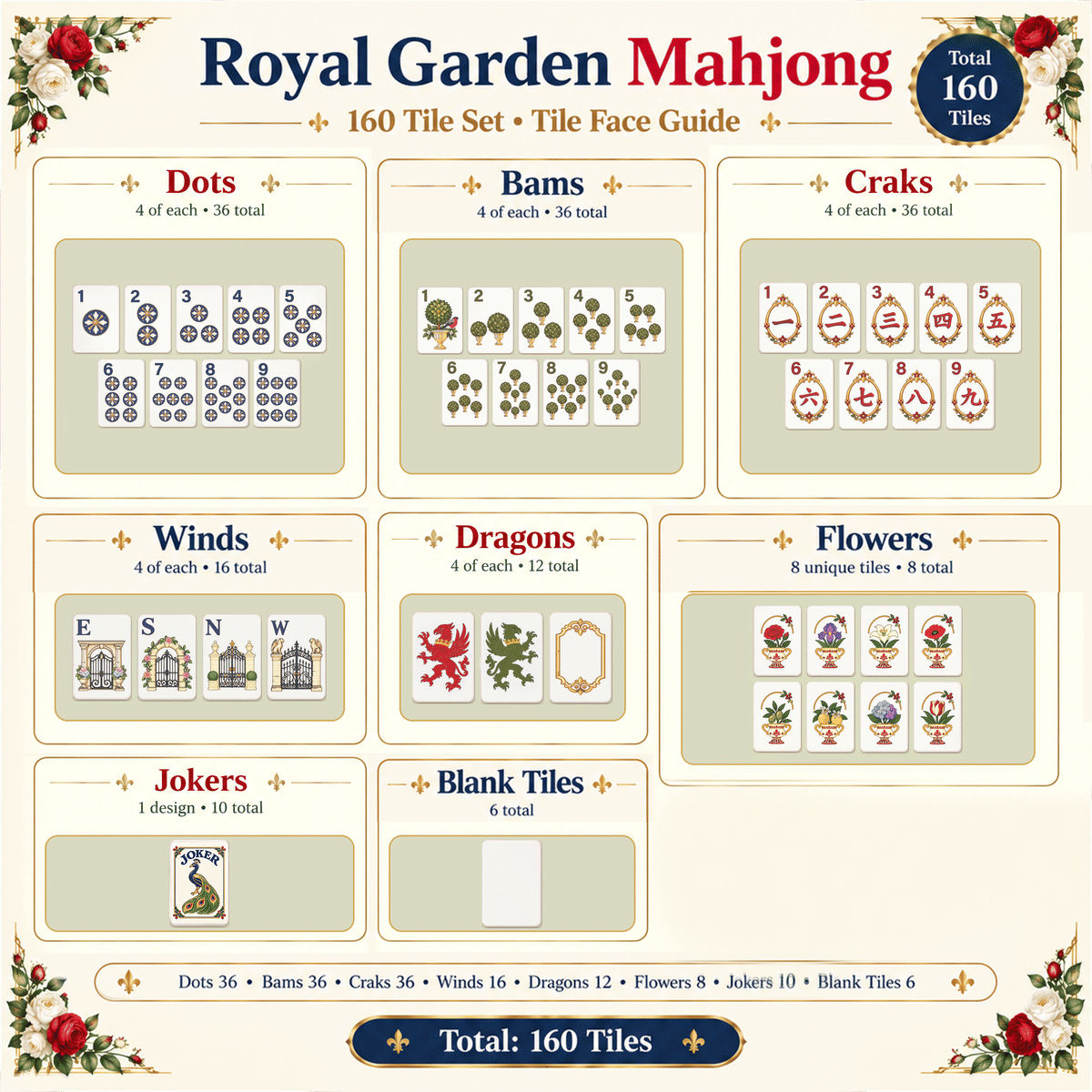
British mahjong (also called Mahjong GB or UK-style play) is a four-player tile rummy game using 144 tiles across four suits (Bams, Craks, Dots, Honours). Players draw and discard tiles to form melds (sequences of 1–9 called chows, or triplets of identical tiles called pungs) and a winning pair. The game differs sharply from American mahjong: no jokers, no annual card hand list, no Charleston, and all melds can be called from the discard pile by any player. Hands come from published rulebooks or memory; a typical game lasts 15–40 minutes depending on house rules. British play is popular in the UK, Australia, and parts of Canada. We recommend learning from a rulebook first, then joining a local club or online group to play live; equipment-wise, you'll need a standard 144-tile set (Mahstead offers quality 160-tile sets with spare tiles that work fine for British play, though you'd use only 144).
British mahjong is a four-player tile rummy game using 144 tiles across four suits (Bams, Craks, Dots, Honours). Players draw and discard tiles to form melds (sequences of 1–9 called chows, or triplets of identical tiles called pungs) and a winning pair. The game differs sharply from American mahjong: no jokers, no annual card hand list, no Charleston, and all melds can be called from the discard pile by any player. Hands come from published rulebooks or memory; a typical game lasts 15–40 minutes depending on house rules. British play is popular in the UK, Australia, and parts of Canada. We recommend learning from a rulebook first, then joining a local club or online group to play live; you'll need a standard 144-tile set—our best-selling mahjong sets include 160-tile options with spare tiles that work perfectly for British play.
What tiles are in a British mahjong set, and where do you get one?
A British mahjong set contains 144 tiles: Bams (1–9), Craks (1–9), Dots (1–9), and Honours (16 wind tiles plus 16 dragon or similar honor tiles). Each tile appears four times. There are no flower tiles and no jokers—this is the core difference from American play. You can buy a 144-tile set from mahjong retailers worldwide or use a larger set (like a 160-tile variant) and simply set aside the extra tiles before play. Since British mahjong predates the standardized American ruleset, many local clubs still teach from handwritten or printed cards rather than a single official yearly card. If you're new to the game, find a rulebook from a UK or Australian mahjong association or ask players in your area which hand-list they use.
🀄 Shop best-selling mahjong sets →

How do you set up a British mahjong game?
Each player sits at one side of the table. The dealer (East) and other players (South, West, North) are assigned by agreement or house rule. The dealer shuffles all 144 tiles face-down and builds a wall of 38 tiles per player (two rows of 19 tiles, stacked two high). Players then draw tiles from the wall in turn—East draws 14, others draw 13—until everyone has a hand of 13 tiles and the deck shows 8 tiles remaining (called the "live end"). East then draws the 14th tile and discards one face-up to the center, and play rotates. The goal is to build a hand of four melds and a pair. Unlike American mahjong, there is no Charleston (pre-game tile pass) and no rack with pushers; players hold tiles in hand and manage their own discard pile.
What are the rules for calling tiles and making melds?
In British mahjong, any player can call a discarded tile to complete a meld—this is the biggest departure from American play. If you need a tile someone just threw away, you announce "Chow" (a sequence like 3–4–5 Bams), "Pung" (three identical tiles like three 7 Dots), or "Kong" (four identical tiles). You take the tile, expose your meld on the table, and play continues. If no one calls, the next player takes a tile from the wall. You can also declare a "loose tile" (one you draw from the wall) by announcing "Chow," "Pung," or "Kong" before anyone else plays. Winning is called "Mah-jong" and happens when you have four melds plus a pair. Some variants require a "concealed" hand (all tiles drawn from the wall, not called) to score higher. Always check house rules before you play, as British clubs vary widely on scoring and special hands.
How does British mahjong scoring work?
British mahjong scoring is simpler than American play and often based on a flat points system or "payments" between players. One common method: the winner collects points from each losing player based on what was on the table (e.g., 1 point per meld, 2 points for winning hand, bonuses for special patterns like all honor tiles or a suit hand). Some clubs use a points card or printed scoresheet; others play "friendly" and don't keep strict tally. Scoring is highly localized—ask other players in your area how they settle up. If you're playing for money, clarify the stake per point beforehand. Unlike American mahjong (which has a detailed 2026 scoring card published by the National Mah Jongg League), British play relies on house rules or club customs, so consistency matters more than knowing a single rulebook.
🎁 See our most-loved mahjong sets & accessories →

British mahjong vs. American mahjong: key differences at a glance
Feature | British Mahjong | American Mahjong |
Tiles in play | 144 tiles only | 152 tiles + 8 jokers |
Jokers | None | 8 (can substitute in any meld) |
Hand list | From rulebook or memory | New National Mah Jongg League card each year |
Pre-game pass | No | Yes—the Charleston |
Calling tiles | Any player can call any discard | Only the next player can call; exposed melds limited |
Melds allowed | Chows (sequences 1–9) and Pungs (triplets) | Pungs, Kongs, Quints, Sextets only—no chows |
Game length | 15–40 minutes | 30–60 minutes |
Scoring | House rules or points card | Detailed National League card with point values |
Where played | UK, Australia, Canada, Asia | USA, Canada, Australia |
This table shows the clearest split: British play allows calling sequences (chows) and open calling from anyone, while American play is more rigid and reserved—a fundamental rule difference that changes strategy and pace entirely.
What equipment do you need to play British mahjong at home?
You need a 144-tile mahjong set (one for each player or shared), a table at least 3 feet square, and a way to keep score (paper and pen, or a scoresheet). British players rarely use racks with pushers; tiles sit in hand or on the table edge. A soft mat under the tiles prevents noise and protects the surface—especially helpful if you play weekly. Many players also use a tile bag or case to store and transport their set. If you're hosting regular games, a durable mahjong mat makes play comfortable and keeps tiles visible; our mahjong mats come in sizes that fit standard tables and protect both tiles and furniture. For travel or storage, a quality bag or case keeps your set safe between sessions.
What to check before you buy a British mahjong set
Tile count: Confirm the set has at least 144 tiles (most retail sets are 144 or 160). British play uses exactly 144; extras are spares.
Suit clarity: Make sure Bams, Craks, and Dots are easy to distinguish at a glance, and Honours are clearly marked (winds and dragons).
Tile size and weight: If you have arthritis or prefer heavier tiles, test them in hand first or ask the seller about dimensions and material.
Storage: Check if the set comes with a bag or case; British players often travel to clubs, so portability matters.
Surface protection: Pair your set with a soft mat if you play on a hard table; noise and tile sliding are real issues in home games.
Rules source: Before buying, confirm you have access to a rulebook, club handout, or online guide for the variant your local group plays—British rules vary by region.
✨ Find your Mahstead set — free US shipping →
Where to find British mahjong players and clubs
Look for mahjong clubs through community centers, libraries, and online mahjong forums or meetup boards in your area. Many UK clubs publish their schedule online or on community notice boards. In Australia and Canada, search "[your city] mahjong club" or ask at local Chinese cultural centers. Online play is also growing—several platforms host British mahjong games; you'll learn rules faster if you play live first with experienced players. Starting with a rulebook and one friendly game will show you whether British or another variant suits you better; each has its own pace and strategy.
What You'll Need
Item | Why it matters | Our pick |
144-tile set | Correct tile count for British play | Best-selling mahjong sets with durable tiles and clear suit markings |
Soft mat | Protects table, reduces noise, makes play comfortable | Quality mahjong mats in multiple sizes |
Bag or case | Keeps tiles safe for weekly club games | Travel bags and cases with padded compartments |
Rulebook or club handout | Ensures you're playing by house rules | Download or request from your local club before first session |

FAQ
Is British mahjong the same as Hong Kong or Chinese mahjong?
No. British mahjong evolved from Chinese play but added distinct rules: players can call any discard (not just the next player's), and all four melds are typically sequences or triplets. Chinese and Hong Kong variants have different scoring systems and honor special hands. Check which rule set your local players use.
Can I use American mahjong tiles to play British mahjong?
American sets have 152 tiles plus 8 jokers; British play uses only 144. You'd need to remove 16 tiles and ignore all jokers. It's simpler to buy a 144-tile set designed for British or standard Chinese play, though a 160-tile set with extras works fine if you set aside the spares.
Do I need racks and pushers for British mahjong?
No. British players hold tiles in hand or lay them on the table edge; racks with pushers are mostly used in American play. You can use them if you prefer, but they're optional and not part of traditional British house rules.
How long does a game of British mahjong take?
Typically 15–40 minutes, depending on how quickly players draw and discard. American mahjong, by contrast, usually takes 30–60 minutes because players must match the annual card hand-list and scoring is more complex.
What's the easiest way to learn British mahjong if I've never played?
Ask a local club or experienced player for their rulebook or handout, watch one complete game, then play alongside someone experienced. Most British clubs are welcoming to beginners; ask for a "teaching game" where players explain calls and strategy as they go.
Can I play British mahjong with two or three players?
Standard British mahjong is four-player, but many clubs have two- and three-player variants with modified walls and scoring. Ask your local club for their house rules; two-player games are faster and more competitive than four-player casual rounds.


View More
View More
View More
