
How Many Tiles in Siamese Mahjong: Setup & Rules
Last updated: Nov 23, 2026
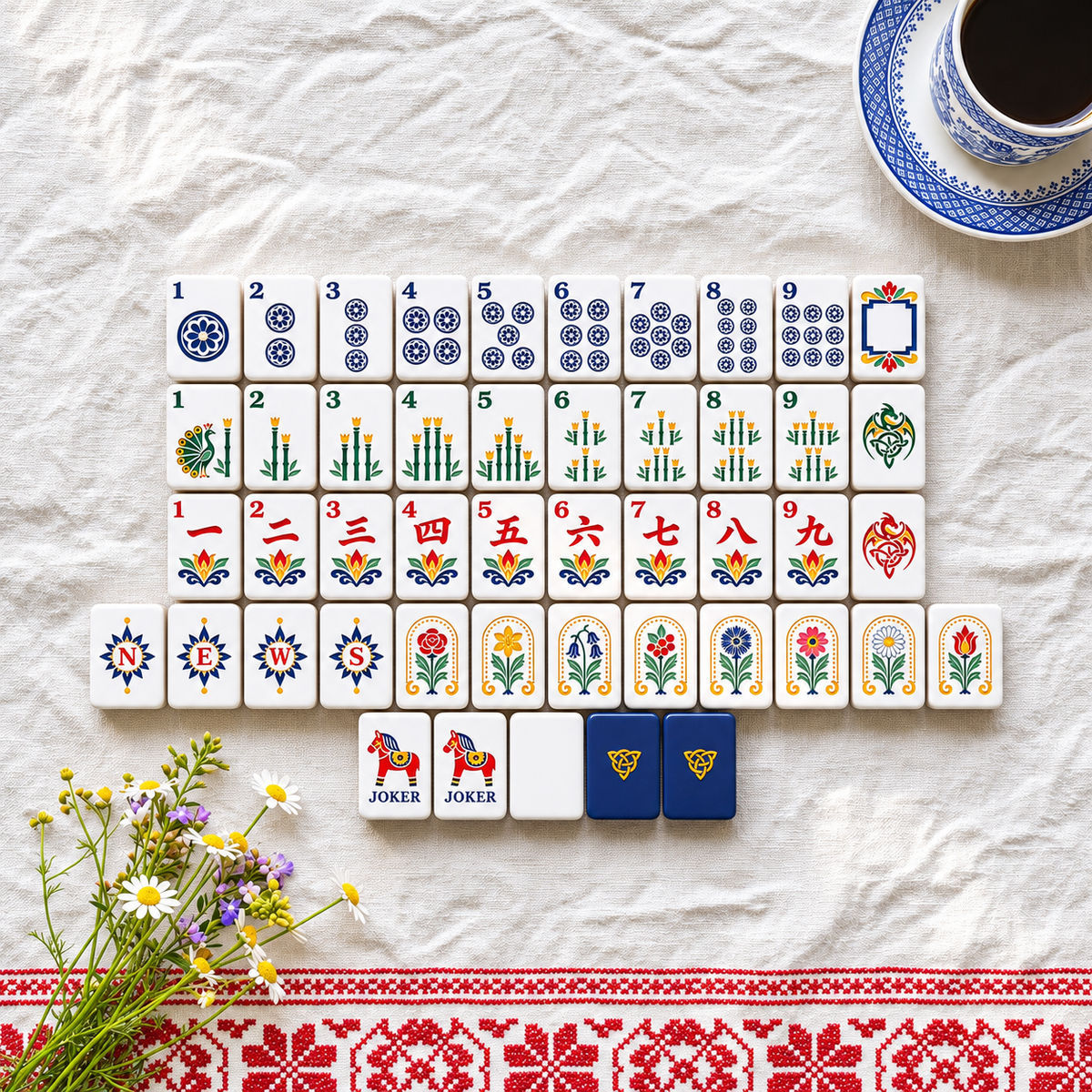
Siamese mahjong uses exactly 144 tiles: four suits (Bamboo, Characters, Circles, and Honors) with each number rank 1–9 appearing four times per suit, plus 16 Winds (four each: North, East, South, West) and 12 Dragons (four each of Red, Green, White). Unlike American mahjong, there are no Flowers, Seasons, or Jokers in the standard Siamese game. The hand size is 14 tiles (13 in hand plus 1 drawn). Siamese play emphasizes chows (sequences of three consecutive tiles)—a core pattern forbidden in American mahjong—and uses a completely different point system based on melds rather than a fixed annual card. If you own a best-selling American mahjong set, you'll need to set aside the flowers and jokers and play with only the numbered suits and honors to approximate Siamese rules.
What exactly is Siamese mahjong?
Siamese mahjong, also called Thai mahjong, is the regional variant played in Thailand and across much of Southeast Asia. It follows a four-suit, 144-tile structure and feels closer to classical Chinese mahjong than to American. The game emphasizes adaptability—players can form chows, pungs, and kongs freely, and draws come from a central wall rather than a pass-around ritual like the American Charleston. Hand completion requires one pair plus four melds of three or four tiles each. Many players who grew up in Thailand, Laos, Cambodia, or Malaysia encounter Siamese rules before—or instead of—American, so learning the tile count first clarifies whether you're switching variants or starting fresh.

How do Siamese and American tile counts differ?
American mahjong uses 160 tiles total (152 playing tiles plus spare jokers): three numbered suits times nine ranks times four copies (108 tiles), plus 16 Winds, 12 Dragons, 8 Flowers, and 8 Jokers. Siamese mahjong uses 144 tiles with no Flowers or Jokers—only the four numbered suits, Winds, and Dragons. This means Siamese sets are smaller, lighter, and faster to shuffle. American games require consulting a new National Mah Jongg League card every spring to know which hands are legal; Siamese play uses a point-based system that stays constant year to year, making it more portable across borders and easier to teach visitors. If you already own a best-selling American set, you can remove the Flowers and Jokers and play pseudo-Siamese by following a simplified rulebook—not ideal, but functional for learning.
What's in each Siamese tile suit?
Suit | Name | Count | Marks |
Bamboo (Bam) | ไม้ | 36 | 1–9, four each |
Characters (Crak) | เลข | 36 | 1–9, four each |
Circles (Dot) | จุด | 36 | 1–9, four each |
Honors | สัญญา | 28 | 16 Winds + 12 Dragons |
Total | 144 |
Each numbered suit contains ranks 1 through 9. Winds appear once per direction (four total copies), and Dragons appear three per color (Red, Green, White), with four copies each—a total of 12 Dragons. There are no blanks, jokers, or flower tiles; every tile in play has a defined rank or honor value. The 1 Bamboo traditionally shows a bird, and the White Dragon (equivalent to American "Soap") sometimes carries zero value in hand calculations. The purity of this set means no ambiguity about which tiles exist during a game.
How do you set up a Siamese game?
Siamese mahjong begins by shuffling all 144 tiles face-down into a long wall—typically arranged as four rows of 36 tiles each. Each player draws 13 tiles and places them in their rack; East draws the 14th. Passing (similar to American Charleston) may or may not occur depending on local house rules—many Siamese groups skip it entirely and begin play after the draw. Chows (three consecutive tiles like 4-5-6 Bamboo) are called and exposed immediately when you need them to complete your hand, unlike American mahjong where chows cannot be called at all. Games proceed counter-clockwise. Unlike American play, you do NOT consult a printed card to see if your hand is valid; instead, you count points and pay based on melds and winning patterns. A winner is first to form one pair plus four melds (pungs, kongs, or chows) equaling 14 tiles total. The point scale and bonus system differ sharply from American scoring, so learners must study the specific rulebook in use at their table or club.

Why do American and Siamese mahjong look similar but play differently?
Both variants use four wind directions, three dragon colors, and numbered tile suits—so a casual glance suggests they're the same game. The core differences run deep: American mahjong forbids sequences (chows) in exposed melds and uses an annual legal-hand card, while Siamese lets you build sequences freely and scores based on meld types and tile honors. American mahjong is played with 152 tiles plus 8 Jokers that substitute for missing tiles; Siamese has no jokers and relies on skill and tile awareness. American hands are often closed (kept face-down) until you win; Siamese exposes melds as you form them. The philosophies differ—American feels like a card game adapted to tiles, with a "lottery" of new hands each year, while Siamese plays like pure strategy where knowledge of probability and opponent play is everything. If you learn both, you'll appreciate that each emphasizes different skills: American rewards pattern recognition and rule speed; Siamese rewards memory and adaptability.
🀄 Shop best-selling mahjong sets →
What if you want to play Siamese but only own an American set?
You can approximate Siamese play using an American set by removing the 8 Flowers and 8 Jokers before the game begins, leaving you with 144 tiles—the exact Siamese count. You'll lose nothing mechanically, since Siamese rules have no use for Flowers or Jokers. However, you'll still need to memorize Siamese scoring rules, which differ fundamentally from the National Mah Jongg League card. The hand-building logic stays similar (one pair, four melds), but the point values and bonus rules require study. Many experienced American players find this hybrid approach bridges the gap until they invest in a dedicated 144-tile set. Long-term, if you expect to play Siamese regularly, a specialized set keeps the experience cleaner and avoids table confusion. Our best-selling collection includes traditional designs that work well for both American and regional variants; some players keep two sets on hand—one American, one for international play—so no one has to strip tiles mid-game.
How to check before you buy a Siamese-ready set
Before ordering any mahjong set, confirm the tile count is 144 (or 152 with a clear note about how to adapt). Look for:
Suit symbols: Bamboo, Characters, Circles, plus Winds and Dragons. No Flowers or Seasons listed.
Tile quantity breakdown: 36 per numbered suit (4 of each rank 1–9), 16 Winds (4 per direction), 12 Dragons (4 per color).
No jokers or blanks: Siamese games have no wildcard tiles.
Rack and mat suitability: Confirm your storage and play surface fit both 144-tile and 152-tile sets if you play multiple variants.
Language or symbols: Check if the set uses Thai numerals, Western Arabic numerals, or character marks—important if you're teaching players unfamiliar with one system.
🎁 See our most-loved mahjong sets & accessories →
What to check before you buy
Tile count: Confirm the set contains exactly 144 tiles if Siamese is your primary game.
Suit clarity: Ensure Bamboo, Characters, Circles, Winds, and Dragons are clearly marked—no ambiguity.
Storage fit: A 144-tile set is lighter; check that your existing mahjong racks or travel bag can accommodate it.
Rulebook: Ask the seller or community whether house rules include passing or chow exposure before drawing.
Thickness: Siamese tiles are often thinner than American acrylic sets; handle samples if possible.
✨ Find your Mahstead set — free US shipping →

FAQ
Can I use an American mahjong set to play Siamese?
Yes, but you must remove the 8 Flowers and 8 Jokers before play, leaving 144 tiles. You'll still need to learn Siamese scoring separately, as the point system and winning patterns differ from American rules. It's a functional workaround but not ideal long-term.
Is Siamese mahjong harder than American mahjong?
They emphasize different skills. Siamese requires memory and pattern adaptability (since chows are legal and the card changes yearly); American rewards card-reading speed and precision rule knowledge (since hands are fixed annually). Neither is objectively harder—each requires practice in its own system.
Why don't Siamese sets include Flowers or Jokers?
Flowers and Jokers are inventions specific to regional or modern variants. Classical and Siamese mahjong trace back to a four-suit, 144-tile structure with no wildcards, relying instead on player skill and tile probability to win. American variants added these elements for gameplay variation and accessibility.
Where can I learn Siamese mahjong rules?
Search online for "Thai mahjong rules" or "Siamese mahjong" rulebooks; many exist in English and Thai. Community centers and libraries in areas with Thai populations sometimes offer classes. Online mahjong forums and regional Thai or Cambodian cultural associations are also good starting points.
Do I need a special mat for Siamese mahjong?
Any mahjong mat works, but measure it to ensure it fits a 144-tile wall comfortably. American mats are often sized for 152-tile sets; a smaller mat may feel cramped. Check dimensions before buying if space is tight.
How long does a Siamese mahjong game typically last?
A single hand takes 10–30 minutes depending on player experience and house rules. A full session (like an American game night) often involves 4–8 hands and lasts 2–3 hours. Siamese play tends to move slightly faster than American once players know the scoring system.


View More
View More
View More
