
How Many Tiles in Chinese Official Mahjong: Full Breakdown
Last updated: Nov 23, 2026
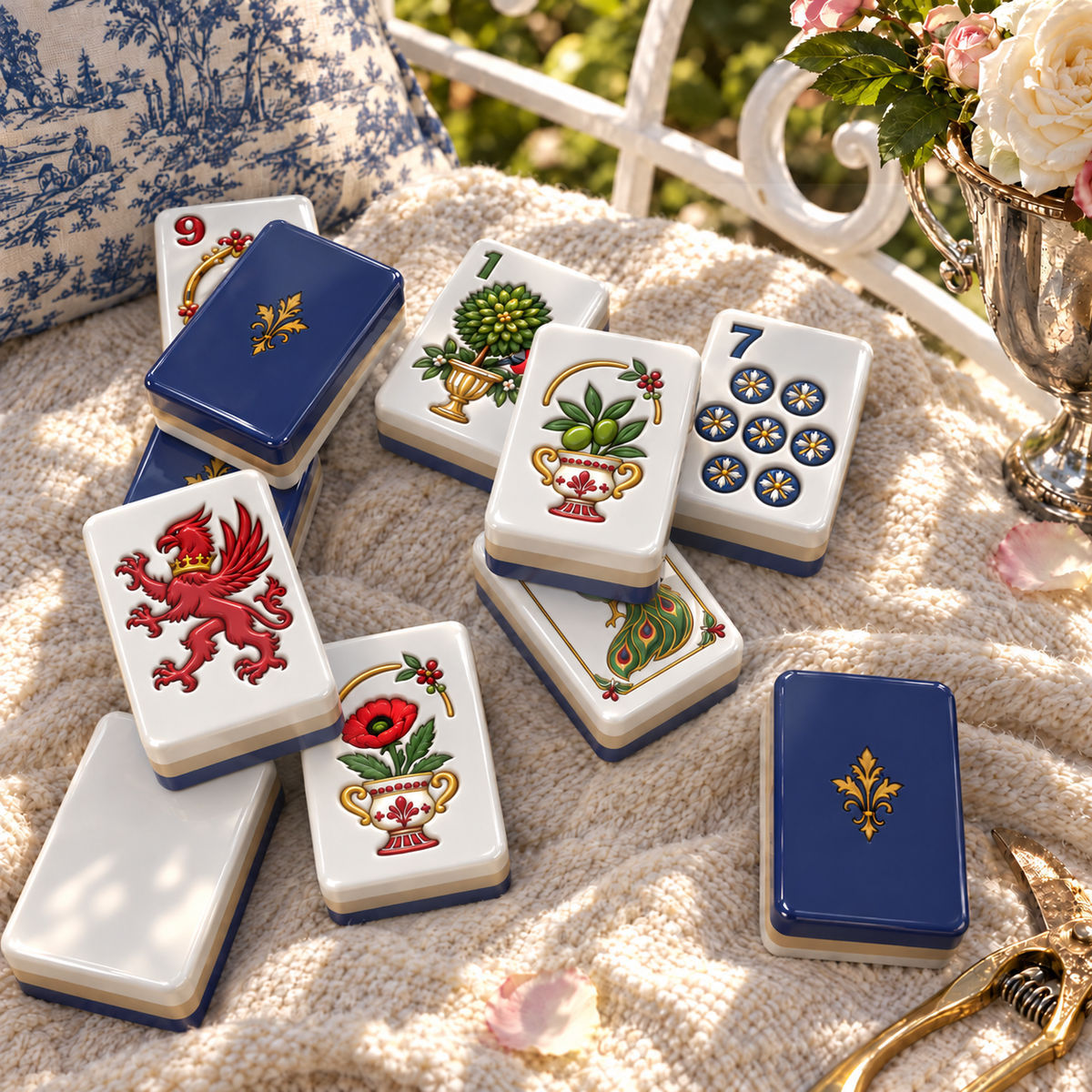
Chinese official mahjong uses exactly 144 tiles: three numbered suits (Bams, Craks, Dots) from 1 to 9, with four copies of each tile per suit (108 tiles total), plus 16 wind tiles (four each: North, East, South, West) and 12 dragon tiles (four Red, four Green, four White). Bonus tiles—eight flowers and eight seasons—are also standard but do not count toward the playable pool in most rulesets; players draw from the wall and discard to the table freely, unlike American mahjong's hand-locking system. No annual card governs hands; winning combinations (chows, pungs, kongs) are determined by game rules and local agreement. A true 144-tile Chinese set contains no jokers or blanks. If you play multiple variants across a group, we recommend a versatile acrylic set from our best-selling collection that works for casual Chinese play and can be customized.
Chinese mahjong is played with exactly 144 tiles: three numbered suits (Bams, Craks, Dots) from 1 to 9, with four copies of each tile per suit (108 tiles total), plus 16 wind tiles (four each: North, East, South, West) and 12 dragon tiles (four Red, four Green, four White). Bonus tiles—eight flowers and eight seasons—are also standard but do not count toward the playable pool in most rulesets; players draw from the wall and discard to the table freely, unlike American mahjong's hand-locking system. No annual card governs hands; winning combinations (chows, pungs, kongs) are determined by game rules and local agreement. A true 144-tile Chinese set contains no jokers or blanks.
Why does Chinese mahjong have 144 tiles instead of 152?
Chinese mahjong evolved over centuries in China; the 144-tile count became standardized across multiple official rulesets (Cantonese, Shanghai, Sichuan). American mahjong, developed in the 1920s in California, added 8 jokers and modified the tile distribution to match the League's licensed annual hand cards, bringing the total to 160-tile sets (152 playable + spare tiles). Chinese players never adopted jokers—they shift strategy through draws, discards, and tile probability instead. The 144-tile format allows a complete wall of four stacks per player and ensures even distribution during the initial deal and draw phases.

What is the exact composition: suits, honors, and bonus tiles?
Chinese mahjong contains three suited families of 36 tiles each: Bams (bamboo, 1–9 with four copies), Craks (characters, 1–9 with four copies), Dots (circles, 1–9 with four copies). Honors include four Wind tiles (North, East, South, West), appearing four times each = 16 total. Dragons number 12: Red (associated with Craks), Green (Bams), and White (Dots), each appearing four times. Bonus tiles—flowers (Plum, Orchid, Bamboo, Chrysanthemum) and seasons (Spring, Summer, Autumn, Winter), four of each—are drawn but typically set aside and replaced immediately or held for scoring, depending on the ruleset. This composition differs from American mahjong, which replaces bonus scoring and adds 8 jokers for hand flexibility.
How does 144-tile play differ from American mahjong's 152-tile game?
Aspect | Chinese (144 tiles) | American (152 tiles) |
Total tiles | 144 playable; no jokers | 152 (144 + 8 jokers) |
Hand source | Current draw and discard only | Annual League card hands only |
Chows (sequences) | Yes, can be called and exposed | No; only pungs, kongs, quints, sextets |
Pair rules | Jokers allowed in pairs | Jokers cannot form a pair |
Game flow | Free draw/discard; high strategy | Fixed hand matching; card-dependent |
Winning hand | Determined by rules and local play | Must match one hand on the card exactly |
Bonus tiles | Drawn, set aside, or scored separately | Not present in American sets |
In Chinese mahjong, you draw freely and respond to opponents' discards by calling chows (1-2-3 sequences), pungs (three identical), or kongs (four identical). American mahjong locks you into one specific hand per game—you can only expose pungs, kongs, or longer like runs, and jokers function as wildcards only in groups of three or more, never alone. Chinese play rewards observation and probability; American rewards card study and pattern matching.
Which Chinese ruleset uses 144 tiles: Cantonese, Shanghai, or Sichuan?
All three major Chinese rulesets—Cantonese, Shanghai, and Sichuan—operate with 144 tiles. Cantonese mahjong (the most common in Hong Kong and overseas communities) treats bonus tiles as immediate replacements when drawn; players discard three tiles after drawing, and winds rotate after each game. Shanghai mahjong, common in eastern China, has stricter hand patterns and often prohibits certain melds early in play. Sichuan mahjong (western China variant) allows hidden melds and has unique scoring for specific tile combinations. All three maintain the 144-tile core, so if you learn one ruleset, your tile literacy transfers—only the winning hands, scoring, and draw mechanics change. When shopping for a set that supports multiple Chinese variants, look for engraved American mahjong sets or our best-selling collection with clear, durable tile faces.
🀄 Shop best-selling mahjong sets →

What happens if a 144-tile Chinese set is missing or damaged?
A full 144-tile Chinese set is a closed system—every tile is unique by position and count. If one tile cracks, warps, or goes missing, you cannot simply skip it; the wall becomes uneven, dealing becomes biased, and hands may not be playable. Most serious players keep spare tiles (often sold separately or carried in larger cases) or replace the entire set. Modern acrylic or bakelite tiles resist cracks better than bone or bamboo; if you play weekly, check tiles before each session and store them in a padded mahjong bag or case to prevent chips and dust. Humidity and temperature swings cause material warping in wooden sets, so a climate-controlled storage spot extends lifespan. If your set is older or heavily used, a refresh set from our collection ensures consistent, readable play—acrylic tiles photograph clearly for online play and tolerate casual handling.
How do I verify a Chinese mahjong set has all 144 tiles?
Before purchasing or playing, count by category: remove all Bams (should be 36: four each of 1 through 9), Craks (36), and Dots (36). Then separate Winds—you need four North, four East, four South, four West (16 total). Dragons: four Red, four Green, four White (12 total). Flowers and seasons: one each of Plum, Orchid, Bamboo, Chrysanthemum, Spring, Summer, Autumn, Winter (8 total). Add them: 36 + 36 + 36 + 16 + 12 + 8 = 144. If you're short, stop play and contact the seller. Online retailers should include a checklist; if not, ask before buying. Mahstead's mahjong mats include printed tile counts for quick reference, and our customer support can guide verification if you're starting with a Chinese set for the first time.
🎁 See our most-loved mahjong sets & accessories →
What to check before you buy a Chinese mahjong set
Tile count: Confirm all 144 are present (36 per suited family, 16 winds, 12 dragons, 8 bonus).
Material: Acrylic resists chips; bone/bamboo looks traditional but cracks over time.
Tile face clarity: Characters must be readable under table light; avoid sets with faded paint.
Storage: Buy or pack with a case; loose tiles in a box invite damage and loss.
Ruleset compatibility: Confirm the set supports the variant you play (Cantonese, Shanghai, etc.).
Spare tiles: Ask if the seller includes replacements for flowers or bonus tiles that wear fastest.

FAQ
Is a 144-tile Chinese mahjong set the same as a 152-tile American mahjong set?
No. Chinese sets have 144 tiles with no jokers; American sets contain 160 tiles (152 playable plus spares) and include 8 jokers that function as wildcards. The suits and honors match, but American mahjong requires the annual League card to play legal hands, while Chinese mahjong relies on open, free-form drawing and discarding.
Can I play Chinese mahjong with an American mahjong set?
Technically yes, but it's awkward. American sets include 8 jokers that aren't used in Chinese play; you'd have to remove them. Additionally, American tile distributions may differ slightly. For best results, buy a true 144-tile Chinese set or an acrylic set from our best-selling collection that works for both variants.
Do Chinese mahjong sets include flower and season tiles?
Yes. Chinese sets include eight bonus tiles: four flowers (Plum, Orchid, Bamboo, Chrysanthemum) and four seasons (Spring, Summer, Autumn, Winter). These are drawn during play but set aside or scored separately depending on the ruleset. American sets do not include these tiles.
Why do some Chinese sets say 152 tiles when I thought it was 144?
Sellers sometimes add extra jokers or blank tiles for replacement or mixed play. The official Chinese mahjong game uses exactly 144 playable tiles. If a set is marketed as 152 or 160, those extra tiles are spares; only the 144 are used in a single game.
Where can I find a reliable 144-tile Chinese mahjong set?
Look for sets labeled "Chinese mahjong" or "Cantonese mahjong" with clear tile faces, acrylic or bakelite material for durability, and free US shipping. Verify the tile count before ordering. Mahstead specializes in customizable best-selling mahjong sets suitable for both casual Chinese play and American games.
What material is best for a Chinese mahjong set?
Acrylic resists chips, dust, and humidity swings. Bakelite (vintage Catalin) looks rich but can yellow. Bone and bamboo are traditional and beautiful but require climate control and hand care. For weekly play in any environment, acrylic is most durable and affordable. --- ✨ Find your Mahstead set — free US shipping →


View More
View More
View More
