
How Many Tiles in British Mahjong: A Guide to UK Rules
Last updated: Nov 23, 2026
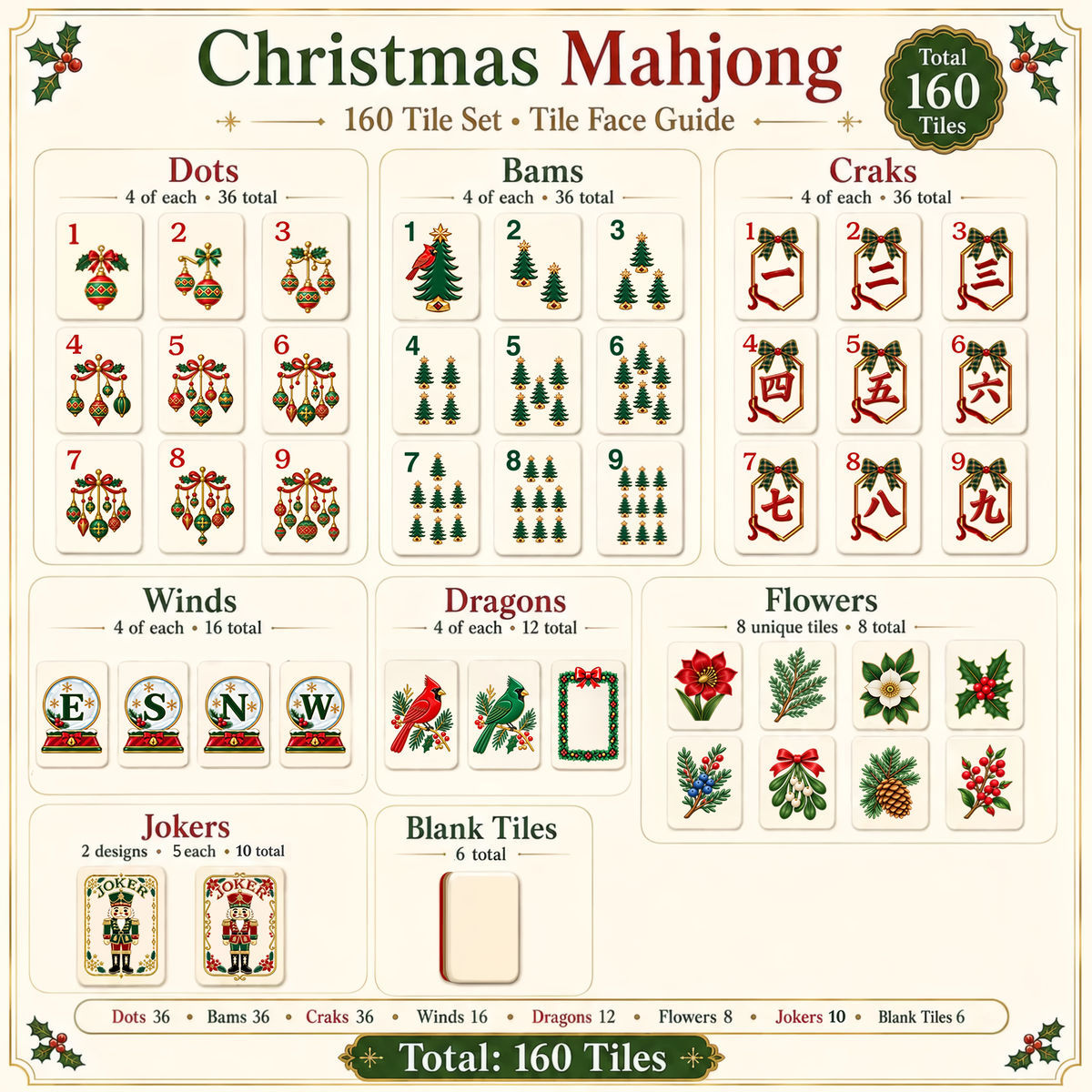
British mahjong uses 152 tiles in standard play: 108 tiles across three suits (Bams, Craks, Dots) numbered 1–9, 16 wind tiles (four each: North, East, West, South), 12 dragon tiles (four each: Red, Green, White), plus 8 flower tiles and 8 jokers. The British version follows Hong Kong-influenced rules rather than the American League card system: hands rely on classical patterns (chows, pungs, kongs) rather than fixed yearly hands, sequences are callable and exposable (unlike American play), and the winning structure emphasizes going out cleanly with one melds-plus-pair configuration. British clubs often play with slightly different scoring and limit systems. When shopping for a set to learn British mahjong, look for acrylic 160-tile sets built to withstand weekly club play, as these contain the core 152 tiles plus spares.
🀄 Shop best-selling mahjong sets →
Why does British mahjong use exactly 152 tiles?
The 152-tile count traces back to Classical Chinese mahjong, which British colonial players adopted in the early 20th century. The figure represents the complete distribution needed for four players: each suit contains 36 tiles (numbers 1–9, four copies each = 4 × 9 × 3 = 108), plus winds and dragons (16 + 12 = 28), plus flowers and jokers (8 + 8 = 16). Together: 108 + 28 + 16 = 152. Every tile type is represented exactly four times, ensuring fair play when tiles are drawn randomly from the wall and during exchanges. No tile appears five times or fewer times; this symmetry is core to the game's integrity across all British clubs.

How does British play differ from American mahjong with the same tile count?
Both American and British mahjong use 152 tiles, but the hand structure and melds differ radically. American mahjong uses only fixed hands from the current year's National Mah Jongg League card—no sequences are callable; only pungs (three identical), kongs (four identical), quints (five identical), and sextets (six identical). British mahjong, rooted in Hong Kong rules, relies on classical melds where chows (runs like 4-5-6 in one suit) are not only allowed but callable and exposable. A British hand is simply any combination of melds (chows, pungs, kongs) plus one final pair—far simpler than memorizing a card. A British player might win with, say, three 5 Dots, three 4-5-6 Craks, four 1 Bams, and a pair of White Dragons. An American player cannot—they must match a specific hand pattern from the League card. This makes British mahjong more flexible but requires deeper knowledge of hand theory.
What does a comparison of tile roles look like across major variants?
Here is how the same 152 tiles distribute and function across British, American, and Hong Kong play:
Tile Category | Count | British Use | American Use | Hong Kong Use |
Numbered (1–9, 3 suits) | 108 | Chows, pungs, sequences callable | No chows; pungs, kongs only from card | Chows, pungs, sequences, all callable |
Winds (N, E, W, S) | 16 | Pair, pung, kong | Exposure per card hand only | Pair, pung, kong |
Dragons (R, G, W) | 12 | Pair, pung, kong | Exposure per card hand only | Pair, pung, kong |
Flowers | 8 | Immediate win bonus or discard | Not used in modern American sets | Immediate win bonus or drawn replacement |
Jokers | 8 | Substitute in melds flexibly | Never used; stored outside play | Substitute per game variant rules |
Key takeaway: British players build hands freely; American players follow the card; Hong Kong players use classical hands with dynamic joker substitution. All three use 152 tiles; the logic is entirely different.
Do British mahjong sets sold in the UK contain 152 or different tile counts?
British sets are typically sold as 160-tile sets—meaning 152 core tiles plus 8 spare tiles (extra jokers and/or blanks). Older British wooden sets sometimes came as 152-tile only, but modern acrylic club sets match the 160-tile standard for durability and to supply replacement tiles if one cracks during years of play. The 152 tiles are always in the wall during a round; the 8 spares sit aside. No British set adds tiles to the wall or changes the count mid-game. Acrylic sets are preferred in British clubs because tiles are consistent, do not chip like bamboo, and withstand thousands of weekly plays. When buying for a British mahjong group, choose a durable set designed for long-term club play with clear tile markings, since British hand recognition is pattern-heavy.

What tile markings and conventions should British players expect?
British mahjong uses the same visual tile system as American and Hong Kong play: Bams display a bamboo plant or bird (especially the 1 Bam with a bird), Craks show a cracked coin symbol, Dots are circles. Dragons are Red (often a red symbol or character), Green (often a green bamboo or character), and White (blank or a white square, sometimes labeled "Soap"). Winds are labeled N, E, W, S or show directional symbols. Flowers are usually numbered or illustrated. Jokers are typically blank or show a special marker. Clear, bold markings matter in British play because hand reading happens faster and more intuitively than in American variants—a player scanning the table must instantly recognize chows and exposed melds. Acrylic tiles with engraved markings and a protective mat reduce mistakes during long club sessions.
How should a British player choose between a new set and an inherited older one?
An inherited wooden set from decades past may be beautiful but often has three problems: inconsistent tile dimensions (hand fitting is poor), worn tile markings (reading becomes frustrating), and fragility (cracking mid-game halts play). A modern acrylic set for club play ensures uniform size, durable markings, and reliability. However, if the inherited set is primarily sentimental and you play casually, light cleaning and a protective travel bag or case can preserve it. For serious British club membership, invest in a modern set with matching rack and pusher tools—these speed up tile organization and reduce hand fatigue during marathon sessions. Pairing a new set with a proper mahjong mat protects the table surface and clearly delineates the wall and discard zones, critical for British play where exposing melds and managing the wall happens rapidly.
🎁 See our most-loved mahjong sets & accessories →
What to check before you buy a British mahjong set
Tile uniformity: All tiles should feel identical in weight and thickness; inconsistency signals poor molding or wear.
Markings clarity: Engravings (not paint) last through thousands of plays; check that 1 Bam, Craks, and White Dragons are unmistakable.
Joker count: Your set should have 8 jokers for British classical play; if fewer, replacements are harder to source.
Racks and pushers included: British club players favor racks to tidy tile handling; confirm the set includes racks or budget separately.
Bag or case: Protection during transport to club sessions prevents chips and lost tiles; verify whether storage is included or sold separately.
Spare tiles policy: A 160-tile set should come with clearly marked spares; ask the seller how to identify and replace damaged tiles.
✨ Find your Mahstead set — free US shipping →

FAQ
Is British mahjong the same as Hong Kong mahjong?
No, though both use 152 tiles and allow callable chows. Hong Kong play features dynamic joker rules and scoring tied to limit hands, while British play typically uses simpler limits and fixed substitution rules. British clubs often blend Hong Kong theory with local house rules.
Can I use an American mahjong set to play British mahjong?
Technically yes—both contain 152 tiles—but American sets often lack jokers or include blanks instead. British play relies on 8 jokers for substitution. You'd need to source or designate four jokers from elsewhere, making it impractical. Buy a set intended for classical play.
Do British mahjong sets contain flowers, and are they required?
Yes, all standard 152-tile sets contain 8 flowers. In British clubs, flowers are typically drawn at the start and award bonus points or are replaced. Some casual groups ignore flowers; competitive clubs enforce them strictly. Confirm your group's house rules before play.
How many tiles does each player start with in British mahjong?
Each of four players draws 13 tiles initially, then one draws a 14th to begin play. That accounts for 54 tiles dealt. The remaining 98 tiles form the wall. If anyone is absent, house rules vary; most clubs require four players for a legal game.
Where can I find British mahjong clubs or lessons in my area?
Search local community centers, libraries, synagogues, and country clubs—many host mahjong groups or can refer you. Online meetup boards and local Facebook groups also list weekly games. Contact your regional mahjong association (if your country has one) for certified club listings.
What's the price difference between an American set and a British-suitable set?
Both are sold as 160-tile acrylic sets at comparable price points; see current price on the product page. The difference lies in joker count and durability features (racks, cases, mat compatibility). A British-ready set pairs well with protective accessories—check bundle pricing on collection pages.


View More
View More
View More
