
How Many Jokers in a Mahjong Set?
Last updated: Nov 23, 2026
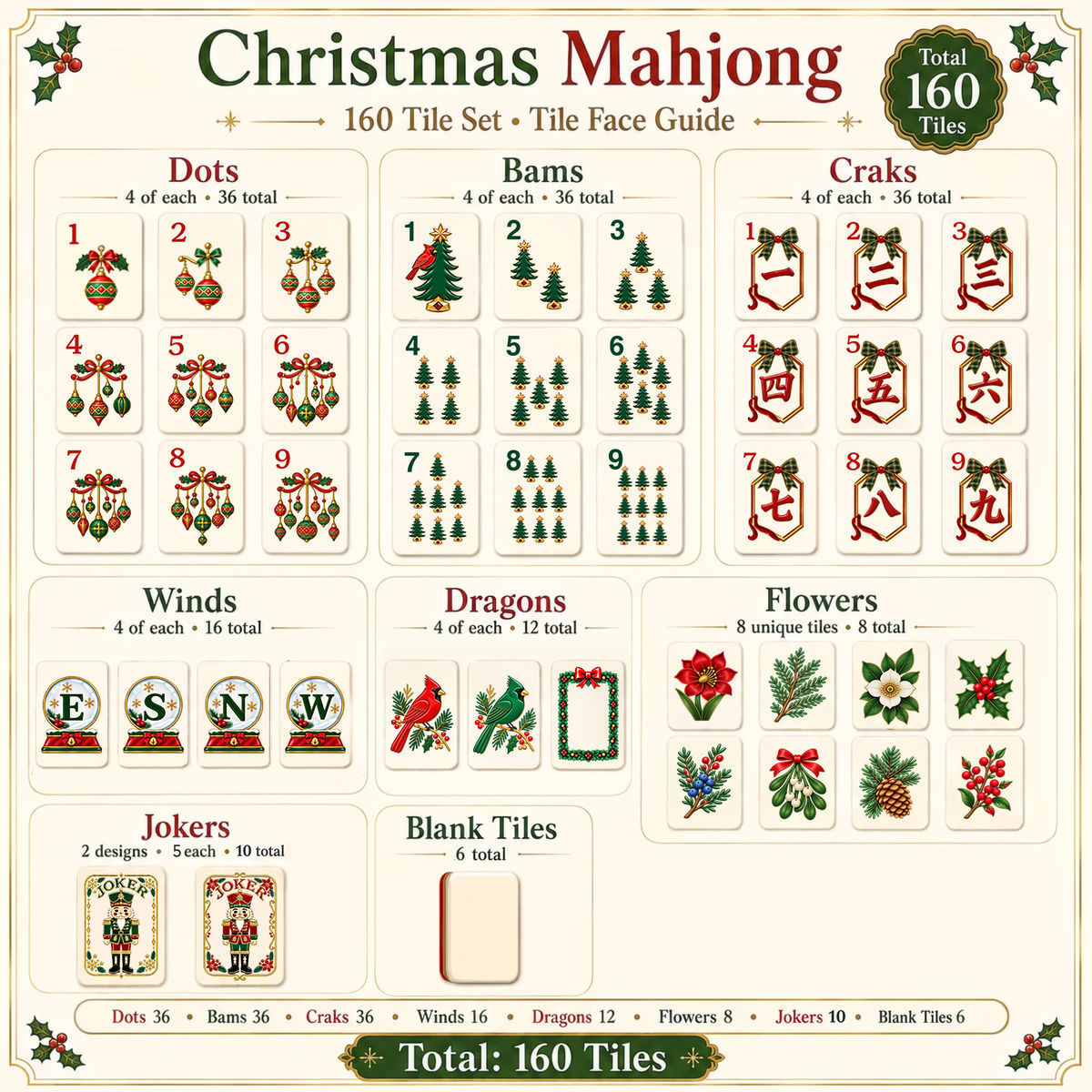
An American mahjong set for play contains 8 jokers—no more, no fewer—built into the standard 152 playing tiles. These jokers are wild tiles: you can substitute one for any other tile when building a pung, kong, quint, or sextet on the board, but never as a single tile or in a pair. The remaining 144 tiles consist of three suits (Bams, Craks, Dots numbered 1–9, four copies each), 16 winds, 12 dragons, 8 flowers, and occasionally blanks in sets sold with spares. Since American mahjong always plays with the same tile count—exactly 152 tiles and 8 jokers—every hand depends on these jokers being present and functional. Sets designed by Mahstead and others come as 160-tile packages to include spare jokers so you never run short mid-season. Losing even one joker to wear or damage compromises your ability to complete certain hands from the current year's National Mah Jongg League card.
Why exactly 8 jokers—not more, not fewer?
The National Mah Jongg League standardized American mahjong to use exactly 8 jokers in a 152-tile set. This number balances playability: enough jokers exist to make complex hands achievable without making every hand trivial. Since four players each draw and discard tiles in turn, and a winning hand uses 14 tiles (often including 1–3 jokers), the eight jokers distribute unevenly across hands—some rounds you'll see three jokers on the table, others none. The 152-tile format has been the tournament standard for decades, so any commercial set you buy follows this rule.
🀄 Shop best-selling mahjong sets →

Can you use a joker as a pair or a single tile?
No—this is one of the most common mistakes we see at the table. In American mahjong, a joker can only be used as a substitute within a group (pung, kong, quint, or sextet), never as a single tile or as one half of a pair. If your hand calls for a pair of 3 Dots, you cannot use two jokers; you must have two actual 3 Dot tiles. This rule exists because jokers are meant to cover shortage, not to replace fundamental building blocks. Misusing a joker as a pair invalidates your win and costs you the round.
How many spare jokers should a home set include?
Our best-selling collection includes 160-tile sets, which contain 152 playing tiles plus extra jokers as spares. Over a season of weekly play, jokers crack, fade, or get lost—especially in sets transported weekly or stored loosely. One spare joker covers minor accidents; two or three give you peace of mind for years. If you play year-round, spares pay for themselves within a season. When you buy a 160-tile set, you're buying insurance that a cracked or missing joker won't kill your game mid-week.
How do jokers differ from blanks and flowers in a mahjong set?
Jokers, blanks, and flowers are three different tiles with distinct rules. A joker is a wild substitute tile used during play. A blank tile (if included as a spare) is a tile with no pip or character—it sits in the spare rack, not in active play. Flowers are honor tiles (eight total: 1–4 Plum, Orchid, Bamboo, Chrysanthemum) that must be matched exactly; they are never wild and do not count as jokers. Many players confuse flowers with jokers because both are less common than numbered suits, but only jokers can substitute for other tiles.

What happens if your set is missing a joker mid-game?
If you discover a missing joker after tiles are dealt, the round is usually abandoned and tiles are returned to the wall—house rules may vary. If a joker is damaged and unplayable (cracked or faded so you can't read it), most players agree to swap it with a spare from the spare rack or declare it a dead joker and play the round without it. Over time, losing jokers means certain hands from the card become impossible to win, frustrating active players and shortening your set's useful life. This is why experienced players invest in sets with spare jokers—the extra tiles cost little and last years.
Do other mahjong variants use a different number of jokers?
Yes—this matters if you play multiple styles. Chinese classical and Hong Kong mahjong do not use jokers at all; they rely on complex hand patterns and honor combinations. Riichi mahjong (Japanese) also has no jokers. Some regional Chinese variants use "wild" tiles but call them by different names and follow different rules. Taiwanese mahjong uses jokers but with different substitution rules and scoring. If you play American mahjong only, the 8-joker standard is universal. If you host mixed groups, clarify the variant before play and keep separate sets if possible—mixing rules causes arguments and misdeals.
Quick reference: Joker rules in American mahjong
Rule | Application | Common mistake |
Number in play | 8 jokers per 152-tile set | Buying a 144-tile "budget" set with fewer jokers |
Substitution | Pung, kong, quint, sextet only | Using a joker as a single tile or pair |
Spare jokers | Included in 160-tile sets | Discarding spares; playing with no backup |
Pair rule | Cannot be paired with each other | Using two jokers for a pair hand |
Wear & tear | Replace damaged jokers from spares | Continuing play with faded or cracked joker |
🎁 See our most-loved mahjong sets & accessories →
What to check before you buy
Count the jokers. Open the set or ask the seller: do you have 8 playable jokers plus spares? A 160-tile set guarantees this; a 152-tile set should have exactly 8.
Test readability. Jokers must be visibly distinct from other tiles—engraved, printed, or embossed clearly. Faded or worn jokers cause disputes.
Check condition. Inspect jokers for cracks, chips, or uneven thickness. Damaged jokers slow the game and ruin tile stacks.
Confirm the tile count. Ask: is this a 152-tile set (8 jokers only) or a 160-tile set (8 jokers plus spares)? Never assume.
Ask about spares. If the set includes spares, which tiles are they? Extra jokers are more useful than blanks for long-term play.
Hosting a weekly game? Plan for joker replacement
If you host four-player American mahjong weekly, mark your calendar: inspect all jokers before each game. After 50–100 plays (roughly one season), check for hairline cracks in acrylic or flaking on tile faces. Replace jokers that fail the crack test before they break mid-game. Keep spare jokers in a small pouch or envelope, labeled and easily accessible. If your set was originally 160 tiles and you've used one spare already, consider buying a replacement set or an extra set of spare jokers. Mahstead engraved sets are designed for this kind of heavy rotation—they last seasons because the spares are included from the start.
✨ Find your Mahstead set — free US shipping →

FAQ
Can I play American mahjong with fewer than 8 jokers?
No. American mahjong always uses exactly 152 tiles and 8 jokers per the National Mah Jongg League standard. Fewer jokers makes certain hands from the card impossible to win. Use spare jokers if originals are damaged.
What's the difference between a joker and a blank tile?
A joker is a wild substitute tile used during play to complete groups. A blank tile is a spare tile with no markings—it never plays. Only jokers are active game tiles.
If my set is missing a joker, can I replace it with a blank?
No. A blank cannot substitute as a wild tile; it has no game function. Replace a missing joker with a spare joker from another set or buy a replacement set with spares included.
Do Chinese and Hong Kong mahjong use jokers?
No. Classical and Hong Kong mahjong use no wild tiles. Riichi (Japanese) also has no jokers. Jokers are unique to American mahjong. Confirm the variant before play.
Why do 160-tile sets exist if only 152 tiles play?
The 8 extra tiles are spares—usually jokers—to replace damaged or worn tiles during the season. Over time, jokers crack or fade. Spares ensure your set stays legal and playable for years.
Can two players share a single set if one player has no jokers?
Not safely. Always verify a set has all 8 jokers before dealing. If one is missing, use a spare from a backup set. Never reduce joker count to match a damaged set.
How many spare jokers should I buy separately if I already own a set?
One or two extra jokers covers accidental breakage. If you play weekly year-round, consider keeping a full backup set of spares. Most players never need more than two replacements per season.
Are engraved or custom jokers any different from standard jokers?
No. A joker's function—wild substitution in groups only—is identical regardless of design. Custom and engraved jokers work the same; choose based on aesthetic preference and set durability.


View More
View More
View More
