
Harbin Mahjong Scoring: Rules, Hand Values & Strategy
Last updated: Nov 23, 2026
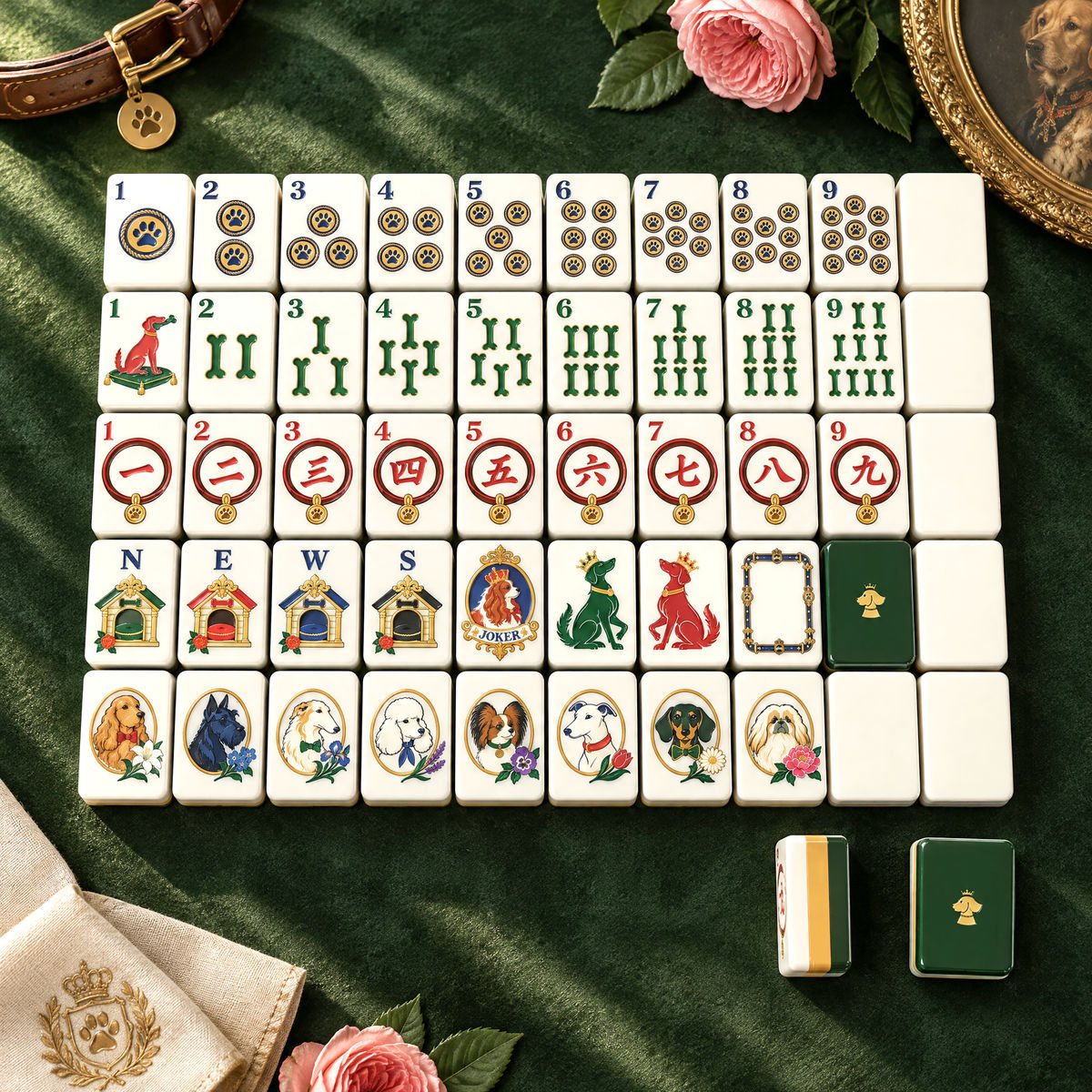
Harbin mahjong scoring awards points based on the winning hand's composition—melds, honors, flowers, and the method of win (self-draw, discard claim, or Kong draw). Unlike American mahjong, which requires hands from an annual card and uses a flat or doubled scoring system, Harbin play builds points through a base value multiplied by doubling conditions: winning on your own draw, holding all terminals and honors, collecting all four seasons or flowers, or declaring certain honor combinations. A typical base hand scores 2–8 points; each doubling rule (e.g., "all Pungs," "prevalent wind") multiplies the total. Games track cumulative scores across rounds, with a preset end-game target. Regional rule variations exist—check with your group's referee before your first session. Explore our best-selling sets to find tiles suitable for any variant you play.
Harbin mahjong scores differently from the American game because it relies on open-hand evaluation rather than a fixed yearly card. Players in northern China developed this scoring to reward specific combinations and winning methods rather than rigid pattern matching. If you're used to American mahjong, expect a more flexible but calculation-heavy system where every completed hand tells a story of its own point value.
What are the base hand point values in Harbin scoring?
Harbin mahjong assigns a base value to each winning hand, typically ranging from 2 to 8 points depending on the hand's difficulty and composition. A "Pung/Kong only" hand (no sequences) scores higher than one with mixed Pungs and Chows because it's harder to complete. A simple hand with one Pung of Winds, two Chows, and one Pung of Dragons might score 2 base points; an all-Pung hand with multiple honors scores 6–8. The base value is your starting multiplier before any doublings or bonuses apply. Once you've calculated the base, you apply doubling rules.

How do doubling rules multiply the final score?
Harbin scoring uses "doubling" (also called "fan" in some regions) to multiply the base hand value by 2, 4, 8, or more depending on how many doubling conditions the hand satisfies. Common doublings include:
Winning on self-draw (drawing the winning tile yourself rather than taking a discard) = 1 double
All Pungs, no Chows = 1 double
Little Three Dragons (two Pungs of Dragons, one Pung of the third Dragon, or Soap) = 1 double
Prevalent Wind (having a Pung of the East Wind when East is the round's prevailing wind) = 1 double
Seat Wind (Pung of your own wind, based on your position) = 1 double
All Terminals and Honors (no number tiles) = typically 6+ doubles (automatic high score)
All Seasons or All Flowers = 1 double each
If your 2-point base hand satisfies four doubling conditions, you calculate: 2 × 2 × 2 × 2 × 2 = 64 points (a major win). The more conditions your hand meets, the exponentially higher the payout to all three other players.
What is the difference between self-draw and discard-claim wins?
A self-draw win (called "zimo" in Mandarin) occurs when you draw the winning tile from the wall yourself; you receive double the normal payment from each player. A discard-claim win happens when another player discards your winning tile and you declare "Mahjong!"; you collect a single payment per doubling rule from all players. Harbin rules often award a full double multiplier for self-draw, making it more valuable. In some house rules, only the discarder pays in a discard-claim win, whereas self-draw collects from all three opponents. Confirm this rule variation with your group's scorekeeper before play, as it drastically changes strategy—players become more conservative when discarding if self-draw pays triple.
How do you calculate final payouts among four players?
Once you've determined your total point value (base × doublings), you calculate who pays what. In the most common Harbin system:
You win by discard claim: Each of the three other players pays you the point value.
You win by self-draw: Each opponent pays you double the point value.
Winning hand with 64 points, discard claim: You collect 64 points from each player (192 total).
Same hand, self-draw: Each pays 128 (384 total).
Many groups track cumulative scores across multiple rounds (typically 4, 8, or 16 rounds with rotating dealer positions) and settle at the end of the session. Settle immediately after each hand, record scores on paper, and rotate the dealer role counterclockwise. Always agree on the point denomination before starting—some groups play 1 point = 1 yuan, 1 chip, or 10 cents—to avoid disputes.
What are common Harbin scoring rule variations?
Harbin is not a single standardized game; regional clubs and groups maintain local variations. Some differences you'll encounter:
Rule Variant | East China (Anhui) | North China (Harbin, Jilin) | Frequency & Impact |
Kong Bonus | Draw bonus tile scores 2 extra | Kong scores as one doubling | Medium—changes final tally 10–20% |
Limit Hand | Any hand over 64 points caps at 64 | Unbounded (can reach 512+) | High—strategic: chase or play safe? |
Flower/Season Bonus | Each counts as one doubling | Four Seasons = instant 6+ doubles | High—affects early-game discard caution |
Prevalent Wind Rule | Only East Wind in East round applies | All winds count if matched to seat | Medium—clarifies payment distribution |
Loose/Tight Play | Jokers allowed in certain melds | No Jokers in any meld | Very high—changes tile accessibility |
Before your first hand, ask the scorekeeper (usually an experienced player) to clarify three rules: (1) Does a Kong draw bonus apply? (2) Is there a cap on hand value? (3) Can Jokers substitute in Chows or only Pungs? Write these answers on your scoresheet for reference.

What should you check before joining a Harbin mahjong game?
House Rules & Scorecard Ask for a written copy or verbal confirmation of the house's doubling rules, limit hand (if any), and payout structure. Harbin rules vary by region and even by club; don't assume what you learned elsewhere applies here.
Tile Set & Joker Rules Confirm whether Jokers are in play and, if so, whether they can substitute in Chows or only in Pungs. Some Harbin groups play with no Jokers at all. Check that all 152 tiles (or the region's standard count) plus Jokers are present and accounted for.
Dealer Rotation & Wind Rounds Determine how many rounds you're playing (typically 4 or 8), which player is dealer first, and how dealer position rotates. Clarify which wind is "prevalent" for each round, as Prevalent Wind doublings depend on this.
Settlement Method & Point Value Agree whether you're settling after each hand or at the end of the session. Decide the monetary or chip value of each point before dealing begins—this prevents arguments about payouts.
🀄 Shop best-selling mahjong sets →
What equipment do you need to play Harbin mahjong?
If you're hosting or joining regular Harbin games, you'll want tiles designed for durability and clarity—especially since scoring calculation takes time and players need to read tiles accurately during hand evaluation. A standard mahjong set with 152 playing tiles works perfectly for any regional variant, including Harbin. A quality mat with scoring zones or trays can help organize your melds while you calculate doublings, and racks with pushers reduce tiles falling during the frantic discard phase. If your group plays multiple times weekly or travels to games, a durable bag or case protects your set from dust and damage. For teams learning Harbin together, acrylic tiles with crisp engravings on each suit and honor make rule discussions faster because players can read numbers and symbols from across the table without squinting.
🎁 See our most-loved mahjong sets & accessories →
How does Harbin scoring compare to American mahjong scoring?
American mahjong uses a single annual card issued every spring; players must match their completed hand to a pattern on the card to win. Scoring is typically flat (e.g., 1 point for a simple hand) or doubled once (e.g., 2 points for a "closed" hand drawn on your own). Harbin mahjong, by contrast, scores every hand based on its inherent composition and the method of win, without consulting an external card. This means Harbin is far more flexible and rewards skilled hand-building—but requires faster mental arithmetic at the table.
Aspect | American Mahjong | Harbin Mahjong |
Hand Matching | Must match current year's card | Any valid composition scores |
Base Scoring | Flat (1 point) or doubled (2 points) | 2–8 points per hand |
Multipliers | Doubled once (closed/open) | Multiple doublings (4, 8, 16+) |
Self-Draw Bonus | +1 point or doubled | Often double payout × each opponent |
Winner Payout | Usually 1–2 from each player | 64–384+ from each player |
Skill Factor | Pattern recognition | Pattern + calculation + reading opponents |
Learning Curve | Moderate (card reference) | Steep (dozens of doubling rules) |
Harbin is better suited to players who enjoy mental calculation and social games where stakes can climb quickly; American is ideal for rule-loving groups who prefer predictability and card-driven play. The tile set itself works for both—what differs is the scoresheet and house rules.
Key takeaway: Write your Harbin rules down
Before your first session, jot down answers to these three questions:
Base scoring range and doubling rules – Which hand combinations count as doublings? (All-Pungs, Wind Pungs, Flowers, etc.)
Limit hand and settlement – Is there a maximum score per hand? Do you settle after each round or at the end?
Jokers and loose tiles – Are Jokers in the game? Can they substitute in Chows or Pungs only?
Post these on your phone or scorecard so everyone agrees throughout the session. Harbin mahjong is more social and negotiable than American play—clarifying rules upfront prevents resentment and keeps the evening fun.
✨ Find your Mahstead set — free US shipping →

FAQ
Can you play Harbin mahjong with an American mahjong set?
Yes. Both use 152 tiles—same composition of Bams, Craks, Dots, Winds, Dragons, Flowers, and Jokers. The set is identical; only the scoring and hand-matching rules differ. Any standard mahjong set works for Harbin.
What happens if two players declare mahjong on the same turn in Harbin?
In most Harbin rules, the player closest to the discarder in turn order (usually the next player counterclockwise) wins the hand. Some groups play "no winner" and pass the hand to the next dealer. Confirm this rule before play—it rarely happens, but knowing it prevents disputes.
How do you score if you win with a Kong?
A Kong draw (drawing the bonus tile after declaring a Kong) typically counts as self-draw and may include a doubling bonus for the Kong itself. Some groups award an extra 2–4 points for Kong wins. This varies regionally—ask your scorekeeper.
Is there a maximum score in Harbin mahjong?
Many Harbin games cap the hand at 64 points (8 base × 2³ doublings) to keep payout realistic and strategy balanced. Others allow unlimited scoring. Confirm the limit before starting—it fundamentally changes whether players chase high-risk hands or play defensively.
How many rounds do you typically play in a Harbin session?
Most casual groups play 4, 8, or 16 rounds. Four rounds (one dealer position per player) takes 45–90 minutes. Eight rounds (two per position) takes 2–3 hours. Agree on round count and total time before sitting down so players know when the game ends.


View More
View More
View More
