
Hangzhou Mahjong for Beginners: Rules, Setup & First Game
Last updated: Nov 23, 2026
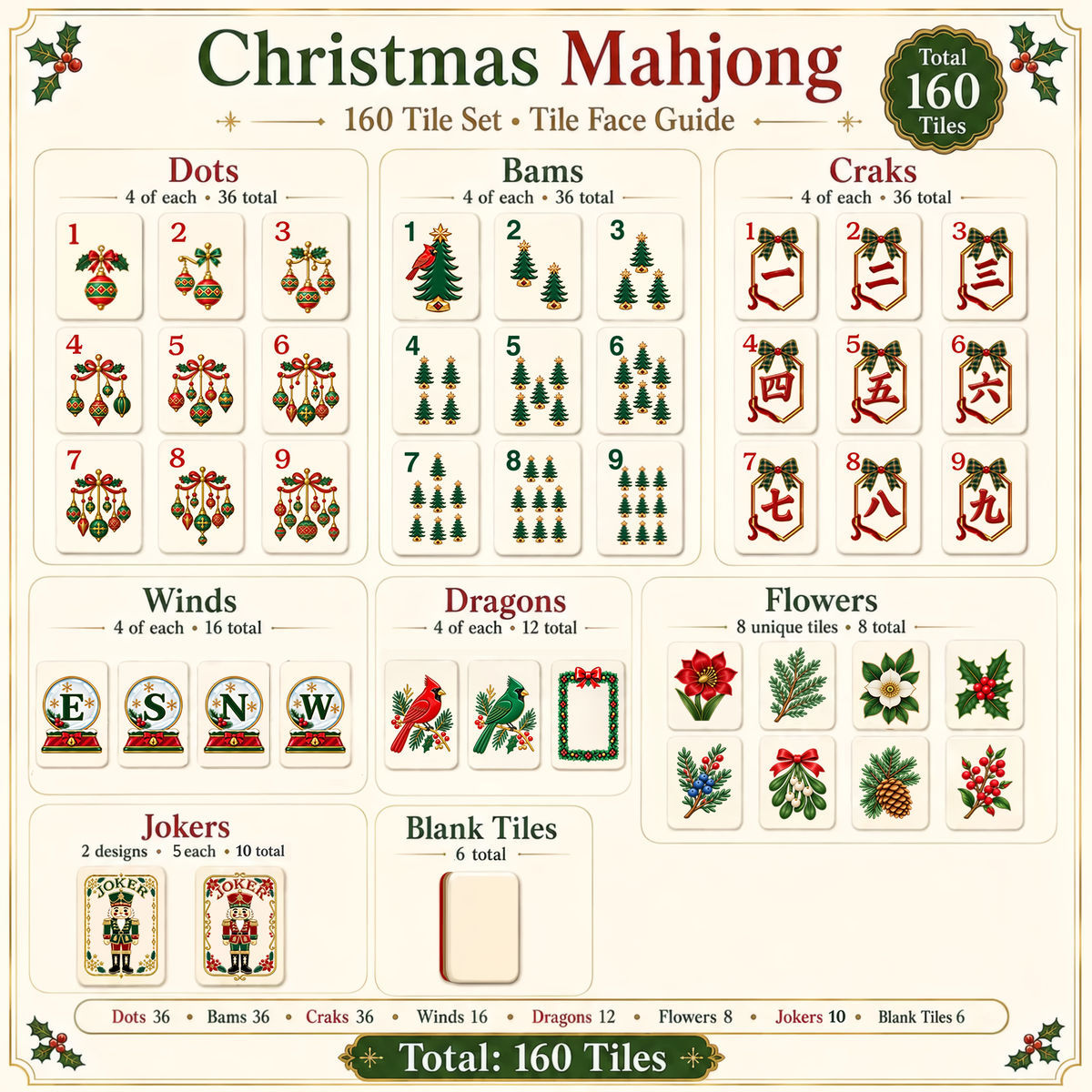
Hangzhou mahjong uses 108 tiles—four copies each of Bams, Craks, and Dots numbered 1–9, plus 16 winds and 12 dragons. Players draw and discard to build a hand of four melds (chows, pungs, or kongs) plus a pair. Unlike American mahjong, which uses a card and jokers, Hangzhou relies on live tile draws and open melds. A round lasts 15–20 minutes. Each player antes a small wager; scoring is split among winners or paid by losers. Beginners should start by memorizing the three suits, learning which numbers form legal sequences (1-2-3, 4-5-6, 7-8-9), and practicing pung recognition (three identical tiles). Avoid drawing from the wrong end of the wall or revealing your hand too early. Our best-selling mahjong sets work for learning, though traditional Chinese tile sets with clear suit symbols are most forgiving for new eyes.
How Is Hangzhou Mahjong Different from American Mahjong?
American mahjong players often feel lost at first because Hangzhou has no card, no jokers in melds, and no 160-tile set. You build hands live—every hand is theoretically possible, not locked to one card per year. American hands use only pungs, kongs, and quints; Hangzhou adds chows (sequences of three consecutive numbers in one suit). Winning hands require four melds plus a pair; American players are used to many more tiles per hand. Hangzhou rounds are much shorter—typically 15 minutes versus 30–45 for American—and the pace is faster because discard strategy is immediate and visible to all. If you know American mahjong, Hangzhou will feel like learning a new language with familiar alphabet; the tile names and suits are the same, but the grammar is completely different.

What Do You Need to Play Hangzhou Mahjong?
You need 108 tiles (never add blanks or extra jokers), a level playing surface, a wind indicator, and score paper. Most sets sold today include 144 tiles—add the four flower tiles to the standard 108 to reach 144, though Hangzhou traditionally plays with 108 alone. A mat with clear zones for each hand helps beginners organize tiles and prevents accidentally knocking them over. Racks with pushers are not required but useful for keeping tiles upright and hidden from opponents; without them, you'll hold tiles in your hand, which tires the wrist during a long session. Many players use a simple notebook for scoring. Unlike American mahjong, you do not need a shuffler, a card holder, or replacement jokers. Start with a simple ceramic or acrylic set; decorative hand-painted tile sets can be harder to read quickly under pressure.
🀄 Shop best-selling mahjong sets →
What Are the Basic Rules of Hangzhou Mahjong?
Four players sit around a table. One is East (dealer); the others are South, West, and North in clockwise order. East draws 14 tiles; the others draw 13 each. Each turn, a player draws one tile from the wall, melds if possible, and discards one tile face-up. Melds are chows (three consecutive numbers, same suit—1-2-3 or 5-6-7), pungs (three identical tiles), or kongs (four identical tiles). When a player discards, anyone can claim that tile to complete a meld—but you must meld it openly on the table, not hide it. The first player to form four melds plus a pair and declare "mahjong" wins the hand. Winning from a discard pays 1 point from the discarder; winning from a self-drawn tile (or if no one discards for you to win from) pays 1 point from all three players. Beginners often miscount their hand or forget to check for a legal winning combination; always count 1+1+1+1+1 = five groups (four melds, one pair) before declaring.
How Do You Read Tiles and Recognize Winning Hands?
Each tile displays a suit symbol and a number (1–9 per suit) or a name (wind, dragon). Bams (bamboo) show stalks, Craks show circles, and Dots show spots. Winds are labeled N, E, W, S; dragons are usually Red, Green, and White (blank-faced). When you hold tiles, arrange them by suit and number so you can spot sequences (1-2-3-4-5 means you have a chow 1-2-3 and a chow 3-4-5 if you draw the other suit's tiles) and pairs (two identical tiles side by side). A winning hand has no "odd" tiles—every tile belongs to exactly one meld or the pair. Many beginners panic because they cannot immediately see if their hand is one tile away from winning. Solution: arrange tiles in meld order, then scan for gaps. If you have 1, 2, 2, 3, 3, 4—you see two 3's (the pair) and a possible chow 1-2-3 if another suit has 1-2-3. Hangzhou does not use card pictures; you must train your eye.
🎁 See our most-loved mahjong sets & accessories →

What Are Common Mistakes New Players Make?
Drawing from the wrong wall end: Each player draws from a specific section; East always draws from the east end first. Beginners draw from wherever they reach; mark the wall clearly before the game starts.
Forgetting the pair rule: A winning hand must have a pair. Many beginners count four melds and assume they've won, forgetting the fifth group. Always count: 1+1+1+1+1.
Claiming a discard too slowly: If Player A discards and Player B sees it can complete their hand, Player B must call "pung" or "kong" immediately. Hesitation loses the right; the tile is dead.
Melding pungs instead of chows: If you can form either a chow or a pung from the discard, choosing the wrong one blocks your other tiles. Always plan ahead: which meld leaves your hand closest to winning?
Not looking for multiple winning hands: Hangzhou has "eyes" (melds that score higher) and bonus melds. Early on, focus on finishing one legal hand; once you're comfortable, study scoring guides to recognize point bonuses.
Revealing your hand: Keeping tiles face-down in your rack until you're ready to meld prevents opponents from reading your strategy. Never fan your hand where others can see it.
Mistake | Why It Happens | How to Avoid It |
Wrong wall draw | No marker set before game | Place a coin or button at your start point |
Forgetting the pair | Counting four melds feels like enough | Recite "four melds plus one pair" before declaring |
Slow claim | Distraction or uncertainty | Practice calling aloud immediately when you see a fit |
Wrong meld type | Habit from other games | Pause and ask: "Does this block a higher-scoring path?" |
Melding too soon | Fear of missing your turn | Observe one full round before melding anything |
Overexposing your hand | No privacy norm established | Agree before the game: tiles stay down unless melded |
How Long Does a Game of Hangzhou Mahjong Take?
A single hand (round) takes 12–20 minutes for beginners, 8–12 for experienced players. Most games are played over four rounds (one per wind position, called a "set" or "session"). A full session lasts 45–90 minutes including setup, wind changes, and score tallying. Hangzhou is much faster than American mahjong because no card limits which hands are valid—players focus on speed and pattern recognition rather than consulting a hand list. If you want a quick social session, two rounds takes 30 minutes. If you're playing for points, a full four-round session with rules discussion and slower play can stretch to two hours.
✨ Find your Mahstead set — free US shipping →
What to Check Before You Buy a Tile Set for Hangzhou Play
Tile clarity: Suit symbols must be obvious even in dim light. Acrylic tiles with bright printed symbols are safer than hand-painted wood if you're still learning to recognize numbers.
Weight and feel: Lighter tiles (plastic or resin) are easier for beginners to move quickly; heavier tiles (bone or ceramic) feel more premium but slow down play if you're slow at sorting.
Tile size: Standard tiles are about 1¼ inches wide; smaller tiles crowd the hand, larger tiles are harder to keep hidden. Check set dimensions before ordering.
Suit markings: Verify that Bams, Craks, and Dots are visually distinct. Some inexpensive sets use faded colors that blend under poor lighting.
Included accessories: Most 108-tile sets include a dice and a wind indicator card. Sets sold as 144 tiles add flowers. Do not assume you're getting a rack or mat; if you need one, order separately.
How Do You Deal and Start a Hand?
One player (usually designated before the session) shuffles all 108 tiles face-down on the table, creating a "wall." Players break the wall into four stacks of 27 tiles. Designate East (dealer), and East draws two tiles from their wall end. South draws two, West draws two, North draws two. Repeat until each player has 12 tiles. East draws one more tile (now has 13), then draws the first discard tile (to 14). South, West, and North now have 13 each. East discards one tile face-up in the center. Play proceeds clockwise: South draws from the wall, melds if able, and discards one tile. Continue until someone completes four melds plus a pair and calls "mahjong." If no one wins and the wall is exhausted, the hand is a draw (no one pays, play resets). Many beginners make dealing errors; count your tiles aloud to confirm you have the right number before playing.

FAQ
Can I play Hangzhou mahjong with a 160-tile American mahjong set?
Technically yes, but it's awkward. You'll use only the 108 standard tiles and ignore the jokers, flowers, and extra blanks. The tiles are identical, so there's no practical problem—just unused pieces. For a smoother game, buy or borrow a purpose-built 108-tile set.
What does "chow" mean, and how is it different from a pung?
A chow is three consecutive numbers in one suit (e.g., 3-4-5 Dots). A pung is three identical tiles (e.g., three 5 Dots). Chows require number sequence; pungs require identical tiles. American mahjong forbids chows, so this is the biggest rule change for American players switching to Hangzhou.
Who is the dealer in Hangzhou mahjong, and does it matter?
East (the dealer) gets 14 tiles and plays first; the others get 13. Being East is a slight advantage because you draw and discard before others. After each hand, the dealer position rotates clockwise (East to South, South to West, etc.). Most games play four hands (one at each position).
What happens if someone calls mahjong with an illegal hand?
The hand is declared void. If the error is caught mid-play, play resumes from the last valid discard. If caught after the winner claims points, most house rules require the falsely winning player to pay a penalty (usually double the round's base bet). Always verify your hand before calling.
Are there bonus points for certain melds in Hangzhou mahjong?
Yes, but variants differ. All-pung hands (no chows), all-chow hands (no pungs), and hands using three or four dragons or three or four winds often score double or triple. Some versions add bonuses for "eyes" (pairs of dragons or winds). Ask your group's house rules before playing; Hangzhou scoring is far more complex than American.
How do I organize my hand so I don't accidentally meld the wrong tiles?
Arrange tiles in suit order (Bams left, Craks center, Dots right) and within each suit, arrange numbers left to right. Group potential melds together visually. If using a rack, push tiles to the right as you draw, keeping your "hand" on the left. This visual separation prevents mistaken discards. ---


View More
View More
View More
