
Han and Fu in Riichi Mahjong Explained
Last updated: Nov 23, 2026
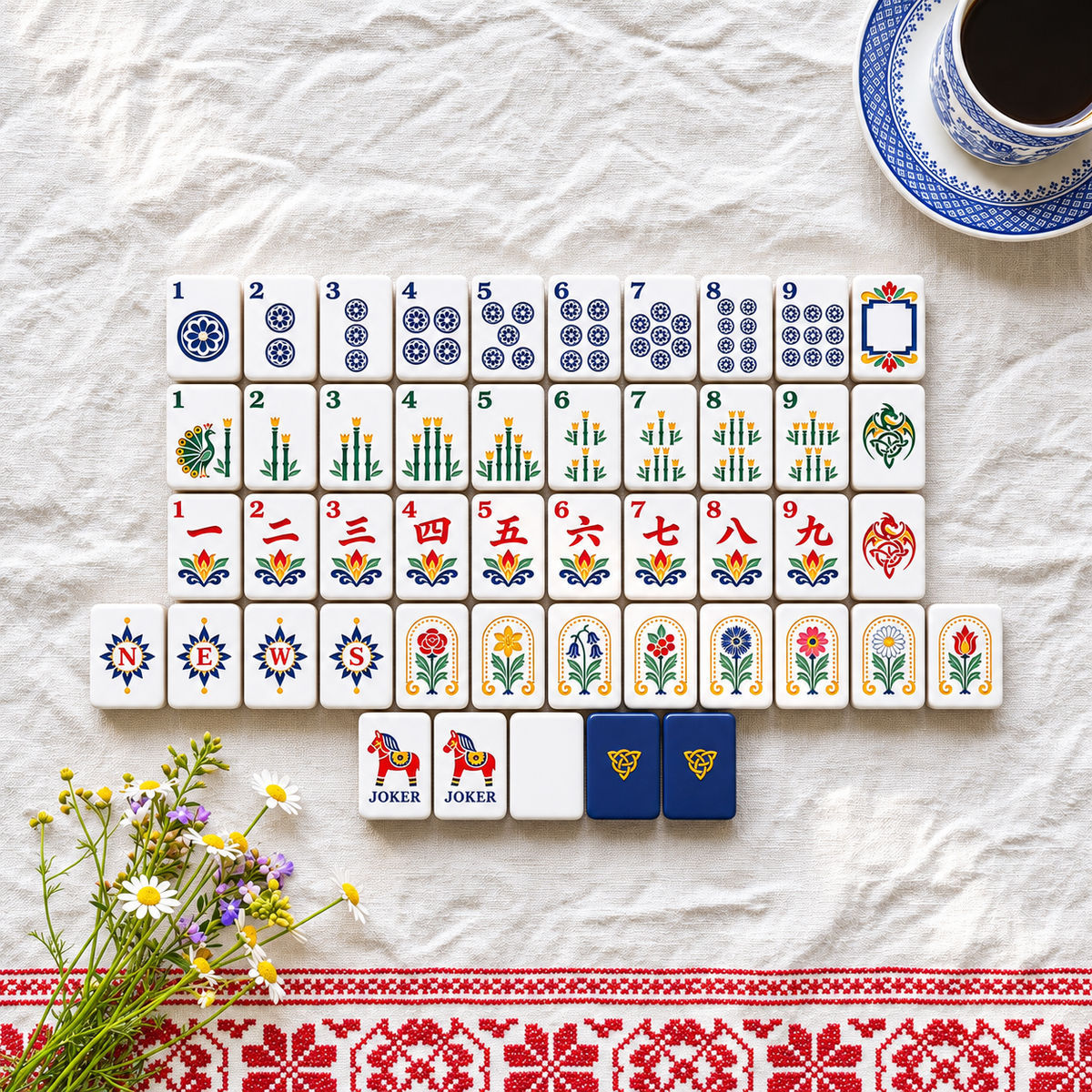
Han and fu are the foundation of riichi mahjong scoring, entirely separate from American mahjong's point-per-hand system. Fu (符, "符" or "points") measures hand structure: melds, wait type, and tile combinations earn incremental fu (2–30 points). Han (飜, "翻" or "doubles") counts the number of tile patterns you've achieved—each named pattern (like "all simples," "all honors," or "seven pairs") equals one or more han. Your final payment is calculated by multiplying a base point value by the number of han, then by the number of players paying you. A hand worth 2 han 30 fu pays differently than 3 han 20 fu, even though both can be winning hands. Unlike American play, which uses a single annual card, riichi scoring is deterministic and the same worldwide; beginners often confuse fu (the tedious math) with han (the pattern recognition), so understanding both separately saves table time and avoids disputes.
Han and fu are the two scoring dimensions in riichi mahjong: fu measures tile efficiency and wait patterns; han counts the value of your winning hand. Together they determine your payment.
What exactly is fu, and why does it matter?
Fu (符) represents the "base points" of your hand structure, calculated before han multipliers apply. Every winning hand starts with a minimum of 20 fu for a standard hand (or 30 fu if you win on your own draw). You earn additional fu from your melds: a hidden pung (3 identical concealed tiles) = 2 fu; an exposed pung = 1 fu; a hidden kong (4 identical concealed tiles) = 8 fu; an exposed kong = 4 fu. Your wait type also adds fu: a pair wait (waiting only to complete a pair) = 2 fu. Terminal or honor tiles in melds add 4 fu per closed pung or 2 fu per open pung instead of the standard rates. The total fu affects your payout multiplier at each han level, so a "cheap" hand (20–30 fu) pays less than an expensive hand (40–70+ fu) at the same han count. Beginners often skip fu calculation and jump straight to han, but that's like ignoring half the score.

How do han work, and what are the common patterns?
Han (飜) measures the named winning patterns in your hand—each distinct pattern you achieve adds one or more han to your score. Common one-han patterns include "all simples" (no terminal or honor tiles), "outside hand" (all terminals or honors), and "one set of identical sequences" (two sequences with the same tiles, e.g. two 1–2–3 Craks). Two-han patterns include "two sets of identical sequences" and "all pung hand" (no sequences at all, only melds). Three-han patterns include "all honors" and "all terminals." Seven-han or higher patterns—such as "all green" (only green dragons and certain green Bams), "little three dragons" (two dragon pungs and a pair of the third dragon), or "all pairs"—are rare and worth significantly more. Each pattern has a specific rule; patterns can combine (e.g., you can achieve both "all simples" and "outside hand" in one hand), so your total han is the sum of all applicable patterns. Han scales exponentially: a 6-han hand pays mangan (a flat 8,000 base points regardless of fu); 7-han is haneman (12,000); 13-han or more is kazoe yakuman (counted as 13-han, 8,000 base). This is why han dominates riichi scoring strategy.
How do I calculate the actual payment from han and fu?
The payment formula in riichi is: base points = (fu × 2^(han+2)) ÷ 4, rounded up. Once you have base points, each non-winning player pays that amount (or times a multiplier if they dealt the winning tile). For example, a 2-han 30-fu hand has base points of (30 × 2^4) ÷ 4 = (30 × 16) ÷ 4 = 120 points. If you win off the discard, the discarder pays 4× the base (480 points). If you win on your own draw, each of the three other players pays the full base (120 each, or 360 total). A 3-han 30-fu hand is (30 × 2^5) ÷ 4 = (30 × 32) ÷ 4 = 240 base; the discarder pays 12,000 yen at some tables (mangan threshold). Rather than memorize formulas, riichi players use standard payout charts; the chart is the fastest way to resolve payments during play without calculation errors.
How does riichi scoring differ from American mahjong?
American mahjong uses an annual card with preset hands, each worth a fixed point value (e.g., "All Simples" on the 2026 card might be worth 40 or 60 points). You score only the hands listed on that year's card; any other combination doesn't count. There are no fu or han calculations in American play—just card lookup, then one score per completed hand. Riichi, by contrast, has no official hand list; any tile combination that fits the named patterns counts, and you calculate payment every time. American mahjong also allows sequences (chows) to be called and exposed, and jokers are integral to play. Riichi has no sequences—only melds (pungs, kongs, or sequences held in your hand, never called), and jokers do not exist. American scoring rewards specific hand types; riichi rewards pattern efficiency and concealment (hidden melds are worth more). Our best-selling mahjong sets are designed for American play, so if you're learning riichi, you'll need separate resources and ideally a riichi-rules reference card at the table.
🀄 Shop best-selling mahjong sets →

What are the most common mistakes beginners make with han and fu?
The biggest mistake is miscounting fu by ignoring wait type or meld source (hidden vs. exposed). A hidden pung is worth 4 fu total (2 base + 2 for the meld), but many beginners count only the 2-fu meld bonus and forget the base. Another error is assuming all patterns stack; some do, but others conflict (you can't achieve "all pung hand" and "all sequences" simultaneously). Many learners also forget that winning on your own draw (tsumo) uses different payout multipliers than winning off the discard (ron), so a 2-han 30-fu hand pays different amounts in each case. A third trap is rounding: the formula explicitly rounds up, so (30 × 16) ÷ 4 = 120, but (40 × 16) ÷ 4 = 160, not 159. Finally, beginners confuse the 20 fu minimum for a "standard" hand with the 30 fu minimum for a hand won on your own draw; these are two different baselines. Use a payout chart to verify, not mental math, until you've played dozens of hands.
Scenario | Han | Fu | Base Points | Discarder Pays | Each Other Player Pays (tsumo) |
Hidden hand, sequence wait | 1 | 30 | 500 | 1,500 | 500 |
Open pung hand, pair wait | 1 | 30 | 500 | 1,500 | 500 |
Two simple patterns | 2 | 30 | 2,000 | 8,000 | 2,000 |
All honors | 3 | 30 | 4,000 | 12,000 | 4,000 |
All pairs (6-han) | 6 | 30 | Mangan (8,000) | 16,000 | 4,000 |
Seven pairs (7-han) | 7 | – | Haneman (12,000) | 24,000 | 8,000 |
(Base points shown; multiply by number of paying players for full table payment. Tsumo payout assumes three players each pay base.)
Should I use a payout chart or calculate by hand?
Every riichi table uses a payout chart; hand calculation during play is unnecessarily slow. Payout charts list every combination of han (1–13+) and fu (20, 30, 40, 50, 60, 70, 80+) with the corresponding payments for ron (discard win) and tsumo (self-draw win). Many online charts are free, and most riichi players photograph a chart or print it for the table. The only scenario where you calculate by hand is to verify a chart or teach a complete beginner how scoring works theoretically. In practice, once a win is declared, you look up han and fu on the chart, announce the payment, collect it, and move to the next hand. This keeps the game flowing at the pace of American mahjong (where you look up a hand on the card). Relying on a chart also eliminates disputes: if everyone sees the same chart, payment is indisputable.
🎁 See our most-loved mahjong sets & accessories →
What to check before you buy riichi mahjong resources
Do you have the right tile set? Riichi uses standard 136 tiles (34 of each suit: 1–9 in three suits, plus 16 winds and 12 dragons, minus one tile per type for a total of 136, though some regions use 144). American mahjong sets contain 152 tiles and jokers; they are not interchangeable with riichi. If you're transitioning from American play and want to try riichi, you'll need a separate riichi-specific tile set.
Is your payout chart authentic? Riichi rules have minor regional variations (some tables add oka, a house fee; others apply different mangan thresholds). Download or purchase a chart from a trusted riichi source or ask your riichi club which variant they use. A wrong chart leads to wrong payouts.
Do you understand hand pattern rules in your region? Riichi has a "Big Three Yakuman" (the highest-scoring patterns), but each region—Japan, Online (Mahjong Soul), Europe—may have slight differences. Before your first game, confirm which rulebook applies.
✨ Find your Mahstead set — free US shipping →

FAQ
Can I use an American mahjong set to play riichi?
No. American sets contain 152 tiles, jokers, and extra flowers; riichi uses exactly 136 tiles with no jokers. You need a riichi-specific set.
Does adding more han always mean I win more?
Yes. Han multiplies the base payout exponentially; each additional han roughly doubles your payment (at low han counts). Patterns stack, so a hand worth 3 han pays significantly more than 2 han.
What if my hand has zero han—can I still win?
No. In riichi, you must complete at least one named pattern (1+ han minimum) to claim the win. A hand with no patterns is invalid.
How long does it take to calculate fu for a complex hand?
With practice, 10–20 seconds by listing melds and wait type. Most players avoid hand calculation entirely and use a payout chart (3 seconds).
Is the fu base always 20 or 30?
Base fu for a standard hand is 20 (or 30 for a self-drawn win). Special hands like "seven pairs" and "all chis" have their own fixed values; always check your rulebook.
Can I combine "all simples" with "all pung hand" in one win?
No. "All simples" requires at least one sequence (chis). "All pung hand" has no sequences. They conflict and cannot both apply to the same hand.
Do I pay more if I discard the winning tile versus losing on my own draw?
Yes. Winning off the discard (ron) pays 4× the base for a 1-han hand; self-draw (tsumo) pays less per player but from all three. Discarder pays the most.


View More
View More
View More
