
Fujian Mahjong Rules: A Regional Variant Guide
Last updated: Nov 23, 2026
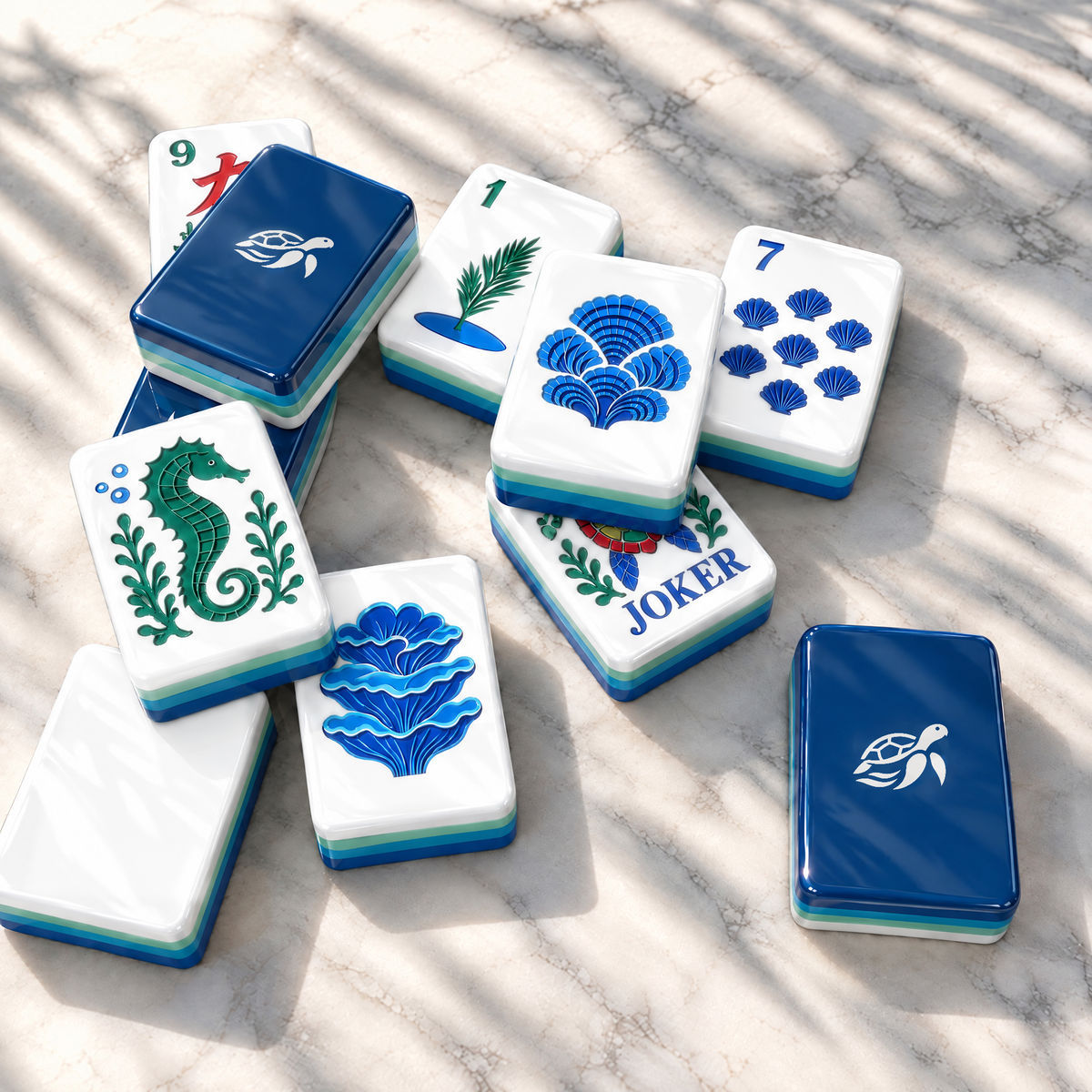
Fujian mahjong, played in China's Fujian Province, uses the standard 144-tile set (Bams, Craks, Dots 1–9 in four copies, winds, dragons, flowers) but plays without the American joker rule entirely. Unlike American mahjong's reliance on the National Mah Jongg League card, Fujian uses fixed hand types: Pung (3), Kong (4), and Chow (1–2–3 sequence in the same suit)—yes, chows are calleable and exposed here. A hand wins when 14 tiles form four melds plus a pair; most hands finish in 8–15 turns. No jokers, no blanks, no points-based scoring in the traditional sense—winning itself is the goal. The pace is faster and more luck-driven than American play. If you're transitioning from American mahjong, the biggest shock is the absence of jokers and the presence of sequences you can actually call mid-game.
Fujian mahjong shares ancestry with Hong Kong and Taiwanese variants but has distinct rules that reward speed and pattern recognition over strategic tile-holding. Here's what you need to know to play it correctly—and what sets you apart from casual players who skip the nuances.
How does Fujian hand-forming differ from American mahjong?
In Fujian mahjong, a complete hand is always 14 tiles: four melds (each 3 or 4 tiles) plus one pair. Melds can be Pung (three identical tiles, e.g., three 5 Dots), Kong (four identical), or Chow (a sequence of three consecutive numbers in one suit, e.g., 3–4–5 Bams). This is radically different from American mahjong, where you consult a seasonal card for legal hand patterns, and sequences are never exposed or callable. In Fujian, you're solving a combinatorial puzzle in real time: can these 14 tiles split into exactly four melds plus a pair? There's no "year card"—the rules are absolute and timeless. The hand doesn't need to match a published list; it simply needs the right structure. For an American player used to holding tiles until the exact card-pattern matches, Fujian feels like improvisation.

What tiles do you use, and is the set different from American?
Fujian mahjong uses the classical 144-tile Chinese set, not the 160-tile American variant. A standard Fujian set contains: 108 suit tiles (Bams, Craks, Dots, 1–9, four copies each), 16 winds (N, E, W, S, four copies each), 12 dragons (Red, Green, White, four copies each), and 8 flowers (optional in some regions). No jokers, no blanks, no extra spares. This means if you own an American 160-tile set from our best-selling collection, you'll need to set aside the jokers and blanks (if included) before playing Fujian—only the core 144 tiles matter. The tile faces are identical, so a single set works across variants; what changes is how you use the tiles and what's legal to call.
🀄 Shop best-selling mahjong sets →
Can you call and expose tiles mid-game in Fujian?
Absolutely—this is a defining feature. In Fujian, when another player discards a tile you need, you can call "Chi!" (Chow), "Pung!" (Pung), or "Kong!" (Kong), draw that tile, and immediately expose your meld face-up on the table. American mahjong forbids exposed chows entirely; you can expose pungs and kongs, but only after the hand is complete. Fujian plays like Hong Kong mahjong in this respect: the game is interactive. If you discard a 5 Crak, a player holding 3–4 Craks can call "Chi!" and lay 3–4–5 flat. If another holds three 5 Craks, they beat the chow call and claim the tile for a pung instead. This creates tension: do you play safe discards (terminals, isolated honors) or risk mid-suit numbers? Call order matters—Kong beats Pung beats Chow. The first person to complete 14 tiles wins the hand immediately; play doesn't continue to the wall.
How is scoring and winning different in Fujian?
In many Fujian house rules, scoring is point-based per tile or per meld type, not a fixed hand-value system like American mahjong. For example, a Kong might earn 2 points, a Pung 1 point, and a Chow 0 points; winning adds a bonus (often 1 point per player or 8 points total). Hands are short and frequent, so the emphasis is on rapid cycles and cumulative scores over a session. Some regions play "all-simples" (no honors in the winning hand), "all-terminals" (mostly 1s and 9s), or "mixed major" (at least one honor), similar to Hong Kong hand types. There's no universal card—players agree on a rule set before the session. American mahjong's point-ladder system (based on hand rarity and composition) doesn't apply. You're aiming to complete your hand first, not to score a specific point-value from a prescribed list. This makes Fujian faster and less strategy-dense than American play.

What are common mistakes Fujian newcomers make?
Mistake 1: Holding too many tiles. American players are trained to hold unmatched tiles in hand and wait for a card-match. In Fujian, you should be chasing completion—if you can't meld what you draw quickly, you're slowing down. New players often hoard honors or wait for a perfect pung when they should expose a chow and speed play.
Mistake 2: Forgetting call order. If a player discards a tile, Kong beats Pung beats Chow. If you have a pung and someone else calls Kong, you don't get the tile—they do. Misordering loses tiles.
Mistake 3: Confusing chow rules. Chows are always 1–2–3, 2–3–4, … 7–8–9 within one suit. You cannot skip numbers (no 1–3–5) or mix suits (no 1 Bam–2 Crak–3 Dot). Each chow is three consecutive tiles, period.
Mistake 4: Mixing American and Fujian variants. Never mix joker rules or card-based hand validation into a Fujian game. Settle house rules before play: Are flowers mandatory or optional? Does a pung of flowers count, or must you have four? Do you play to a score, a round count, or first-to-win? Write them down.
Mistake 5: Unclear discard etiquette. In American play, you clearly state "discard" and place the tile in the pond. In Fujian, speed matters—some players tap the tile or place it quickly. Agree on whether a tap commits the discard (call-able) or if it's still held until released. Ambiguity causes disputes.
Aspect | American Mahjong | Fujian Mahjong | Key Difference |
Tile count | 160 (152 play + 8 spare jokers) | 144 (no jokers) | Fujian is simpler, faster |
Hand formation | Season card–based patterns | 4 melds + 1 pair (fixed) | American is rule-heavy; Fujian is math-based |
Jokers | Yes, flexible; wildcard use | None | American relies on jokers; Fujian does not |
Exposed chows | Never; sequences illegal | Yes; called mid-game | Fujian is interactive; American is turn-based |
Scoring | Fixed hand-value system | Points per tile/meld (varies by house) | American uses a ladder; Fujian varies |
Game pace | 20–30 min per hand | 5–15 min per hand | Fujian is fast; American is strategic |
Call order | Kong > Pung (no chows) | Kong > Pung > Chow | Fujian has strict hierarchy |
🎁 See our most-loved mahjong sets & accessories →
What should you check before hosting a Fujian game?
Settle tile type & hand rules first. Confirm whether you're using 144 tiles (classical) or allowing flowers as optional. Some groups add regional flowers (plum, orchid, bamboo, chrysanthemum); others drop flowers entirely. If using a 160-tile set, physically set aside the jokers and blanks before shuffling.
Agree on scoring & winning conditions. Is the winner determined by first hand completed, or do you play to 100 points? Are there bonus points for all-simples, kongs, or a self-drawn tile? Write the rule set on a notepad—no arguing mid-session.
Verify call conventions. Can players call Kong if they already have an exposed Pung in the same meld? Must a chow be immediately laid or can it be claimed then held? What happens if two players call on the same discard? Nail these down in advance.
Check tile face clarity. Fujian relies on quick pattern recognition—are your tiles easy to read under your table lighting? If tiles are faded, worn, or hard to distinguish (especially the red/green/white dragons), swap them out before play begins. Confused tiles slow the game and cause errors.
Practice one mock hand. Walk through a single hand—deal tiles, make the Charleston if you're doing that round, play one or two turns—so everyone remembers the call sequence and tile-claiming process. New players especially benefit from a live example.
How does Fujian fit into the wider mahjong family?
Fujian mahjong sits between Hong Kong (interactive, call-based, fewer rules) and American mahjong (strategic, card-based, complex patterns). If you've played Hong Kong or Taiwanese, Fujian will feel familiar—chows are callable, kongs beat pungs, and hands complete quickly. If you know only American mahjong, Fujian will seem anarchic: no card, no jokers, sequences allowed, constant calling. Neither is harder; they're solving different games. Fujian rewards pattern speed and luck; American rewards memory and planning. Many players enjoy both because they exercise different skills. The regional variants—Cantonese, Sichuanese, Fujian—each have local tweaks (scoring bonuses for pairs, bonus points for all-simples, alternative flower rules), so no single "Fujian rulebook" exists outside a specific locality or house.
✨ Find your Mahstead set — free US shipping →
What to check before you buy tiles for Fujian play
If you already own an American mahjong set and want to try Fujian, you have the tiles you need—just remove the jokers and blanks. No purchase required. If you're starting fresh or want a dedicated Fujian set, look for a 144-tile Chinese mahjong set (classical, no jokers). Mahstead sells 160-tile acrylic sets designed for American play, but because the core 144 tiles are identical across variants, our sets work fine for Fujian once you set the jokers aside. For Fujian specifically, you may prefer a 144-tile set to avoid confusion, but that's a convenience, not a requirement. Make sure your tiles are clearly marked (bird on the 1 Bam, distinct dragon colors) so quick pattern-spotting isn't hampered by ambiguity. If you host weekly Fujian games, a durable mat and racks with pushers speed play and reduce table talk about tile order.

FAQ
Do I need to own a separate 144-tile set to play Fujian, or can I use my American 160-tile mahjong set?
Your American 160-tile set works fine for Fujian. Simply set the 8 jokers aside before play—the remaining 152 tiles include the 144 core tiles Fujian uses, plus 8 blanks (spares). Only the core 144 matter for the game. Many players use one set for both variants.
Can I use jokers in a Fujian hand like I do in American mahjong?
No. Fujian mahjong has no jokers and no wildcards. Every tile in a meld must be identical (for pung/kong) or consecutive in suit (for chow). Joker-free play is one reason Fujian games finish faster than American rounds.
What happens if two players call on the same discarded tile in Fujian?
Kong beats Pung beats Chow. If Player A calls Kong and Player B calls Pung on the same discard, Player A gets the tile. If no Kong is called, the Pung claimer takes it. This order is absolute and prevents deadlock.
Is there a hand card like the American mahjong card that lists legal patterns?
No. Fujian uses a universal rule: any four melds plus one pair wins. There's no seasonal card, no pattern list. This simplicity is why Fujian feels faster and more intuitive to newcomers than the American card-based system.
How long does a typical Fujian round last compared to American mahjong?
A Fujian hand usually completes in 5–15 minutes because tiles are called and melded mid-game, accelerating play. American hands typically run 20–30 minutes due to the strategic tile-holding and pattern-waiting. Speed varies with player experience and house rules, but Fujian is consistently faster.


View More
View More
View More
