
Fujian Mahjong Quick Start Guide: Rules, Setup & First Game
Last updated: Nov 23, 2026
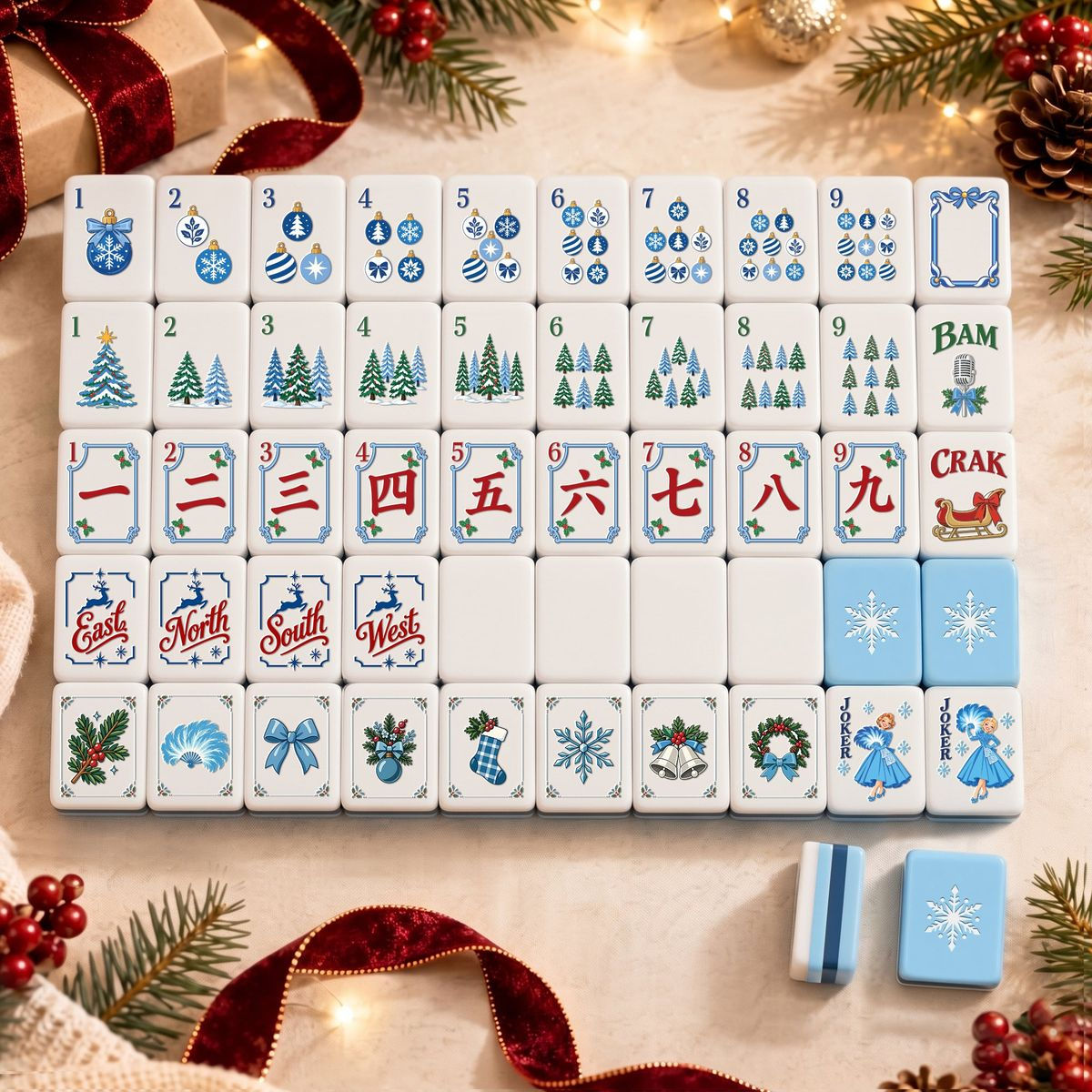
Fujian mahjong uses 144 tiles (no jokers or flowers) in four suits: Bams, Craks, Dots (1–9 each, four copies) plus 16 winds and 12 dragons. The goal is to form a complete hand of four melds plus a pair in one turn or after drawing. Unlike American mahjong, Fujian hands use chows (sequences like 3–4–5 Bams) and pungs (identical triplets); players can call or steal exposed tiles mid-play. Games are faster—usually 15–30 minutes per round—because the hand patterns are fixed and simpler. No player receives a free tile on their first turn; rotation and claiming follow strict calling rules. Setup takes five minutes: mix tiles, build walls by player, deal 13 tiles each (East gets 14 after the break). We recommend a mat with a clean surface to mark zones clearly and racks with pushers to organize your hand for speed.
Fujian mahjong is a fast-paced Chinese regional variant played with 144 tiles (no jokers or flowers) in four suits: Bams, Craks, Dots (1–9 each, four copies) plus 16 winds and 12 dragons. The goal is to form a complete hand of four melds plus a pair in one turn or after drawing. Unlike American mahjong, Fujian hands use chows (sequences like 3–4–5 Bams) and pungs (identical triplets); players can call or steal exposed tiles mid-play. Games are faster—usually 15–30 minutes per round—because the hand patterns are fixed and simpler. No player receives a free tile on their first turn; rotation and claiming follow strict calling rules. Setup takes five minutes: mix tiles, build walls by player, deal 13 tiles each (East gets 14 after the break). We recommend a mat with a clean surface to mark zones clearly and racks with pushers to organize your hand for speed.
How does Fujian differ from American mahjong?
American mahjong uses 152 tiles plus 8 jokers, hands come only from the annual National Mah Jongg League card, and no chows or sequences are playable—only pungs, kongs, and jokers. Fujian uses 144 tiles with no jokers, any chow or pung is valid, players call tiles mid-hand, and you win by making four melds plus a pair in your own draw. American games take 30–60 minutes; Fujian rounds run 15–30 minutes because hand patterns are simpler and the pace is continuous. American play stops for each discard; Fujian's calling rule means the hand stays in motion.

What tiles do you need to start?
Fujian sets contain exactly 144 tiles: three suits of 36 (Bams, Craks, Dots numbered 1–9, four copies each = 108 tiles) plus 16 winds (four each: North, East, South, West) and 12 dragons (four Red, four Green, four White). No flowers, no jokers, no blanks. If you're new to the variant, starting with a dedicated Fujian set is simpler than adapting an American set—you eliminate confusion over missing pieces and focus on learning the rules. Check your tile count before setup: a short tally prevents disputes mid-game.
🀄 Shop best-selling mahjong sets →
What's the step-by-step setup and first deal?
Step 1: Shuffle all 144 tiles face-down on a table. Players agree who is East (dealer); the other three sit North, South, West in counterclockwise order.
Step 2: East builds a wall in front of them: create 36 stacks of two tiles each, 18 stacks high and 2 stacks deep (a 1 × 18 rectangle of doubled tiles).
Step 3: The three non-dealers repeat: each builds a wall of 36 stacks (1 × 18) adjacent to East's wall, forming a square.
Step 4: East throws dice to determine who draws first. The sum determines the break point in the wall (usually a count of 1–18 tiles from the right end of East's wall, going counterclockwise).
Step 5: Starting from the break, players take tiles in turn—East takes 14 tiles (two at a time, going right to left), then South, West, North each take 13 (two at a time). After all draws, East draws one more tile from the wall (the "head" of the remaining wall).
Step 6: Each player arranges their tiles privately. East discards first; play proceeds counterclockwise.
A mat marked with player zones makes the wall break and draw positions visible to everyone and speeds up the deal. Racks with pushers help organize hand tiles so you don't drop or miscall pieces.
How do hand-making and winning work in Fujian?
In Fujian, a winning hand is always four melds (chows or pungs/kongs) plus one pair. A chow is three consecutive tiles of the same suit (e.g., 5–6–7 Dots); a pung is three identical tiles (e.g., 3–3–3 Bams); a kong is four identical tiles. On your turn, you either:
Draw from the wall, make your hand, and declare "Win" (or "Mahjong").
Draw from the wall and pass by discarding one tile face-up.
Call a discard from another player if it completes a chow, pung, or kong in your hand (the calling player then exposes their meld and continues their turn).
Unlike American mahjong, every pung, chow, or kong you call is exposed immediately on the table for all to see. This means the hand is visible to opponents, and your discards reveal what you're hunting for—strategy relies heavily on reading the table.
Winning is automatic: the moment your hand contains four melds plus a pair, you announce and stop play. There is no scoring system in basic Fujian play—the winner simply takes the pot (or gains one point, depending on house rules). Record wins per player over a session.

Common mistakes and how to avoid them
Mistake | What happens | How to avoid it |
Calling a tile from a non-adjacent discarder | Play is invalid; tile returns. | Call only from the player whose turn just ended. |
Exposing a pung/chow out of turn | Other players may challenge you. | Wait until you draw or a tile is discarded to you. |
Drawing two tiles when the rule is one | Hand becomes invalid. | Agree on your variant before play: one draw per turn, or two on the first pull from the wall. |
Discarding a tile already on the table | Tiles are duplicated; confusion spreads. | Verify the discard pile before placing a tile—no duplicates. |
Mixing Fujian and American rules | Players argue over valid hands. | Assign a dealer/rule keeper and confirm variant at session start. |
Not reshuffling after a long session | Tiles settle into predictable order. | Mix tiles fully for at least 1–2 minutes before the first deal. |
🎁 See our most-loved mahjong sets & accessories →
Fujian vs. other Chinese variants: a quick comparison
Fujian shares roots with Hong Kong and Guangdong mahjong but has a few key differences. Guangdong mahjong also uses 144 tiles and chows but includes flowers and jokers, making hands more complex. Fujian removes those bonus tiles entirely, keeping it lean and fast. Riichi (Japanese) mahjong uses 136 tiles, a grid-based hand pattern, and a rigid scoring table—it's more cerebral and less social. Taiwanese mahjong often uses 144 tiles with flowers, bonus scoring, and betting that escalates per round; it's louder and higher-stakes than Fujian's casual rhythm.
For your first Fujian session, stick to the 144-tile format, learn the three meld types (chow, pung, kong), and practice the calling rule—that's the core. Once you're comfortable, explore house variants like bonus tiles, multiple winners, or penalty scoring if your group wants them.
What to check before you buy
Tile count: Verify the set is 144 tiles (no more, no less).
Suit symbols: Confirm Bams show bamboo stalks, Craks show coins or cracks, Dots show circles.
Dragon clarity: Check that Red, Green, and White dragons are distinct and easy to spot in low light.
Pung legibility: Numbers 1–9 must be clear; avoid sets with tiny or faded numerals.
Tile thickness: Thicker tiles (¼ inch or more) resist wear and stand up better in racks.
Weight and balance: Tiles should feel substantial enough not to shift in your hand or scatter on the mat.
Carrying case: If you travel between venues, ensure the set includes a sturdy bag or case with compartments for the tile walls and racks.
Most Fujian-dedicated sets from reputable makers include a mat and racks to speed up play and protect tile faces from scratches.
✨ Find your Mahstead set — free US shipping →

FAQ
Can I use an American mahjong set to play Fujian?
Not directly. American sets have 152 tiles plus 8 jokers and include flowers; Fujian needs exactly 144 tiles with no jokers or flowers. You'd have to remove tiles and learn which ones, risking confusion mid-game. A dedicated Fujian set is clearer and faster.
How long does a Fujian game take?
A single round usually runs 15–30 minutes, depending on how quickly players call tiles and how familiar they are with hand patterns. A full session of four rounds (one per dealer) takes 60–90 minutes. American mahjong rounds are typically 30–60 minutes per round due to slower tile availability and the tile card reference.
Do I need to memorize all the winning hands?
No. In Fujian, any hand with four melds (chows and/or pungs) plus a pair wins. Once you know what a chow and a pung are, you can spot a win instantly. American mahjong requires you to reference the annual hand card; Fujian is rule-based, so it's faster to learn.
What's the difference between a chow and a pung?
A chow is three consecutive tiles of the same suit (e.g., 5–6–7 Dots). A pung is three identical tiles regardless of suit grouping (e.g., 3–3–3 Bams). Chows must always be sequential; pungs must always be the same tile.
Can I call a tile from any player or only the last discarder?
In most Fujian variants, you call only from the player whose turn just ended (the previous discarder). Some house rules allow calling from anyone in the circle if your call wins the hand. Agree on this before play.
How do I organize my hand so I don't lose tiles?
Use a rack with a pusher. Tiles slot into the rack and the pusher advances them as you call or discard, keeping your hand tidy and stopping tiles from sliding or falling onto the mat or floor.


View More
View More
View More
