
Flower Mahjong Tile Meaning in American Games
Last updated: Nov 23, 2026
In American mahjong, the eight flower tiles—one each for spring, summer, autumn, winter, plum, orchid, chrysanthemum, and bamboo—are bonus tiles that function as jokers during play. When drawn, they're immediately revealed and replaced with a new tile from the wall, allowing you to keep playing without disruption. Flowers never count as a pung, kong, or exposed meld; instead, they live in your rack as "in-hand" bonuses. Each flower you hold at the end of a winning hand adds points to your final score. Because flowers act separately from the standard 152-tile set structure, they make scoring more rewarding and add an element of luck that keeps casual and competitive games fresh.
What exactly are the 8 flower tiles?
The eight flower tiles are divided into two groups: four seasons (spring, summer, autumn, winter) and four flowers (plum, orchid, chrysanthemum, bamboo). Each appears once in a complete American mahjong set. Unlike numbered Dots, Bams, and Craks, flowers carry symbolic names and traditional Chinese associations rather than numeric values. You'll recognize them immediately on the tile face because they feature artwork or clear labeling, making them impossible to confuse with honor tiles. In what's in an American mahjong set, flowers occupy their own category entirely—they're neither winds nor dragons, but a third honor type reserved solely for bonus scoring.

How do flower tiles work during a game?
When you draw a flower tile from the wall at any point—during your initial 13 tiles, the Charleston, or your turn draw—you immediately reveal it face-up to all players. You then draw a replacement tile from the end of the wall to maintain your 13-tile hand. This happens automatically; you don't pause play or use your turn. Flowers never need to be melded or exposed as pungs or kongs because they're not part of your winning hand pattern. Instead, they sit in your rack as held bonuses. If you draw multiple flowers in one hand, each one stays visible, and you track them on your own. The moment you win—whether on your turn or by another player's discard—any flowers in your hand add bonus points according to the current year's scoring card from the National Mah Jongg League.
🀄 Shop best-selling mahjong sets →
Do flower tiles count toward your winning hand?
No. Flowers are entirely separate from the hand you build to win. Your winning hand must consist of Bams, Craks, Dots, winds, or dragons arranged in the pattern shown on the current year's National Mah Jongg League card. Flowers cannot be substituted into a pung, kong, or sequence, nor can they complete a hand on their own. Instead, they sit as passive bonuses in your rack. When the winning hand is declared, the flowers are counted purely for additional points, not as part of the meld pattern itself. This separation is what makes flowers feel different from jokers—jokers actively replace specific tiles within a meld, while flowers simply add value once you've already won. Understanding this distinction helps beginners stop trying to "use" flowers in their patterns and instead enjoy them as pure good fortune.
What's the point value of each flower tile?
Point values for flowers vary year to year based on the National Mah Jongg League's annual scoring card, which is released each spring. Typically, each flower in your hand when you win adds a set number of bonus points—often between 2 and 10 points per flower, though the exact amount depends on the current card and your winning pattern. The scoring card issued for 2026 play will show the precise value clearly marked in its flower section. Because values change annually, we recommend keeping the current year's card visible during play so all players can verify flower scoring instantly. Some players new to the game assume flowers are worth different amounts individually (e.g., spring is worth more than summer), but that's not how American mahjong works—each flower contributes the same base value when you win.

How do flowers affect strategy and game flow?
Drawing a flower early in a hand feels like a small gift because you're guaranteed at least one bonus point without effort. However, flowers can also mislead players into thinking they're closer to a strong hand than they actually are. We've seen many hands where someone holds two or three flowers and becomes overconfident, holding onto unrelated tiles too long and missing a win that was staring at them. The strategic element lies in recognizing that flowers are nice to have but never essential—your focus should always be on building the pattern you committed to on your card. In casual games, drawing flowers keeps the mood light and gives trailing players hope that a lucky draw can rescue their score. In more serious play, flowers are simply accounted for during scoring and don't change your core tactics. The real strategy is staying calm and pattern-focused regardless of flower luck.
🎁 See our most-loved mahjong sets & accessories →
How do flowers in American mahjong differ from other variants?
Chinese and Hong Kong mahjong do not use separate "flower" tiles at all—those games substitute flowers with an additional rank or treat them as special draws with different mechanics. Riichi mahjong (Japanese) has no flowers whatsoever. Vietnamese mahjong sometimes includes flowers but with entirely different scoring rules. In American mahjong specifically, the eight flowers are a standardized, unchanging feature built into every official set and game. They exist purely to add bonus scoring and a touch of luck, not to replace tiles or alter melds. This American design choice reflects the game's approach to inclusivity: newer players appreciate the simple boost to their score, while experienced players treat flowers as a minor variable that doesn't override solid pattern-building strategy. If you're playing American mahjong for the first time, knowing that flowers always work the same way—draw, reveal, replace, hold for bonus points—removes confusion and lets you focus on learning the core game.
Feature | American Flowers | Chinese/Hong Kong | Riichi (Japanese) |
Tiles included | 8 (4 seasons + 4 flowers) | 0 or variant rules | 0 |
When drawn | Immediately revealed, replaced | N/A | N/A |
Role in hand | Bonus points only | N/A | N/A |
Can form melds | No | N/A | N/A |
Point value | Per annual card | N/A | N/A |
What should you check before you buy a mahjong set?
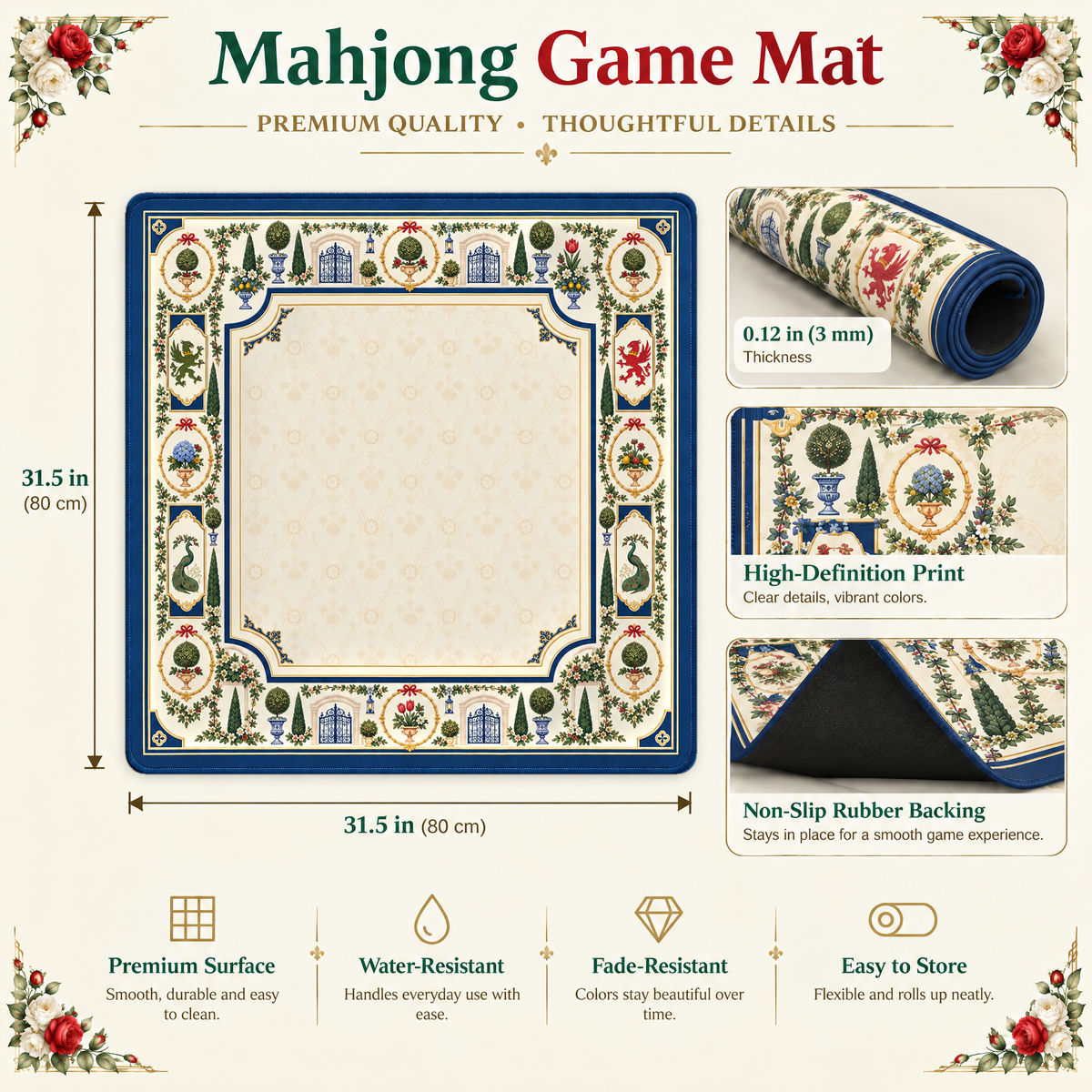
Before purchasing a set, verify that it includes all eight flower tiles—not all sets sold online do, especially older stock or incomplete resales. Count the tiles when they arrive: a standard American set contains 152 playing tiles plus 8 jokers, totaling 160 tiles. Our best-selling collection includes complete sets with flowers, jokers, and clear tile faces that make season and flower artwork unmistakable. Check that flowers are large and legible; if you can't tell spring from bamboo at arm's length, your game slows down during scoring. We also recommend a set with a mat or a carrying case, because flowers are easy to separate from the main pile—a mahjong mat with a flower bonus rack keeps them visible and organized throughout the hand. If you're hosting weekly games, our engraved mahjong sets let you customize the design, making flowers part of a unified look that feels like home every time.
✨ Find your Mahstead set — free US shipping →

FAQ
Can I use a flower tile as a joker to complete a pung or kong?
No. Flowers are never interchangeable with jokers. They are bonus-only tiles that sit in your rack and add points after you win. Jokers substitute for specific tiles within melds; flowers never do.
What happens if I draw a flower on my very first draw before the game starts?
You immediately reveal it, set it aside in your bonus area, and draw a replacement tile from the wall. This keeps your hand at 13 tiles and ensures everyone starts fairly.
Are all eight flowers worth the same points when I win?
Yes, within a single year. Each flower you hold at the end of a winning hand adds the same bonus value according to that year's National Mah Jongg League card. Values change annually, so always check the current card.
If I win with three flowers in my hand, do I get triple bonus?
Yes. Each flower contributes its base bonus points to your final score. If the card says each flower is worth 5 points and you hold three, you gain 15 bonus points from flowers on top of your hand's base value.
Do I have to announce I have flowers, or can I keep them hidden until I win?
You must reveal them immediately when drawn. All players see them face-up in your bonus area throughout the hand. This keeps the game transparent and prevents disputes at scoring time.
Can I refuse a flower if I draw one, or does it have to stay in my hand?
In standard American mahjong, flowers cannot be refused—they're automatically part of your hand and must be revealed. You cannot discard them or "put them back."


View More
View More
View More
