
Faan in Mahjong: Points, Scoring & Hand Values Explained
Last updated: Nov 23, 2026
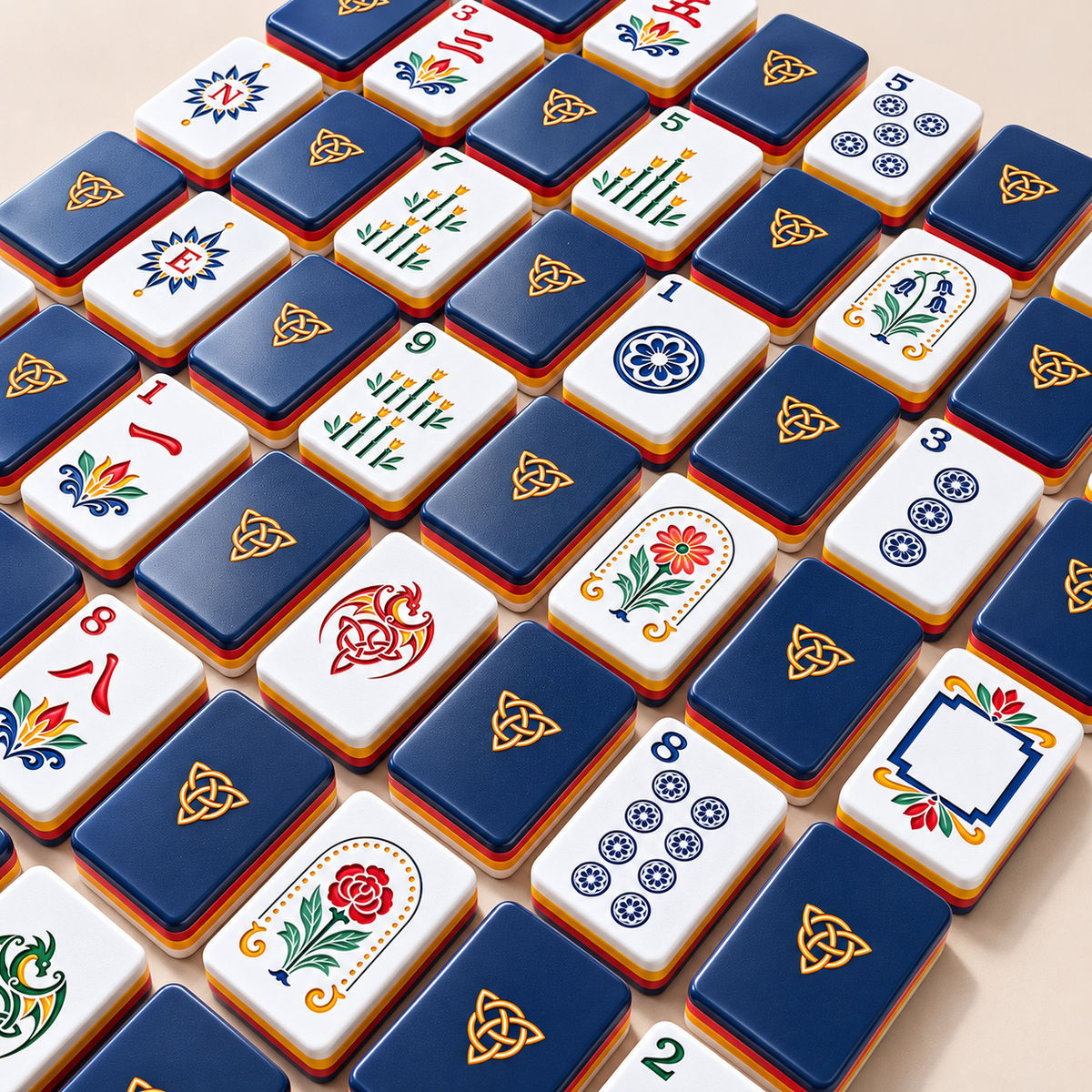
Faan (番, also spelled "fan") is a point-multiplier unit in mahjong scoring that measures hand complexity. In American mahjong, scoring is based on the current National Mah Jongg League card—each valid hand is assigned a fixed point value (e.g., 30, 40, 50, 60 points) determined by tile patterns and exposure rules, not faan. Faan scoring is standard in Chinese, Hong Kong, and Riichi variants, where a hand accumulates faan value (typically 1–8+ faan) by combining tile patterns, melds, and honors; base points then multiply by faan level to reach the final payout. American players rarely use faan; instead, we reference the card-year's fixed values and focus on concealment, exposure rules, and joker placement. Learning faan is essential if you play cross-variant or teach mixed groups; understanding both systems helps you switch games confidently and score fairly whether you're playing at home or in a community setting.
Faan (番) is the point-multiplier unit in mahjong scoring that measures hand complexity. In American mahjong, scoring is based on the current National Mah Jongg League card—each valid hand is assigned a fixed point value (e.g., 30, 40, 50, 60 points) determined by tile patterns and exposure rules, not faan. Faan scoring is standard in Chinese, Hong Kong, and Riichi variants, where a hand accumulates faan value (typically 1–8+ faan) by combining tile patterns, melds, and honors; base points then multiply by faan level to reach the final payout. American players rarely use faan; instead, we reference the card-year's fixed values and focus on concealment, exposure rules, and joker placement. Learning faan is essential if you play cross-variant or teach mixed groups; understanding both systems helps you switch games confidently and score fairly whether you're playing at home or in a community setting.
How does faan differ from American mahjong scoring?
American mahjong uses a fixed-point system tied to a published card that changes annually. The National Mah Jongg League card lists all legal hand combinations—each earns a predetermined score like 30, 40, 50, 60, or 70 points. You don't calculate points; you match your tiles to the card. In contrast, Chinese and Hong Kong variants use faan (and sometimes a base-point system) to calculate points dynamically. A hand earns 1–8+ faan by combining winning criteria: a pair, four melds, and bonuses for concealment, dragons, winds, or special patterns. Points = base points × (2^faan), or a fixed table lookup. American players need only memorize the card's hand patterns; faan players must learn scoring rules and calculations.

What are the main faan categories that increase your score?
Faan is earned in distinct categories, each representing a tile-pattern achievement. Suit purity (all one suit, or mostly one suit) yields 1–3 faan depending on variant and completeness. Honors and terminals (dragons, winds, bamboo face-value tiles) add 1–2 faan each, stacking with other bonuses. Hand structure bonuses include concealed hand (no exposed melds except win tile), all pung hands (no sequences), or "all honors" (dragons and winds only), typically 1–3 faan. Winning conditions such as robbing the kong, drawing from the wall, or winning on a discard each carry faan or multipliers. Flower and season tiles (in Chinese and Asian variants) contribute minor faan or decorative scoring. Consecutive pungs (e.g., 2-3-4 all pungs) or no-honor hands (only number tiles) add complexity bonuses. Each variant weights these categories differently; Hong Kong mahjong emphasizes pungs and limits sequences; Riichi mahjong uses yaku (pattern sets) rather than faan. American players ignore these categories entirely and rely on the card.
How do you calculate the final payout when faan is involved?
In Chinese mahjong, the calculation is straightforward: base points × 2^faan = payout per player. For example, a 1-faan hand with 20 base points pays 20 × 2 = 40 points per player. A 3-faan hand pays 20 × 8 = 160 per player. Some variants cap faan (e.g., 8-faan maximum), and the winner collects from all three opponents unless they also lost or won from Kong. Hong Kong mahjong uses a lookup table instead: base points, faan level, and meld exposure status intersect on a grid to yield the payout directly. Taiwanese and Riichi mahjong have their own payout formulas and multipliers. American mahjong skips all arithmetic: you look up your hand on the card, read the point value (e.g., "40 points"), and collect that amount from each player who didn't win or tie. Beginners often confuse faan with American scoring; always clarify which variant before play.
🀄 Shop best-selling mahjong sets →
Why does faan matter if you play American mahjong exclusively?
If you play only American mahjong at home, faan is purely educational—you won't need it. However, three scenarios make faan knowledge valuable. First, if you ever host a mixed-experience group, one player may know Chinese or Hong Kong rules; you'll need to explain why American scoring is different. Second, if you travel or play online across regions, you'll encounter faan-based games and won't be confused by scoring charts or hand-value discussions. Third, understanding faan deepens your appreciation of mahjong strategy: faan rewards concealment, honors, and hand structure, while American scoring emphasizes exposure flexibility and the card. Learning both systems trains your pattern recognition and helps you appreciate how different cultures optimize the same game. Many Dallas-area players host weekly games that rotate variants; knowing faan lets you join without stumbling through rules.

What scoring mistakes do new faan players make most often?
Common errors in faan play include forgetting that the hand must be complete before any faan count—if you're one tile short, faan is zero and you lose. Beginners often double-count bonuses: a concealed hand earns faan only once, not again for each meld type. They also misunderstand multiplier capping; many variants set a maximum (e.g., 8 faan pays the same as 13 faan), so an ultra-rare hand doesn't auto-win huge amounts. New players in Hong Kong games often forget that only the winner collects; in some rule sets, losers don't split equally. Another trap: confusing flowers with suit purity—a flower bonus does NOT count toward a suit-pure hand in most variants. Finally, players often miscalculate base points: always determine base points before applying the faan multiplier. When hosting games at home, clarify your variant's rules in writing before dealing, and use engraved American mahjong sets with rule cards or reference materials to prevent disputes.
How do you teach faan scoring to a beginner player at your table?
Start by explaining the three layers: hand completion, faan categories, payout. First, teach the hand structure: pair + four melds (pungs, kongs, or sequences, depending on variant). Next, walk them through one easy hand: all 3s, 4s, and 5s (suit purity, 1 faan), plus a red dragon pung (1 faan), total 2 faan. Show the base-point calculation or lookup, then multiply: "2 faan doubles your points." Play practice rounds where you announce faan and payout before dealing; repetition builds confidence. For American mahjong players learning faan, stress that no fixed card exists—points come from rules and math. Use dice to determine who pays whom, as some variants do; this adds clarity. Provide a printed faan chart or a phone reference for the first 2–3 games so they don't feel lost. Ask them to identify faan sources after each hand, not before—this builds pattern recognition. Avoid switching variants mid-session; consistency beats variety for learning.
Scoring System | Hand Calculation | Payout Method | Card Needed? | Concealment Bonus |
American | Match tiles to fixed hand list | Read point value directly | Yes (annual) | Affects card hand value |
Chinese | Base points × 2^faan | Formula or lookup table | No | 1–2 faan for concealed win |
Hong Kong | Base points × faan table | Grid-based payout table | Sometimes reference | Exposure affects payout |
Riichi | Base points × multiplier + yaku | Formula + bonus points | Optional guide | Tsumo (self-draw) doubles |
🎁 See our most-loved mahjong sets & accessories →
What tiles and melds should you prioritize to maximize faan?
To build high-faan hands, prioritize concealment: keeping all four melds hidden until win earns 1–2 faan across most variants. Next, chase honors (dragons and winds); each pung of a dragon is usually 1 faan, and winds can be 1–3 faan depending on your position and variant. Suit purity is a heavy hitter—an all-one-suit hand or mostly one suit yields 1–3 faan easily. Terminal sequences (1-2-3 or 7-8-9 bamboo/craks/dots) or honor-only hands are variant-specific bonuses, so check your ruleset. Avoid mixing too many suits unless they carry a specific bonus pattern. Prioritize consecutive or triplet patterns: three pungs of consecutive numbers often yield extra faan. When building your hand, always ask: "Which tile combination gives me the most faan for my current melds?" This differs sharply from American mahjong, where you scan the card for fixed patterns. Faan thinking is forward-looking and flexible; card thinking is pattern-matching and rigid. Both are valid—just know which game you're playing.
Should you switch between faan and American mahjong scoring at the same table?
No—never mix scoring systems in a single game or session. Confusion over payout breeds disputes and kills the social flow. Instead, decide before dealing which system you'll use. If your group is 80% American players and 20% faan-experienced, start with American and the published card; this keeps 80% of players comfortable. For mixed groups, host separate games: "Tuesday night is American card; Thursday night is Hong Kong faan." If someone insists on faan during an American game, offer to teach them between rounds or invite them to a dedicated faan session later. Many communities use travel-friendly mahjong bags with multiple sets so you can host variant-specific games on rotation. Switching systems mid-session exhausts everyone and breaks trust in scoring fairness.
What to check before you buy
What variant does your group play? If 100% American, you'll never calculate faan; skip detailed faan study and focus on the National Mah Jongg League card instead.
Do you host mixed groups? Learn both systems so you can explain scoring fairly to anyone.
Is your ruleset documented? Print or screenshot your group's specific faan rules (base points, maximum faan, concealment definition) so new players can reference it at home.
Do you have a reference card or chart? Keep a laminated faan lookup table, payout grid, or yaku list at the table during games.
✨ Find your Mahstead set — free US shipping →

FAQ
Is faan the same in every mahjong variant?
No. Chinese mahjong uses faan with base points; Hong Kong mahjong uses faan with a payout grid; Riichi (Japanese) mahjong uses yaku instead. American mahjong doesn't use faan at all. Each variant weights faan differently and combines it with different bonuses.
Do jokers count toward faan in any variant?
In American mahjong, jokers are wild tiles and don't count toward faan (because American doesn't use faan). In Chinese and Hong Kong variants, jokers may substitute for any tile in a meld, but they don't earn extra faan on their own—the meld they complete counts.
What's the minimum faan required to win in Chinese mahjong?
Most Chinese variants require 1 faan minimum to win. A hand with zero faan cannot be declared as a winning hand; you must keep playing. This prevents too many short rounds and low-value payouts.
Can you win American mahjong without understanding faan?
Yes, completely. American mahjong uses a fixed card system, not faan. You match your tiles to the card, read the points, and collect. You never calculate faan. Learning faan is only useful if you play Asian variants or teach cross-variant groups.
How do you explain faan to someone who only knows American mahjong?
Say: "American mahjong is like reading a menu—the card lists all dishes and prices, and you order one. Faan mahjong is like a recipe—you combine ingredients (tiles and patterns) to build a dish, and points depend on what you cooked." Faan is flexible and math-based; the card is fixed and lookup-based.


View More
View More
View More
