
Chinese Official Mahjong with 3 Players: Rules & Setup
Last updated: Nov 23, 2026
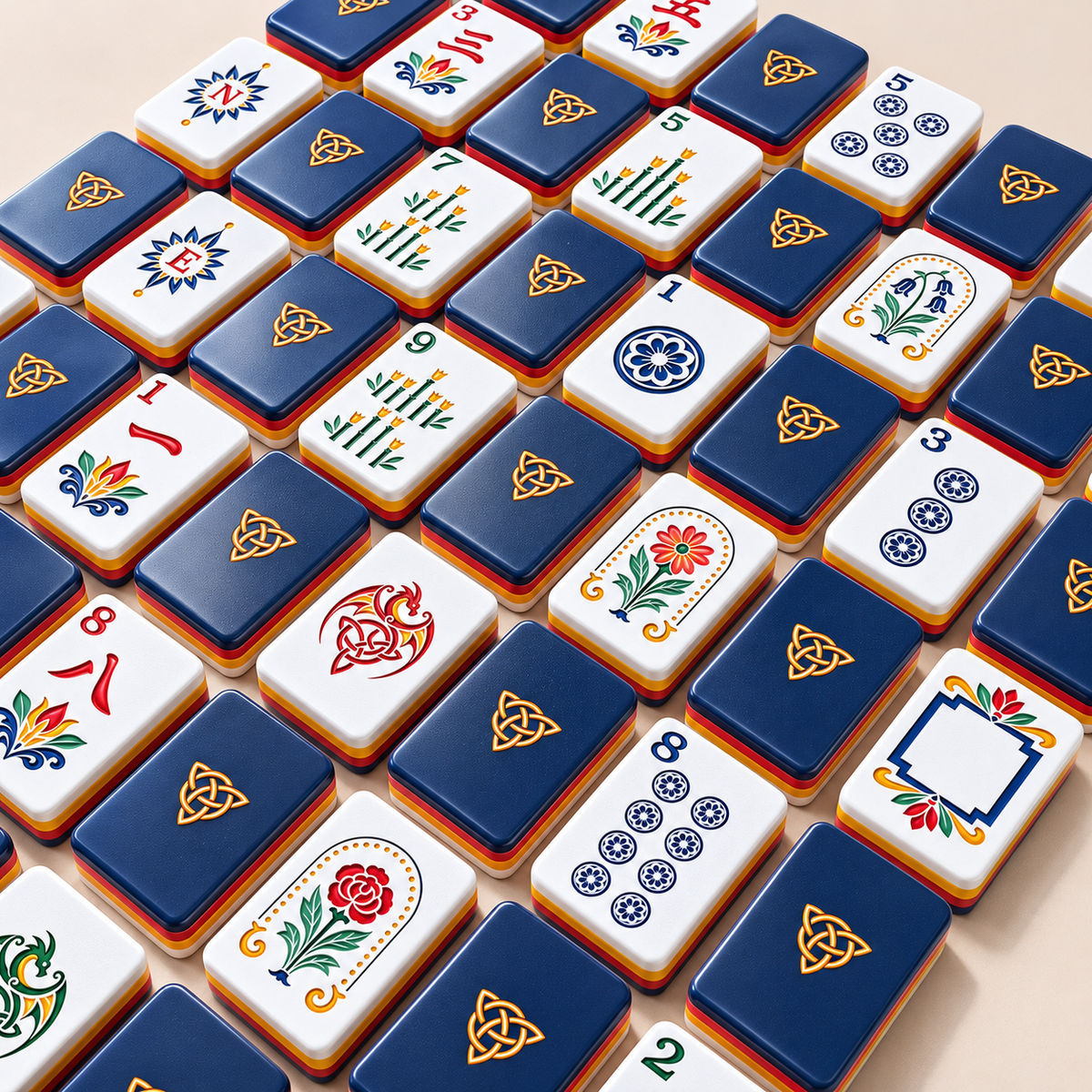
Chinese official mahjong with three players removes 8 tiles (usually Bams 2, 3, 4, 5 and Craks 2, 3, 4, 5, or another agreed set) to create a 136-tile deck, reducing each hand from 13 to 11 tiles and the initial draw from 14 to 12. The dealer sits East and draws first; turns proceed counterclockwise. Three players mean no North wind is used—only East, South, and West. You'll need a standard 144-tile Chinese set; American sets cannot be used because they lack the required flowers and seasons, and include jokers that Chinese play never allows. Rounds complete in 20–40 minutes depending on speed and luck; scoring follows official Mahjong Competition Rules (MCR) or your group's regional variant.
🀄 Shop best-selling mahjong sets →
Which 8 tiles do you remove, and why does it matter?
Most groups agree to remove Bams 2–5 and Craks 2–5, creating symmetry and balance. Some play remove Dots 2–5 instead, or let the dealer choose yearly. The removal forces faster play: fewer draw options, harder winning combos, sharper competition. Document your group's choice before the first hand—switching mid-session breaks rhythm and trust. The eight tiles sit unused on the side of the table throughout the game; if someone accidentally draws one, that hand voids and restarts.

How does three-player seating and wind assignment work?
East (dealer) sits at the table's head position. South sits to the dealer's left; West to the right. There is no North seat or North player. East keeps the wind tile; South and West each hold their own. The dealer wins an extra point if they make Mahjong on their turn (in many variants, dealer wins +1 base per hand). After each hand, winds rotate: South becomes East, West becomes South, East becomes West. After three rounds (nine hands total), all players have been dealer three times—the game ends, and scores settle.
What is the hand size and how do the draws work?
In three-player Chinese mahjong, each player receives 11 tiles (not the standard 13). East draws 12 on their first turn (11 for the hand + 1 opening draw), then plays 1 tile. South draws 1, plays 1. West draws 1, plays 1. Play cycles until someone wins or the wall runs out. Because the deck is smaller and hands are shorter, no player sits with a full 13-tile hand at rest—every turn feels urgent. Dead wall (tiles set aside for Kong draws) is usually 8 tiles in three-player, versus 14 in four-player, so Kong rewards come faster and tiles run out sooner.

Which winning patterns work in three-player versus four-player?
Chinese mahjong winning patterns (e.g., all Pungs, mixed sequences, specific suit combos) remain identical in three-player. You still need a winning hand: four melds (Pungs, Kongs, or Chows) plus one pair. The difference: with 11-tile hands, rarer patterns (like seven pairs or closed hands) are harder to assemble, so simpler combos win more often. Scoring multipliers (fans) stay the same across variants—a pattern worth 4 fans in four-player is worth 4 fans in three-player, but your base payment may differ based on your group's rules. Three-player games reward melds made on opponents' discards less generously (some groups split payouts three ways instead of player-to-player), because fewer players share the liability.
When should you use a set with a mat and racks, and what if you have only American tiles?
A mahjong mat with clear suit markings and discard zone lines keeps three players organized on a small table. Racks with pushers prevent tile spill and let each player stack hidden tiles neatly. American mahjong sets cannot be used for Chinese play: they include jokers (which break the game logic), lack flowers and seasons (required in Chinese), and use a different tile count. If you own only an American set, you'd need to remove jokers and substitute blanks or other tiles for the missing flowers—this undermines game integrity and creates confusion. Buy a proper Chinese 144-tile or larger set from the start.
🎁 See our most-loved mahjong sets & accessories →
Comparison table: Three-player setup vs. standard four-player
Element | 3-Player Chinese | 4-Player Chinese |
Tiles removed | 8 (agreed subset) | None (all 144 used) |
Hand size | 11 tiles | 13 tiles |
Initial draw (East) | 12 tiles | 14 tiles |
Winds in play | East, South, West only | East, South, West, North |
Rounds to completion | 3 (9 hands total) | 4 (16 hands total) |
Dead wall tiles | 8 | 14 |
Typical game length | 20–40 min | 45–90 min |
Melds required to win | 4 melds + 1 pair | 4 melds + 1 pair |
What mistakes do three-player groups make most often?
Forgetting to remove the eight tiles before the first draw. The wall builder (usually the player opposite East) must set aside the agreed tiles face-down, away from the wall. If discovered mid-hand, the hand is void.
Using American tiles. American sets have jokers and no flowers/seasons. The game cannot function. Use a Chinese set only.
Changing wind rotation mid-session. Once the first hand starts, winds lock in order (East → South → West → East) until the session ends. Switching confuses scoring and scoring precedence.
Paying the dealer wrong. In many three-player variants, the dealer pays or receives a premium for Mahjong wins. Confirm your group's payment rule before play.
Drawing Kong replacements from the wrong end of the wall. The dead wall sits at a marked spot. After a Kong, the next tile must come from the dead wall end, not the live draw end. Mixing this up creates illegal hands.
What to check before you buy
Confirm your group plays Chinese, not American. American mahjong uses a yearly card, jokers, and 152 tiles—wholly incompatible. Ask your friends which rules they follow.
Check tile material. Bamboo and bone tiles last decades but chip if dropped hard. Acrylic tiles are lighter and won't splinter; they show wear faster but won't crack. Buy what fits your table space and durability needs.
Measure your table. A 144-tile set with racks and a mat occupies roughly 30″ × 30″. Three players on a small round or folding table will feel crowded without a proper mat. Plan space before ordering.
Verify the tile count. Chinese sets come in 144, 152, or 160 tiles. For three-player official, 144 is standard; larger sets give spares if tiles go missing. Confirm the listing before checkout.
✨ Find your Mahstead set — free US shipping →

FAQ
Can I play three-player Chinese mahjong with an American set?
No. American sets include jokers and lack flowers and seasons—core tiles in Chinese play. American mahjong also uses a yearly card and exposed sequences (chows), which are not allowed in Chinese. Always use a Chinese 144-tile set.
Does the dealer always win more money in three-player?
Many groups pay the dealer +1 base point per hand when they make Mahjong on their own turn. Some groups also have the non-dealer players split the dealer's loss 50/50 instead of paying full. Clarify your table's rule before the first hand.
What happens if someone draws one of the eight removed tiles by accident?
The hand voids immediately, all tiles are gathered, and a new hand is dealt. The same player re-deals East if it was their first draw; otherwise, winds rotate normally.
How many rounds do we play to call it a session?
Three rounds (nine hands total) is traditional—each player deals three times. Some groups play one round only, or continue until a set time or score milestone. Decide before you start.
Can three-player and four-player groups use the same set?
Yes, if the set contains at least 144 tiles and has all Chinese elements (Flowers, Seasons, Dragons, Winds). Just remove the agreed eight tiles for three-player; use all 144 for four-player. A larger set offers spare tiles for wear or loss.


View More
View More
View More
