
Chinese Mahjong vs Taiwanese Mahjong: Rules, Tiles & Gameplay
Last updated: Nov 23, 2026
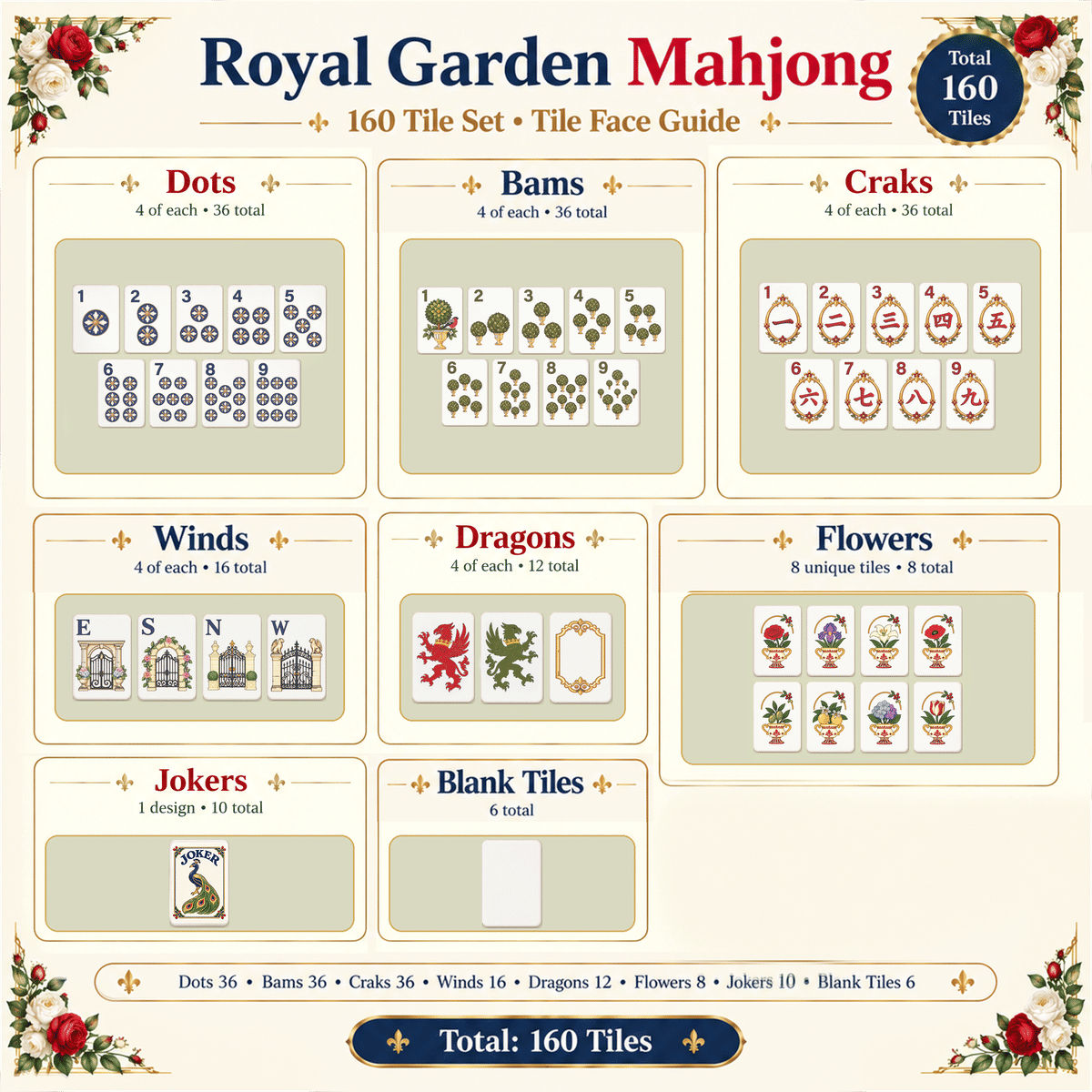
Chinese mahjong (also called Cantonese mahjong) uses 136 tiles with pung/kong/chow sequences; Taiwanese mahjong adds bonus tiles and uses 144 tiles with different hand patterns and higher scoring multipliers; American mahjong uses 152 tiles, no sequences or chows, fixed hand patterns from an annual card, and jokers as wildcards. All three trace to Qing Dynasty tile games but diverged in tile sets, winning mechanics and regional rule books. The main practical difference: Chinese and Taiwanese are draw-and-discard games with endless hand possibilities; American mahjong is card-based with one official hand list per year. Beginner difficulty: American is most structured (easier for first-timers), Chinese requires sequence-spotting (intermediate), Taiwanese demands quick pattern recognition under multiplier pressure (advanced). Each game takes 10–20 minutes per hand with four players. If you're hosting a weekly game, picking one variant early and sticking with it avoids confusion; Mahstead's best-selling acrylic sets work equally well for any variant, though American play benefits from our mats and pushers for clarity. --- 🀄 Shop best-selling mahjong sets →
What are the core tile differences between these three games?
Chinese mahjong has 108 tiles (Bams, Craks, Dots 1–9 × 4 each) plus 16 winds, 12 dragons and no flowers, jokers or blanks — always 136 tiles total, played with no wildcards. Taiwanese mahjong uses the same 136-tile base but adds 8 bonus tiles (flowers and seasons), making 144; some sets include jokers as optional additions but they're not standard. American mahjong uses 152 tiles: Bams, Craks, Dots 1–9 (36 per suit, 108 total), 16 winds (4 each direction), 12 dragons (where White serves as zero) and 8 flowers, plus 8 mandatory jokers that act as wildcards — the jokers are never removed and are central to gameplay. The key: Chinese and Taiwanese games never use jokers; American mahjong can't work without them, and the joker count stays at 8 for any legal game.

Which game allows sequences, and how do they work differently?
Chinese mahjong allows chow sequences (three consecutive numbers in one suit, like 3–4–5 Dots) plus pungs (identical three tiles) and kongs (identical four tiles). You can call an exposed chow from any player's discard or keep sequences hidden. Taiwanese mahjong works the same way: chows, pungs, kongs, plus bonus tile combinations. American mahjong has no chows at all — you may expose only pungs (three identical), kongs (four identical), quints (five identical) and sextets (six identical). That single rule difference changes everything: American players can't build 1-2-3 chains, so they read from a fixed card showing 88 legal hand patterns per year instead of inventing hands from open-ended sequence logic. If you've played Scrabble (combining small tiles into words), Chinese/Taiwanese feel closer; American mahjong feels closer to bingo (matching a published pattern).
How do scoring and winning hands differ?
Chinese mahjong scoring is additive: each concealed or exposed combination (chow, pung, kong) adds points; bonus tiles add fixed values; winning adds a base score plus multipliers for special hands. Taiwanese mahjong uses a similar base system but includes aggressive multipliers — a hand with many high-value combos can be worth 2×, 4×, 8× the base or higher, making single hands swing games dramatically. American mahjong scoring is simpler in structure but requires the annual League card: each legal hand on the card carries a point value and a specific multiplier (singles, doubles, triples). You win by calling "Mahjong" and showing a hand that exactly matches one line on the current year's card; you cannot win with a sequence combination not listed that season. Scoring speed: Chinese is slowest (calculate each meld); Taiwanese is moderate (base score + multipliers); American is quickest once the card is memorized (one hand = one score).
What role do bonus tiles and jokers play in each variant?
In Chinese mahjong, there are no bonus tiles or jokers — the game moves entirely on number and wind combinations. In Taiwanese mahjong, bonus tiles (flowers and seasons, typically 8 total) are drawn at game start and replaced immediately; they add fixed points but don't influence the core hand-winning logic. In American mahjong, flowers are part of the standard 152-tile set but jokers dominate strategy: all 8 jokers act as wildcards that can substitute for any tile in an exposed pung, kong, quint or sextet. However, jokers can never form a pair (the critical ending combination) and cannot be used alone — they only add value in groups. This makes joker placement central to American endgame decisions: do you use them to complete a pung now, or save them to build a rarer hand later? Bonus tiles and jokers make each variant's rhythm distinct — Chinese requires memory, Taiwanese adds luck through bonus draws, American adds joker strategy.

Which variant is easiest for beginners, and how do you start learning?
Beginner difficulty ranking:
Variant | Setup time | Learning curve | Best for | Why |
American | 5 min (card + Charleston) | Easiest | First-timers | Fixed 88 hands per year; no sequence math |
Chinese | 3 min (tiles only) | Intermediate | Sequence players | Chows unlock infinite combos; memory-heavy |
Taiwanese | 3 min | Hardest | Advanced | Chows + multipliers + bonus draws = speed + math |
American mahjong is designed for structured learning: grab an annual card, start with one-hand-at-a-time study, then learn the Charleston (tile-passing ritual) in one session. You can play safely without memorizing the full card if one player watches. Chinese mahjong requires understanding chow logic first — practice spotting 1-2-3, 5-6-7, 8-9-1 patterns and how they stay hidden or reveal. Taiwanese mahjong assumes you know Chinese play, then adds the multiplier layer; start watching experienced tables before joining. Most beginner-friendly entry point: American mahjong with a printed card and our best-selling sets, which come sized for clear tile reading under house lighting.
🎁 See our most-loved mahjong sets & accessories →
How does the passing ritual (Charleston) differ?
American mahjong includes the Charleston — a three-pass ritual before play where each player passes tiles to their neighbors. Pass 1: pass three tiles right. Pass 2: pass three tiles across. Pass 3: pass three tiles left. Then optional "return" exchanges happen if players want them. The Charleston breaks up tile clusters and creates unpredictable starting hands, making every game feel fresh even with the same 152-tile pool. Chinese and Taiwanese mahjong have no Charleston — the dealer draws 14 tiles, other players draw 13, and the first discard begins immediately. This means Chinese/Taiwanese games feel faster to start but can develop repetitive tile patterns week to week. American's Charleston takes 2–3 minutes but guarantees better hand distribution. If you host weekly games and notice patterns (same players always getting high-number combos), the Charleston is why American mahjong feels more balanced.
What equipment and references do you actually need to play each?
Chinese mahjong: 136-tile set (acrylic, bamboo or bone), wind/dragon reference sheet, score pad. No card, no mat required for casual play, though a mat helps tile visibility.
Taiwanese mahjong: 144-tile set (136 + 8 bonus), same reference sheet, score pad with multiplier rows. Some players add pushers for speed. No jokers.
American mahjong: 152-tile set (includes 8 jokers), current-year National Mah Jongg League card (essential; without it you cannot win legally), mat (highly recommended for tile organization and the pushing ritual), racks with pushers (optional but helpful for speed and hand-hiding). Our mahjong mats are sized for the American pushing and organizing flow.
The single biggest difference in equipment needs: American mahjong requires the annual card (published every spring) — you cannot play legally without it. Chinese and Taiwanese are play-anywhere games once you memorize scoring. If you're buying your first set and can't commit to one variant yet, American sets are most versatile because they include flowers and jokers; if you strip the jokers, you can experiment with simplified Chinese-style play.
✨ Find your Mahstead set — free US shipping →
What to check before you buy
Tile count: Verify your set includes exactly the tiles your chosen variant requires (136 for Chinese, 144 for Taiwanese with bonus draw option, 152 for American).
Joker presence: American sets must have 8 jokers; Chinese and Taiwanese sets should have zero jokers unless you're experimenting with house rules.
Readability: Check tile engraving or painting clarity — the number or wind should be visible from 3 feet away in room light; acrylic sets read faster than bamboo under poor lighting.
Card inclusion: If buying for American mahjong, confirm the current-year National Mah Jongg League card is included or you know where to source one separately.
Size and weight: American play with mats and pushers favors standard tiles (0.75–1 inch); Chinese tables often use smaller tiles (0.6–0.7 inch). If you're hosting mixed-variant nights, oversized tiles reduce confusion.
Joker rules in your group: Before buying, ask your regular players: are jokers ever used in Chinese or Taiwanese casual play? Some house rules adapt them; official tournament play never does.

FAQ
Can I play all three variants with the same tile set?
No. An American set (152 tiles + 8 jokers) is too big for Chinese (needs 136, no jokers). A Chinese set lacks the jokers and 16 extra tiles American requires. You need separate sets, though some experienced groups own both and swap them. Taiwanese play works with either a dedicated 144-tile set or a 152-tile American set (using only 144 tiles), but clarity suffers if tile counts mismatch your scorecard.
Which variant is fastest in real play?
American is fastest once the card is memorized — hand recognition takes seconds. Taiwanese is moderate — scoring multipliers add 30–60 seconds per hand. Chinese is slowest — counting exposed melds and bonus values can take 2–3 minutes. If you're hosting casual Thursday nights, American keeps pace; if you want strategic depth, Chinese rewards slower play.
Do I need to learn sequences to play American mahjong?
No. American mahjong has no sequences at all. You need only to recognize numbers, winds, dragons and flowers — no chow logic required. This is why many American players find it simpler to teach to newcomers than Chinese mahjong.
Is the annual American mahjong card really necessary every year?
Yes. The National Mah Jongg League releases a new card every spring, and legal tournaments use only that year's card. Casual home games sometimes play multiple older cards for variety, but for consistency and rule clarity, one group should agree on one card per season.
Can I use bonus tiles or house rules to adapt one variant into another?
Cautiously. Some house rules hybridize games — adding jokers to Chinese, dropping bonus tiles from Taiwanese — but this creates scoring confusion. If your group wants to experiment, write down the house rules clearly and keep them consistent across sessions. Tournament play does not allow this; only home games can bend rules by group consent.
Which variant has the most online tutorials and learning resources?
American mahjong has the most structured beginner content (the card is standardized yearly); Chinese mahjong has deep regional variation (Cantonese, Beijing, Sichuan), so tutorials vary. Taiwanese resources are fewer in English but growing. All three benefit from watching experienced players live — reading a rule book without seeing play is slow. Join a local community center or library group if possible.


View More
View More
View More
