
Chinese Mahjong vs. American Mahjong: Rules & Competition Differences
Last updated: Nov 23, 2026
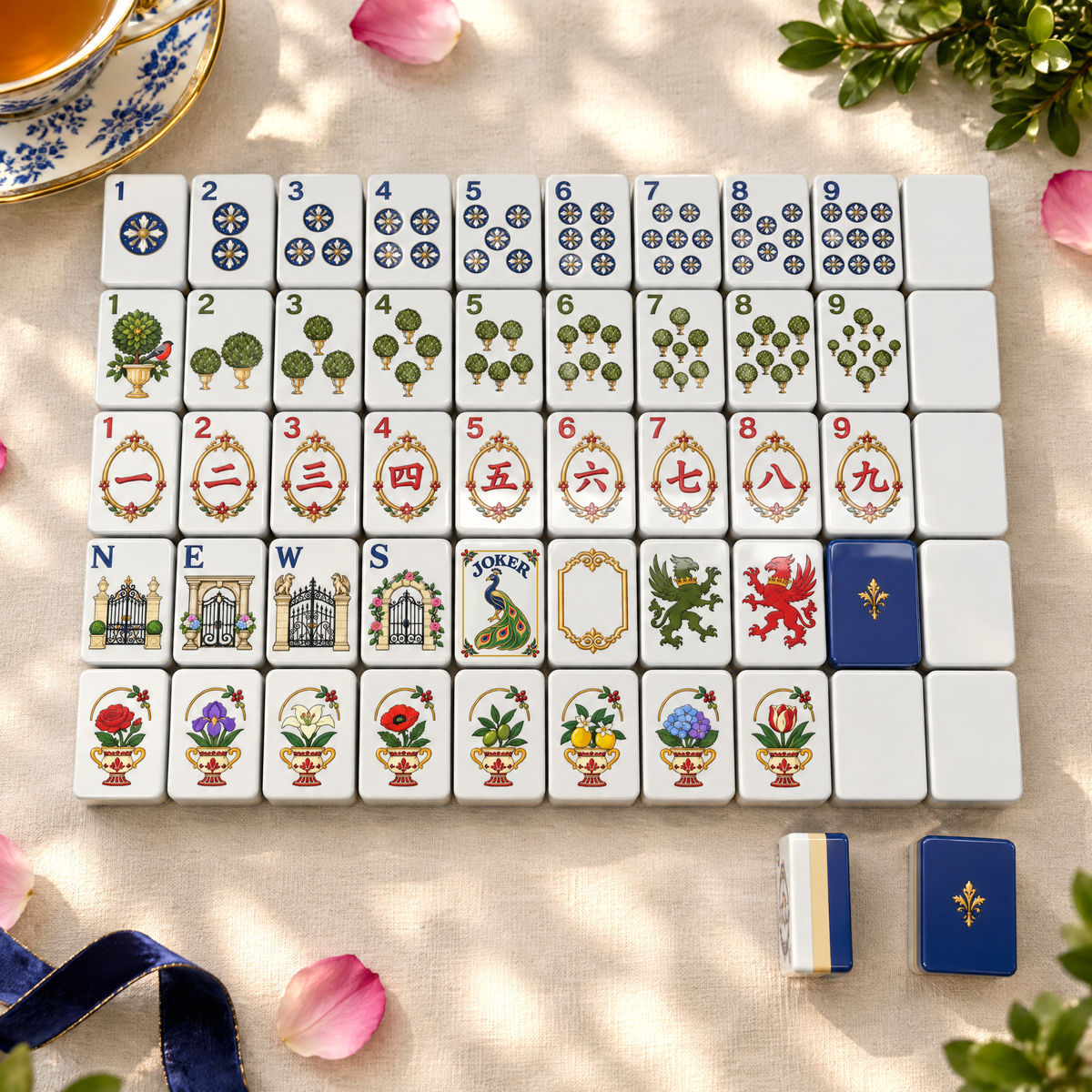
Chinese mahjong uses 144 tiles (36 per suit: Bams, Craks, Dots, plus Winds and Dragons), plays with chows (sequences like 1-2-3), and scores based on point values assigned to each winning hand. American mahjong uses 152 tiles with 8 jokers, forbids sequences entirely (only pungs, kongs, and joker-enhanced sets allowed), and requires hands to match only the current year's National Mah Jongg League card—no hand flexibility. Chinese games end when any player completes a valid combination; American play rotates through one full round (East, South, West, North). Scoring differs radically: Chinese awards points for tile combinations and melds; American assigns flat or multiplied values per the card. Both reward strategy, but Chinese emphasizes real-time pattern recognition and quick melds, while American demands pre-game card study and strict hand validation. Choose based on your group's preference for improvisation (Chinese) or rigid structure (American).
What is the core difference between the two games?
Chinese mahjong and American mahjong are distinct games that happen to share a name and some tile imagery. Chinese mahjong emerged in 19th-century China and has hundreds of regional rule variations; American mahjong crystallized in the 1920s–1930s among Jewish and non-Jewish women in the U.S. and now operates under the National Mah Jongg League's standardized rules. The two are not interchangeable. A hand valid in Shanghai rules is meaningless in an American game, and vice versa. If you sit down to play, you must agree on the variant first—it changes tile distribution, legal moves, and the entire winning condition.

How many tiles and what suits does each version use?
Chinese mahjong plays with 144 tiles: three numbered suits (Bams 1–9, Craks 1–9, Dots 1–9), four copies of each = 108 tiles total, plus 16 Winds (four each: North, East, South, West) and 12 Dragons (four each: Red, Green, White), totaling exactly 144. No jokers, no flowers, no blanks—the deck is closed and finite.
American mahjong uses 152 playing tiles plus 8 jokers: the same three numbered suits (Bams, Craks, Dots) with four copies each, plus 16 Winds and 12 Dragons, plus 8 flowers (totaling 156 base tiles), then removes 4 flower tiles and adds 8 jokers to land at exactly 160 in the physical set—152 active + spare jokers and blanks reserved. The National League game always draws from exactly 152 tiles and 8 jokers per round; spares remain in the case. This flexibility is core to American play: jokers act as wildcards that substitute for any single tile in a meld, enabling hand patterns the static Chinese deck cannot create.
Aspect | Chinese | American |
Total tiles in play | 144 | 152 + 8 jokers |
Suits | Bams, Craks, Dots (3) | Bams, Craks, Dots (3) |
Winds | 4 each (16 total) | 4 each (16 total) |
Dragons | 4 each (12 total) | 4 each (12 total) |
Flowers | None | 8 (removed from active play) |
Jokers | None | 8 (active wildcards) |
Blanks | None | Spares in set |
Hand rigidity | Open—adapt patterns on the fly | Closed—must match League card only |
What are the biggest rule differences?
Sequences (chows) and melds: Chinese mahjong allows and requires chows—sequences like 1 Bam, 2 Bam, 3 Bam in the same suit. Players build and call chows to the table during play. A valid winning hand always contains at least one chow. American mahjong forbids chows entirely. You may expose only pungs (three identical tiles), kongs (four identical), quints (five), and sextets (six). Jokers can stand in for missing tiles in pungs and larger sets, but never in a pair or as a single tile. This single rule reversal makes the games structurally incompatible.
Hand validation: In Chinese mahjong, any hand meeting the rule structure (typically 14 tiles: four melds of three + one pair, or regional variants thereof) is valid. Players improvise as tiles are drawn.
In American mahjong, only hands listed on the current year's National Mah Jongg League card are legal. A player winning with a hand not on the card—even if it looks "perfect" in Chinese terms—is disqualified. This means serious American players study the card before each game. The card is reissued every April and changes annually, so last year's card is invalid. You cannot call a hand because it looks right; it must be on the card.
Play order and rounds: Chinese games typically end the moment any player completes a winning hand and declares. The player who wins collects points; the game resets immediately or after a brief score settlement.
American play follows a fixed four-player, one-round structure: East, South, West, North each take a turn as the "discarder" (the player from whom the winning player draws). A "game" equals one complete round; players often play multiple consecutive rounds. The hand must be called before the next tile is drawn—timing is strict.
How is scoring calculated differently?
Chinese scoring assigns point values to tile combinations. For example, a set of three Dragons might be worth 4 points; a chow might be worth 0 (considered "cheap"); winning on a terminal tile (1 or 9) adds bonus points. Winning players collect points from all three opponents based on hand difficulty. Regional rules vary widely—Cantonese scoring differs sharply from Shanghai or Sichuan rules. Most Chinese games use a running total to a target (e.g., first to 2,000 points wins).
American scoring uses the current year's National Mah Jongg League card as its authority. Each valid hand on the card carries a fixed point value, often multiplied by the number of players won against (typically a player collects points from all three non-winners). The card updates annually; a hand in the "2 Simples" section might be worth 40 points, while a rare "Like Numbers" pattern might be worth 60 or more. Scoring is arithmetic and deterministic—no judgment calls. Players track scores by hand and often play to a cumulative game total (e.g., highest score after three games).

What about the initial tile-passing ritual?
Chinese mahjong begins with players rolling dice and drawing a "wall" of tiles in a prescribed order. Wall-building varies by region, but the principle is standard: players draw tiles in sequence from a centralized wall until hands are built (often 13 or 14 tiles each). No pre-game tile exchange occurs in most Chinese variants; play begins immediately once hands are drawn.
American mahjong begins with the Charleston—a three-stage tile-passing ritual unique to the American game. Before play starts, all four players exchange three groups of tiles (first pass to the right, second to the left, third across the table). Players can then pass up to three additional tiles if both sides agree. This ritual gives players influence over their initial hand and adds a social, negotiating element. The Charleston is mandatory in league play and is considered essential to American mahjong's identity—it slows the game's start, extends the social period, and creates a sense of collective hand-building before competition begins.
🀄 Shop best-selling mahjong sets →
Which variant is easier to learn, and which is more competitive?
Chinese mahjong is often easier to start because rules are more intuitive: draw a tile, discard a tile, meld when you have three identical or a sequence, win when you have a valid hand. Beginners grasp chows immediately. However, regional rule variation means you must ask "which rules?" at every new table; switching from Cantonese to Shanghai rules can be jarring. Competitive Chinese mahjong in tournaments follows a standardized ruleset, but casual home games often improvise or mix variants, which can frustrate newcomers.
American mahjong has a higher entry barrier because you must memorize or reference the current League card to play legally. New players often feel overwhelmed by the card's density (hundreds of patterns across multiple sections). However, once you accept that constraint, the rules are consistent—no regional variation. Competitive American play is highly standardized because all tournaments use the same card. Serious players invest time in card study, making the learning curve steep but stable.
For casual players, Chinese mahjong feels more pick-up-and-play; for structured competition and rule consistency, American mahjong is clearer—you always know where the authority lies. If you prefer strategy that emerges during play, choose Chinese; if you prefer pre-game preparation and predictable rule enforcement, choose American. Neither is objectively "easier"—it depends on your preference for improvisation versus structure.
🎁 See our most-loved mahjong sets & accessories →
What should I check before I buy a set?
If you're planning to host games, clarify which variant your group plays before purchasing a set. American and Chinese mahjong can both be played with similar tile sets, but American-specific equipment (like mahjong racks with pushers for organizing larger hands or engraved sets with League-card sections) enhance the American experience. Chinese play is lighter on accessories—you mainly need tiles and a mat.
For American mahjong, confirm your group has access to the current year's National Mah Jongg League card (available for purchase from the League or bundled with many sets). Without it, no valid hand can be called.
For Chinese mahjong, establish which regional rules your table plays before the first game. YouTube searches for "Cantonese mahjong rules" or "Shanghai mahjong" will show you video tutorials; rule guides vary, so watch a few and pick one your group agrees on.
For either game, buy a mahjong mat to protect tiles and table and a durable travel bag if you're moving sets between homes. A clear, well-lit mat makes both variants easier to read and more pleasant to play.
What to check before you buy
Tile count: Ensure the set includes the correct count for your variant (144 for Chinese, 152 + 8 jokers for American).
Tile clarity: Check that numbers and suit symbols are legible under your lighting—engraved or painted tiles degrade; acrylic or plastic with high-contrast markings last longer.
Current League card: For American play, confirm you have the current year's card or that it's included with your purchase.
Regional rules: For Chinese play, decide on one ruleset and teach all players the same version before play starts.
Mat and storage: Protect your investment with a dedicated mat and bag; loose tiles get lost or damaged in transit.
✨ Find your Mahstead set — free US shipping →

FAQ
Can I use the same mahjong set to play both Chinese and American mahjong?
Partially. Both use the same core tile imagery (Bams, Craks, Dots, Winds, Dragons), but American sets include 8 jokers and are designed for 152-tile play, while Chinese sets use 144 tiles with no jokers. You can play Chinese mahjong with an American set by removing the jokers and playing by Chinese rules, but you cannot play American mahjong with a Chinese 144-tile set—the joker-based hand patterns will be impossible.
What does the National Mah Jongg League card do?
The League card is a reference sheet updated every April listing all legal winning hands for that year's American mahjong season. Each hand shows a tile pattern, and hands are organized by category (Like Numbers, Consecutive Pungs, etc.). To call a win in American play, your hand must match a hand on the current card exactly—if it's not listed, you cannot win, even if your hand looks valid by Chinese or other rules.
Why does American mahjong forbid chows?
Historical and design reasons: American mahjong was simplified for Western players in the 1920s–1930s to be faster and less memorization-heavy than some Chinese variants. Removing chows reduced the number of valid hand combinations and made the game more rule-bound. The League card replaced improvisation; players study the card rather than learning complex sequence logic. This trade-off made American mahjong more accessible to casual players but also more rigid and standardized.
How long does a round of American mahjong take vs. Chinese?
An American round (one player as discarder) typically takes 15–30 minutes depending on skill and luck. A full American "game" (all four players as discarder, one round each) takes 60–120 minutes. A Chinese game round varies widely—casual play might run 20–40 minutes per round; competitive tournament play with strict timers might run faster. Chinese games have no fixed round structure, so duration depends entirely on when someone wins, whereas American play has a pre-set four-discarder sequence.
Do I need to buy the National Mah Jongg League card separately?
Yes, in most cases. The card is not included with all sets; you must purchase it separately or check if your set explicitly includes it. The League sells cards annually; they expire each April when a new card is released. Serious American players keep multiple years of cards on hand for reference, though only the current year is legal for League play.
Which variant has more tournaments and organized play?
American mahjong has far more organized tournament structure in the U.S., sponsored by the National Mah Jongg League and held in dozens of cities throughout the year. Chinese mahjong tournaments exist but are less standardized in North America; they're more common in China, Hong Kong, Taiwan, and communities with Chinese diaspora populations. If you want to join organized competitive play in the U.S., American mahjong is more accessible.


View More
View More
View More
