
Chinese Mahjong vs. American Mahjong: Key Rules & Differences
Last updated: Nov 23, 2026
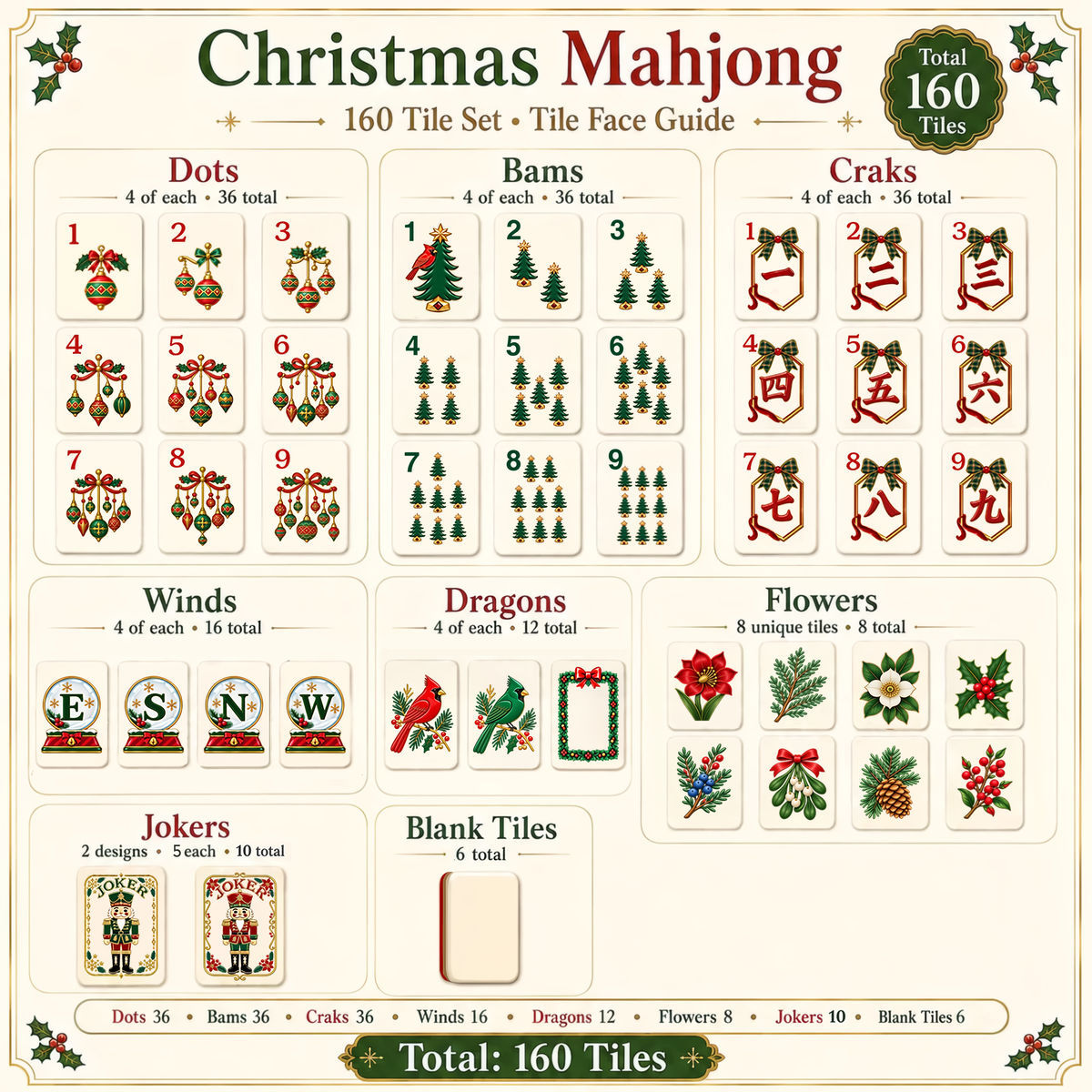
Chinese mahjong (also called Hong Kong or Cantonese mahjong) uses 144 tiles, permits sequences called "chows" (1-2-3 runs in a single suit), and allows "eyes" (pairs) of any tile type. American mahjong uses 152 tiles with eight jokers, forbids chows entirely, and only exposes pungs (three identical tiles), kongs (four), and quints or sextets (five or six identical tiles). Chinese hands are built freely during play; American hands come only from the current year's National Mah Jongg League card. Chinese scoring is based on point multipliers and tile combinations; American scoring draws from a published card. Both are four-player games, but the tile sets, valid hands, and gameplay flow are fundamentally incompatible—you cannot play one ruleset with the other's tiles. If you're in the US, American mahjong dominates; internationally, Chinese variants are standard.
What tiles does each game use?
Chinese mahjong plays with 144 tiles: three suits (Bams, Craks, Dots) numbered 1–9 with four copies each, plus 16 winds (North, East, South, West, four of each), 12 dragons (Red, Green, White), and eight flowers. American mahjong uses 152 tiles—the same base (144 tiles) plus eight jokers. Our best-selling mahjong sets are designed for American play; Chinese players source specialized 144-tile sets without jokers. The joker is the game-changer: American rules treat jokers as wildcards for exposed melded groups, a mechanic that forces a completely different hand-building strategy than Chinese play.
🀄 Shop best-selling mahjong sets →

Can you make sequences (chows) in both games?
No—this is the sharpest rule split. Chinese mahjong requires chows: three consecutive numbered tiles in one suit (e.g., 4-5-6 Dots). You must expose chows to win, and you can call (claim) a discard to complete one. American mahjong has zero chows. You can only meld pungs (three identical tiles), kongs (four identical), quints (five identical), or sextets (six identical). A sequence like 4-5-6 is illegal; you cannot even declare it as a private hand. This alone means American and Chinese players operate in entirely different tactical worlds—Chinese players hunt for runs; American players hunt for sets of identical tiles.
How do winning hands work in each variant?
In Chinese mahjong, you assemble 14 tiles into four melds (chows or pungs/kongs) plus a pair; your winning tile completes one meld, and scoring depends on the composition (all pung hands score higher than mixed chow/pung hands, for example). In American mahjong, your 14 tiles must match exactly one of roughly 100 valid hand patterns printed on the current year's National Mah Jongg League card. You cannot win with a hand that isn't on the card, even if it looks perfect. Chinese mahjong is generative—you discover winning hands as you play. American mahjong is prescriptive—the card governs all legal hands. This means American players must know the card, while Chinese players need to memorize scoring principles and hand values.
How do jokers and wildcards function?
Chinese mahjong has no jokers or universal wildcards in traditional play. Some variants allow optional joker rules, but the base game relies on tile-for-tile accuracy. American mahjong grants eight jokers per set, and they substitute for any tile in an exposed group only—never in a single tile or a pair. If you need a 7 Crak to complete an exposed pung, you can use a joker. But if you need one 7 Crak as your pair, no joker allowed; you must use an actual 7 Crak tile. This distinction teaches American players precision and resource management—each joker is a precious card that enables specific, legal moves.

What about the Charleston and hand selection?
American mahjong opens with the Charleston: players pass tiles in a three-round ritual (right, left, diagonal, then reverse) before any play begins. This ritual is ceremonial and strategic—it shapes the opening distribution. Chinese mahjong skips the Charleston; one player draws 14 tiles (or 13 plus a draw), and play begins immediately. The Charleston is uniquely American and builds community energy; it signals the start of the game and gives all four players equal input into the opening hand. If you're learning American mahjong, understanding the Charleston is as important as learning tile names.
Scoring: card-based vs. point-based
American mahjong scoring is tied to the card. Each valid hand pattern on the card lists its point value (usually 25–70 points per season). A hand is legal and scores if it matches the card. Scores are tightly regulated, and ties break by hand type or by house rule. Chinese mahjong scoring is algorithmic: you tally points based on factors like hand type (all pungs, mixed, all terminals), dragon or wind presence, bonus tiles, and self-draw. A Chinese hand may score anywhere from 1 base point to 128+ points (or more with multipliers and bonuses). American scores are narrower and predictable; Chinese scores explode with combinations.
Comparison: American vs. Chinese Mahjong at a Glance
Feature | American Mahjong | Chinese Mahjong |
Tile count | 152 (144 + 8 jokers) | 144 |
Sequences allowed | None (no chows) | Required (chows mandatory) |
Melds | Pungs, kongs, quints, sextets only | Chows, pungs, kongs |
Hand selection | From current year's NMJL card only | Generative (any winning combination) |
Jokers | 8 wildcards for exposed groups only | None (or optional variants) |
Charleston | Required before play | Not used |
Scoring basis | Card-printed point values | Algorithmic multipliers & bonuses |
Opening draw | Ritual tile-passing (Charleston) | Direct draw (13 or 14 tiles) |
🎁 See our most-loved mahjong sets & accessories →
Which variant should you learn?
If you live in North America, play with an existing American group, or want a rule card you can hold and reference, American mahjong is your entry point. If you travel internationally, live in Asia, or want a game with looser hand rules and higher strategic freedom, Chinese mahjong rewards study. Many players learn American first because the ruleset is written down and stable each season; Chinese mahjong has regional variants (Hong Kong, Taiwanese, Fujian), so you must agree on house rules with your table. There's no wrong choice—but they're incompatible games, so pick one and invest in the right tile set and resources.
What to check before you buy
Confirm your local game's ruleset — Ask your club, teacher, or group explicitly: "Is this American NMJL or Chinese (Hong Kong/Taiwanese/Riichi)?" Mismatched rule sets waste money.
Count the tiles and jokers — American play requires exactly 152 tiles and 8 jokers; don't accept a 144-tile set labeled "American" or vice versa.
Verify the card format — American sets should include or point to the current year's NMJL card; Chinese sets don't need a card.
Check tile marking clarity — American players read jokers and suit marks quickly; Chinese players need clear wind and dragon symbols.
Match your table's mat and racks — If your group uses mahjong racks with pushers, make sure your tile size fits (American standard is ~0.75" × 1").
✨ Find your Mahstead set — free US shipping →
Why does equipment matter for the right variant?
American mahjong sets are engineered for speed and card compliance. Jokers must be visually distinct (usually solid color or numbered); suit colors must be bright and readable under table lights. Our mahjong sets are 160-tile acrylic sets designed for American play, with clear engravings and joker separation. If you need Chinese mahjong, you'll source a traditional 144-tile set elsewhere; many feature classical imagery and bamboo-style backs unsuitable for American card-based gameplay. Your equipment choice locks you into a ruleset—buy wrong, and you'll discover mid-game that your tiles don't match your rules.

FAQ
Can I play American mahjong with a Chinese 144-tile set?
No. American requires 152 tiles and 8 jokers to play legally. A 144-tile set lacks jokers and is incompatible with NMJL hand patterns.
Do Chinese players use the National Mah Jongg League card?
No. The NMJL card is American-only. Chinese players memorize hand values and scoring rules; they have no single printed card.
Is Chinese mahjong harder than American mahjong?
Different, not harder. American requires card memorization and precise hand-matching; Chinese requires pattern recognition and point arithmetic. Both demand practice.
Can I switch between American and Chinese mahjong at the same table?
Not simultaneously. You'd need two tile sets and agreement to restart play under new rules. Most groups stick to one variant per session.
What's the fastest way to learn which variant I should play?
Ask your local mahjong club, community center, or existing group. They'll tell you the ruleset, and that decision drives your tile set and learning path.
Do jokers exist in Chinese mahjong?
Not in the classical game. Some modern regional variants allow optional jokers, but traditional Chinese mahjong uses only the 144-tile base.


View More
View More
View More
