
Chinese Mahjong Beginner Strategy: Tile Combinations & Winning Plays
Last updated: Nov 23, 2026
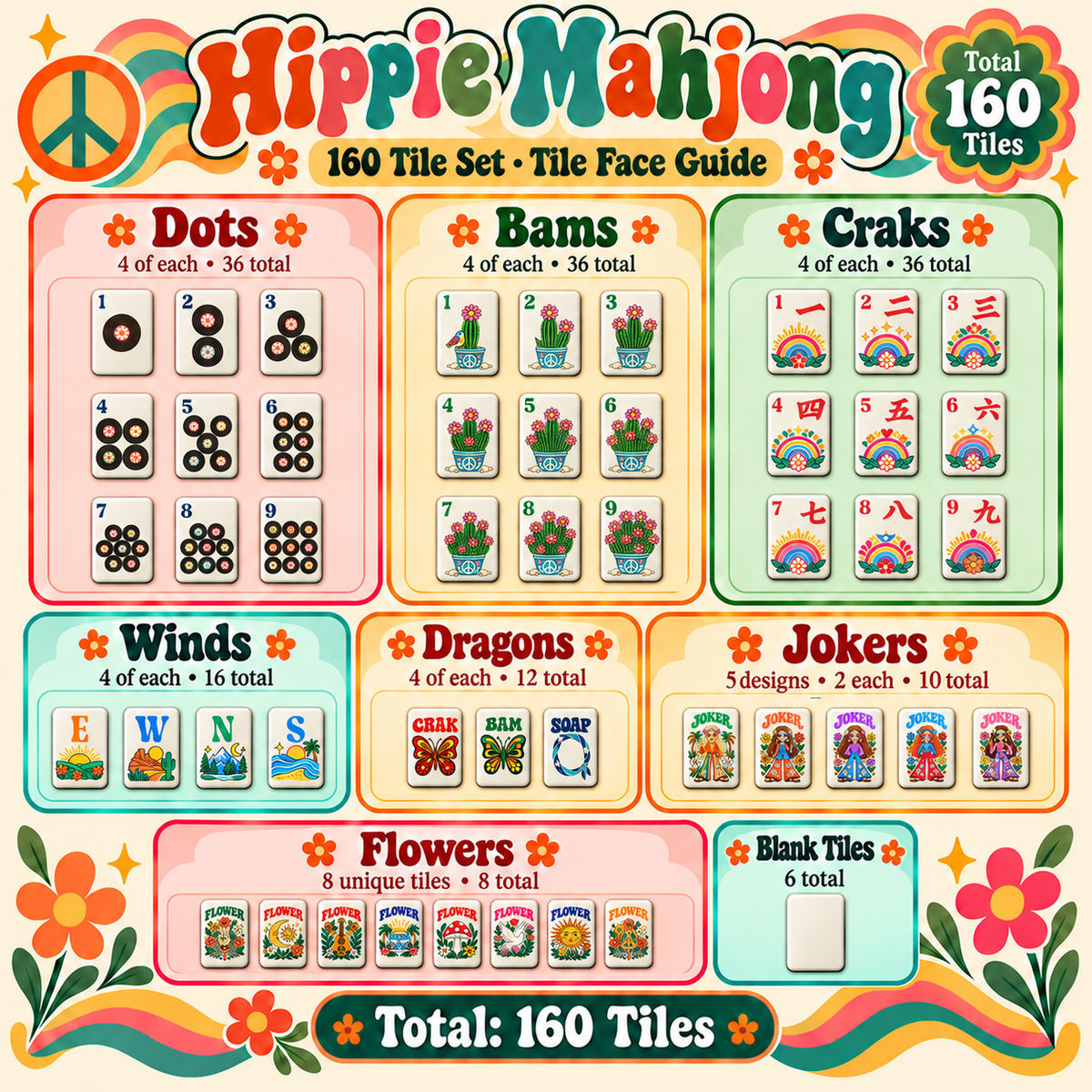
Chinese mahjong strategy revolves around building melds—pungs (three identical tiles), kongs (four identical), and crucially, chows (three consecutive number tiles in one suit, like 3-4-5 Bams). Unlike American mahjong, which only allows exposed sets after drawing and has no sequences, Chinese play encourages discarding to signal weakness and reading opponents' intentions. Beginners should prioritize keeping adjacent number tiles and terminal honors (1 and 9), accepting melds cautiously until winning combinations are near, and watching what others discard to infer hand direction. A typical game lasts 1–2 hours; winning occurs when all 13 tiles plus a draw form four complete melds and a pair. Strategy hinges on patience, hand transparency (what you expose signals safety), and tile probability—fewer remaining copies of a tile you need means others hold them.
Why do beginners lose melds in Chinese mahjong?
Beginners expose pungs and kongs too early, telegraphing their hand strategy and letting opponents adjust. The safer approach: hold sets hidden until your winning combination is one tile away—then either call a pung, kong, or chow to complete. When you announce a meld (especially a pung), opponents deduce what you don't have and adjust their discards accordingly. Strong players watch your melds like a map: three 5 Dots exposed means you likely aren't building sequences around that tile. Minimize early calls; wait until the endgame when exposing a set truly closes your winning path.

How do you spot a winning combination before it happens?
Identify your "waiting pattern"—the exact shape of tiles you need to win. In Chinese mahjong, you hold 13 tiles and need one more draw (or a called tile) to complete four melds plus a pair. Before discarding, mentally map which single tile completes your hand. For example: if you hold three 5 Bams (pung), three 1 Dots (pung), three East Winds (pung), and pairs of 3-4-5 Craks, you're waiting for a 6 Crak to make a chow (4-5-6) and keep your winning pair intact—or a pair tile if your four melds are already solid. Most beginners discard randomly; strong players always know their one-tile target. This focus prevents "dead hands" (tile combinations that can never win) and speeds decision time.
What's the safest discard strategy when you're unsure?
Discard high-terminal tiles (8s and 9s) and isolated honors early, then transition to numbered tiles in sequence. Terminals are statistically hardest to use in chows (a 9 Bam only forms 7-8-9, while a 5 Dot forms 3-4-5, 4-5-6, and 5-6-7). Isolate your hand into "safe" suits—if you keep only Bams and Dots active, never discard a Crak until forced, signaling to opponents that Craks are dangerous. A tile is dangerous once three copies have been discarded or exposed; the fourth is in someone's hand. Watch the discard pile: if two 3 Dots are gone and one is exposed, the remaining 3 Dot is held. Discarding it is safer than holding it. The safest tiles to shed are those already exposed in opponents' melds (they won't call them again) and tiles that don't neighbor your kept tiles.
Discard Timing | Tile Type | Risk Level | When to Use It |
Very Early (first 3 turns) | Isolated honors, 8s, 9s | Low | Clear space; signal strength in other suits |
Early-Mid (turns 4–8) | Paired terminals, duplicate numbered tiles | Medium | You've drawn enough; assess your path |
Late-Game (turns 9–12) | Mid-range neighbors to your kept tiles | High | Only when your winning tile is single-copy and safe |
Final Draw (waiting) | Only non-winning tiles; hold everything else | Critical | One wrong discard = no win this hand |
How do hand reading and probability drive strategy?
Track which tiles are gone—discarded, exposed, or held—to calculate the probability your winning tile is still in the draw or someone's hand. If you need a 4 Crak and one is already discarded, three remain (out of four copies in a standard Chinese mahjong set). If two of those three are exposed in other players' melds, only one 4 Crak remains in the wall or opponents' hidden tiles. Your odds of drawing or calling it drop significantly. Strong players maintain a mental count: "Two 7 Bams gone, one exposed—one left somewhere; I'll discard my 7 Bam now, not worth the wait." Beginners ignore the discards and hold every tile they think might be useful, clogging their hand with low-probability pieces. Each turn, update your probability map based on new discards and calls. When a tile you need drops to a single copy with four players holding 12 hidden tiles each, odds favor someone else—fold that possibility and pivot.
When should you accept a pung or chow call vs. wait for a self-draw?
Accept a pung or chow call (in variants that allow it, like Hong Kong mahjong) only if it accelerates your winning hand or if passing risks the tile cycling back to the wall unseen. Beginners often call greedily, exposing melds that don't help. The golden rule: call only if your remaining 10 hidden tiles can form two complete melds plus a pair in one draw. For example, you hold four Dots (1, 2, 3, 4), two Bams (2, 3), three East Winds, one 5 Crak, and one 6 Crak. An opponent discards a 7 Crak—accepting gives you 5-6-7 chow, but now you need two Bams, three more Bams/Dots, and East Wind pair in one draw. Too many unknowns; pass. If instead you hold 1, 2 Bams and an opponent discards a 3 Bam, that completes your chow and leaves 10 tiles that need just three more melds and a pair—much tighter, worth calling. Hesitate at the table: calculate the remaining hand's completeness first.
🀄 Shop best-selling mahjong sets →

What's the difference between a "safe" suit and a "dangerous" suit at the table?
A safe suit is one where you keep no melds and discard actively—opponents know you have nothing there. A dangerous suit is one you've exposed pungs or kongs in; opponents assume you're building more and won't discard those tiles. Early in the hand, narrow your active suits to two (e.g., Bams and Dots only) and treat Craks and honors as pure dead weight until mid-game. Once three suits or more are active in your exposed melds, your hand becomes predictable and slow. Most winning hands use two main suits plus one or two honors. Beginners spread across all three suits and wind up with unrelated pieces—a 3 Dot, a 5 Bam, two honors—that form no coherent meld. Specialize early; generalize late only if you've drawn enough flexibility. When an opponent has exposed two Craks pungs, they're deep in Craks—never discard Craks to them.
How do you recover when your hand dies mid-game?
A dead hand occurs when your winning target becomes impossible (e.g., you need three 4 Bams but all four are gone, or your required chow is blocked). Recognize death early: by turn 8, if your hand still has three or more singletons (unpaired tiles with no neighbors) and no clear path to four melds, you're likely dead. Shift to defensive mode—discard the safest tiles (those already exposed in melds, or tiles no one else seems to want) and play for survival: don't win this hand, but don't lose big either. Some variants allow a player to discard their entire hand and sit out the round; others lock you in. Learn your ruleset first. If forced to stay, minimize your liability by discarding from opponents' safe suits, staying alive longer, and watching the next hand form.
🎁 See our most-loved mahjong sets & accessories →
What early warning signs tell you an opponent is close to winning?
Watch for three changes: sudden silence (opponent stops accepting calls—they're protecting a hidden hand), a shift to dangerous discards (they're only shedding high-terminal tiles, meaning sequences or pairs dominate), and a narrowing discard pattern (always from one suit). If opponent A keeps calling 2-3-4 and 5-6-7 Bams and has discarded no Bams in the last four turns, they're close. Count their melds: three or four exposed? One or two? If three melds are exposed and they're on turn 11–12, they're waiting. Respond by discarding only tiles already in their exposed melds (they can't call them again) or tiles so obscure nobody wants them (a 1 Crak if honors and Bams are everywhere). If you sense multiple opponents are near, throw the most dangerous tiles simultaneously and hope they conflict.
✨ Find your Mahstead set — free US shipping →
What to Check Before You Buy
If you're building a Chinese mahjong practice set at home, buy one with acrylic or resin tiles—they're durable for weekly games and won't crack like bamboo if bumped. Ensure your set contains a mahjong mat with clear number zones so discards don't overlap; confusion during endgame costs games. Pair it with racks and pushers so tiles stand upright and you can't accidentally expose your hand. For travel, a padded bag or case protects against dropped sets. Our best-selling collection includes complete starter sets designed for beginners; all ship free across the US.

FAQ
Is Chinese mahjong harder than American mahjong?
Yes, Chinese requires learning chows (sequences), deeper probability tracking, and faster mental math. American mahjong's rigid hand card and no-sequence rule make it more mechanical; Chinese rewards reading opponents and adjusting mid-game. Both demand practice—choose based on your playgroup's preference.
How many tiles are in a Chinese mahjong set?
Standard Chinese sets contain 144 tiles: three suits (Bams, Craks, Dots) with numbers 1–9, four copies each (108 tiles); plus 16 winds (four each of North, East, West, South), 12 dragons (four each), and 8 flowers. Sets vary by region; some include bonus tiles or blank tiles.
Can beginners play Chinese mahjong without memorizing hand patterns?
Partially. Understanding chows (3-4-5 in one suit) and pungs (three identical) covers 90% of melds. Winning patterns vary by ruleset; start with simple "four melds plus a pair" and learn regional variations once you're comfortable. Play slow initially; speed comes naturally.
What's the best way to practice Chinese mahjong strategy alone?
Deal yourself 13 tiles, draw from the wall, and practice identifying winning targets without calling. Repeat 20–30 times; notice which tile shapes complete fastest. Also replay hands with friends or online platforms that let you see all four hands—this trains probability reading in a risk-free way.
How long does a Chinese mahjong game typically last?
A casual 1–2 hour session includes 4–8 hands; one hand averages 15 minutes. Tournament play is faster (12 minutes per hand). Beginners take longer due to tile counting and decision hesitation. Playing weekly accelerates speed and confidence.
Should I learn Chinese mahjong first or American mahjong?
If your friends play Chinese, start there—local context beats abstract strategy. If American is available locally, it's gentler for newcomers (no sequences, fixed hand card, simpler rules). Both improve tile reading; neither blocks learning the other later.


View More
View More
View More
