
Cantonese Mahjong Cheat Sheet: Rules, Tiles & Hand Charts
Last updated: Nov 23, 2026
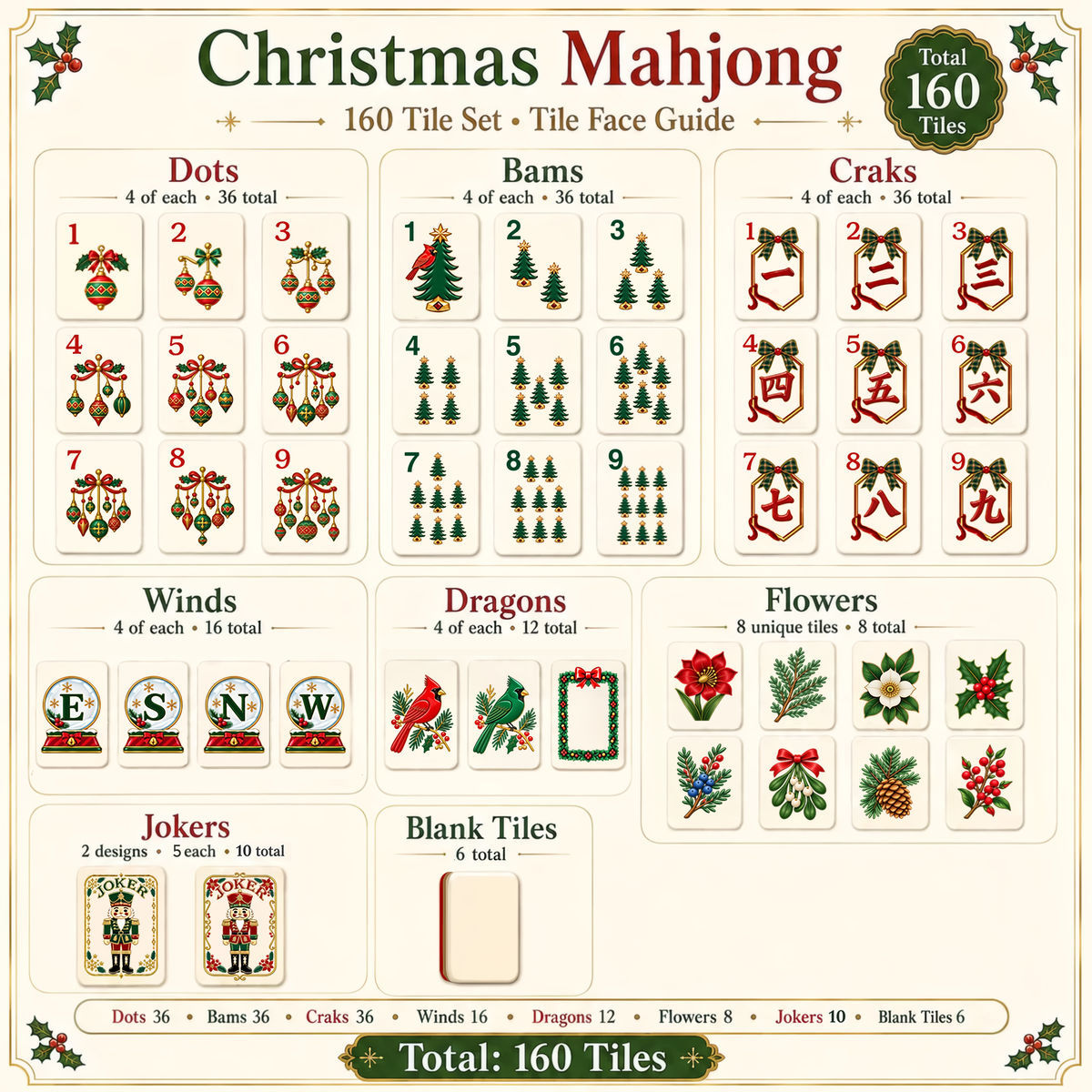
Cantonese mahjong uses a 136-tile set—three number suits plus Winds and Dragons, with no Flowers or blanks—and differs fundamentally from American play. Players build hands from 13 tiles plus 1 drawn (or called), then declare a winning pattern; unlike American mahjong (which uses a fixed yearly card), Cantonese hands are free-form and must include at least one "pair" plus melds that are either Pungs (three identical), Kongs (four identical), or Chows (three consecutive numbers in one suit). Sequences are exposed and called live, jokers do not exist, and scoring combines tile point values with bonuses for concealment, honor tiles, and terminal patterns. A typical game session lasts 2–4 hours depending on scoring complexity. Learning Cantonese rules is best done by playing with experienced players; many communities across North America host weekly games, and sets are readily available online, including from Mahstead's best-selling mahjong collection.
Cantonese (Hong Kong) mahjong is one of the oldest continuous traditions in the game, predating American mahjong by decades. It remains the standard in Hong Kong, Macau, Singapore, and Chinese communities worldwide. If you learned American mahjong—with its hand card, Charleston, and fixed tile sets—switching to Cantonese requires unlearning several core rules. The payoff is speed, flexibility, and a deeper connection to the game's strategic roots.
How many tiles and what do they do?
A Cantonese set contains exactly 136 tiles: four each of numbers 1–9 in three suits (Dots, Bams, Craks; 108 tiles), four each of four Winds (East, South, West, North; 16 tiles), and four each of three Dragons (Red, Green, White; 12 tiles). There are no Flowers, no blanks, and no jokers. Each tile has a numeric point value: number tiles 1–9 are worth face value; Winds and Dragons are worth 10 points each (called "honors"). Terminals (1s and 9s) and all honors are worth double in certain scoring contexts. Unlike American sets (which come as 152 playing tiles plus spares), Cantonese sets are always exactly 136 and used as-is; no reservations. This tight inventory forces strict turn order and makes the discard pile the central battleground—once a tile is thrown, three other players compete to claim it.

What's the difference between a Pung, Kong, and Chow?
In Cantonese mahjong, a Pung is three identical tiles (e.g., three 5 Dots); a Kong is four identical tiles (all 5 Dots). Both must contain only one kind of tile, never mixed numbers. A Chow (or "sequence") is three consecutive numbers in the same suit—for example, 4 Dots, 5 Dots, 6 Dots. Chows are unique to Cantonese play; American mahjong forbids sequences entirely. When you claim a tile from the discard pile (called a "throw" or "discard play"), you call the meld type aloud and expose it face-up on the table. Concealed melds (tiles drawn from the deck rather than called) score higher. Importantly, a Chow can only be called if you already have two of the three tiles in your hand—you cannot win on a discard that completes a Chow, and you cannot claim a tile you don't immediately meld. This rule prevents "stealing" cheap sequences and maintains the integrity of draw-and-build strategy.
Comparison: Melds in Cantonese vs. American Mahjong
Meld Type | Cantonese | American | Exposure | Notes |
Pung (3 identical) | Yes, always 3 tiles | Yes, always 3 tiles | Both called and concealed | Identical tiles only |
Kong (4 identical) | Yes, always 4 tiles | Yes, always 4 tiles | Both called and concealed | Identical tiles only |
Chow (sequence) | Yes, 3 consecutive in one suit | No, forbidden | Called or concealed | Cantonese-only; only 1, 2, or 3 at meld ends |
Free pairs | Yes, must have ≥1 pair | Rare (hand-card-dependent) | Concealed only | Essential to all Cantonese hands |
Joker use | None; jokers don't exist | American play; yes, many roles | N/A | Different game systems |
What hand patterns win in Cantonese mahjong?
A winning Cantonese hand is 14 tiles—four melds (Pung, Kong, or Chow) plus one pair. The simplest win is a "Standard Hand" or "平手": four melds and a pair, with no bonus conditions. For example: Pung of East Winds, Chow of 3–4–5 Craks, Kong of White Dragons, Pung of 7 Dots, and a pair of 2 Bams. That's a valid win.
However, Cantonese mahjong rewards specific patterns with bonus points or rapid play:
All Pungs: All four melds are Pungs (no Chows); often worth 2× or more.
All Chows: All four melds are Chows (harder to achieve); high multiplier.
Terminal/Honor Pung or Kong: Any meld using only 1s, 9s, Winds, or Dragons scores a bonus.
Pair of honors: A pair that is a Wind or Dragon scores extra.
Concealed hand: All melds built from the deck (none called); doubles or triples the base score.
Win on the last tile: Winning on the final draw from the deck is a bonus.
Pair of Dragons that match the prevailing Wind: Rare, high bonus.
A crucial rule: you must declare your hand pattern before you play the winning tile. You do not simply lay down tiles and announce "win"; you state the hand structure (e.g., "all Pungs, concealed") and then win, so all players know exactly what you are scoring. This transparency is central to Cantonese play and prevents disputes.
How is the hand ranking order different from American mahjong?
American mahjong uses a published hand card updated yearly by the National Mah Jongg League; thousands of fixed patterns rank from "easy" (low points) to "hard" (high points, called "a maximum"). Players consult the card during play to verify and score hands.
Cantonese mahjong has no printed card. Instead, hands rank by a multiplier system based on pattern rarity and concealment. The base score for any valid hand is typically the sum of point values of honor tiles plus any lucky or pattern bonuses—often around 20–40 points per hand. Multipliers then apply: 1× for a standard mixed hand, 2× for all Pungs, 3× for all honors (only 1s, 9s, Winds, Dragons), 4× for hands with specific Wind or Dragon combinations, and 8× or "limit" (a ceiling score) for rare hands like all terminals, all honors in one suit, or a "Blessing of Heaven" (winning on the very first discard). Scoring is verbal and agreed upon before the game; house rules vary significantly by region. Some players use a scorecard to track multipliers; others trust memory. The key difference: American mahjong is pattern-driven (you find your hand on the card), while Cantonese is rule-driven (you verify components—honor count, meld types, concealment—then calculate the multiplier).

What are the biggest mistakes new Cantonese players make?
Forgetting that Chows must be consecutive in one suit only. New players sometimes try to build 1 Dot, 1 Crak, 1 Bam as a Chow; wrong. It must be 1–2–3 all Dots, or all Craks, or all Bams, etc.
Calling a tile without a complete meld in hand. You cannot claim a discard unless you have the other two tiles for a Pung or Kong, or the two surrounding tiles for a Chow. Calling prematurely and then discarding is a violation and often forfeits your turn or the hand.
Throwing too fast and then trying to take back a tile. In Cantonese play, once a tile leaves your hand and lands in the discard area, it is no longer yours. Many games enforce a "tile must be three tiles away from your hand" rule. Practice deliberate, clean discards to avoid accidental claims against you.
Ignoring the "ready hand" announce. In formal games, when you have 13 tiles and are waiting for just one tile to complete your hand, you should (or must, depending on house rules) announce "waiting" or "ready." Failure to do so can affect scoring or eligibility to win.
Miscounting or undervaluing concealed melds. A concealed hand (all melds built from the deck) is much stronger than one with called melds. If you are building melds from your draw, prioritize keeping them hidden and do not call discard tiles unless the hand is nearly complete. Many beginners call too eagerly and miss the multiplier boost.
Playing with a set that has damaged or worn tiles. Cantonese play is fast; worn tiles can be hard to identify mid-play, leading to misreads and delays. Using a high-quality set with clear, durable faces (such as those in our best-selling collection) makes the game smoother and more enjoyable.
🀄 Shop best-selling mahjong sets →
Step-by-step: Reading a Discard and Deciding to Claim or Pass
1. Player throws a tile into the center. The tile is announced (e.g., "East Wind" or "3 Dots") and placed in the discard area.
2. Check your hand for a match. Do you have a Pung (two more of that tile)? A Kong (three more)? Two tiles that sandwich a Chow (e.g., you have 4 Dots and 6 Dots, and the thrown tile is 5 Dots)?
3. Decide: claim or pass. If you claim, you are committing to expose that meld and forgoing your draw for this round (the next player draws as normal, then you draw if you pass). If you pass, the tile stays in the discard and the next player may claim it.
4. Announce your meld type aloud and expose it. Place the tiles face-up perpendicular to your hand and say, e.g., "Pung, East Winds" or "Chow, 4–5–6 Dots." All players see it instantly.
5. Continue play in turn order. Do not interrupt. If you skip a turn by claiming a discard, the player after you still draws and plays; you do not draw.
6. When you are ready to win, declare your hand pattern. State it clearly ("All Pungs, concealed, 40 points") before laying down the final tile. This prevents scoring disputes later.
How scoring actually works: A real-game example
Let's say you have built a hand:
Pung of 2 Bams (concealed, 2 points each tile = 6 points)
Chow of 5–6–7 Craks (exposed, 0 bonus)
Kong of East Winds (concealed, 10 points each × 4 = 40 points)
Pung of 9 Dots (concealed, 9 points each × 3 = 27 points)
Pair of Red Dragons (concealed, 10 points each × 2 = 20 points)
Base score: 6 + 40 + 27 + 20 = 93 points. Multiplier: Concealed hand (all melds drawn) = 2×. Bonus: Pung of honors (East Wind) = +1× bonus. Final: (93 × 2) + bonus = roughly 200–220 points to you, depending on the house rule for bonuses.
In faster, casual games, scoring is simplified: you might just say "concealed mixed hand" and each player pays you a set amount (e.g., 1 unit for a non-concealed hand, 2 for concealed, 4 for all Pungs). Agreeing on scoring before the first hand prevents long delays and arguments.
🎁 See our most-loved mahjong sets & accessories →
What to check before you buy a Cantonese mahjong set
Tile size and weight. Cantonese sets are typically smaller and lighter than American sets; ensure the tiles feel smooth and are easy to shuffle and handle for extended play.
Suit clarity. Characters on Dots, Bams, and Craks must be crisp and visible. If you have aging eyes, test readability in the lighting where you'll play.
Wind and Dragon tiles. Cantonese sets label Winds with Chinese characters (東南西北; East, South, West, North) and Dragons with characters (中發白; Red, Green, White). Verify these are legible on your chosen set.
Tile organization. The set should come with a carrying rack or case to keep the 136 tiles organized and protected between sessions. Look for racks or bags that hold all tiles securely; mahjong racks with pushers designed for standard 136-tile play are ideal.
Durability. Cantonese play is often fast and social; tiles endure heavy handling. Acrylic or resin tiles with reinforced edges resist chipping better than ceramic.
If you are learning Cantonese mahjong and need a reliable set that will last through weekly games, our best-selling sets include options with clear, durable tiles and organized storage—no mixing required with American sets.
✨ Find your Mahstead set — free US shipping →

FAQ
Can I use an American mahjong set to play Cantonese mahjong?
Technically yes, but only if the American set has all 136 Cantonese tiles (three number suits, Winds, Dragons—no Flowers or blanks). Most American sets include Flowers and extra jokers, making them unsuitable. For clean, unambiguous play, use a Cantonese-specific set with exactly 136 tiles.
How long does a typical Cantonese mahjong game last?
A full session of 4 rounds (one per player as "dealer") typically lasts 1.5–3 hours, depending on table speed and scoring disputes. Casual play with simplified scoring is faster; formal play with complex multipliers and honor bonuses is slower. Most groups play 4–8 hands per hour.
What is the difference between "waiting" and declaring your hand before you win?
"Waiting" (or "ready") means you have 13 tiles and need one more tile to complete a valid 14-tile hand; some house rules require this announcement. Declaring your hand before winning means you state the meld structure and bonus type (e.g., "All Pungs, concealed") so all players know exactly what you are scoring. Together, these rules ensure transparency and prevent scoring errors.
Why can't I claim a discard if I don't have the other tiles in hand?
Claiming a tile commits you to an immediate, exposed meld. If you tried to claim a tile without the supporting tiles already in hand, you would have to discard something unused, which creates confusion and claims of "stealing" or playing out of turn. The rule enforces that melds are complete and visible the moment you declare them.
How do I know which Cantonese hand patterns are high-scoring?
Patterns involving only honors (Winds and Dragons), concealment (all melds from the deck), terminals (1s and 9s), or rare combinations like all one suit command high multipliers. Ask your group before play what multipliers apply (often 1×, 2×, 3×, 4×, 8×, or "limit"). Written house rules prevent disputes and speed up scoring.
Can I play Cantonese mahjong with fewer than four players?
Cantonese mahjong is designed for exactly four players. Variants for two or three players exist, but they change turn order, draw rules, and scoring significantly. Stick to four players for your first games; once you master the standard rules, explore variants with experienced players.


View More
View More
View More
