
Thirteen Orphans Mahjong: Meaning, Hand Pattern & Point Value
Last updated: Nov 23, 2026
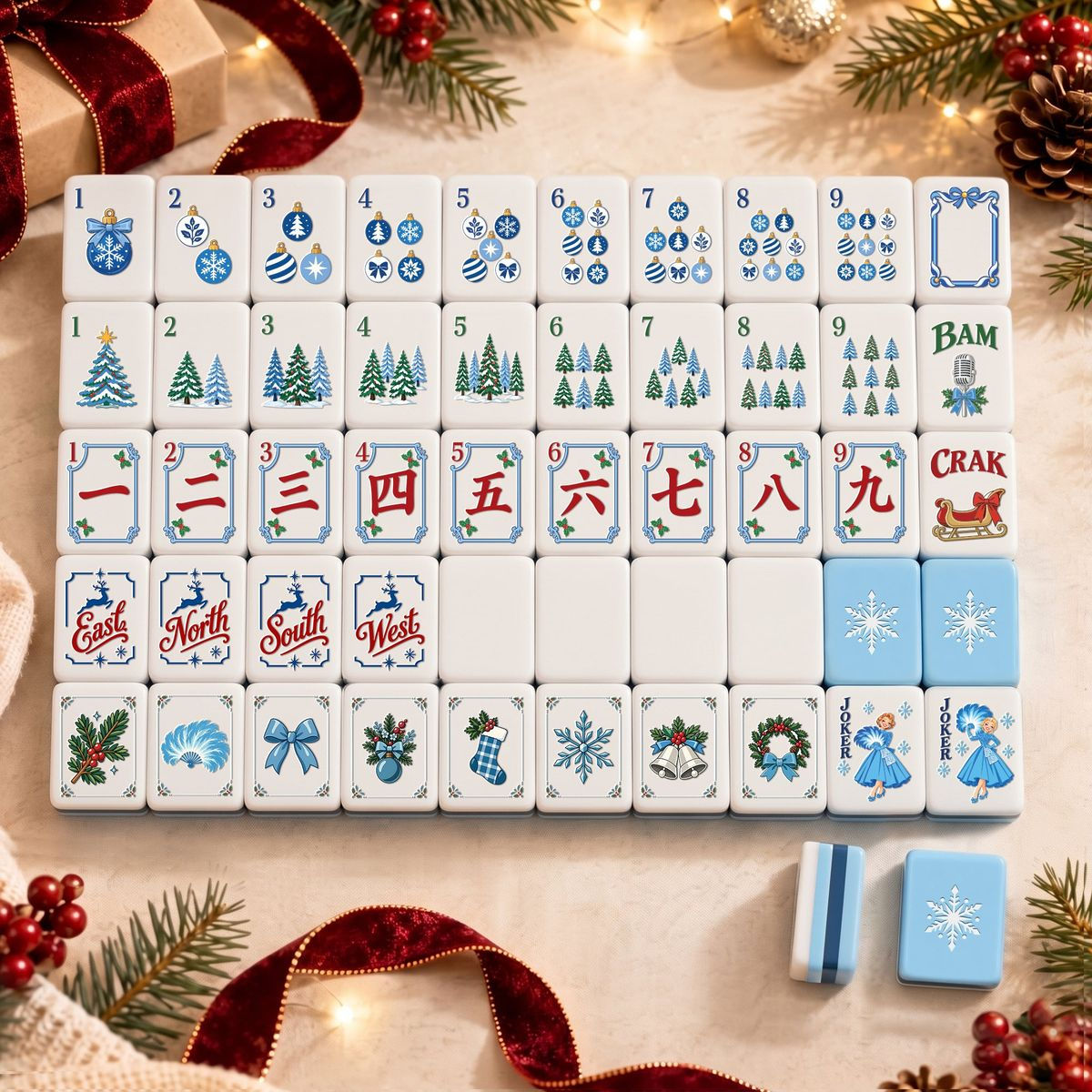
The Thirteen Orphans hand (also called "Orphans" or "Thirteen Different Honors") requires you to hold exactly one of each of the 13 unique tiles that appear singly in mahjong: the terminals (1 and 9 of each suit: Bam, Crak, Dot—six tiles) plus all four winds (North, East, West, South) and three dragons (Red, Green, White). You then draw or declare one more of any of these 13 tiles to form a pair; all remaining tiles you possess must be jokers or honor/terminal tiles of those same 13 types. It appears on the current National Mah Jongg League card in select yearly editions and typically scores 80 points or higher (exact value varies by year's card and whether quints or sextets are involved). The hand is exceptionally rare because you must collect such a diverse and specific set of tiles while still maintaining valid exposure rules. When building your regular collection, many players use best-selling acrylic American mahjong sets because the durable tiles and visible numerals help you sort and track these rare honor combinations more easily during long sessions.
What exactly are the 13 unique tiles you need?
The 13 unique tiles consist of all terminals (1 and 9 in each of three suits) and all honors (four winds plus three dragons). Terminals are the edge tiles: 1 Bam, 9 Bam, 1 Crak, 9 Crak, 1 Dot, 9 Dot. Honors are the non-numbered tiles: North, East, West, South, Red Dragon, Green Dragon, and White Dragon (Soap). Together these 13 tiles form the "orphans"—the tiles that stand alone and cannot be part of a run or sequence in American mahjong. Your pair must duplicate exactly one of these 13; all other tiles in your hand must either be the same 13 types (to make pungs, kongs, quints, or sextets) or jokers. This specificity is why many players keep a printed-copy of the season's card within arm's reach at the table.

Can you use jokers in a Thirteen Orphans hand?
Yes—jokers are the only non-honor/non-terminal tiles allowed in a Thirteen Orphans hand. You may use jokers to fill pungs, kongs, quints, or sextets made from the 13 unique tiles, but you cannot use a joker as the pair itself or as a single tile. For example, if your hand contains one 1 Bam (a terminal) and you draw a joker, you can use that joker with two other 1 Bams to form a visible pung; the joker substitutes for the missing tile. However, you cannot declare "joker and joker as my pair"; your pair must be two identical honor or terminal tiles. Beginners often misunderstand this rule and incorrectly assume jokers fill any role—they don't, and violating this leads to a false declaration.
How many points is Thirteen Orphans worth?
Point value depends entirely on the current year's National Mah Jongg League card. Most seasons award 80–120 points for a basic Thirteen Orphans hand, but the exact figure, multipliers, and whether bonus points apply (e.g., for declaring it as a kong or quint) vary. You must consult the current season's official card to know the precise value before you declare. If you've won with Thirteen Orphans but disagree on the score, stop and verify the card entry together with all players present; disputes are best settled by referring to the printed card at the table. A laminated or high-contrast printed mahjong mat helps you keep the card visible and legible during play, reducing scoring confusion.
🀄 Shop best-selling mahjong sets →
Why is Thirteen Orphans so rare and hard to win?
Collecting all 13 unique tiles requires an improbable draw sequence. You need exactly one of each of six terminals (1 and 9 Bam, Crak, Dot) and seven honors (four winds, three dragons)—13 different tiles with no flexibility or substitution. In a typical game, players are drawing tiles one or two at a time; assembling all 13 unique types before someone else declares a winning hand is statistically unlikely. Additionally, you must do this while observing the Charleston (the pre-game tile exchange), the pass cycles, and the existing board of tiles already exposed by other players. Many veteran players report going years between seeing a Thirteen Orphans win at their table. When it does happen, the table usually celebrates, because it signals a lucky night and a memorable play.
How do you hold and organize 13 Orphans tiles during a game?
Organization is critical because you must mentally track whether you have one or more of each of the 13 types. Many experienced players use mahjong racks with pushers to stand tiles at an angle, making it easier to count at a glance: all 13 types displayed clearly, duplicates grouped together. Others lay tiles flat on the mat in neat rows labeled by suit and honor, moving them into pung/kong formation as they appear. The key is speed and accuracy—you do not want to miscount your tiles and declare a false hand. Jokers should be stored separately or in a distinct section of your rack so they are never confused with a pair. Some players mentally visualize the hand before drawing each new tile, asking themselves, "Do I have all 13 types now, and is this the 14th tile?" This mental discipline, combined with organized display, prevents costly errors.
Aspect | Single Tile | Pair | Joker Role |
Count | 1 of each orphan (13 total) | 1 duplicate of any orphan | Fills pung/kong/quint/sextet only |
Can be a pair? | No | Yes (must be identical honor/terminal) | No |
Can stand alone in winning hand? | Yes (1 each of 13 types) | Yes (counted as 2 of 1 type) | No—must complete a group |
Example | 1 Bam, East, Red Dragon | East and East | Joker + 1 Bam + 1 Bam = pung |
🎁 See our most-loved mahjong sets & accessories →

What mistakes do beginners make with Thirteen Orphans?
Common pitfalls:
Using a joker as the pair. The pair must be two identical honor or terminal tiles—never a joker or a joker–tile combination.
Including non-orphan tiles. If your hand holds even one tile outside the 13 unique types (e.g., a 5 Dot), you cannot declare Thirteen Orphans. Every tile not in the pair or a pung/kong/quint/sextet must be a joker or one of the 13 types.
Miscounting the 13 types. Writing them down on paper or checking off a list before announcing helps avoid declaring with only 12 unique tiles.
Not checking the card beforehand. Some years Thirteen Orphans appears on the card; some years it does not. Always verify the current season's card includes this hand in the section you're trying to claim.
Declaring before holding exactly 14 tiles. You must have 13 unique types plus 1 duplicate (the pair) plus any jokers or group tiles totaling exactly 14 tiles in your hand to declare.
How does Thirteen Orphans compare to other rare hands?
Thirteen Orphans ranks among the most difficult hands to win, similar to other difficult patterns on the League card. Unlike hands that ask for runs or repeated sequences (which you can build gradually), Thirteen Orphans demands you gather a specific set of 13 one-of-a-kind types before your opponents finish their games. Players who regularly win high-point hands (Limit hands, 80+ points) are often those who play multiple games per week and study the card deeply. Casual weekly players may play for years without seeing Thirteen Orphans declared. If you've won it once, you've experienced something most recreational players never will—a testament to patience, observation, and a good draw.
Do other mahjong variants have an equivalent to Thirteen Orphans?
Chinese, Hong Kong, Riichi, and other variants have their own rare honor-based hands, but the specific tile composition and point value differ significantly from American mahjong's Thirteen Orphans. For example, some Chinese variants have "all honors" hands that include flower and season tiles, or point bonuses for declaring with only terminals and winds. Riichi mahjong has honor-based limit hands but structures them differently (e.g., "all terminals and honors" or "all dragons"). If you play multiple variants, clarify with your group which rules apply in each; American Thirteen Orphans is specific to the National Mah Jongg League card and does not transfer directly to other rulesets. Always reference the rulebook or card for your chosen variant to avoid disputes.
✨ Find your Mahstead set — free US shipping →
What to check before you declare Thirteen Orphans:
Confirm the hand appears on this year's League card. Open the current season's card and locate Thirteen Orphans in the appropriate section (usually under rare or special hands).
Count your 13 unique tiles. Touch each honor and terminal tile in your hand and list them: 1 Bam, 9 Bam, 1 Crak, 9 Crak, 1 Dot, 9 Dot, North, East, West, South, Red, Green, White.
Verify your pair. Confirm you hold exactly two identical tiles from the 13 unique types—not a joker pair, not a mixed pair.
Check all other tiles. Every tile in your hand outside the pair and any visible pung/kong/quint/sextet must be a joker or one of the 13 types.
Announce clearly. Say the hand name, the position (Pung, Kong, etc.), and your point value—e.g., "Thirteen Orphans, Kong, 80 points."
Allow other players to verify. Let each player see your exposed tiles before the round is scored; disputes are settled by checking the card together.

FAQ
Can I declare Thirteen Orphans if I am missing one of the 13 tiles?
No. You must have exactly one of each of the 13 unique tiles (1 and 9 Bam, Crak, Dot; North, East, West, South; Red, Green, White) plus one duplicate to form a pair. Missing even one type disqualifies the hand.
Does Thirteen Orphans ever appear as a Kong or Quint on the card?
Yes, some years the card lists variants of Thirteen Orphans (e.g., "Thirteen Orphans Kong" or "Thirteen Orphans Quint") with different point values. Always check the current card to see if the version you've formed matches the listed pattern and scoring.
If I draw a joker while building toward Thirteen Orphans, how do I use it?
Use the joker to complete a pung, kong, quint, or sextet made from any of the 13 unique tiles. You cannot use it as a single tile or as the pair. For example, if you hold two North Winds and draw a joker, the joker becomes the third North Wind in a pung.
What is the fastest way to check if I have all 13 orphans in my hand?
Point to each tile while counting aloud: all six terminals (1, 9 of each suit), then all seven honors (four winds, three dragons). Use mahjong racks with pushers to group them visibly so you can confirm at a glance without fumbling or miscounting.
Has anyone from Mahstead won with Thirteen Orphans, and what did they say?
We don't track individual player wins, but our team has seen it declared a handful of times in weekly games across many seasons—each time was a genuine shock and celebration. The rarity is part of its charm.
If the current year's League card does not list Thirteen Orphans, can I still declare it?
No. American mahjong hands are only valid if they appear on the current year's National Mah Jongg League card. If Thirteen Orphans is not on the card that season, you cannot declare it as a winning hand, even if you hold the tiles.


View More
View More
View More
