
Riichi Mahjong Rules: How to Play the Japanese Variant
Last updated: Nov 23, 2026
Riichi mahjong uses a standard 136-tile set (34 types × 4 copies each: Bams, Craks, Dots 1–9; Winds; Dragons; no flowers, no Soap, no jokers). Four players draw tiles one per turn from a central wall, discard openly, and try to complete a hand of 14 tiles (13 + 1 drawn, or 13 + 1 claimed from discards). Unlike American mahjong, you form chows (sequences like 3–4–5 Dots), pungs (three identical), and kongs (four identical), combining them into a hand. When you're one tile away from winning, you declare riichi—a bet that commits you to that hand. When you win (or someone discards your final tile), scoring depends on your hand's complexity, called yaku, plus bonus points for melds and speed. A game typically lasts 4 rounds (East, South, West, North wind) with rotating dealer seats; rounds take 20–40 minutes each. If you play American mahjong using our best-selling mahjong sets, switching to Riichi requires learning hand patterns (yaku), a tile wall, and the discard pile—a different rhythm entirely.
What makes Riichi different from American mahjong?
American mahjong requires the National Mah Jongg League card and hands you memorize; Riichi plays card-free, focusing on yaku—fixed hand patterns. American uses 152 tiles with flowers, winds in sets of 16, and jokers; Riichi uses 136 tiles with no flowers or jokers. In American, chows (sequences) cannot be exposed or called; in Riichi, you build chows openly and claim discards to complete them, creating a dynamic, fluid game. American rounds last 8 hands (one per player as dealer); Riichi rounds consist of 4 dealer hands, then rotate. The pacing feels faster—constant small decisions, visible strategy, and more luck involved.

How do you declare riichi and what does it mean?
Riichi means you're one tile short of a winning hand (waiting hand) and willing to bet on it. When you declare riichi, you pay a 1,000-point riichi stick to the table, flip your last discarded tile sideways, and then draw and discard without speaking, signaling your hand is locked. Once you declare, you cannot change your winning tile—if you draw a tile that doesn't win or is thrown by another player, you lose points to whoever throws that tile (even if it wasn't the winning tile). Declaring riichi before anyone else wins that hand earns you +1,000 bonus points; if you declare riichi and then win, your hand's value doubles. If you declare riichi but never win, you lose nothing beyond the 1,000-point bet.
What are yaku and how do you score?
Yaku are fixed patterns—your hand's "shape"—that determine base score. Riichi itself is one yaku (1 point-unit, called han). A tanyao (all tiles are middle numbers: 2–8, no terminals 1–9) is 1 han. An iipeikou (two identical sequences, like two 2–3–4 Dots sequences) is 2 han. A chiitoitsu (seven pairs) is 2 han. Scoring multiplies han by your hand's complexity (called fu, based on melds and pairs), then by the round's wind. If you win as the dealer (East), your score triples; if you win as a non-dealer, your score doubles. A simple 1 han, 30 fu hand as a non-dealer pays about 1,000–2,000 points per player; a 3 han, 30 fu hand pays 5,900–8,000. A 5+ han hand is mangan (8,000 base) and pays flat regardless of fu. Speed bonuses apply: if you win on your first possible draw (your second turn) with no one calling your melds, you score extra points.
How does the tile wall work and what's the discard pile?
In Riichi, a dealer (East) builds a wall of 136 tiles—four stacks of 34, two tiles high—in the center of the table. Each player draws 13 tiles from the wall in clockwise order; the dealer draws 14. On each turn, you draw one tile from the wall (called tsumo), then discard one face-up tile to a central discard pile visible to all. Other players may call (claim) your discard to complete a pung, kong, or chow (chi, pon, kan), which exposes part of their hand and disrupts turn order. Once you claim a discard, play passes to the next player—you don't draw again that turn. The discard pile never resets; it grows throughout the round and tells you which tiles are "dead" (already played or too risky). If the wall empties before anyone wins, the round is a draw.

What hands can you claim and which ones win?
You can claim any discard to complete a pung (three identical tiles), a kong (four identical), or a chow (sequence of three—you can only claim the latest tile in the sequence). A pung or kong claim makes your hand "open" and resets play to you. A chow claim also opens your hand and plays after a pung/kong claim. When you win (tsumo—draw from wall, or ron—claim another player's discard), your hand must include at least one yaku. A hand of all separate pairs, with no melds or yaku pattern, does not win. If you win by claiming a discard, whoever threw that tile pays you double; other players pay single. If you win by drawing, all three players pay equal shares.
Feature | American Mahjong | Riichi Mahjong | Why It Matters |
Tiles & Size | 152 tiles (includes flowers, jokers) | 136 tiles (no flowers, jokers, Soap) | Riichi sets are smaller, fit any table |
Sequences (Chows) | Cannot be called or exposed | Can be called and exposed | Riichi is more dynamic and social |
Winning Hands | Must match current National League card | Must contain at least one yaku pattern | Riichi is card-free and memorization-light |
Game Length per Round | 8 hands (one per player as dealer) | 4 dealer hands, then rotate | Riichi rounds end faster |
Scoring Basis | Points and repeats from card | Han (hand complexity) × fu (tile count) × dealer/wind multiplier | Riichi is simpler math once you know yaku |
Discard Pile | Tiles pile up; recycling depends on locality | Discard pile stays visible all game | Riichi strategy reads the pile early |
Dealer Status | Dealer stays same all game; others rotate | Dealer rotates each hand (E → S → W → N) | Riichi dealers risk more each hand |
🀄 Shop best-selling mahjong sets →
What should you check before buying a Riichi mahjong set?
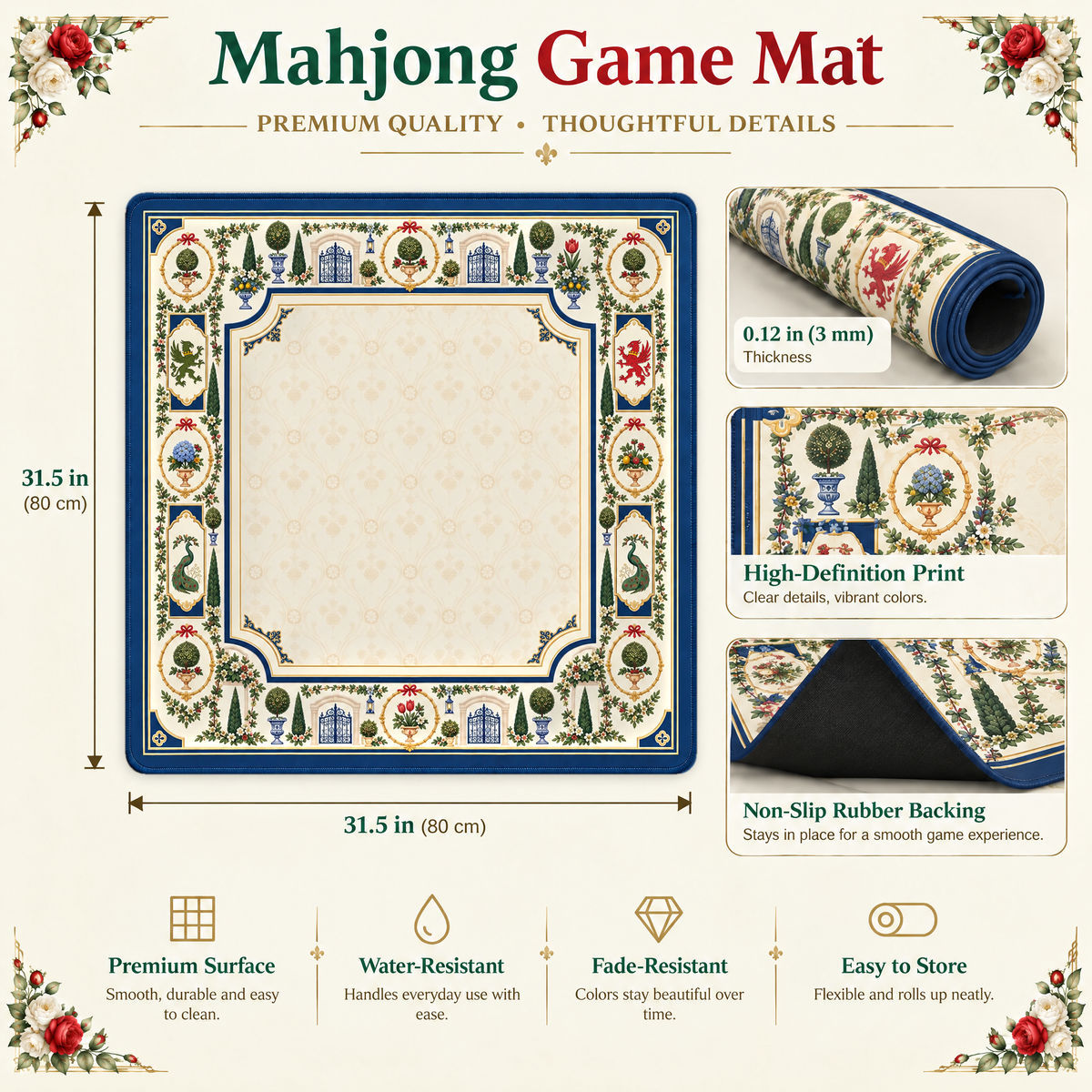
Riichi sets are built for the 136-tile standard, but many Western sellers mix variants. Verify the set includes exactly 34 types (Bams, Craks, Dots 1–9 each; four Winds; three Dragons; no flowers, no Soap). Tile size matters: Riichi tiles are typically 20–22 mm, smaller than American 25 mm tiles. Check that the set includes a discard pile tray or mat to organize the play area; mahjong mats designed for Riichi often mark a central wall zone and discard square. If you're stepping up from American play, know that Riichi scoring rules require a reference sheet for your first 5–10 games—many sets include a yaku chart or you'll need a smartphone app. Acrylic tiles are durable and visible; bamboo or bone tiles feel premium but scratch more easily in constant play. If you're hosting weekly Riichi games, ensure your mahjong racks with pushers suit 136-tile ergonomics and that you have a travel bag for portability if rotating hosts.
How do you start learning Riichi quickly?
Play first with someone who knows the game—watching a full round beats reading rules alone. Start with simple yaku only (riichi, tanyao, pinfu, all simples). Use a yaku cheat sheet (printed or app) for your first 10 games; you'll internalize patterns fast. Learn the discard pile strategy: watch which tiles others discard early (safe) and which they hold (dangerous). Declare riichi only when you've won games without it, so you understand hand speed first. Focus on one rule per session: tile wall draw today, chow claims next session, scoring rules after. Many Riichi clubs online (Reddit, Discord, Mahjong Hub) offer teaching games with patient players—join one, ask questions, and don't play for stakes until you've won 5+ games. Once the rhythm clicks (usually 3–5 hours of play), you'll spot why Riichi players call it the faster, more social cousin of American mahjong.
🎁 See our most-loved mahjong sets & accessories →
Can you play Riichi and American mahjong on the same table?
Not simultaneously, but you can switch between them at the same table on different days. American mahjong requires the card, 152 tiles with flowers and jokers, and a 8-hand round; Riichi needs no card, 136 tiles, and a 4-hand round. If you host both games weekly, keep separate sets in mahjong bags labeled clearly. A single mahjong mat works for both if it marks dealer and wind positions (both games use those). The main trap: accidentally mixing American and Riichi tiles mid-game—avoid it by storing sets in different cases. If you're a veteran American player, Riichi will feel "faster and sloppier" at first; you're trading memorized hands for constant small decisions. Most dual players say Riichi sharpens their probability reading, which improves American play too.

FAQ
What is riichi mahjong?
Riichi is Japan's national mahjong variant, played without a tile card. You draw and discard from a central wall, form sequences and sets, and win by matching one of 30+ fixed hand patterns (yaku). When you're one tile away, you declare riichi—betting 1,000 points that you'll win—and lock your hand. A 4-player game runs 4–5 rounds in 60–90 minutes total.
How many tiles are in a riichi set?
A standard Riichi set contains 136 tiles: three suits (Bams, Craks, Dots, 1–9 each) × 4 copies = 108 tiles; plus 16 wind tiles (4 each of East, South, West, North), 12 dragon tiles (4 Red, 4 Green, 4 White), and no flowers, jokers, or Soap. Each tile type appears exactly 4 times.
What does declaring riichi cost?
Declaring riichi costs 1,000 points (a riichi stick) placed on the table. If you win while in riichi, your hand's value doubles and you collect the 1,000 points back plus your winnings. If you never win that hand, you lose the 1,000 points—it goes to whoever eventually wins, or is split among all players if the round ends in a draw.
Can you teach yourself riichi mahjong from a book?
You can learn rules from a book, but Riichi is easier learned by watching play (in-person or on video) combined with a yaku reference sheet. The discard pile strategy, turn order after calling melds, and scoring multipliers are visual—reading alone often confuses beginners. Join a teaching game, play 3–5 rounds with a patient dealer, then refer to a book for clarification.
How is riichi mahjong scoring calculated?
Scoring = base points × dealer/non-dealer multiplier × speed/complexity. A simple hand (1 han + 30 fu) as a non-dealer pays ~1,000–2,000 points per player; as a dealer, ~3,000–4,000. Higher han hands (2, 3, 4, 5+) earn exponentially more. A "mangan" (5+ han) pays flat 8,000 base. Winners collect from all three other players (or split the pot in draw rounds). Most players track scores on paper or a phone app built for Riichi.
Is riichi mahjong luck or skill?
Both. Luck determines tile draws and discard order; skill governs which yaku you chase, when to declare riichi, which discards to keep safe, and reading opponents' hands from their discards. Winning Riichi players study patterns, calculate tile probability, and know when to fold early. Casual players still win sometimes—Riichi is more forgiving than American mahjong, where memorizing the card is non-negotiable. --- ✨ Find your Mahstead set — free US shipping →


View More
View More
View More
