
Riichi Mahjong Han and Fu Rules Explained
Last updated: Nov 23, 2026
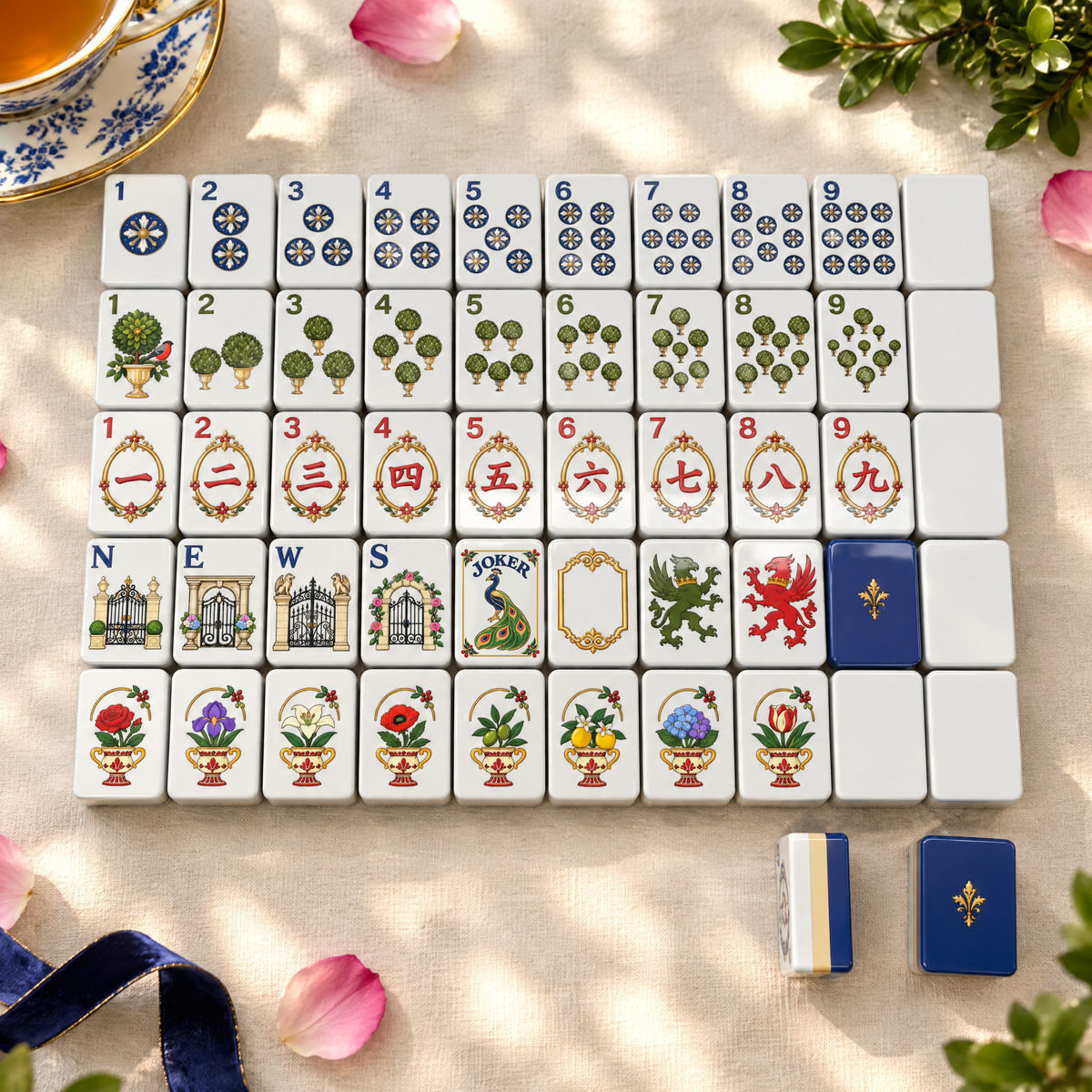
Han (翻) and fu (符) are the two components that determine point values in riichi mahjong. Fu is the base unit (counted in multiples of 10, usually 30–60); han is the number of scoring patterns your hand contains (1–13+). To find points, multiply the base (fu × 2^han) and apply table lookups; the dealer pays 1.5× the non-dealer rate. Unlike American mahjong, which matches hands to an annual card, riichi scoring is rule-based and portable across all riichi variants (Japanese, Hong Kong, Taiwanese). Most weekly players use a best-selling collection of acrylic sets with scoring racks or reference cards built in to keep pace. The formula feels abstract at first, but once you memorize the top 10 han patterns (all simples, all terminals, all honors, self-draw, etc.), calculating points takes seconds.
What is han, exactly?
Han counts the number of winning patterns your hand contains—think of them as multipliers rather than points themselves. A hand with one pattern (one han) is worth less than a hand with three patterns (three han). Patterns range from simple (all simples tiles only, low han value) to extremely rare (thirteen han = a special grand hand, automatic maximum). Each pattern is triggered by specific tile combinations: exposed pungs of dragons award one han, concealed pungs award two, sequences of special tiles award more, and so on. The maximum everyday score is twelve han (unless the variant allows thirteen); anything above that becomes a flat payment called a "counted yaku." Han is stackable—if your winning hand satisfies five different patterns, you earn five han total.

What is fu, and why does it matter?
Fu is the baseline point unit, always a multiple of 10 (30, 40, 50, 60, etc.). It reflects the "complexity" or "wait" quality of your hand: a simpler winning wait (like a two-way edge wait on a pair) is lower fu, while a trickier shape (like a closed wait on a sequence plus a pair edge) is higher. Most winning hands at the table fall between 30 and 60 fu; calculating fu requires counting specific tile shapes within your melds and the pair. Fu is less intuitive than han, which is why many casual players keep a fu-calculation reference sheet handy during games. The formula (fu × 2^han) means fu acts as a multiplier floor; two hands with the same han but different fu can have very different payouts. A 30-fu hand and 60-fu hand at three han will score nearly half as much because fu directly scales the result.
How do you calculate the base points from han and fu?
The calculation is: base points = fu × 2^(han). For example, a three-han, 30-fu hand = 30 × 2³ = 30 × 8 = 240 base points. Once you have the base, apply the payout rule: non-dealers pay 1× the base to the winner; the dealer pays 1.5× the base to the winner. If you went out as the dealer on a three-han, 30-fu hand (240 base), each of the three non-dealers pays you 360 points (240 × 1.5). If a non-dealer wins the same hand, each opponent pays 240. Most riichi scoreboards or hand-tally sheets include a lookup table that does this math for you—you just find the intersection of your han row and fu column, read the payout, and collect. This is why the scoring reference is so valuable during play: speed matters, and reference tables eliminate mental math errors mid-game.
🀄 Shop best-selling mahjong sets →
What are the most common han patterns?
Real weekly games usually feature about a dozen recognizable han patterns that account for 80% of hands. All simples (tiles 2–8 only, no terminals or honors) = one han. All terminals and honors only (1, 9, winds, dragons) = two han. A concealed pung (three identical tiles you did not expose) = two han; an exposed pung = one han. Self-draw winning (drawing your own winning tile rather than claiming a discard) = one han. Discard sequence (calling a tile from a discard) = one han in most variants, zero in others. Dragon pung (three identical dragons, exposed or concealed) = one or two han depending on variant. All pungs (no sequences; all melds are 3+ identical tiles) = two han. Winning on first discard (your initial hand is already complete) = one han in some variants. Outside hand (only sequences with 1 or 9) = one han. The patterns stack; if your hand is all simples and all pungs, you earn one + two = three han automatically. Learning these ten takes three or four games; after that, scoring becomes muscle memory.
How does han and fu compare to American mahjong scoring?
American mahjong is a hand-matching system: you draw thirteen tiles, compare them against a published card (released yearly by the National Mah Jongg League), and if your exact tile pattern matches a listed hand, you win and collect a fixed payout—usually 1 unit per hand. Riichi mahjong is a rule-based scoring system: you calculate points from the patterns within your hand using the han-and-fu formula, so the same winning shape can be worth different amounts depending on what tiles comprise it. In American mahjong, a winning hand either matches the card (win) or it doesn't (bust); payout is predetermined. In riichi, the same hand shape (e.g., three pungs and a pair) might be worth two, three, or four han depending on whether the pungs are dragons, sequences are specials, the pair is terminal, etc. American mahjong is fastest for new players because there's no calculation—just match and collect. Riichi scoring requires pattern recognition and one formula, but it rewards skilled tile reading and hand building because the score reflects your choices. Both systems are fun; riichi is portable and played worldwide (Japan, Hong Kong, Taiwan, online), while American mahjong is the standard across the United States and easier to learn if you don't want arithmetic during games.
System | Scoring Method | Player Skill Impact | Speed to Learn | Portability |
American | Match hand to yearly card | Tile selection, pattern memory | Fast (1–2 games) | USA-centric; card changes annually |
Riichi | Calculate han + fu per patterns | Tile reading, pattern stacking | Moderate (4–6 games) | Global; rules stable across variants |
Taiwanese | Han + fu with local variant rules | Same as riichi plus local nuance | Slower; variant rules differ | Taiwan, some diaspora communities |
Hong Kong | Han + fu, different pattern set | Emphasis on limit hands (12 han+) | Moderate; limit hands dominate | Hong Kong, some diaspora communities |
🎁 See our most-loved mahjong sets & accessories →

Common scoring mistakes and how to avoid them
Mistake 1: Forgetting the dealer multiplier. Non-dealer scores are paid 1×; dealer scores are paid 1.5×. If you calculate 240 base points but forget to multiply by 1.5, you'll underpay the dealer by 25%. Solution: say "base is X, dealer pays Y" aloud before collecting; a friend's quick nod catches the error.
Mistake 2: Miscounting han because you double-count overlapping patterns. A hand of all simples that is also all pungs should not be scored as five han—it's one han (all simples) + two han (all pungs) = three han total, even though the hand satisfies multiple conditions. Solution: list each pattern you see, then strike out duplicates or check against a reference before announcing the score.
Mistake 3: Adding fu instead of doubling when han increases. Han is exponential (2^han); adding han should double the payout, not add linearly. A three-han hand at 30 fu is 240 base; a four-han hand at the same 30 fu is 480, not 260. Solution: use a printed or digital lookup table; mental math is error-prone. Most riichi apps or scoring apps calculate this automatically.
Mistake 4: Applying fu when hand hits six han or more. At six han and above, fu is ignored—the score becomes a flat "limit" or "mangan" payout (often 8000 base points for non-dealers, 12000 for dealer, regardless of fu). Mixing fu into limit-hand scores creates huge errors. Solution: memorize limit thresholds (six han = mangan, eight han = haneman, thirteen han = kazoe yakuman) and check the table; don't calculate fu for limit hands.
Mistake 5: Confusing concealed vs. exposed fu count. A concealed self-drawn hand (draw your own winning tile) adds two fu; an exposed hand drawn from discard subtracts fu in some variants. If you miscategorize, your fu count is wrong and the final score is wrong. Solution: clarify the winning method (self-draw or discard, hand fully concealed or some exposed) before you start the formula.
How to set up a riichi game with scoring resources
Start with a riichi mahjong set designed for the Japanese or global standard (144 tiles: three suits 1–9 × four copies each, 36 per suit; 16 winds; 12 dragons). Acrylic sets like those in our best-selling collection are durable for weekly play. Pair the set with a fu counter or han-fu reference card—many players print a small fu chart or use a phone app (e.g., Mahjong Calculator, Mahjong Scorer) to look up payouts. Seat four players, distribute tiles, and before each hand, agree on:
Which variant you're playing (Japanese, Hong Kong, Taiwan).
Whether limit hands (six+ han) apply.
The rotation direction (often: dealer → east → south → west → north → new dealer).
A house rule for abortive hands (e.g., if two players declare ready on turn 2, replay or discard hand).
Once you've played three to five hands and looked up scores in the same reference table, you'll start to remember the common payouts (30 fu at two han, 40 fu at three han, etc.) and scoring will accelerate. Most casual groups reach comfortable speed within one evening.
✨ Find your Mahstead set — free US shipping →
What to check before you buy a riichi set
Tile count: Riichi mahjong uses a standard 144-tile set (not 152 like American mahjong). Verify the product description says 144 or lists "three suits 1–9, 16 winds, 12 dragons, 8 flowers" to confirm.
Tile material and size: Acrylic tiles are durable for frequent play; bamboo is traditional but fragile. Tiles should be roughly 25–28 mm per side to fit standard racks comfortably.
Suit symbols and orientation: Chinese characters (万 Bam, 筒 Crak, 索 Dot) are standard for riichi; English numerals also work but slow learning. Check that the 1 Crak shows a bird-like pattern, not just a circle.
Rack or rack-less play: If you're used to American mahjong racks, riichi sets sometimes don't include them. Some casual players prefer no racks (tiles in hand or on mat); decide your preference before ordering.
Scoring reference included: Many riichi sets come with a small fu-calculation guide or app code. Confirm what scoring aids ship with the set so you're not hunting for a reference on game day.
Why riichi han and fu matters for your weekly game
Understanding han and fu transforms riichi mahjong from mysterious to intuitive. Once you recognize that a hand with all pungs and all simples earns three han automatically (because the patterns stack), you start building hands strategically—tilting toward sequences that trigger multiple patterns, or pivoting away from shapes that score low. Dealers recognize they'll pay 1.5× and play more defensively; non-dealers know when a winning hand is worth fighting for. The scoring formula is portable: play in Tokyo, Bangkok, or Los Angeles, and the same hand calculates identically. American mahjong is faster to learn if you want zero math, but riichi rewards deep play because the score reflects the skill of your tile reading and hand design. Your weekly game becomes richer—players trade points not just by tile selection but by understanding the value of each discard and the payout each opponent could chase.

FAQ
Can I use American mahjong tiles to play riichi?
No. American sets have 152 tiles (extra jokers and blanks); riichi uses 144 and no jokers or blanks. Tile symbols also differ: American uses Arabic numerals and Western letters, while riichi uses Chinese characters or symbols. You'll need a proper riichi set to play the game correctly.
What's the highest possible han I can score?
The maximum is thirteen han (called kazoe yakuman in Japanese riichi), worth a flat maximum payout. Some variants cap everyday scoring at twelve han before invoking limit payouts. A few extremely rare patterns (like thirteen wait on a single tile type) are instant thirteen han.
Does fu matter if I score seven han or above?
No. At six han and above, the hand becomes a "limit" (mangan, haneman, baiman, sanbaiman, or yakuman), and fu is ignored—payouts are flat. Your fu calculation only matters up to five han. This is why many players say "mangan" instead of calculating fu at high han.
How do I count fu without a reference chart?
Fu depends on tile shapes: a closed wait (tricky to win) adds fu; a two-way edge wait adds less. Base fu is 20 per pung, 10 per sequence, plus bonuses for special patterns. Most players memorize common fu values (30, 40, 50, 60) rather than calculate from scratch; use a chart or app until you see the patterns repeat.
Is riichi mahjong harder to learn than American mahjong?
Riichi has a learning curve (four to six games) because you calculate points; American mahjong is faster (one to two games) because you match a card. But riichi is easier to play portably—the rules are the same worldwide, while American mahjong's card changes every year. Both are fun; choose based on whether you prefer speed or portability.
Can I play riichi mahjong with fewer or more than four players?
Standard riichi is four-player. Some variants support three players (reduced tile distribution), and online play sometimes accommodates two, but three- and two-player rules differ significantly from the four-player standard. Stick with four for a true riichi experience.


View More
View More
View More
