
Filipino Mahjong Cheat Sheet: Rules, Hand Patterns & Setup
Last updated: Nov 23, 2026
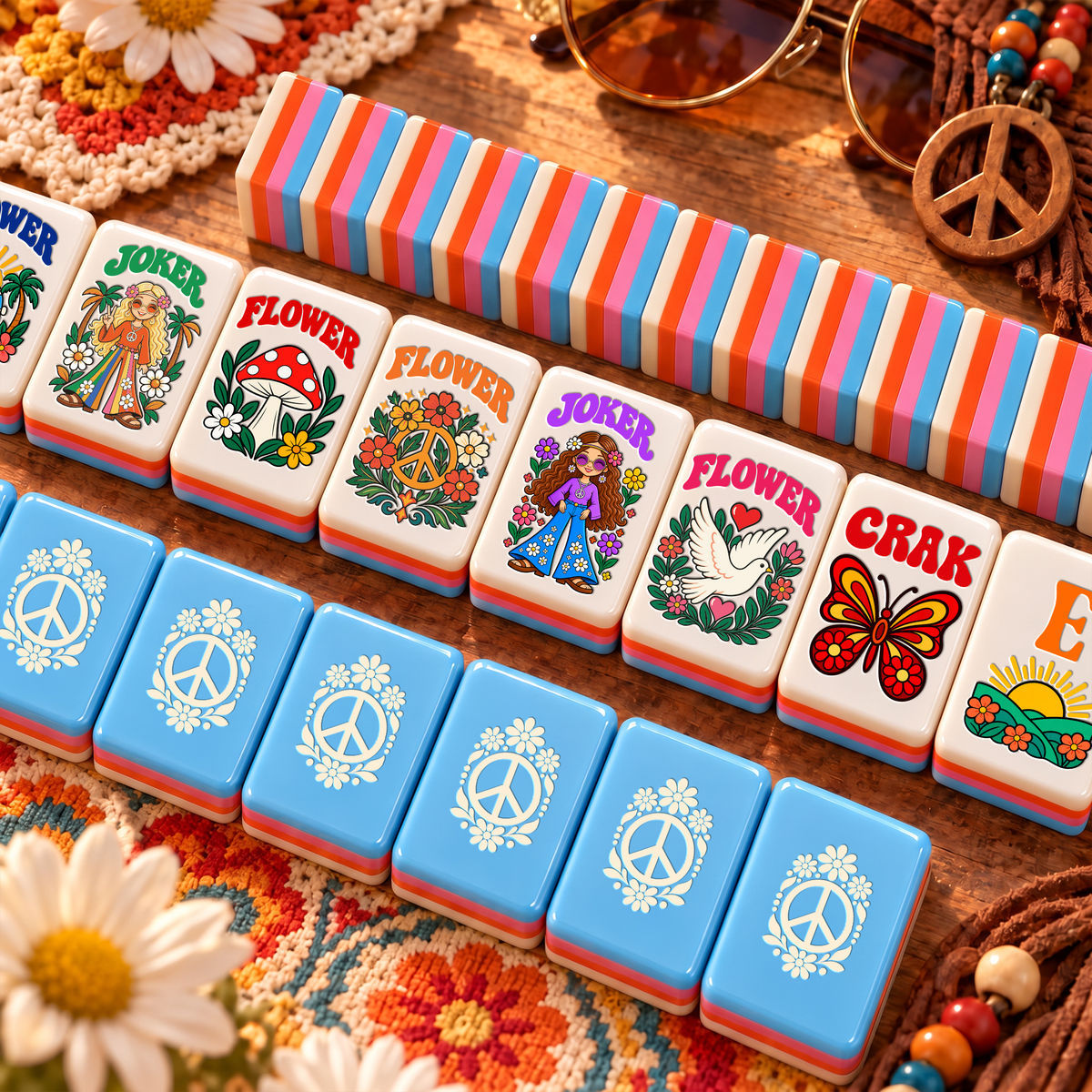
Filipino mahjong uses a 144-tile set (three suits 1–9 with four copies each, plus 16 winds, 12 dragons, 8 flowers) and draws from both American and Chinese variants. Unlike American mahjong, Filipino play allows sequences (chows: 1-2-3 of the same suit, exposed or hidden) alongside pungs and kongs, and you can win with any hand meeting the point threshold—not just hands from a yearly card. Most games use a 3-point minimum to win. The Charleston (tile-passing before play) is optional; many groups skip it. A full hand takes 13 tiles plus one drawn tile to complete. Setup takes 2–3 minutes; a game runs 20–45 minutes depending on luck and table speed. Mahstead's best-selling American mahjong sets use 152 tiles and work for learning, though you'll want to confirm the tile count matches your group's local rules first. 🀄 Shop best-selling mahjong sets →
What is Filipino mahjong and how does it differ from American play?
Filipino mahjong evolved as a hybrid of American and Chinese rulesets, spreading through family networks and social clubs since the mid-20th century. The core difference: Filipino players use chows (consecutive numbered tiles like 3-4-5 Bams) as valid melds, and you win when your hand scores enough points, not by matching a licensed card pattern. American mahjong forbids chows entirely and ties hands to the National Mah Jongg League's annual card. Most Filipino games run quicker and feel more fluid because fewer hands are invalid on any given turn.

How is a Filipino mahjong hand built and what wins?
A Filipino hand is 13 tiles in sets (melds) plus one drawn tile—14 total. Each set must be either a pung (three identical tiles), a kong (four identical), a quint (five identical), or a chow (three consecutive numbered tiles: 1-2-3, 2-3-4, etc., same suit only). Honors (winds and dragons) cannot form chows. You win when your hand meets the agreed point threshold (usually 3 points minimum) and you've declared "mahjong" after drawing or claiming a discard. Point values depend on your melds: pungs of dragons or winds are worth more than number-tile pungs; kongs double the pung value. The exact scoring table varies by region and house rules—always confirm before sitting down.
What are common Filipino hand patterns and combinations?
A winning hand typically pairs one of these shapes: all pungs (the simplest: four three-tile identical sets plus a pair); mixed chow and pung (two chows, two pungs, one pair); all chows (four sequences plus a pair, also called "straight" or "chicken hand"); seven pairs (seven different two-tile sets, a quick win if you catch the right draw); quints and pungs (uses rare five-tile melds). Many groups allow loose hands where your melds don't all follow one pattern. Some regions score bonus points for all honors, all terminals (1s and 9s), or no number tiles. Before any game, ask: "What hands pay double?" and "Can I use quints?" The answers reshape strategy entirely.
What mistakes trip up beginners in Filipino games?
The three most common errors: (1) misunderstanding the chow rule—players forget that chows must be consecutive and same suit (you cannot make 1 Bam, 2 Crak, 3 Dot). (2) Declaring too early—calling "mahjong" on a hand that doesn't meet your group's minimum points (verify the threshold before play begins). (3) Forgetting pair rules—your final 14th tile must include a pair somewhere in your hand; a hand of all melds with no pair is dead. Also: if your group allows the Charleston, hands are reshuffled only once before first draw; clarify whether passes go left, right, or both before you start. Write the house rules on a card and leave it at the table.
How do you set up and begin a Filipino game?
Step 1: Arrange 144 tiles face-down in four walls of 36 tiles each. (If using a 152-tile American set, remove 8 tiles or mark them as spares before building walls.) Step 2: Each player builds a hand: draw 13 tiles from the wall in groups of 4, then 4, then 4, then 1—or draw all 13 at once and sort.Step 3: Decide who plays first (roll dice, highest number starts as the dealer, or rotate). Step 4: Dealer draws one tile; play begins. On each turn, you draw one tile, meld if you wish (or keep all 14 hidden until you win), then discard one to the center. First player to form a complete hand and call "mahjong" wins the round. Reset walls and rotate dealer after each hand. Most groups play best-of-three or a set time limit (e.g., one hour).

Where do Filipino house rules diverge most from Chinese and American mahjong?
Rule Area | Filipino | American | Chinese (Riichi) | Why It Matters |
Chows allowed? | Yes | No | Yes | Determines valid melds & strategy |
Winning hands | Any pattern ≥3 pts | Licensed card only | Any pattern ≥ threshold | Affects flexibility & speed |
Joker use | Rare or none | 8 jokers in play | Wild tiles vary by style | Changes hand difficulty |
1 Bam tile | Often a bird | Often a bird | Often a bird | Visual ID only |
Pair rules | One pair required | One pair required | One pair required | Must be identical tiles |
Kong scoring | Double the pung | Fixed by card | Double the pung | Bonus for 4-tile melds |
Game speed | 20–45 min per hand | 15–30 min per hand | 15–40 min per hand | Faster play, fewer disputes |
🎁 See our most-loved mahjong sets & accessories →
The biggest divergence is hand freedom: Filipino players adapt to any 144-tile set and score on merit; American players commit to one card per year and one fixed hand list. Chinese (including Riichi, Hong Kong, and Taiwanese variants) sit between, allowing sequences but restricting point calculations and kong scoring to strict tables. If you're hosting mixed experience levels, start with American rules (card-based, clearest disputes) or Filipino all-pungs only (simplest pattern, no chows).
What tile count should your set be, and does it affect play?
Filipino mahjong traditionally uses 144 tiles (no jokers). American sets ship with 152 tiles plus 8 jokers, designed for the joker-heavy American game. If you bring an American set to a Filipino game, remove all 8 jokers and 8 spare/blank tiles before play—or store them in a separate bag and confirm your group's count before sitting down. The extra tiles don't harm play, but they can confuse scorekeeping and wall-building if players accidentally add them. A dedicated Filipino set holds exactly 144 tiles and fits most regional house rules without negotiation. Many casual groups, however, play with whatever set is handy—American, Chinese, mixed—and just agree beforehand on which tiles are "in play" and which are spares.
What you'll need to host a Filipino mahjong game
Hosting a smooth, dispute-free game requires three things: a complete tile set (confirm tile count with your group), a mat to protect your table and speed play, and racks or tile holders so players can see their own hands without strain.
✨ Find your Mahstead set — free US shipping →
A mahjong mat protects your furniture, defines the play space, and keeps tiles from sliding—especially useful if your group plays at a dining table. Racks with pushers let each player hold 13 or 14 tiles upright so no one can accidentally see a neighbor's hand (a common source of argument). If you're traveling with your set, mahjong bags and cases keep tiles organized and prevent loss. Our best-selling mahjong sets come with clear acrylic tiles and durable storage, making them ideal whether you're learning American rules first or hosting a Filipino game directly.
Before you buy: What to check
Tile count: Confirm your group plays 144, 152, or another number before purchasing. Many Filipino groups are flexible, but some are strict.
Tile size: Standard tiles are roughly 1 × 1.25 inches. Verify your racks and mat accommodate your set's dimensions.
Joker vs. no-joker: American sets always include jokers; Filipino-specific sets rarely do. If in doubt, ask your regular players.
Engraving: If gifting or personalizing your set, order engraved titles so your set feels unique at the table.
Storage: Check whether your bag fits your tile count and mat. A set with a mat and racks may need a larger case.
✨ Find your Mahstead set — free US shipping →

FAQ
Can I play Filipino mahjong with an American mahjong set?
Yes, if you remove jokers and limit your tile count to 144. Most Filipino groups are flexible about equipment as long as you agree on rules beforehand. American sets work fine; just confirm house rules on chows, scoring, and winning hands with your group first.
What's the minimum number of players for Filipino mahjong?
Four players is standard; three-player Filipino games exist but require rule tweaks (fewer draw walls, adjusted scoring). Two-player Filipino mahjong is rare. Always confirm your group's player count before game night.
Do Filipino and American mahjong use the same tiles?
Mostly yes. Both use 1–9 in three suits (Bams, Craks, Dots), 16 winds, 12 dragons, and 8 flowers. American sets add 8 jokers; Filipino sets rarely do. Tile symbols and colors are identical, so sets are interchangeable with rule agreement.
What is the easiest winning hand pattern in Filipino mahjong?
"All pungs"—four three-tile identical sets plus one pair. It's the simplest because you don't have to track sequences (chows). Most beginners start by learning all-pung hands before attempting mixed chow-and-pung combos.
How long does a typical Filipino mahjong game take?
A single hand usually takes 20–45 minutes, depending on player speed and luck. A best-of-three match runs 60–90 minutes. Experienced, fast-talking groups move quicker; beginners and groups that allow the Charleston take longer.
Is there a "official" Filipino mahjong rulebook?
No single authority; Filipino rules vary by region, family, and social club. House rules dominate. Before any game, ask: "What hands pay double?" "Can we use chows?" and "What's the point minimum to win?" Write the answers down and keep them at the table.
How do I host a Filipino mahjong night for the first time?
(1) Gather four players and confirm which ruleset (all-pungs only, mixed chows, or "anything goes"). (2) Get a 144- or 152-tile set and a mat or hard surface. (3) Set up walls, run through one practice hand so everyone sees the tile flow. (4) Start a slow game, answer questions as they arise, and take notes on disputed calls. (5) Adjust house rules for round two if needed. Most beginners settle into a rhythm after three hands.


View More
View More
View More
