
Chinese Mahjong vs Riichi Mahjong: Rules & How They Differ
Last updated: Nov 23, 2026
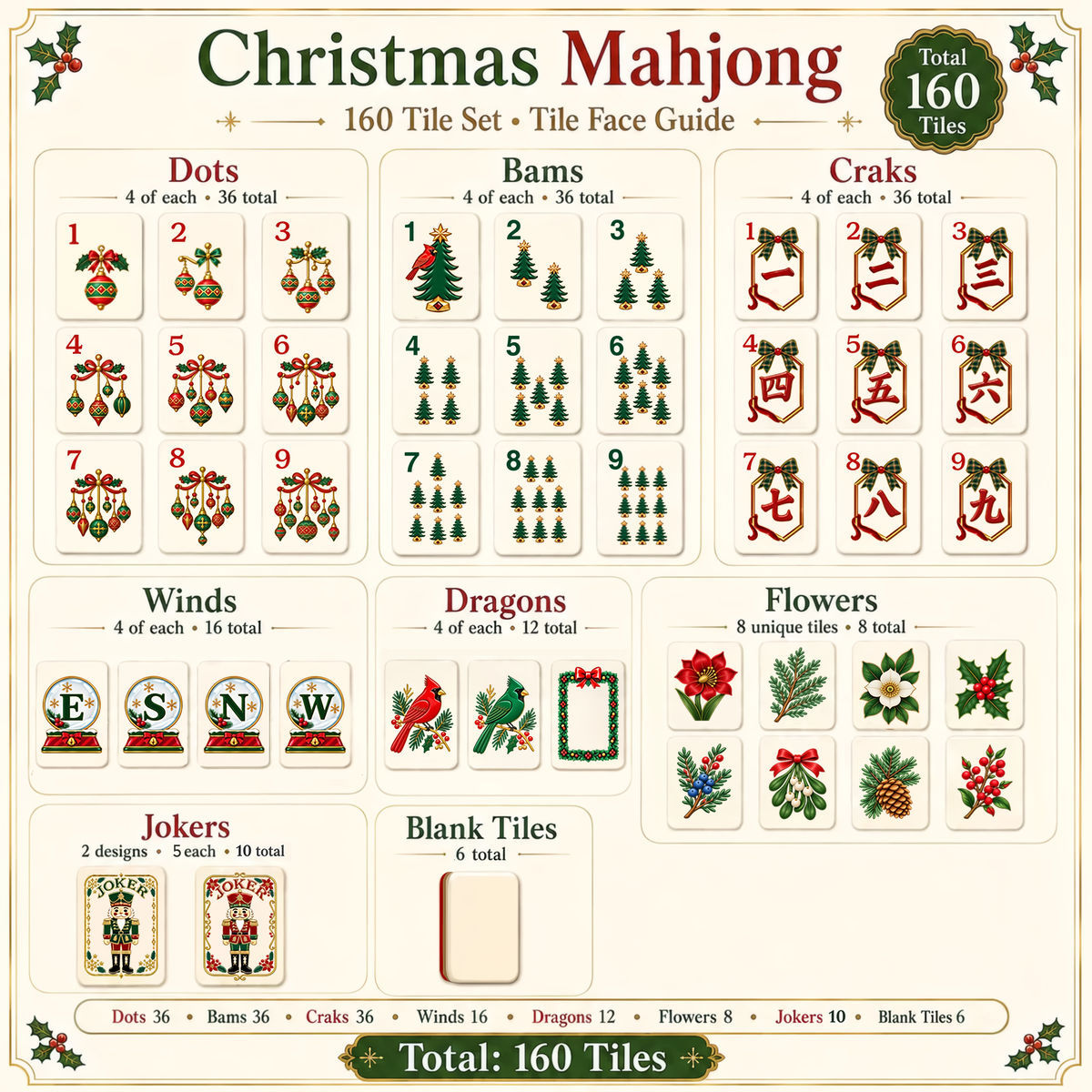
Chinese mahjong uses 144 tiles (Bams, Craks, Dots 1–9, Winds, Dragons, no Flowers/Jokers) and requires 14 tiles to win with one pair plus four melds (Pung, Kong, Chow). Riichi mahjong, the Japanese variant, also uses 136 tiles and adds a "ready" declaration (riichi) that locks your hand until you win. American mahjong stands apart: it uses 152 tiles, introduces 8 Flowers and 8 Jokers, requires hands from the current-year National Mah Jongg League card, and forbids chows entirely—only Pungs, Kongs, and Quints are exposed. No variant's hands transfer between games; players must learn the specific winning patterns for each. Riichi demands strategic patience; Chinese rewards tile-reading speed; American balances pattern-matching with hand management. Choose your variant by group preference, then buy a set designed for that game to avoid tile-count confusion.
What tiles does each game use?
Chinese mahjong contains exactly 144 tiles: Bams, Craks, and Dots (1–9, four of each = 108 tiles), 16 Winds (four each: North, East, South, West), and 12 Dragons (four each: Red, Green, White). Riichi mahjong uses 136 tiles—the same structure minus four tiles (often a wind or dragon reduced to three copies). American mahjong jumps to 152 tiles: those same Bams, Craks, Dots, Winds, and Dragons as Chinese, plus 8 Flowers (Spring, Summer, Autumn, Winter × 2 each) and 8 Jokers. Because American mahjong adds Flowers and Jokers, sets sold for American play include extra tiles to spare. Chinese and Riichi sets are smaller and lighter because they stop at 136–144 tiles.
If you play multiple variants at home, keep sets separate—mixing tiles from a 144-tile set into an American game ruins scoring and hand completion. Best-selling acrylic American sets clearly mark tile quantities and are sized for 152-tile games with spare Jokers and blanks.

How do winning hands differ?
Chinese mahjong wins with 14 tiles: one pair (two identical tiles) plus four melds. Melds can be Pungs (three identical), Kongs (four identical), or Chows (three consecutive tiles in the same suit: 1–2–3 Dots, for example). Any player can call a discard to complete a Pung, Kong, or Chow and declare it face-up.
Riichi mahjong also requires 14 tiles (one pair + four melds) but adds a critical mechanic: when your hand is one tile away from winning, you declare riichi, freezing your discards and locking your hand strategy. Winning becomes a waiting game of psychology and tile-tracking.
American mahjong requires 13 tiles, not 14, and winning hands come exclusively from the current-year National Mah Jongg League card. You cannot win with a "free" hand—the pattern must match the card exactly. Chows are never permitted in American mahjong; only Pungs (three identical), Kongs (four identical), and Quints (five identical) can be exposed. Jokers cannot be used as a single tile or a pair; they can only substitute for tiles within a Pung, Kong, Quint, or Sextet. This rigid structure makes American mahjong more about hand-reading and card-matching than improvisation.
Can players call and declare melds?
In Chinese mahjong, any player can call a discard from another player to complete a Pung, Kong, or Chow. Once you call, you expose the meld face-up on the table. This creates interruptions and surprises—the flow is fast and reactive.
Riichi mahjong permits calling but restricts it. You can call only to complete a meld relevant to your winning strategy, and once riichi is declared, your options narrow sharply. The game slows and becomes tense.
American mahjong has no calling. You build your hand from the wall (tiles drawn in turn) and the discard pile (only your own turn's previous discard is available to draw). You expose Pungs, Kongs, and Quints only when you have them; you cannot call a meld from another player's discard. This makes American mahjong quieter and more introspective than Chinese or Riichi play.
How does scoring work across variants?
Chinese mahjong scoring hinges on melds and winning conditions. A Pung of Winds or Dragons scores higher than a Pung of number tiles. Winning by drawing from the wall (self-drawn) pays double. Scoring can reach dozens of points per hand, and games track cumulative scores across dozens of rounds. Exact point values vary by region (Cantonese, Sichuan, Shanghai styles each differ).
Riichi mahjong uses a strict point system tied to hand value (fu and han). Fu measures meld difficulty; han counts winning patterns. A 1-han hand is worth 1,000 points; a 6-han hand is worth 12,000. Payments flow to the winner from all players or the dealer alone, depending on who won and how. Scores reset each round; games often run to a target score (e.g., 100,000 points).
American mahjong awards no points. You win the round by completing a hand; winnings (typically money, chips, or counters) are paid by the other three players to the winner. A game is usually 16 hands (four rounds of four). Scoring is flat and symmetrical: you either win or you do not. This simplicity appeals to social players who prioritize play speed over number-crunching.

Which variant should your group choose?
Variant | Player Skill Curve | Game Length | Best For | Tile Set Size |
Chinese | Steep; memory + speed | 1–2 hours | Speed-play groups; tile-reading lovers | 144 tiles |
Riichi | Steep; strategy + psychology | 1.5–2.5 hours | Competitive players; slow, tense play | 136 tiles |
American | Moderate; card-matching + tile management | 1–1.5 hours | Casual social groups; newer players | 152 tiles |
Choose Chinese if your group enjoys fast calls, interruptions, and regional scoring debates. Riichi suits players who relish long-term strategy and the dramatic riichi mechanic. American mahjong works best for groups that gather weekly without formal training—the card standardizes hands, so everyone's learning the same patterns each year, and no one needs years of tile-memory practice.
🎁 See our most-loved mahjong sets & accessories →
If you already play one variant and want to explore another, buy a set explicitly labeled for that game. Mixing tile sets creates confusion and ruins scoring. Our best-selling collection includes American sets sized for 152 tiles; if you play Chinese or Riichi, source those sets from retailers specializing in those variants, as tile counts must be exact.
What to check before you buy
Tile count: Verify your game's tile requirement before purchasing. American mahjong requires 152 tiles for play; Chinese needs 144; Riichi uses 136. Do not assume all sets are interchangeable.
Suit markings: Confirm the set labels Bams, Craks, and Dots clearly (not alternative romanizations). Confused suit names cause play errors.
Joker and Flower count: American sets include Flowers and Jokers; Chinese and Riichi do not. If your set lacks Flowers, you cannot play American mahjong.
Material and durability: Acrylic tiles last decades if stored dry. Bamboo and bone sets are beautiful but fragile. For weekly home play, acrylic handles shuffling and storage wear best.
Case or bag inclusion: Long-term players benefit from mahjong bags and cases that protect tiles during transport and storage.
Why hosting setup matters
All three variants require a table large enough for four players to sit comfortably, each with tile racks. American players often use mahjong racks with pushers to organize tiles and manage the 13-tile hand smoothly. Chinese and Riichi players may prefer open-hand layouts without racks, though racks help newer players organize tiles faster.
A mahjong mat protects table surfaces and provides a designated play zone, reducing tile scatter. Mats also dampen noise—important for apartment players. Whether you host American, Chinese, or Riichi games, a durable mat and organized tile storage make weekly play more enjoyable and tile replacement less frequent.
✨ Find your Mahstead set — free US shipping →

FAQ
Can I use the same mahjong set for Chinese, Riichi, and American mahjong?
No. Each variant requires a specific tile count and set of tiles. Chinese uses 144; Riichi uses 136; American uses 152 and includes Flowers and Jokers. Mixing sets corrupts hand-scoring and winning-pattern validity. Buy a set designed for the variant your group plays.
Is American mahjong easier to learn than Chinese or Riichi?
American mahjong has a gentler learning curve for newcomers because winning hands are printed on the annual card—you do not memorize patterns. Chinese and Riichi reward tile-memory and strategic depth, making them harder initially but rewarding long-term players. Choose based on your group's patience and commitment level.
How long does a typical game of each variant take?
Chinese mahjong games run 1–2 hours; Riichi takes 1.5–2.5 hours due to strategic depth; American mahjong typically finishes in 1–1.5 hours because 16-hand games and flat scoring move play along briskly.
Do the same scoring rules apply across Chinese mahjong regions?
No. Cantonese, Sichuan, Shanghai, and other Chinese regional variants have different point systems, bonus patterns, and payment rules. Agree on a regional ruleset before your first game or establish house rules clearly.
What tiles can I use as jokers or wild cards in each variant?
American mahjong uses dedicated Joker tiles to substitute for any tile within a Pung, Kong, Quint, or Sextet—never as a single tile or pair. Chinese and Riichi typically do not include Joker tiles at all; some regional Chinese variants allow the White Dragon to act as a substitute, but this varies by house rule.
If I buy an American mahjong set, can I teach Riichi beginners with it?
No. An American 152-tile set includes Flowers and Jokers that Riichi does not use; you will have extra tiles cluttering play and confusing scorekeeping. Buy a dedicated Riichi set (136 tiles, no Flowers or Jokers) for that variant.


View More
View More
View More
