
American Mahjong vs Singapore Mahjong: Key Rules & Differences
Last updated: Nov 23, 2026
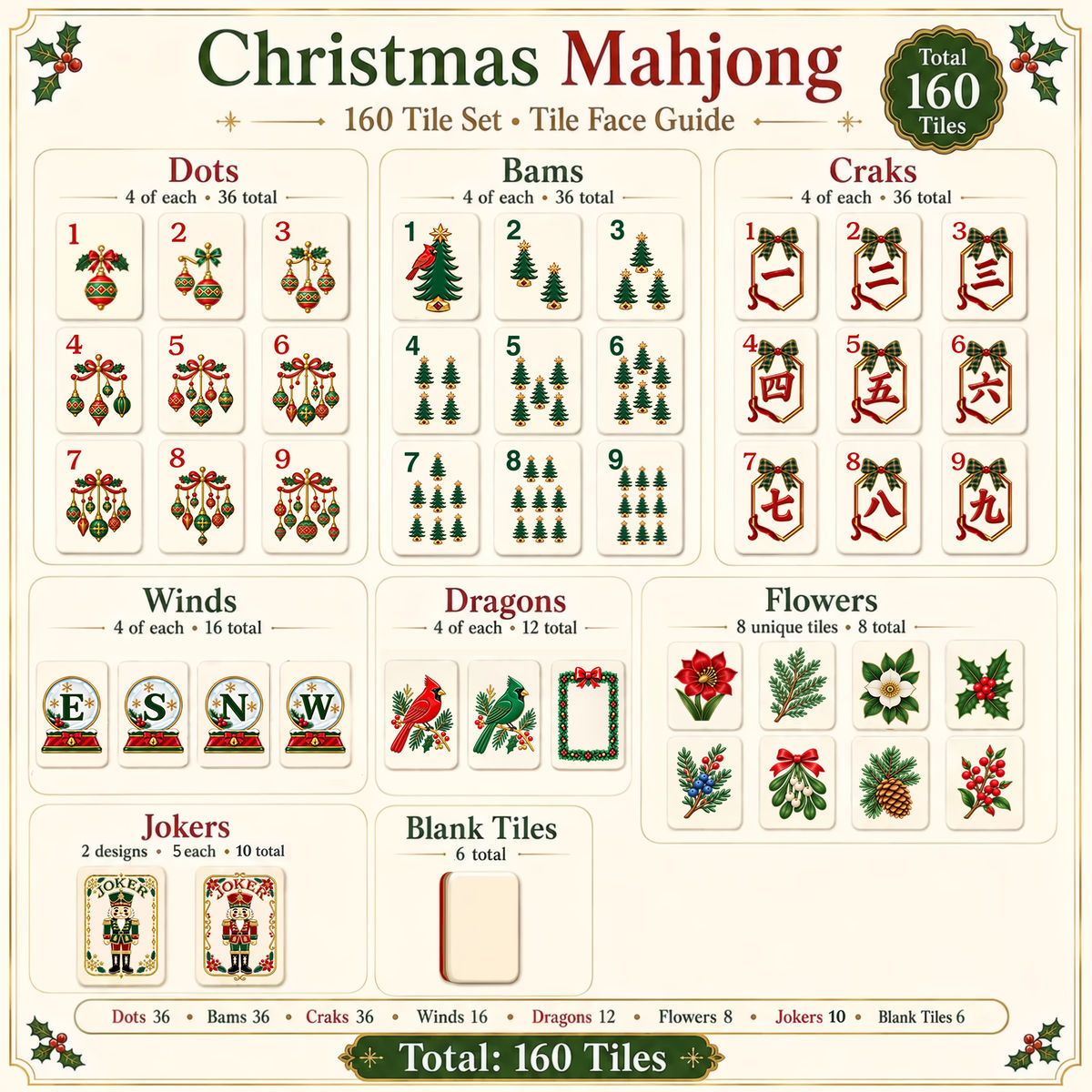
American mahjong uses 152 tiles (three suits of 1–9, winds, dragons, flowers, jokers) and requires hands from the current year's National Mah Jongg League card—no improvisation allowed. Singapore mahjong (a Chinese variant played across Southeast Asia) uses 144 tiles, draws from a traditional hand book, and permits chows (sequences like 1-2-3 of the same suit)—a mechanic American mahjong forbids entirely. American exposures are limited to pungs, kongs, quints, and sextets; Singapore allows exposed chows. Winning conditions differ too: American requires an exact card match; Singapore has more flexible interpretations. Both demand strategy and quick reading, but American's rigid hand structure and card dependency make it the more rule-bound variant, while Singapore offers looser, faster-paced play. If you're hosting an American game, invest in a proper 160-tile best-selling set with a current League card; for Singapore, a traditional 144-tile deck works fine.
Which tiles make up each game?
American mahjong runs exactly 152 tiles: 36 per suit (Bams, Craks, Dots numbered 1–9, four of each), 16 winds (four each: North, East, West, South), 12 dragons (four Red, four Green, four White/Soap), 8 flowers, and 8 jokers. Every American game uses every single one of these tiles—no more, no fewer. Singapore mahjong works with 144 tiles: the same three suits and winds, but only three dragon types (no separate Soap), no flowers, no jokers, and traditional honor tiles. The absence of jokers in Singapore is fundamental—it changes winning strategy entirely, since there's no way to substitute or "wild card" your way into a hand. American players coming to Singapore often underestimate how tight the tile economy becomes without jokers forcing flexibility.

Can you make sequences in Singapore but not American?
In American mahjong, you cannot expose or play chows (sequences like 1-2-3 of Bams). You may only lay exposed pungs (three identical tiles), kongs (four identical), quints (five), and sextets (six). Jokers can never stand alone or form a pair. Singapore mahjong allows exposed chows—a player can lay down 1-2-3 of Bams in the middle of the table just as freely as a pung. This single difference cascades through strategy: in American, your hand options narrow because you're stuck building only groups of identical numbers; in Singapore, the sequence option opens pathways to win that American players never explore. An American player switching to Singapore often takes weeks to rewire their brain around chow-building. Conversely, Singapore players find American's no-chow rule suffocating at first but eventually appreciate how it forces deeper pattern recognition.
How do you know what hands are legal?
American mahjong hands come exclusively from the National Mah Jongg League card, issued every spring. Each card displays rows of legal hand patterns—your job is to read the card and match your tiles to one pattern exactly. No improvisation, no house rules, no "well, I think this works." Singapore mahjong uses a traditional hand book (or melds book), which lists traditional winning combinations, but the structure is looser and regional variations exist. An American player reads a single authoritative card; a Singapore player might face three different rulebooks depending on which club or region they join. For casual home play, Americans treat the League card as scripture; Singaporeans might adopt a single community standard and stick with it. This explains why American mahjong is easier to teach standardly—one card per year, everyone nationwide plays the same hands.
Feature | American Mahjong | Singapore Mahjong |
Total Tiles | 152 | 144 |
Jokers | 8 (required) | 0 |
Flowers | 8 (required) | 0 |
Chows Allowed | No | Yes |
Hand Source | Annual NMJL card | Traditional book (regional) |
Exposure Rules | Pung, Kong, Quint, Sextet | Pung, Kong, Chow |
Winning Flexibility | Rigid (exact card match) | Moderate (book + local rules) |
Typical Player Base | North America, mostly | Southeast Asia, Singapore, Malaysia |
🀄 Shop best-selling mahjong sets →
How does scoring work differently?
American mahjong scoring is point-based and depends entirely on which hand you've completed—each pattern on the card carries a specific point value (often 30, 40, 50, 60 points or more). You win by being first to complete a hand and calling "Mahjong"; scoring settles among all four players based on that hand's published point value. Singapore mahjong uses a simpler model: you win by being first to complete a legal meld, and the payment is typically a flat amount per player (often doubled if you went out "self-drawn"), or a graduated payout based on hand complexity. American scoring rewards precise knowledge of the card; Singapore scoring rewards speed and tile-reading over point-hunting. Neither system is harder—just different incentives. American games can take 30–45 minutes per round because players hunt for high-point hands; Singapore rounds often finish in 20–25 minutes because any legal win pays out and play moves on.

What's the learning curve for each?
American mahjong demands memorizing that year's card—the rules are strict, the hand list is finite, and you study before you play. Most casual American players spend 4–6 weeks getting comfortable reading the card and spotting patterns at speed. Singapore mahjong asks you to learn the core meld types (pung, chow, kong) and the traditional winning shapes, but no single card dominates; you learn principles and apply them, which feels less like rote work and more like pattern improvisation. A Singapore beginner can often play a social game within 2–3 weeks. American demands more upfront study; Singapore rewards quicker intuition. If your household includes both types of player, hosting American requires everyone to have a current card at the table; hosting Singapore only needs agreement on one house book. For a Dallas table hosting weekly American games, a 160-tile set with an annual card is non-negotiable equipment; for Singapore, a 144-tile deck and a printed melds sheet suffice.
🎁 See our most-loved mahjong sets & accessories →
Which variant should you learn first?
If you live in North America and your friends play mahjong, you'll almost certainly encounter American rules first. American has a unified rulebook (the NMJL card), standardized vocabulary, and a defined competitive structure—it's the "official" home game across the US and Canada. Singapore mahjong thrives in communities with Southeast Asian heritage or expat networks; it's excellent to learn if you travel to or have family in that region, but finding a weekly game outside those areas is harder. For beginners, American is more accessible because resources are abundant and standardized—one set of rules, one annual card, one learning path. Singapore offers richer strategic depth once you've mastered sequences, but requires either a local community or online coaching to learn well. Starting with American, then moving to Singapore if travel or friendship invites you, is a natural progression. The skills overlap enough (tile recognition, grouping, speed, memory) that learning a second variant takes only weeks once you've mastered the first.
✨ Find your Mahstead set — free US shipping →
What to check before you buy equipment for either game
For American mahjong: Confirm your set includes 152 playing tiles plus spare jokers or blanks (a 160-tile set does this). Check that you have or can access the current year's National Mah Jongg League card—buy a printed card at game shops or print a PDF from the League. If hosting multiple players, consider mahjong racks with pushers to speed up play and a mat to protect your table. Verify tile size (most sets use standard 1-inch tiles) so they fit your racks comfortably.
For Singapore mahjong: A standard 144-tile set works; you don't need jokers or flowers. Obtain or print a copy of the melds book your group uses—ask your players or club which version they follow (this matters more than Americans realize, since variants exist). Racks and mats are helpful but not essential; Singapore is often played in casual home settings without formal equipment.
For both: Inspect tiles before first play—acrylic tiles should have clean engravings and no cracks. If you're storing sets between games, a padded bag or case protects against spills and dust. Keep the current card (American) or melds book (Singapore) in a sleeve near the table so players can reference quickly.

FAQ
Can I use the same mahjong set for both American and Singapore games?
No. American requires 152 tiles (including 8 jokers and 8 flowers); Singapore uses 144 and has no jokers or flowers. If you own an American set, you can remove the jokers and flowers and play a modified Singapore variant, but you won't have the traditional 144-tile deck that Singapore players expect. Owning both is ideal if you host both games regularly.
Why does American mahjong require a new card every year?
The National Mah Jongg League publishes a new card each spring with updated legal hands. This prevents the game from becoming stale and gives players fresh patterns to learn. Singapore uses traditional, unchanging melds, so no yearly update is needed.
Are American and Singapore winnings paid the same way?
No. American uses a point-based payout: the hand you completed has a specific point value on the card, and all players pay you that amount. Singapore typically uses a flat per-player payout or a graduated system based on how you won (self-drawn pays more). American rewards knowing high-point hands; Singapore rewards speed and compliance.
Can Singapore players understand an American card?
Not easily. An American card shows patterns unfamiliar to Singapore players because American forbids chows and emphasizes rigid groupings. Conversely, an American player looking at a Singapore melds book will feel confused by the presence of so many chow-based hands. Each system's card is custom-built for its rules.
Which game is faster: American or Singapore?
Singapore is typically faster. American rounds often run 30–45 minutes per hand because players hunt for high-point patterns; Singapore rounds often finish in 20–25 minutes because any valid win ends the hand. American rewards patience; Singapore rewards efficiency.
Do I need jokers to play Singapore mahjong?
No. Singapore's traditional game never used jokers. If your group has agreed to use jokers as "wild" tiles (a modern house rule), then yes—but this is a variant, not standard Singapore play.
How long does it take to get good at each variant?
American: 4–6 weeks for casual play (reading the card fluently, spotting hands at the table). Singapore: 2–3 weeks for casual play (learning chows and traditional melds). Competitive-level play in either takes months to years.
Can I play American or Singapore mahjong with fewer than four players?
American has official 2- and 3-player rules (published by the NMJL), though 4-player is standard. Singapore is designed for four; 2- and 3-player variants exist but are less common and less standardized. --- We host weekly American mahjong games in Dallas and have played Singapore with expat friends. The differences are real and worth understanding before you invite someone to your table. Choose your variant based on your community and commit to one set of rules; mixing them mid-game breeds confusion every time.


View More
View More
View More
